
Why Do AI Search Platforms Cite Different Sources?
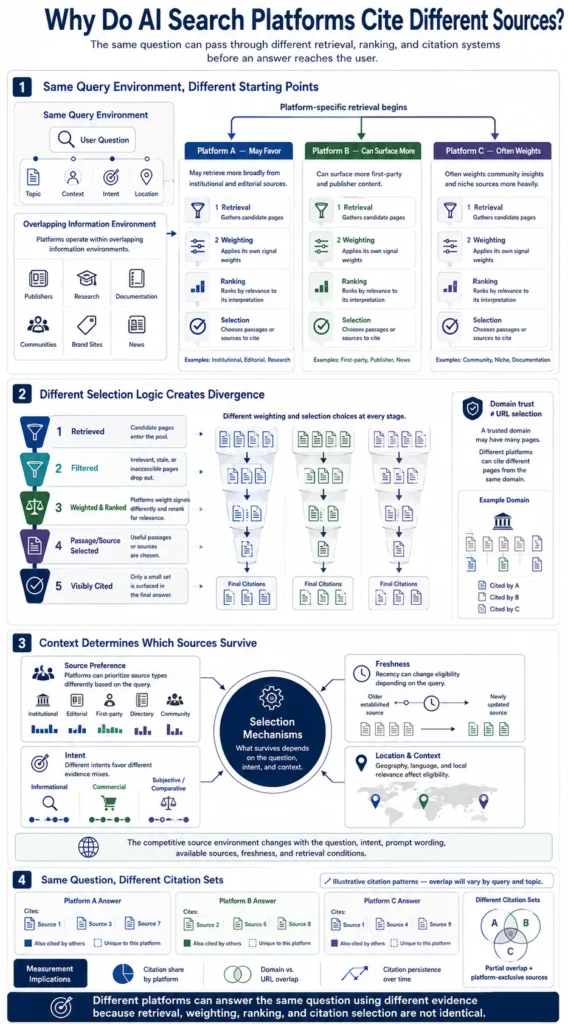
AI search platforms cite different sources because each system applies its own sequence of retrieval, ranking, passage selection, source weighting, and citation decisions. The differences begin before an answer is generated and can continue through the final interface.
“What the data shows is that there was a wide discrepancy across the five AI search engines tested, with the lowest level of overlapping source citations between any two AI search surfaces at 16% and the highest level of agreement between any two engines at 59%” — Search Engine Journal.
That fragmentation creates a measurement problem. Content Ops Lab treats AI visibility as a portfolio of independent surfaces, each requiring a separate baseline.
Related: How AI Search Engines Decide Which Sources to Cite
Why Can the Same Query Produce Different Citation Pools?
The same query can yield different citation pools because AI platforms do not necessarily start with identical indexes, interpret prompts in the same way, or perform the same searches. Those differences alter which documents become candidates before ranking, synthesis, or citation selection begins.
Different Platforms Start With Different Search Indexes
Retrieval infrastructure creates an early point of divergence. Some platforms depend partly on established search indexes, while others combine external search infrastructure with proprietary crawling or retrieval systems.
- Search indexes contain different known pages
- Crawl timing affects document availability
- Proprietary systems add platform-specific candidates
- Index coverage varies across content types
One study reported that 87% of ChatGPT Search citations matched Bing’s top organic results. — Parse.gl. That 87% figure describes the study’s observed relationship, not proof that every ChatGPT citation comes exclusively from Bing.
AI Search Engines Transform the Query Before Retrieval
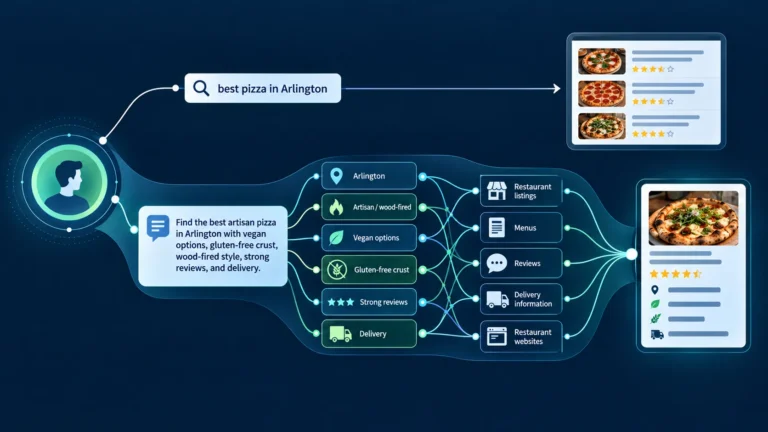
Generative search systems can interpret, decompose, or expand a user’s prompt before retrieving supporting material. The visible question should not automatically be treated as the only query executed behind the answer.
- Prompts can contain multiple implicit intents
- Systems may generate supporting sub-queries
- Fan-out expands potential evidence paths
- Query interpretation changes candidate relevance
Query decomposition and fan-out are established generative-retrieval mechanisms, but their exact implementations differ by platform and are not fully public.
Two platforms can therefore receive identical wording while searching different representations of the same underlying need.
Different Candidate Pools Produce Different Citation Possibilities
Index coverage and query transformation determine which queries advance to later selection stages. A source absent from the candidate pool cannot survive reranking, passage extraction, synthesis, or visible citation filtering.
- Retrieval determines initial source eligibility
- Candidate sets vary before reranking begins
- Missing pages cannot reach later stages
- Expanded queries introduce additional source classes
This is the first reason AI search platforms cite different sources: the systems may not be evaluating identical documents.
How Do Ranking and Passage Selection Change Which Sources Survive?
Ranking and passage selection create another layer of citation divergence because retrieved documents are only candidates. Systems can rerank those documents, evaluate individual passages, compress redundant information, and attach citations differently during synthesis.
Retrieval Produces Candidates, Not Final Citations
Being retrieved means a document entered consideration. It does not mean the document will support the final answer or receive visible credit in the interface.
- Discovered: Page enters the candidate pool
- Filtered: Weak or irrelevant candidates disappear
- Reranked: Stronger answer-supporting sources advance
- Extracted: Relevant passages enter model context
- Cited: Selected evidence receives visible attribution
Every stage can reduce the source set, making retrieval visibility broader than citation visibility alone.
Reranking Rewards Passage-Level Relevance
AI search can compare smaller units of evidence against the information required to answer. A lower-profile page with a highly relevant passage may therefore survive while a stronger-ranking URL from the same domain does not.
- Passage relevance can outweigh page prominence
- Specific sections may satisfy generated sub-queries
- Extractable answers strengthen source usefulness
- Page-wide authority remains only one input
Semrush describes the distinction: “LLMs like ChatGPT show a strong correlation with domains that rank well in Google’s organic results—but that doesn’t mean they cite the same URLs you see in the top 10. Instead, LLMs often pull from different pages within the same trusted domains. That’s why we see high domain-level correlation but less direct overlap at the URL level” — Semrush.
That distinction separates domain trust from the page-level usefulness needed for a particular answer.
Context Compression Can Remove Otherwise Relevant Sources
Answer generation operates within practical context and interface constraints. When several documents support substantially the same claim, a system may preserve the information while reducing duplicate passages or visible citations.
- Redundant evidence can be compressed
- Similar passages compete for context space
- Extractability influences evidence retention
- Visible citations may represent fewer sources
A system can consume information from more documents than the final interface visibly credits, although proprietary implementation details remain largely undisclosed.
Citation divergence can therefore arise after retrieval, not only during discovery.
Why Do AI Platforms Prefer Different Types of Sources?
AI platforms can prefer different source types because their retrieval systems, source weighting, answer formats, and citation constraints are not architecturally neutral. Comparative research shows meaningful differences in how institutional, community, directory, editorial, and other sources appear across generative-search surfaces.
Each Platform Applies Its Own Source Weighting
Observed citation profiles indicate that platforms assign different shares to particular source categories. These are current behavioral patterns rather than permanent rules.
- Institutional sources receive unequal citation shares
- Community content varies sharply by platform
- Source weighting depends on query context
- Current preferences should not become assumptions
BrightEdge found that Gemini cited institutional sources 26% of the time and community sources just 0.2%, while Google AI Overviews cited institutional sources 10% of the time and community sources 18% — Search Engine Journal.
The important point is that different systems construct different visible source portfolios.
Citation Budgets Change What Users Actually See
Interfaces differ in how many sources they display and how citations are attached to generated claims. A lower-density citation environment can expose fewer supporting sources, even when retrieval overlap exists beneath the surface.
- Interfaces allow different citation densities
- Source lists face practical space constraints
- Redundant citations may receive less visibility
- Attribution rules influence displayed evidence
The visible citation count, therefore, does not necessarily represent the full evidence-processing pipeline.
Domain Agreement Can Hide URL-Level Disagreement
Two systems can trust the same publication, company, institution, or marketplace while selecting different pages from that domain. Domain overlap therefore provides a different signal from exact-URL overlap.
- Domains indicate broader authority recognition
- URLs reveal intent-specific page selection
- Passage usefulness determines individual candidates
- Strong domains can support many answers
This distinction helps explain why AI search platforms cite different sources even when source lists look similar at the domain level.
| Platform / Surface | Observed Source-Type Tendency | Interpretation |
| Gemini | 26% institutional in cited BrightEdge study | Stronger institutional representation in this sample |
| Google AI Overviews | 10% institutional, 18% community | More community representation in this sample |
| Other AI surfaces | Source composition varies by system | Measure rather than assume platform preference |
These percentages are study findings, not fixed platform rules.
If your operation needs to produce 20–50+ articles per month without sacrificing compliance or quality, Content Ops Lab builds the infrastructure to make that possible. Contact us to discuss your content production requirements.
How Do Freshness, Intent, and Location Change Citation Selection?
Freshness, intent, and location can change both the eligible source pool and the evidence an AI system needs. The same brand may compete against publishers, directories, first-party websites, reviews, or community sources depending on how the prompt is framed and where the user is searching.
Freshness Changes the Eligible Source Pool
Recency matters differently across queries and platforms. A time-sensitive question can favor newly crawled or recently updated evidence, while an evergreen informational query may rely more heavily on established material.
- Index timing changes available documents
- Recency matters more for changing topics
- Evergreen questions tolerate older evidence
- Freshness never acts as one rule
Platforms also refresh indexes, caches, and retrieval systems on different schedules, creating temporary differences even when they later discover similar documents.
Freshness changes the pool without becoming a universal citation advantage.
Query Intent Changes the Type of Evidence an Engine Needs
Intent affects which evidence appears useful. Authority-heavy informational queries may converge on established sources, while exploratory, transactional, or subjective prompts can lead to broader disagreement over the preferred evidence set.
- Informational prompts often reward established authority
- Commercial prompts expand candidate source types
- Subjective questions introduce social evidence
- Industry characteristics affect ranking convergence
BrightEdge found Google AI Overview and organic-result overlap of 75.3% in healthcare, 72.6% in education, and 71.0% in B2B technology, compared with 22.9% in e-commerce — BrightEdge.
Those figures measure Google AI Overview-to-organic convergence by industry, not universal cross-platform citation overlap.
Intent changes the evidence requirement, which can produce different citation behavior within the same retrieval infrastructure.
Location Adds Another Retrieval Filter
Local queries include geographic context, business attributes, reviews, directories, and first-party location information. Whether the user asks an objective question or requests a subjective recommendation can further reshape the source mix.
- Objective questions favor factual business information
- Subjective prompts require comparative evidence
- Directories become stronger recommendation sources
- Geography changes which entities qualify
Yext found that first-party websites accounted for more than 40% of citations across Gemini, OpenAI, and Perplexity for objective, unbranded local queries. For subjective queries, directories became more prominent, reaching 46.3% of citations for branded subjective queries on OpenAI — Yext.
| Local Query Context | Likely Source Environment |
| Objective, unbranded | First-party websites remain prominent |
| Subjective or comparative | Directories and third-party sources increase |
| Location constrained | Geographic eligibility narrows candidates |
| Branded subjective | Directory influence can increase materially |
When AI search platforms cite different sources, the prompt context may change the competitive set before final citation selection.
Related: Google Rankings vs AI Citations – What Is the Difference?
Why Don’t Google Rankings Predict AI Citations Consistently?
Google rankings do not consistently predict AI citations because page ordering and generative-source selection answer different questions. Organic visibility still matters, but AI systems can retrieve, rerank, and cite pages outside the top 10 when individual passages better support the generated response.
Page-One Ranking Is Not the Same as Citation Eligibility
Traditional ranking asks where a page appears in the ordered search results. Generative retrieval asks whether a page or passage provides useful evidence for the specific information being assembled.
- Organic position measures ranked page order
- AI retrieval evaluates answer usefulness
- Lower positions remain candidate sources
- Passage relevance changes selection probability
BrightEdge found that AI Overview citation overlap with organic rankings grew from 32.3% to 54.5%, while only 16.7% of citations came from top-10 results. Most of the overlap growth came from pages ranking in positions 21–100 — BrightEdge.
This finding concerns Google AI Overviews and should not be generalized across all AI platforms.
Domain Authority Still Matters Even When the URL Changes
Partial decoupling at the page level does not make traditional SEO irrelevant. Strong organic visibility, indexability, recognizable domain authority, and accessible content can still improve the pool from which AI systems retrieve evidence.
- Trusted domains provide broader retrieval inventory
- Strong crawling improves candidate availability
- Organic authority still supports discovery
- Individual URLs compete on passage relevance
The distinction is between establishing enough authority to enter consideration and producing the specific page that survives citation selection.
That is why domain-level visibility and exact-URL visibility need separate measurement.
Citation Selection Changes Over Time
AI citation results can change even when surrounding search conditions appear relatively stable. A single successful citation therefore provides much weaker evidence than repeated inclusion across equivalent prompts over time.
- Citation snapshots capture temporary selections
- Repeated checks reveal persistence
- URL churn exposes unstable page selection
- Volatility changes competitive interpretation
Authoritas found: “There is a very weak correlation (0.04) between a SERP Layout change and a change in the AI Overview ranking pages and a slightly less weak correlation (0.14) with the number of generative results appearing” — Authoritas.
The study concerns AI Overviews, but it reinforces the broader measurement lesson: generative visibility requires repeated observation.
| Traditional Ranking Question | AI Citation Question |
| Where does this page rank? | Did this page enter the candidate pool? |
| Is the URL on page one? | Does a passage support the generated answer? |
| Which pages rank above us? | Which source types survived reranking? |
| Did ranking position change? | Did citation visibility persist over time? |
The two measurement systems overlap, but they do not describe the same selection process.
What Should Marketing Teams Do About Cross-Platform Citation Differences?
Marketing teams should measure AI visibility by platform rather than collapsing ChatGPT, Google AI surfaces, Gemini, Perplexity, and other systems into a single score. The objective is to identify where authority persists, which pages are selected, how source composition changes, and whether results hold up under repeated testing.
Measure Each Platform as a Separate Visibility Surface
Platform-level reporting reveals whether apparent AI visibility is broad or concentrated. A brand performing well on one answer engine may be largely absent from another, which may exhibit different retrieval and citation behavior.
- Track citation share by platform
- Record brand mentions without citations
- Monitor representative prompt coverage
- Compare source composition independently
The 16%–59% source-overlap range makes aggregate visibility particularly easy to misread.
Track Domain Authority and Page Selection Separately
Domain-level presence shows whether systems repeatedly recognize a source as trustworthy. URL-level tracking indicates whether specific assets meet sufficient intent-specific retrieval needs to receive citation visibility.
- Domain overlap signals recurring source trust
- URL overlap reveals page-level convergence
- Passage selection exposes content usefulness
- Prompt segmentation explains page variation
A company can have healthy domain representation while relying on inconsistent pages or third-party sources for important commercial questions.
Measure Persistence Instead of Celebrating a Single Citation
One-time citation wins can disappear on the next run. Repeating controlled prompt sets creates a stronger baseline and exposes which gains have become persistent rather than incidental.
- Repeat prompts on a fixed cadence
- Measure recurring citation appearances
- Track exact-URL replacement rates
- Record source-category changes over time
Persistence turns citation monitoring into a measurable operating discipline.
| Metric | What It Reveals | Why It Matters |
| Citation share by platform | Presence within each AI surface | Prevents one platform masking another |
| Domain vs. URL overlap | Authority agreement versus page agreement | Separates trust from content selection |
| Prompt coverage | Visibility across target questions | Identifies intent and content gaps |
| Source mix | Types of sources earning citations | Shows changing competitive environments |
| Citation volatility | Persistence and source churn | Distinguishes durable visibility from snapshots |
This model explains why AI search platforms cite different sources without forcing every system into one universal ranking framework.
How Does Content Ops Lab Build for Multi-Platform AI Visibility?
Content Ops Lab treats fragmented AI-search visibility as an operational measurement problem rather than a single ranking target. Across a 23-month regulated healthcare engagement, the system produced 1,000+ citation-verified articles and pages while maintaining zero compliance issues.
Content Ops Lab recorded a 21.4% average AI search conversion rate versus a 3.32% site average, a 6.4x performance multiplier, alongside 887% ChatGPT traffic growth in seven months, from eight sessions to 79. Those results do not prove citation optimization caused either outcome. They show why AI-search traffic deserves its own performance model.
- 1,000+ citation-verified articles and pages delivered
- Zero compliance issues across entire engagement
- Monthly output increased from 10 to 50+
- 2.3M monthly impressions by February 2026
- 13.2K monthly organic clicks by February 2026
- 95+ confirmed AI-search conversions during measurement
- 21.4% AI-search CVR versus 3.32% overall
- ChatGPT traffic increased 887% in seven months
The Content Ops Lab Production System
The production system separates evidence discovery, factual control, search optimization, and final deployment so scale does not require loosening the standards governing what gets published.
- Research: Build evidence around assigned search and audience intent
- Verification: Confirm claims, citations, numbers, and risk boundaries
- Optimization: Structure content for retrieval, extraction, and organic discovery
- Delivery: Publish repeatable assets through controlled production workflows
That discipline makes platform-level citation measurement operational rather than occasional.
Ready to build content infrastructure that scales without the compliance risk? Get in touch — we’ll assess your current content operation and outline what a systematic approach would look like for your organization.
FAQs About AI Search Platforms Cite Different Sources
If AI platforms cite different sources, is optimizing content for AI search still worthwhile?
Yes. Citation divergence makes systematic AI-search work more important, not less. The objective is not to force every platform to cite the same URL. It is to build enough authority, coverage, extractable evidence, and technical accessibility to compete across several retrieval environments while measuring where visibility actually develops.
How should marketers measure citation visibility across multiple AI platforms?
Measure each platform independently using a controlled set of prompts. Track citation share, brand mentions, prompt coverage, exact URLs, cited domains, source composition, and repeat visibility over time. Then compare cross-platform overlap. That approach distinguishes broad authority from platform concentration and shows whether citation gains persist rather than appearing once.
Can a brand rely on one AI visibility tool to represent every search platform?
No single aggregate score should be assumed to represent every AI-search surface accurately. Tools may vary in platform access, prompt execution, geography, personalization, and measurement methodology. Marketing teams should understand which systems a tool actually measures and preserve platform-level results, rather than relying exclusively on a single blended visibility score.
Is ranking well in Google enough to earn citations from ChatGPT and Perplexity?
No. Strong Google rankings remain useful because authority, indexability, and organic visibility can contribute to retrieval eligibility. They do not guarantee citation selection elsewhere. ChatGPT, Perplexity, and other systems can use different candidate pools, query transformations, reranking processes, passages, and source preferences when constructing answers.
How can a content operations system support visibility across different AI search platforms?
A content operations system creates repeatable coverage across the questions, entities, evidence requirements, and source environments AI platforms may retrieve. Research, citation verification, structured content, technical accessibility, earned authority, and recurring measurement can then operate together. The goal is broader retrievability and durable coverage, not a separate tactical checklist for every engine.
Key Takeaways
- AI citation divergence results from layered retrieval and selection decisions, not from a single universal AI search ranking algorithm.
- Cross-platform citation overlap has ranged from 16% to 59%, making one-surface visibility an unreliable market-wide proxy.
- Strong domain agreement can coexist with significant URL disagreement because systems retrieve different passages for different intents.
- Content Ops Lab measures AI traffic separately; AI-referred visitors converted at 21.4% versus a 3.32% site average.
- Research, verification, optimization, and delivery create the operating discipline needed for consistent multi-platform content coverage.
- Track platform citation share, domain and URL overlap, source composition, prompt coverage, and persistence over time.
Why Cross-Platform AI Citation Visibility Requires Its Own Measurement Model
AI search platforms cite different sources because source selection occurs across multiple independent layers: indexing, query interpretation, retrieval, reranking, passage selection, compression, source weighting, context, and visible citation rules. Agreement at one layer does not guarantee agreement at the next.
Marketing teams should preserve traditional SEO metrics while adding platform-specific AI visibility tracking alongside them. The question is no longer whether a brand appeared once. It is where the brand appears, which pages survive, what source environments dominate, and whether that visibility persists.
Content Ops Lab applies that distinction through a research-first production and measurement system built around repeatable evidence rather than isolated citation wins.