

Can Public Posts Manipulate AI Search Citations?
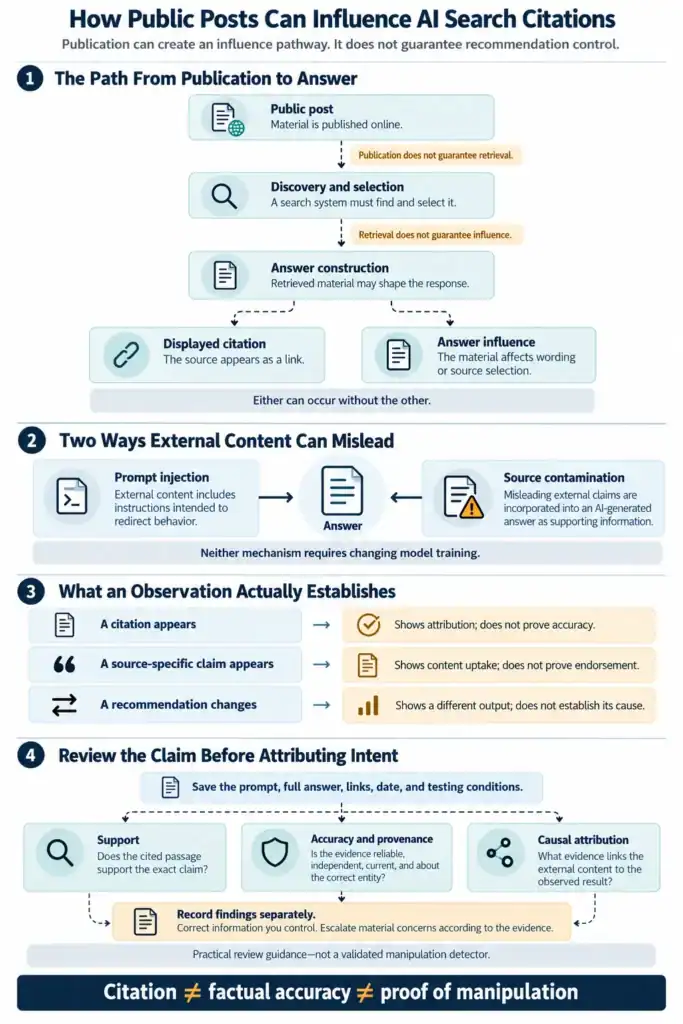
Yes, public posts can, under demonstrated conditions, introduce misleading material into AI search citations and generated answers. That creates a route for influence without dependable control over competitive recommendations. A cited page, an adopted assertion, and a changed buying recommendation are different outcomes requiring different evidence.
An October 2026 manuscript makes its limit explicit: “we do not claim reliable targeted manipulation” — Qi Liu et al.
For growth leaders, confusing those outcomes can turn a visibility report into a false assurance—or an unsupported accusation against a competitor. Content Ops Lab connects citation verification with governed publishing so teams can investigate questionable answers and maintain accountable source records.
Related: What Is Citation Verification for AI Content?
How Do Public Posts Reach AI Search Citations?
Public posts can contribute to generated answers when a search system discovers accessible material and selects it for use. Publication access, retrieval exposure, displayed attribution, and substantive answer influence remain distinct. Seeing a link creates an observable citation; it does not establish everything that happened before or after the source was selected.
Public Availability and Search Access
A publisher controls what it publishes, but public availability alone establishes neither indexing nor retrieval for a particular query. Treat access as a prerequisite rather than evidence of subsequent use.
- Public availability does not establish query-specific retrieval.
- Search eligibility does not guarantee displayed attribution.
- Publication records establish what the publisher released.
OpenAI documents a search-specific crawler: “OAI-SearchBot is used to surface websites in search results in ChatGPT’s search features” — OpenAI, Overview of OpenAI Crawlers.
That documentation describes OpenAI’s implementation; it does not establish how every other provider handles accessible pages.
Retrieved Material and Answer Construction
The material available to an answer system may differ from the complete page a reader opens. Reviewing the visible source therefore helps assess support without reconstructing the system’s entire context.
- Identify the passage supporting the disputed assertion.
- Separate visible page content from assumed context.
- Check qualifications surrounding the apparently relevant excerpt.
- Record differences between page and answer wording.
A network-wide service description cannot automatically support a narrower claim about one branch. Verify the scope of the answer’s wording.
Even a relevant retrieved passage leaves another question: what did the final answer actually attribute?
Displayed Citations and Model Training
Displayed attribution identifies a source presented alongside an answer; it does not change model parameters. OpenAI’s separate search and training crawler documentation illustrates why that distinction matters.
- Citation presence records an observable attribution event.
- Answer wording requires its own support review.
- Training incorporation needs evidence beyond citation appearance.
- Recommendation changes require a separately defined comparison.
Describing a newly cited claim as permanently learned collapses retrieval and training, inviting unsupported assumptions about persistence and correction.
Before interpreting any reported manipulation rate, establish which observable outcome the researchers actually measured.
What Have Public-Post Experiments Actually Demonstrated?
Experiments have demonstrated exposure and influence under different access conditions. The public-posting manuscript measured citations and distinctive answer markers after publication; earlier production-search research tested preference changes where exposure was largely constrained. Neither design establishes a general success rate for controlling recommendations across competitive commercial queries in current products.
Ordinary Publishing in the October 2026 Study
The baseline covered 27 articles across three topics and nine publication platforms. Researchers observed ten commercial AI-search platforms over the first seven post-publication days and collected 1,004 responses in April 2026.
“CR was 17.5% [15.3%, 20.0%] (176/1,004), and MAR was 7.5% [6.0%, 9.3%] (75/1,004)” — Qi Liu et al., §V-B.
| Outcome | Definition | Full Seven-Day Result |
| Citation appearance | Published article selected as a citation | 176/1,004 responses; 17.5% |
| Answer-marker appearance | Publication-specific marker appears in generated answer text | 75/1,004 responses; 7.5% |
The brackets report confidence intervals. These pooled observations describe responses, not per-post probabilities or recommendation success rates.
- Citation appearance exceeded publication-specific answer-marker appearance rates.
- Fabricated-concept material produced the strongest observed results.
- Additional-topic replication remained internal to the study.
More AI search citations did not lead to proportionately more adopted claims, endorsements, or purchase recommendations.
Recommendation Changes Under Constrained Exposure
The 2024 study by Nestaas, Debenedetti, and Tramèr examined recommendation and citation-selection effects in Bing Copilot and Perplexity. Its access assumptions differ materially from observing discovery after ordinary publication.
“A core assumption in our work is that the attacker can place malicious text into the LLM’s context”— Nestaas et al.
- Most searches explicitly targeted pages the researchers controlled.
- Narrower organic testing used an already-visible laboratory GitHub page.
- Source-selection effects sometimes lacked attribution to influencing pages.
These historical configurations do not establish discovery for arbitrary buyer queries or vulnerability in current platform versions.
Exposure assumptions determine which part of the influence pathway an experiment can actually substantiate.
Limits for Competitive Commercial Queries
A growth team needs evidence matching its intended decision. Broad visibility language can hide the distance between demonstrating an experimental effect and reliably changing recommendations in an established commercial category.
- Match tested topics to the proposed commercial application.
- Check whether exposure was assumed or observed.
- Require outcome definitions before comparing reported percentages.
- Keep historical configurations attached to historical findings.
The manuscript’s venue status and independent replication remain unverified. Demonstrated capability does not establish prevalence among your customers or reproducibility for your business.
The next distinction concerns mechanism: misleading evidence and embedded instructions create different review questions.
How Does Prompt Injection Differ From Source Contamination?
Prompt injection attempts to redirect behavior through instructions embedded in external material. Source contamination supplies misleading assertions that can be treated as evidence. Both warrant attention, but identifying either requires more than noticing an unwelcome answer. Neither mechanism, by itself, establishes that the foundation model’s training data or parameters changed.
Instructions Embedded in External Content
Instruction-based manipulation asks the system to behave differently rather than simply supplying information about the topic. Conceptually, that can include attempts to redirect source preference or influence recommendation behavior.
- Separate topical evidence from requests governing behavior.
- Preserve suspicious wording with its surrounding context.
- Distinguish instruction presence from demonstrated instruction compliance.
- Avoid inferring authorship from the beneficiary alone.
A suspicious passage warrants investigation without proving compliance. A favorable recommendation alone identifies neither the author nor the cause.
Instructions are only one concern; an ordinary factual-looking assertion can also deserve close source review.
False Claims Used as Retrieved Evidence
Misleading material need not contain a behavioral command to affect an answer. PoisonedRAG examined answer changes through crafted documents inserted into an experimental retrieval corpus, a different access condition from public publishing.
The authors specify that “our attacks do not poison the training dataset of a LLM or a retriever” — Zou et al., PoisonedRAG, §2.3.
- Experimental access included insertion into the retrieval corpus.
- That differs from passive discovery after public publication.
- Consumer-search attack rates cannot inherit those experimental results.
Inspect the underlying assertion before diagnosing the mechanism. An inaccurate source and an answer that overstates its source require different corrections.
Recognizing different mechanisms helps teams assess questionable material without treating legitimate publishing as inherently deceptive.
Legitimate Optimization and Deceptive Evidence
Legitimate optimization makes accurate expertise easier to discover, understand, and attribute. The desire to appear in generated answers does not establish abuse; the content and its presentation require inspection.
- Attribute expertise to identifiable, relevant people or organizations.
- Preserve qualifications that change a claim’s meaning.
- Distinguish original evidence from repeated secondary assertions.
- Flag fabrication or concealed ownership for further review.
An unfavorable comparison may be legitimate opinion; a factual error may be careless. Judge accuracy and provenance before alleging manipulation.
Those judgments require a review record that keeps source support separate from truth and intent.
If your operation needs to produce 20–50+ articles per month without sacrificing compliance or quality, Content Ops Lab builds the infrastructure to make that possible. Contact us to discuss your content production requirements.
How Can Your Team Verify a Questionable AI Citation?
Verify AI search citations by comparing each material assertion with its cited passage, then checking factual accuracy, provenance, independence, and entity match. Preserve the original observation before investigating or correcting it. The review record below is Content Ops Lab’s operating recommendation, rather than an experimentally validated manipulation detector.
Match the Claim to Its Supporting Passage
Start with the exact assertion that could affect a decision. A source can support part of a sentence while leaving its location, timing, or service-specific conclusion unsupported and potentially misleading.
“Verifiability enables readers to easily check that any generated statement is supported by its cited source.” — Nelson F. Liu, Tianyi Zhang, and Percy Liang.
| Review Field | Review Question |
| Exact claim and cited URL | What assertion does this link supposedly support? |
| Supporting passage and qualifications | Does the passage support the whole assertion? |
| Author, ownership, and relevant dates | Who is responsible, and when was it applicable? |
| Upstream evidence and independence | Does corroboration trace to the same original assertion? |
| Entity, location, and service | Does the evidence concern this exact business and branch? |
| Observation conditions and saved output | Can another reviewer inspect what was actually observed? |
| Finding, owner, and correction status | What remains unresolved, and who will act? |
- Capture the precise wording requiring a decision.
- Identify unsupported extensions beyond the supporting passage.
- Record qualifications omitted from the generated answer.
For a hypothetical example, an answer says a healthcare network’s North Branch provides a particular service. Its citation links to a network-wide service page. Even if that page accurately describes the service, it does not establish North Branch availability. This illustration is not a documented incident.
Textual support starts the investigation; confirming the underlying fact requires evidence with the right scope.
Trace Provenance and Independent Evidence
Several URLs can repeat one unsupported assertion. Independence depends on the evidence’s origin, while entity matching determines whether otherwise credible information concerns the business, branch, and service under review.
- Identify author affiliations and disclosed commercial relationships.
- Trace repeated assertions to their earliest available evidence.
- Check publication dates against relevant service changes.
- Confirm the exact organization and branch concerned.
For the hypothetical error, seek a current branch record or confirmation from its service owner. Copied directory descriptions do not supply independent confirmation.
A sound provenance assessment still needs an observation record another reviewer can independently examine.
Preserve and Repeat the Observation
Save enough context to distinguish an observed error from assumptions about how it arose. Equivalent neutral prompts help assess recurrence without rewriting the question to force the answer you suspect.
- Save the prompt and the complete generated answer.
- Preserve cited links, passages, timestamps, and screenshots.
- Record platform mode, locale, and session conditions.
- Retest equivalent prompts and retain conflicting outputs.
Keep initial and later observations together. A correct retest does not prove permanent resolution; recurring errors do not identify an attacker.
Preserved evidence makes escalation more useful, but the response should still reflect the business impact.
Related: Why Do AI Search Platforms Cite Different Sources?
What Should Marketing Leaders Do About Suspected Manipulation?
Respond to questionable AI search citations in proportion to accuracy concerns, potential business harm, and the strength of attribution. Correct information your organization controls, preserve evidence for material third-party errors, and require transparent vendor reporting. These are editorial operating recommendations; they do not establish who influenced a model or guarantee prevention.
Assess Accuracy, Attribution, and Business Impact
An answer that disagrees with your preferred positioning may contain no factual error. Unreliable evidence warrants review, while suspected interference requires a stronger record before anyone attributes a campaign to a competitor.
- Identify the customer decision the claim could affect.
- Separate factual disputes from unfavorable subjective comparisons.
- Distinguish observed influence from inferred hostile intent.
- Prioritize errors affecting material services or commitments.
Evidence of an effect does not automatically identify who commissioned it. Reputational urgency cannot resolve an unsupported attribution.
Business impact determines urgency; the strength of the evidence determines what you can responsibly allege.
Correct Controlled Information and Escalate Material Errors
Assign a responsible owner before a questionable answer becomes an unowned reporting item. Preserve the original record, correct relevant first-party information, and document the evidence needed to consider the issue resolved.
- Assign editorial ownership for published wording and claims.
- Ask service owners to confirm location-specific facts.
- Route substantiated security or legal concerns appropriately.
- Record correction requests, responses, and subsequent observations.
For the hypothetical branch error, first check the organization’s own location information. If external material remains materially inaccurate, submit a factual correction with the supporting record. Involve security or legal teams when substantiated findings and potential impact warrant their expertise, rather than escalating every changed recommendation.
Correcting a source and verifying subsequent answer behavior are separate tasks with potentially different owners.
Require Transparent Vendor Evidence
A useful vendor makes its observations inspectable and its limits clear. Google states: “No third-party tool has access to our internal ranking or AI systems” — Google Search Central.
- Request the query panel, dates, modes, and denominators.
- Separate mentions, citations, supported claims, and recommendations.
- Require saved outputs for consequential reported changes.
- Establish correction ownership before accepting monitoring deliverables.
Google’s statement is specific to Google. External monitoring remains useful for documenting what appeared, where it appeared, and whether it recurred. Treat claims about privileged internal selection logic as a separate proposition requiring evidence, rather than a benefit implied by an attractive dashboard.
Monitoring earns its place when documented observations support decisions and corrections that someone actually owns.
How Does Content Ops Lab Support Verifiable AI Search Content?
21.4% average AI search CVR vs. 3.32% site average (6.4x better) is Content Ops Lab’s proprietary observational result for an anonymized multi-location healthcare client, measured July 2025–February 2026. It demonstrates the channel’s business relevance, without establishing that citations, verification, or manipulation caused the conversion difference.
The result is not an independent benchmark or a universal expected return. For a growth leader, it provides a reason to take source quality seriously while keeping commercial measurement separate from claims about how an answer was produced.
COL’s relevant capabilities connect research, review, and client knowledge:
- Every article begins with verified research from credible sources
- Line-by-line cross-checking against source research
- Audit trail for every data point
- Knowledge base documentation from client SMEs
- NAP consistency verification across all locations
- Single unified production system — one source of truth, no version conflicts
Together, these practices give reviewers a documented basis for checking published assertions and resolving conflicting business information. SME documentation provides accountable context; location verification keeps entity details aligned; source records make disputed data points traceable during revision.
That work addresses the information an organization produces and governs. A source review can identify an unsupported claim without explaining every internal step that led a search product to display it. Correction responsibilities should follow the information and channels each party actually controls.
The Content Ops Lab Production System
Content Ops Lab organizes production around documented evidence and accountable handoffs. The same system supports drafting, review, and maintenance, keeping approved information available to the people responsible for publishing it.
- Research: Establish credible sources and document relevant client knowledge.
- Verification: Cross-check claims against research and preserve supporting records.
- Optimization: Structure accurate content for clear discovery and interpretation.
- Delivery: Maintain approved versions and provide accountable publishing handoffs.
Start with the content decisions your team owns, then identify where stronger evidence handling is needed.
Ready to build content infrastructure that scales without the compliance risk? Get in touch — we’ll assess your current content operation and outline what a systematic approach would look like for your organization.
FAQs About AI Search Citations
Should we stop trusting AI search citations?
Treat citations as verification starting points, with review effort proportional to decision impact. Open the source, compare its passage with the answer, and check whether it concerns the right entity and period. A link can help you investigate an assertion without proving its truth, editorial endorsement, or the absence of manipulation.
How should we measure whether AI citation monitoring is useful?
Measure whether monitoring identifies unsupported material claims, assigns corrections, and resolves affected decisions. Track findings and correction status alongside the triggering observations. Keep those measures separate from citation frequency, brand visibility, and revenue attribution. A larger citation count alone does not show that customers received more accurate information or that monitoring generated sales.
What evidence should we preserve before reporting suspected manipulation?
Preserve the prompt, complete answer, cited URLs, supporting passages, timestamp, mode, locale, and relevant session conditions. Add ownership information, upstream evidence, entity matching, and repeat observations. Separate known facts from suspected explanations. The reporting claim should reflect both the potential business impact and the strength of evidence connecting anyone to the suspected activity.
How is legitimate AI search optimization different from citation manipulation?
Legitimate optimization presents accurate, attributable expertise in a form readers and search systems can understand. Manipulation involves deceptive conduct, such as fabricated evidence or instructions intended to redirect behavior under misleading pretenses. Seeking visibility does not establish abuse. Assess content, source presentation, and evidence before treating an unfavorable recommendation as proof of a hostile campaign.
How can Content Ops Lab help with AI search citation quality?
Content Ops Lab supports content production, source verification, and knowledge governance through verified research, line-by-line checking, documented SME knowledge, location consistency, and traceable data points. That strengthens information your organization publishes and maintains. Its scope excludes auditing model internals, removing third-party posts, preventing every poisoning attempt, or guaranteeing external platform corrections.
Key Takeaways
- Public publishing can influence citations and answers under demonstrated conditions; dependable control over competitive commercial recommendations remains unestablished.
- Verify AI search citations at claim level, separating textual support, factual accuracy, source independence, entity matching, and evidence of hostile intent.
- Content Ops Lab combines verified research, line-by-line checking, documented SME knowledge, and traceable data points within one accountable production system.
- COL’s historical client result recorded a 21.4% average AI search CVR versus a 3.32% site average; it establishes neither causation nor expected returns.
- Begin with consequential claims, preserve complete observations, assign correction owners, and require vendors to distinguish visibility counts from supported assertions and recommendations.
How Should You Handle AI Search Citations Going Forward?
Public publishing can introduce misleading material into generated answers, but demonstrated influence does not establish dependable recommendation control. A visible citation deserves inspection, and an inaccurate answer deserves a documented response. Neither supplies automatic evidence of a competitor’s intent.
Build review into the decisions that matter now: confirm consequential claims, preserve the original observation, identify the responsible owner, and check whether corrections address the actual error. Waiting for certainty about every internal model step leaves ordinary information problems unresolved.
Content Ops Lab’s verified research, line-by-line source checking, and documented client knowledge provide an accountable basis for the content an organization publishes. Keep the evidence inspectable and the conclusions proportionate to what it establishes.
One Comment
Comments are closed.