

How Do You Monitor Brand Mentions in AI Search?
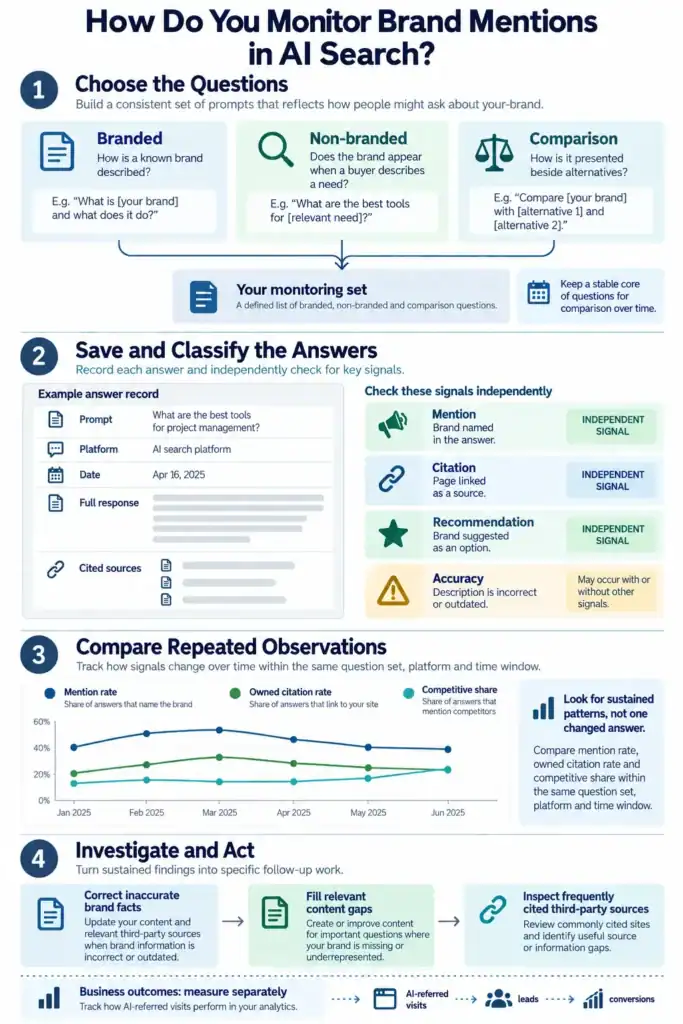
To monitor brand mentions in AI search, build a stable set of customer questions, collect answers across relevant platforms, and record when and how your brand appears. Repeat the observations over time, inspect cited sources, and keep referral and conversion data in a separate reporting layer.
Ahrefs distinguishes observed results from modeled exposure: “Impressions are mentions that are weighted by Google search volume to estimate potential exposure” — Ahrefs. A single chatbot answer cannot tell you whether discovery is improving or whether anyone visited your site.
Content Ops Lab uses research-first, verified content operations to turn observed gaps into editorial work; it does not need to treat a monitoring score as a business outcome.
Related: What Is AI Search Monitoring and What Should Brands Track?
What Counts as a Brand Mention in an AI Answer?
A brand mention occurs when an AI answer names a company, product, or recognizable brand entity. Count the answer as observed, then classify its context: an inaccurate description still counts as a mention, while a linked page may be cited without the brand being named. Neither event proves endorsement, traffic, or a sale.
Direct Brand and Product Mentions
Define the entity before collecting responses. Avoid assigning unrelated uses of generic names to the brand. Scrunch says it “uses pattern matching validated against continuously updated datasets to detect explicit brand mentions”— Scrunch.
- List company names, product names, and accepted aliases.
- Include former names when customers still use them.
- Track owned domains separately from names in answers.
- Record competitor entities using the same identification rules.
- Review generic names manually when context remains ambiguous.
A clean entity definition makes the next classification meaningful: what exactly did the answer do?
Citations and Recommendations
Being named, cited, and recommended are distinct. Inspect the language when an answer lists alternatives without favoring one.
| Event | What to record | What it does not establish |
| Mention | Brand named in answer text | Endorsement or click |
| Citation | Brand page linked as a source | Brand named or recommended |
| Recommendation | Brand suggested as an option | Visit or purchase |
| Referral | Visit attributed to an AI source | Which observed answer caused it |
- Mark each event independently in the saved answer.
- Note whether the brand appears beside competing options.
- Check qualifiers before assigning a positive recommendation.
- Preserve inaccurate and unfavorable mentions for investigation.
- Separate cited third-party pages from owned domains.
Even a favorable answer remains an answer until a user actually follows a link.
Referral Traffic
A referral is a website session attributed to an AI service. Assess its quality and conversions in analytics.
- Segment AI-referred sessions by identifiable source platform.
- Track engaged sessions, leads, and completed conversions.
- Check landing pages for misleading source classifications.
- Preserve attribution rules when comparing reporting periods.
- Keep unclicked answers outside the traffic denominator.
Missing referrers prevent complete journey reconstruction.
Which Questions Should You Track for Brand Discovery?
To monitor brand mentions in AI search, track how prospects investigate problems, providers, and alternatives. Keep branded, non-branded, and comparison intents in separate groups. Non-branded questions matter most for discovery because the buyer has not supplied your name; branded questions test whether the system describes an already known entity accurately.
Branded Questions
Branded prompts show what happens once the customer knows the name. They can reveal outdated claims, wrong service descriptions, and confusion between companies with similar names, but they do not show whether an unknown prospect would discover you.
- Test common company and product-name variants separately.
- Ask about specific capabilities and relevant service areas.
- Record factual errors against a maintained source of truth.
- Separate navigational questions from evaluation and purchase questions.
- Watch for outdated descriptions that persist across platforms.
Use those observations to audit entity accuracy, then ask whether the brand appears without prompting.
Non-Branded Discovery Questions
These questions describe a need, category, or purchasing situation without naming a provider. Their answers reveal discovery gaps. FAII advises: “Build a durable query inventory across brand, product, category, and competitor patterns” — FAII.
- Start with recurring customer problems and decision criteria.
- Include category questions that fit actual business capabilities.
- Sample purchase scenarios across relevant audience segments.
- Keep core phrasing stable for meaningful time comparisons.
- Add emerging questions without rewriting the historical baseline.
A representative sample is a deliberate business choice, not a transcript of all customer conversations.
Comparison Questions
Comparison prompts test inclusion during evaluation. Keep the competitor list explicit: a share calculated against two named rivals says nothing about competitors outside that set.
- Compare brands within the same relevant buying category.
- Include direct alternatives and buyer decision criteria.
- Record which brands appear together or alone.
- Separate comparisons from unprompted non-branded discovery answers.
- Retain the exact competitor set in every report.
For example, an inventory for a multi-location content operations partner could contain these three prompts:
| Intent | Illustrative question |
| Branded | “What does Content Ops Lab do for multi-location content teams?” |
| Non-branded | “How can a multi-location healthcare group scale verified educational content?” |
| Comparison | “How should I compare Content Ops Lab with another content operations partner?” |
This example does not imply search volume.
What Should You Record From Each AI Search Answer?
To monitor brand mentions in AI search, save the full answer and observation context. A dashboard score alone cannot explain a change. Store the prompt, platform, timing, relevant audience or locale, named entities, framing, and displayed citations so an editor can later inspect the actual answer.
The Full Answer and Observation Context
Keep each run as a separate observation. Preserve the original wording and the conditions under which it appeared; otherwise, a changed prompt or locale can masquerade as a change in brand visibility.
- Exact prompt and any platform-specific prompt variant.
- Platform, run date, and relevant locale or persona.
- Full answer text, with a stable saved copy.
- Named brands and their order in the answer.
- Framing, cited URLs or domains, and result classification.
If a tool changes the prompt behind the scenes, retain that variant alongside the original seed.
Brand Placement and Framing
A brand may appear first as a strong option, last as a passing example, or inside a warning. Automated labels help, but material errors and ambiguous tone require human review.
- Mark neutral inclusion separately from explicit endorsement.
- Capture limitations and conditions attached to recommendations.
- Check whether product attributes match current company information.
- Flag false service, price, location, or eligibility claims.
- Save examples that need subject-matter expert review.
That review explains what a visibility score means before anyone tries to improve the score itself.
Cited Pages and Third-Party Sources
Capture the links displayed with each answer, including owned, competitor, and third-party URLs. Perplexity says, “Each answer includes numbered citations linking to the original sources”; that describes its interface, not every platform — Perplexity.
- Save exact URLs and canonical domains where possible.
- Classify owned, competitor, publisher, and directory sources.
- Note whether any cited page actually discusses the brand.
- Distinguish displayed citations from unrelated organic rankings.
- Recheck links before assigning an editorial action.
A displayed citation guides investigation without proving cause.
If your operation needs to produce 20–50+ articles per month without sacrificing compliance or quality, Content Ops Lab builds the infrastructure to make that possible. Contact us to discuss your content production requirements.
Which Brand Mention Metrics Are Useful?
Brand-mention metrics in AI search need explicit denominators. Mention rate measures inclusion in sampled answers; citation rate measures linked sources in that same observation set; competitive share of voice compares tracked brands under a defined counting rule. Report each by prompt group, platform, and time period. Vendor-modeled exposure is a separate estimate, not an observed answer count.
Mention Rate and Prompt Coverage
Choose whether the unit is a distinct prompt or an individual answer run, and state it. Multiple runs of one question can otherwise outweigh every other question, hiding weak topic coverage behind repeated success on one prompt.
- Count answers naming the brand under stated rules.
- Divide by all sampled answers in that segment.
- Report distinct prompts represented beside the answer rate.
- Split branded and non-branded questions before interpretation.
- Keep excluded or failed runs visible in methodology.
An increase within branded questions cannot substitute for improved inclusion in discovery answers.
Citation Rate and Source Mix
Citation rate should answer a specific question: how often did sampled answers link to an owned page? A separate source inventory identifies which external domains appear repeatedly, even when the brand is absent from answer text.
- Count answers linking to at least one owned page.
- Divide by eligible sampled answers with citation inspection.
- List recurring third-party domains for each topic.
- Compare owned citation changes within the same platform.
- Review source content before assuming an editorial gap.
Keep the displayed citation in view; a page ranking in traditional search is different evidence.
Competitive Share of Voice
Share of voice has no universal denominator across vendors. Peec AI defines its share as the “Percentage of your brand mentions in AI responses compared to all tracked brands mentioned.” Divide brand mentions by all tracked-brand mentions and multiply by 100 — Peec AI. Ahrefs uses an impressions-weighted version; compare scores only after reading each definition.
| Metric | Calculation on the sampled set | Measured unit | Interpretation limit |
| Mention rate | Answers naming brand ÷ sampled answers | Answer run | Only selected prompts and platforms |
| Owned citation rate | Answers citing owned page ÷ inspected answers | Answer run | Does not prove recommendation |
| Competitive share | Brand mentions ÷ all tracked-brand mentions | Tracked-brand mention | Changes with competitor set and method |
- Name every competitor included in the denominator.
- Document whether co-mentions count once per answer.
- Separate raw observed counts from weighted estimates.
- Avoid combining incompatible platform behaviors into certainty.
- Show sample size alongside every percentage reported.
A defensible comparison is narrow enough to reproduce and broad enough to inform a decision.
Related: What Causes AI Visibility Volatility?
How Do You Tell a Real Shift From Answer Variability?
Repeat the same core questions under comparable conditions and look for sustained changes across several observations. One changed answer may reflect normal output variation, a source change, or a different prompt context. Segment by topic and platform, then inspect the underlying answers before changing strategy or claiming an improvement.
Repeat and Preserve Comparable Runs
Set a cadence the team can maintain, then preserve each response and its source snapshot. An unstable prompt inventory undermines trend comparisons.
- Reuse exact core questions for longitudinal comparisons.
- Save answer text and displayed citation URLs.
- Record platform, date, locale, and audience context.
- Mark new prompts separately from the stable baseline.
- Keep detection and classification rules versioned over time.
The protocol lets an analyst identify a sampling change before attributing the difference to answers.
Compare Time Windows and Platforms
Under exact repeats at temperature zero, a study found “gpt-4o-mini produced distinct outputs in roughly 0.24 of runs”; llama3.1-8b did so in about 0.09 — arXiv. Those figures describe those models and settings; they are not brand-mention volatility estimates.
- Compare repeated observations within the same prompt family.
- Show topic and intent cuts beside overall results.
- Report each platform before producing a combined view.
- Annotate prompt, model, interface, and locale changes.
- Look for persistence across several comparable observations.
Cross-platform differences can reveal a real research question without turning one platform into another’s benchmark.
Inspect Outliers Before Drawing Conclusions
When a percentage moves sharply, retrieve the answers responsible. A brand might gain mentions only because an answer lists every provider, while losing a useful owned citation on an important decision prompt.
- Read changed answers rather than trusting chart labels.
- Confirm whether brand detection matched the right entity.
- Compare cited pages and wording with earlier runs.
- Investigate new errors before celebrating mention growth.
- Escalate repeated patterns, not isolated awkward answers.
The strongest signal is a documented pattern with an identifiable editorial or source question behind it.
How Do You Act on the Results Without Overclaiming ROI?
Turn persistent mention, accuracy, and citation patterns into investigations with clear owners. Check your own facts and content, inspect displayed third-party sources, and decide what needs correction or publication. Measure AI-referred visits and conversions separately in analytics. Neither dashboard alone establishes that a monitored answer caused a customer action.
Investigate Missing or Inaccurate Brand Context
Begin with the claims a customer would act on: services, capabilities, locations, qualifications, and limitations. If several saved answers repeat the same mistake, find where your controlled information conflicts or remains unclear before commissioning new material.
- Compare answer claims against the approved source of truth.
- Correct outdated product and location details on owned pages.
- Strengthen category explanations where eligibility stays unclear.
- Escalate consequential errors for subject-matter review.
- Recheck affected prompt families after corrections publish.
That creates a testable content task without promising an answer change.
Study the Sources AI Systems Use
Repeated third-party citations can expose how a category is described outside your site. Inspect the pages themselves, the facts they carry, and legitimate opportunities to correct or contribute information; a citation pattern does not establish a causal ranking recipe.
- Group recurring publishers by topic and buyer intent.
- Check whether cited pages describe competitors accurately.
- Identify missing factual context in credible external sources.
- Prioritize corrections or outreach where editorially appropriate.
- Track subsequent citations without promising source placement.
Some sources will remain outside your control, which makes accurate owned information more important.
Join Visibility With Referral and Conversion Reporting
Use one view for observed answers and another for sessions, leads, and sales. A review of one monitoring tool states, “The most significant limitation is the lack of traffic attribution.” The broader distinction applies when interpreting observed answers and site visits — Discovered Labs.
- Track AI-referred sessions under consistent analytics rules.
- Compare engaged visits and conversions by source.
- Incorporate first-party lead feedback where available.
- Note missing referrers and cross-device attribution gaps.
- Report correlations without assigning single-answer causation.
The editorial decision follows the answer evidence; the business report measures a different event.
How Content Ops Lab Builds Content Infrastructure
21.4% average AI search CVR vs. 3.32% site average (6.4x better) describes observed AI search referrals for a 12-location regulated healthcare client from July 2025 through February 2026. It doesn’t identify which answer or citation drove a conversion, and it doesn’t predict another organization’s results. It shows why referral outcomes deserve their own measurement layer beside answer visibility.
Content Ops Lab turns verified topic gaps, source observations, and accuracy problems into a controlled content production queue. A monitoring tool can expose where a brand appears; editors still have to decide whether the evidence warrants a factual correction, a stronger explanation, or further observation.
- Research begins with specific audience and business questions.
- Each assignment retains its evidence and claim boundaries.
- Citation verification checks quotations against original source material.
- A maintained source of truth reduces conflicting brand descriptions.
- Topic gaps become briefs with defined editorial decisions.
- Multi-platform optimization supports clear, extractable factual explanations.
- Review gates preserve accuracy as production volume grows.
- Delivery records what changed and which evidence supported it.
This approach keeps answer monitoring connected to work the team can actually execute. An uncited mention, inaccurate recommendation, and discovery gap require different responses and owners.
The Content Ops Lab Production System
The production system gives each investigation a path from an observed issue to a reviewed asset. It provides decision points for evidence, accuracy, and publication without assuming control over an AI platform’s output.
- Research: Group repeatable prompt and source patterns into assignments.
- Verification: Check every material claim and citation against sources.
- Optimization: Make approved information clear across relevant discovery contexts.
- Delivery: Publish reviewed assets and record subsequent observation changes.
The next step is to connect that production queue to a reporting practice stakeholders can audit.
Ready to build content infrastructure that scales without the compliance risk? Get in touch — we’ll assess your current content operation and outline what a systematic approach would look like for your organization.
FAQs About Brand Mentions in AI Search
Can I Monitor Brand Mentions in AI Search by Checking ChatGPT Manually?
Yes. Manual checks can establish an initial set of questions and reveal examples of inaccurate brand descriptions. Save the exact prompt, full answer, date, and any displayed sources each time. One check does not establish a trend, and a ChatGPT-only sample says nothing about other platforms. Repeat comparable checks before reporting movement.
How Many Prompts Should a Brand Track to Start Measuring AI Visibility?
Start with a set your team can justify and revisit consistently. Include commercially relevant non-branded discovery questions, then separate branded and comparison questions into their own segments. Cover key topics and customer decisions rather than chasing a universal count. Document additions so a changing prompt inventory does not distort the baseline.
What Should I Do if an AI Answer Describes My Brand Inaccurately?
Save the answer, prompt, date, platform, and displayed citations, then verify the disputed detail with an internal subject-matter owner. Correct conflicting or outdated information on controlled pages and consider legitimate corrections to external sources. Recheck the affected question family over time. An isolated answer may change without any intervention.
How Do I Compare My AI Brand Mentions With Competitors Fairly?
Compare the same prompt group, platform, locale, and time period against a named competitor set. Disclose whether the metric counts answers containing a brand or total tracked-brand mentions, including co-mentions. Keep branded prompts out of a discovery comparison. That percentage describes the sample, not total market share.
Can a Content Operations Partner Help Act on AI Mention and Citation Gaps?
Yes. A content operations partner can convert recurring accuracy, topic, and source gaps into researched briefs, verified updates, and a publication queue. It should preserve the underlying answer records and claim limits, then assess changes against a stable baseline. No edit guarantees a mention, citation, referral, or conversion.
Key Takeaways
- Monitor saved answers across a stable prompt set; a single mention or dashboard score cannot establish meaningful movement.
- Separate non-branded discovery questions from branded and competitor comparisons so each segment answers a distinct business question.
- Record named brands, framing, displayed citations, and material errors before translating visibility patterns into editorial assignments.
- Content Ops Lab uses research and citation verification to turn observed gaps into controlled, reviewable content production.
- Its client’s 21.4% average AI search CVR vs. 3.32% site average (6.4x better) measures referrals, not mention-driven causation.
- Start a baseline now, review sustained shifts, and prioritize factual corrections and source investigations before expanding the prompt set.
How Should You Monitor Brand Mentions in AI Search Going Forward?
Define the questions that matter, save the answers, and maintain a stable baseline across the AI platforms your buyers use. Then inspect what changed: the brand’s presence, its description, its recommendation context, and the pages displayed as sources. Report referral sessions and conversions alongside those observations, with their separate attribution limits. The practical advantage comes from identifying an accuracy problem or missing topic while there is still time to correct the underlying information.
Content Ops Lab’s role begins at that decision point: turning documented gaps into researched, verified content that a team can publish and review again against the same questions.
2 Comments
Comments are closed.