

What Causes AI Visibility Volatility?
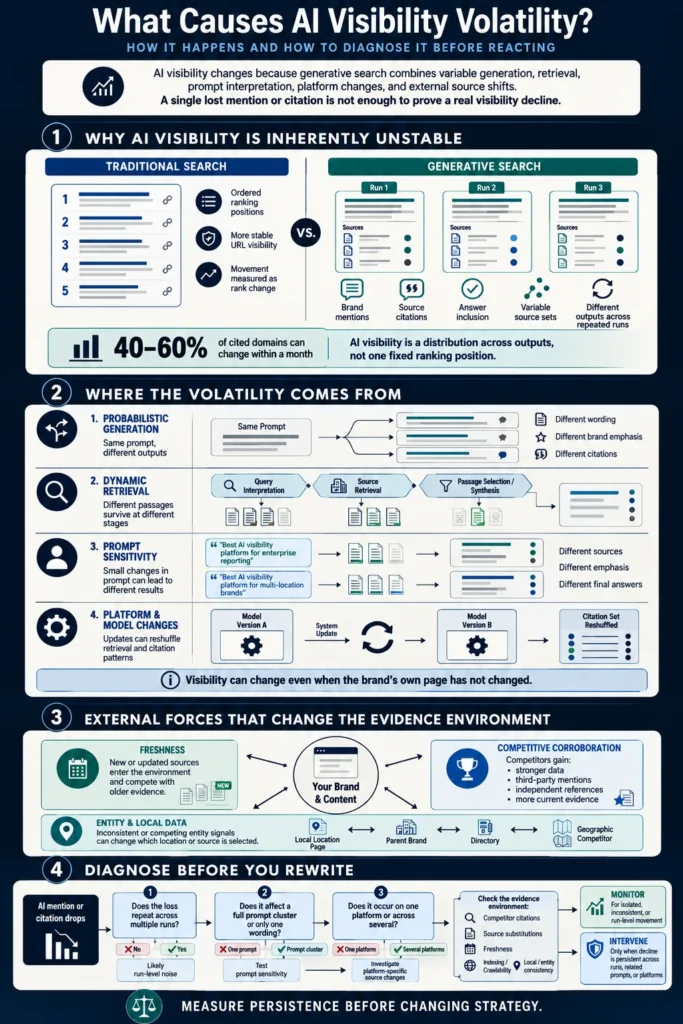
AI visibility volatility occurs because generative search combines dynamic retrieval, source selection, ranking, and probabilistic answer generation, rather than returning a single fixed, ordered result. “AI citations are inherently less stable than traditional rankings. Research shows that AI answer content changes approximately 70% of the time when the same query is repeated, and only 30% of brands remain visible in consecutive responses for the same question” — Gorilla Marketing.
For marketing leaders, that instability creates a reporting problem: reacting to every lost mention can produce unnecessary rewrites. Content Ops Lab treats AI visibility volatility as a measurement problem first, evaluating persistent trends before recommending intervention.
Related: What Drives AI Brand Visibility?
Why Does AI Visibility Change Even When Nothing Else Appears to Change?
AI visibility can change between runs even when a brand has not altered its content, rankings, or site. Generative systems assemble answers from multiple variable stages, so a single result is better treated as one observation within a distribution than as a stable position. “Across all major AI platforms, 40% to 60% of cited domains change within a single month (every 30 days)” — Search Atlas.
Generative Answers Are Probabilistic
Generative systems can produce different wording, emphasis, brands, and evidence from similar inputs because answer construction is not equivalent to returning a fixed ranked list.
- Different runs can emphasize different supporting evidence
- Brand inclusion can change between identical prompts
- Answer structure may alter which sources matter
- Small generation differences can compound downstream
That variability is normal, but it becomes useful only when teams separate noise from persistent change.
Mentions and Citations Can Move Independently
A brand mention and a source citation are related visibility signals, but they do not measure the same thing or always move together.
- Mentions show conversational brand inclusion
- Citations show explicit source attribution
- A brand may appear without citation
- A domain may support unmentioned claims
- Citation loss does not prove disappearance
Tracking only citations can therefore misclassify continuing brand visibility as a full loss of generative presence.
AI Visibility Is More Dynamic Than a Ranking Position
Traditional organic rankings fluctuate, but they still provide an ordered result set that can be checked repeatedly. AI visibility adds another layer of variation.
- Organic rankings preserve explicit ordered positions
- AI answers may omit ordered placement
- Source sets can change between responses
- Brand prominence can shift without disappearance
“AI Overview ranking volatility score: 0.68 (8 weeks), 0.73 (13 weeks); Google Search organic ranking volatility score: 0.49 (8 weeks), 0.55 (13 weeks)” — Search Engine Land.
| Measurement Dimension | Traditional Rank Fluctuation | AI Visibility Volatility |
| Primary unit | Ordered search position | Mention, citation, answer inclusion |
| Run-to-run behavior | Usually observable as rank movement | Can change without fixed position |
| Source visibility | URL remains directly visible | Source may rotate or disappear |
| Brand visibility | Often tied to ranked page | Can persist without cited domain |
| Best reporting view | Position and trend | Consistency across runs and prompts |
The practical difference is not that every AI platform behaves identically, but that single-answer snapshots are weaker evidence.
How Does Retrieval Cause AI Citations to Change?
AI citations can change before answer generation begins because retrieval determines which passages and sources are available for synthesis. Query expansion, semantic matching, chunking, reranking, and context limits can all alter the candidate evidence set. This operating model explains why unchanged pages can gain or lose citations without assuming every platform implements the same retrieval architecture.
Query Expansion Changes the Candidate Source Set
A user prompt can be interpreted into related concepts or subqueries, creating different retrieval paths even when the original wording appears nearly identical.
- One prompt can imply several subquestions
- Expanded queries surface different source pools
- Related concepts may receive different weighting
- Candidate evidence changes before final synthesis
Once the candidate pool changes, later stages can only rank and synthesize what retrieval actually surfaced.
Chunking and Reranking Change Which Evidence Survives
Retrieval often works at the passage level rather than treating every page as one indivisible unit. That creates additional opportunities for source turnover.
- Chunking changes which passages remain retrievable
- Semantic matching favors conceptually aligned passages
- Reranking changes candidate evidence priority
- Strong pages can lose passage-level competition
The important point for marketers is that page quality and citation inclusion are connected, but never perfectly interchangeable.
Limited Context Forces Source Trade-Offs
A generated answer cannot use all potentially relevant sources simultaneously, so context selection entails trade-offs among competing passages and domains.
- Context windows constrain usable supporting material
- Similar sources can substitute for each other
- Corroborating passages compete for limited space
- Synthesis may retain fewer final citations
| Retrieval Stage | What Can Change | Visibility Effect |
| Query expansion | Related subqueries and interpreted concepts | Different domains enter consideration |
| Semantic retrieval | Passage-level relevance matches | New candidate chunks surface |
| Reranking and chunking | Priority and granularity of evidence | Different passages survive |
| Attributed synthesis | Final evidence used in answer | Citations rotate or disappear |
This is a general RAG operating model, not proof that every AI platform uses the same pipeline.
Why Can Small Prompt Changes Produce Different Brands and Sources?
Small prompt changes can produce different brands and sources because wording changes the system’s interpretation of intent. A modifier, comparison term, geography, or decision criterion can shift query expansion and retrieval enough to produce a different evidence set. Marketing teams therefore need prompt clusters that represent buyer intent, not one exact query treated as a permanent benchmark.
Wording Changes the Interpreted Intent
Two prompts can look equivalent to a marketer while signaling different priorities to the retrieval and generation system processing the question.
- Modifiers change what “best” actually means
- Question structure can alter expected evidence
- Geographic terms narrow candidate source sets
- Purchase-stage language changes answer emphasis
This makes prompt sensitivity a measurement variable, not simply another label for random run-to-run fluctuation.
Different Intent Produces Different Retrieval Paths
Once wording changes the interpreted intent, retrieval can expand to different concepts, evidence types, competitors, or sources, even within the same topic.
- Comparison prompts favor comparative evidence
- Implementation prompts favor process-oriented sources
- Risk prompts may favor authoritative references
- Vendor prompts can surface category competitors
| Prompt A | Prompt B |
| “Which AI visibility platforms are best for enterprise reporting?” | “Which AI visibility platforms are best for multi-location brands?” |
| Emphasizes enterprise measurement and reporting | Emphasizes local entities and distributed locations |
| May retrieve analytics and governance sources | May retrieve local visibility and entity sources |
A different answer may therefore reflect a different retrieval instruction rather than a deterioration in the brand’s underlying authority.
Prompt Clusters Matter More Than One Keyword
A prompt cluster measures visibility across several natural ways buyers can express the same broader need, reducing dependence on one brittle query.
- Cluster related buyer-language variations together
- Track repeated answers within each cluster
- Compare brand mentions separately from citations
- Watch direction across multiple measurement periods
The stronger diagnostic question is whether visibility weakened across the cluster, not whether one wording lost one mention.
If your operation needs to produce 20–50+ articles per month without sacrificing compliance or quality, Content Ops Lab builds the infrastructure to make that possible. Contact us to discuss your content production requirements.
How Do Model Updates and Platform Changes Reset AI Visibility?
Model and platform changes can abruptly alter citation baselines, even when a brand’s page remains unchanged. New models, retrieval behavior, source preferences, or synthesis rules can change which evidence survives into an answer. The key diagnostic is whether the shift is isolated to a single surface or occurs across multiple platforms, prompts, and time periods.
Model Changes Can Alter Source Selection
A model transition can change the relationship between retrieved evidence and the sources ultimately selected for attribution, creating an abrupt shift in visibility.
- System updates can change source preferences
- Citation behavior may shift after deployment
- Existing content can lose prior inclusion
- New sources may enter immediately
“On January 27, 2026, Google made Gemini 3 the default model for AI Overviews. The shift was not cosmetic. It was a citation reset”— Frase.
That phrase is Frase’s characterization, not official Google terminology, so it should be treated as an observed platform-change example.
Citation Mix Can Shift Without an Organic Ranking Loss
AI citation selection can diverge from organic rankings, meaning stable search performance does not guarantee stable inclusion of generative sources.
- Organic strength does not guarantee citation selection
- Citation turnover can occur without rank loss
- Lower-ranked pages can still gain inclusion
- Source diversity can increase after updates
“Ahrefs analyzed 863,000 keywords and 4 million AI Overview URLs and found that only 38% of cited pages also rank in the top 10 organic results. Seven months earlier, that figure was 76%” — Frase.
| Reported Period | Top-10 Organic Overlap With AI Overview Citations |
| Earlier measurement | 76% |
| Later measurement | 38% |
| Change | -38 percentage points |
The comparison shows imperfect overlap between ranking and citation systems, not that classic SEO authority has stopped mattering.
Platform-Specific Losses Need Platform-Specific Diagnosis
A loss of visibility on one generative surface is not enough to declare a broader decline, because platforms can use different models, retrieval systems, sources, and update cycles.
- Compare the same prompt across platforms
- Identify whether mentions decline everywhere
- Check citations separately from brand inclusion
- Look for platform-specific source substitutions
A broad strategic response becomes justified only when the loss persists beyond one platform’s changing source-selection behavior.
Related: Why Can a Brand Rank Well in Google but Have Low AI Share of Voice?
What External Changes Can Make a Brand Disappear From AI Results?
A brand can lose AI visibility because the evidence environment around it changes, even when its own page stays untouched. Fresh content, stronger competitor corroboration, changes to third-party sources, and local entity inconsistencies can alter what retrieval systems surface. This makes external monitoring part of diagnosis before any content rewrite is approved.
Freshness Changes the Available Evidence
Freshness can influence retrieval when the topic depends on current facts, changing products, new research, or evolving market conditions.
- Updated sources can become more relevant
- New evidence can displace older passages
- Time-sensitive topics reward current corroboration
- Stale facts can weaken retrieval suitability
The research supports freshness as a factor, but it does not establish a universal 30-day or 90-day cutoff.
Competitors Can Change the Corroboration Landscape
Competitors can improve visibility by publishing stronger evidence, earning third-party mentions, or creating more corroborating signals across independent sources.
- New research strengthens competitor evidence
- Third-party mentions improve source corroboration
- Updated comparisons reshape category consensus
- Stronger sources can displace weaker ones
A lost citation can therefore reflect a stronger evidence environment elsewhere rather than sudden deterioration in the brand’s own page.
Local Entity Signals Create Additional Instability
Multi-location brands face additional volatility because location data, parent-brand relationships, directories, and geographic competitors can change which entity the system resolves to.
- Directory inconsistencies can fragment location evidence
- Parent brands can replace local entities
- Nearby competitors alter geographic source sets
- Location pages may compete internally
“According to SOCi’s 2026 Local Visibility Index, AI platforms recommend only 1.2% of locations on ChatGPT and 7.4% on Perplexity, compared to 35.9% visibility in Google’s local 3-pack” — SOCi.
| Surface | Reported Local Recommendation Visibility |
| ChatGPT | 1.2% |
| Perplexity | 7.4% |
| Google local 3-pack | 35.9% |
That spread reinforces the need for multi-location teams to compare surfaces rather than treat a single visibility score as universal.
How Can Marketing Teams Tell Measurement Noise From a Real Visibility Drop?
Marketing teams should treat a decline in visibility as meaningful only after testing whether it repeats across runs, related prompts, and relevant platforms. The goal is to distinguish normal variation in answers from a persistent structural change. Intervention should follow diagnosis of the pattern, likely cause, and commercial importance rather than the first screenshot showing a lost citation.
Test Whether the Drop Repeats
Repeated identical runs help determine whether a missing mention or citation is persistent or simply an instance of normal output variability.
- Repeat the same prompt several times
- Record mentions and citations separately
- Compare source turnover between consecutive runs
- Look for repeated absence, not novelty
Three to five runs can be a practical choice for internal tracking, but not a universal industry standard.
Check Whether the Change Spans a Prompt Cluster
A persistent loss across related buyer-language prompts carries more weight than a disappearance from a single exact query or an unusually phrased variant.
- Review multiple natural prompt variations
- Separate topic decline from wording sensitivity
- Compare cluster-level mention consistency
- Track citation share across the cluster
Cluster-level decline suggests a broader retrieval or competitive shift that warrants investigation before changing content.
Diagnose the Source of a Persistent Change
Once a drop repeats, teams should identify where the change is concentrated before deciding whether content, technical, entity, or competitive action is appropriate.
- Check whether one platform is isolated
- Compare competitor gains and source substitutions
- Review freshness, indexing, and crawlability
- Audit local and parent-entity consistency
- Identify changed source types in answers
Decision path
If the loss does not repeat, classify it as run-level noise and continue tracking. If it repeats on a single prompt but not in the cluster, test prompt sensitivity. If it spans a cluster but only one platform, investigate platform-specific source changes. If it persists across prompts and platforms, review competitors, source mix, freshness, indexing, and entity signals before changing content strategy.
The purpose of diagnosis is restraint: intervene when the pattern persists, not when a single answer happens to change.
How Should Marketing Teams Build a More Reliable AI Visibility Measurement System?
AI visibility gaps are already large enough to matter at the executive level. “Graph’s AI Visibility Report for 2026 found that 82% of B2B manufacturing and industrial brands are invisible in early-stage AI buyer discovery: the moment a buyer describes a problem without naming a vendor” — Graph Digital.
That makes reliable measurement more useful than reacting to individual mentions or citations. Content Ops Lab treats unstable AI visibility as a measurement problem first, using consistent research and verification practices to determine whether movement is isolated noise or a durable change across prompts, platforms, and time.
The commercial stakes can be significant even when visibility fluctuates. 21.4% average AI search CVR vs. 3.32% site average = 6.4x performance multiplier. The figure does not explain volatility; it shows why disciplined measurement deserves executive attention.
Content Ops Lab’s production evidence includes:
- 1,000+ articles and pages delivered with verified citations across full 23-month engagement
- 5x increase in monthly output (10 → 50+ articles/month)
- 2.3M monthly impressions across the network
- Zero compliance issues over entire engagement
- 21.4% average AI search CVR vs. 3.32% site average = 6.4x performance multiplier
- 95+ confirmed conversions
- 887% ChatGPT traffic growth in 7 months
- 188 question-based keywords ranking (83% in positions 1-10)
The Content Ops Lab Production System
The production system creates a repeatable evidence trail from source research through delivery, making performance changes easier to interpret without confusing content output with measurement noise.
- Research: Map prompts, sources, competitors, and evidence
- Verification: Confirm claims before they enter production
- Optimization: Structure content for search and extraction
- Delivery: Track outputs against visibility and conversion
That operating discipline gives leadership a clearer basis for deciding when changes in visibility require action.
Ready to build content infrastructure that scales without the compliance risk? Get in touch — we’ll assess your current content operation and outline what a systematic approach would look like for your organization.
FAQs About AI Visibility Volatility
Is AI Visibility Volatility a Sign That Our AI Search Strategy Is Failing?
No. AI visibility volatility is expected because answers can change across repeated runs, retrieval states, prompts, and platform updates. A single lost mention or citation is weak evidence of strategic failure. Look for persistent decline across repeated runs, prompt clusters, and platforms before concluding that the underlying content or authority strategy needs correction.
How Often Should a Marketing Team Measure AI Visibility Before Making Changes?
Measure often enough to establish a repeatable trend rather than relying on isolated screenshots. Multiple runs of important prompts, recurring checks of prompt clusters, and consistent reporting intervals are more useful than one-off tests. The exact cadence should align with business importance and platform volatility; the research does not establish a single universal frequency for every team.
Can Unstable AI Answers Create Brand or Information-Accuracy Risks?
Yes. Variability can create risk when answers substitute outdated sources, omit important context, confuse local entities, or present inconsistent brand information. Teams should monitor not only whether the brand appears, but also how it is described and which sources support the answer. Persistent accuracy problems deserve faster escalation than ordinary citation turnover.
Is AI Visibility More Volatile Than Traditional Organic Search Rankings?
Available evidence suggests that AI visibility can be more volatile, but comparisons depend on the platform, query set, and measurement method. Authoritas reported higher volatility scores for AI Overviews than organic rankings over eight- and 13-week periods. The important operational difference is that AI answers can change brands, sources, and composition without exposing one stable rank position.
How Can Content Ops Lab Help a Marketing Team Measure and Respond to AI Visibility Changes?
Content Ops Lab builds repeatable systems for tracking the prompts and sources that matter to a business. The goal is not to rewrite content after every visibility change. It is to establish whether movement persists, identify the likely source, and connect intervention decisions to evidence rather than isolated AI outputs.
Key Takeaways
- Volatility is structural; a single change in answer does not prove that a brand’s strategy has failed.
- Track mentions and citations separately because either can change without the other disappearing.
- Repeated prompt runs and cluster-level trends provide stronger evidence than screenshots from single AI answers.
- Content Ops Lab uses its production system to separate persistent change from measurement noise before intervention.
- 21.4% average AI search CVR vs. 3.32% site average = 6.4x performance multiplier.
- With 82% of surveyed B2B industrial brands absent from early AI discovery, measurement discipline still creates an early advantage.
- Diagnose repeated, cross-platform deterioration before rewriting content or changing the broader visibility strategy.
What Should Marketing Leaders Do About AI Visibility Volatility?
AI visibility volatility should change how marketing leaders measure generative search, rather than pushing them into constant reactive optimization. Individual mentions and citations will shift as retrieval, prompts, competitors, source environments, and platform systems change. The signal worth acting on is persistence across repeated runs, prompt clusters, platforms, and time.
The next step is to build reporting that emphasizes consistency, direction, source mix, and commercial relevance, rather than treating each answer as a ranking report. Teams that establish measurement discipline now can identify real deterioration more quickly while avoiding unnecessary rewrites.
Content Ops Lab applies the same principle operationally: investigate persistent changes, verify their causes, and respond only when the evidence supports intervention.






3 Comments
Comments are closed.