

What Is AI Citation Absorption and Why Does It Matter?
AI citation absorption is an analytical framework for measuring how much citation share a brand, domain, or source captures within a defined set of AI answers. It shifts the question from “Did we get cited?” to “How much of the available citation visibility are we capturing?”
“We find that generative search systems exhibit significant source-selection biases in their citations, favoring certain sources over others” — arXiv.
That distinction matters because isolated citations reveal little about competitive position. Content Ops Lab treats citation visibility as a measurable operating system: define the competitive set, track share, and determine where content earns or loses visibility.
Related: What Increases a Brand’s AI Citation Share?
What Does AI Citation Absorption Mean?
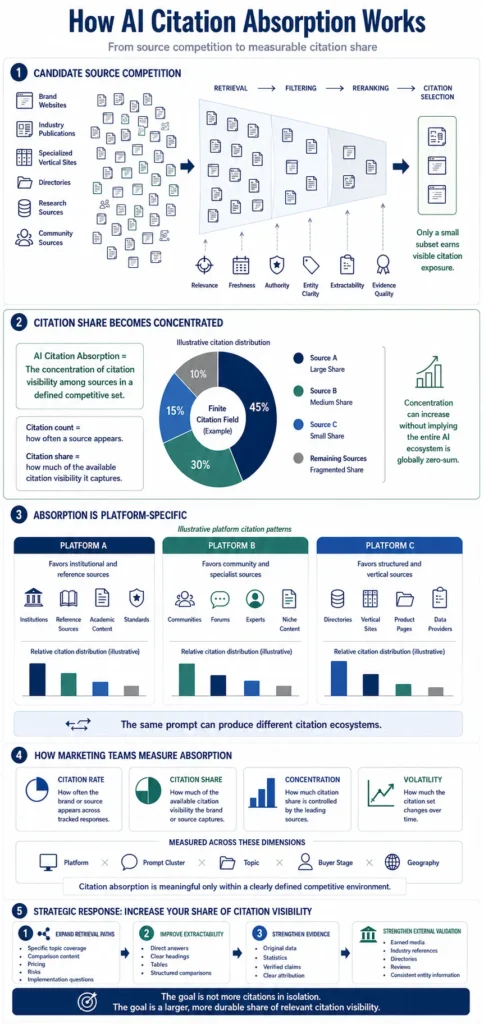
AI citation absorption describes the concentration of citation share within a defined AI answer environment. It is not an official platform term, ranking factor, or documented model mechanism. The framework is useful because it measures relative competitive visibility instead of treating every citation as an isolated success.
Citation Absorption vs. Citation Count
Raw citation counts tell marketers how often a source appeared. They do not show whether that appearance represents growing influence, declining share, or simple expansion of the total citation pool.
- Citation counts measure the absolute number of appearances across measured answers.
- Citation share measures relative competitive visibility instead.
- Larger citation pools can inflate raw totals.
- Stable counts can conceal falling competitive share.
A count becomes strategically useful only after the surrounding citation opportunity is defined.
Citation Share Within a Defined Ecosystem
Citation share requires clearly defined analytical boundaries. Without them, marketers combine unrelated prompts, platforms, markets, and buyer stages into a single number that cannot accurately reflect competitive performance.
Useful boundaries include:
- Individual AI platform or answer engine
- Defined topic or commercial product category
- Consistent prompt cluster built around related questions
- Specific stage within the buyer journey
- Geographic market, service area, or operating region
Those boundaries turn citation activity into something a growth team can compare, trend, and act on.
Why Absorption Is Not Globally Zero-Sum
Citation opportunities can be constrained within a single answer without making the entire AI search environment fixed-sum. Platforms can expand source diversity, generate longer answers, or retrieve different documents.
- Individual answers expose a limited number of citations.
- Prompt sets create bounded competitive measurement samples.
- Total citation volume can continue increasing overall.
- New sources can enter active retrieval pools.
- Platforms can broaden sourcing behavior between responses.
The useful competitive lens is therefore local concentration, not universal one-for-one citation replacement.
How Do AI Systems Create Competition for Citations?
Citation competition begins before a source becomes visible. An AI system may retrieve or consider far more documents than it ultimately cites, creating successive stages of selection. The competitive pressure comes from surviving retrieval, filtering, reranking, and final answer construction, rather than simply being present in an index.
Query Expansion and Candidate Retrieval
Complex questions can generate multiple retrieval paths before an answer is assembled. That means one user query may expose many subtopics, source types, and candidate documents to selection pressure.
- Broad questions can produce multiple narrower sub-queries.
- Candidate pools substantially exceed final citation sets.
- Multiple retrieval paths increase competition among sources.
- Relevant pages still compete for final inclusion.
“Google performs query decomposition, breaking complex queries into sub-queries. The system retrieves 200–500 candidate documents using semantic embeddings and keyword matches” — ZipTie.
ZipTie presents that figure as a reconstructed Google AI Overview pipeline, not an officially documented Google threshold.
Quality and Relevance Filtering
Retrieved material still has to survive additional selection pressure before citation. Relevance, freshness, authority, clarity, and extractability can influence whether a source remains useful in constructing an answer.
- Relevance should match the specific underlying sub-question.
- Freshness matters when information changes over time.
- Clear entities can reduce ambiguity during retrieval.
- Extractable passages simplify downstream answer construction.
- Supporting evidence strengthens individual source claims.
These pressures should be treated as observable selection considerations, not universal undocumented ranking factors.
Final Citation Exposure
The final answer contains only a fraction of the material that may have been retrieved or considered. That narrowing creates answer-level scarcity even as the larger source universe continues to expand.
- Retrieval creates a broad candidate source universe.
- Filtering removes weaker or less relevant matches.
- Answer construction compresses the available supporting evidence.
- Visible citations represent a much narrower subset.
The result is a competitive funnel in which citation visibility depends on surviving multiple selection stages.
What Evidence Shows That AI Citations Become Concentrated?
Research on AI search systems shows that citation visibility is often concentrated in a limited set of domains, publishers, or source categories. The exact winners vary by dataset and query type, but concentration itself appears repeatedly enough to justify measuring relative share rather than assuming sources receive roughly equal exposure.
Domain-Level Citation Concentration
Large citation datasets show winner-take-most patterns in which a relatively small collection of publishers receives disproportionate visibility across sampled AI answers and repeated query sets.
- Citation distribution rarely remains uniform across domains.
- Favored domains can recur across many answers.
- Concentration levels vary substantially by query category.
- Dominant sources differ across competing model providers.
“We find that while models from different providers cite distinct news sources, they exhibit shared patterns in citation behavior. News citations concentrate heavily among a small number of outlets and display a pronounced liberal bias, though low-credibility sources are rarely cited” — arXiv.
The relevant finding here is concentration, not the study’s separate ideological-bias analysis.
Source-Type Concentration
Concentration can also occur by source category. Different engines may repeatedly favor publishers, vertical specialists, directories, forums, institutional sources, or other recognizable classes of content.
- Source categories can develop disproportionate citation visibility.
- Preference patterns differ materially across AI platforms.
- Query intent can change the preferred source mix.
- Category dominance does not establish universal preference.
That makes source-type analysis useful, but only when marketers avoid assuming one platform’s preferred mix applies everywhere.
Why Specialized Sources Can Still Win
Large general-purpose domains do not automatically dominate every citation dataset. Specialized sites can capture significant visibility when their content closely matches a defined query category or buyer need.
“Analysis of 950,000+ citations reveals specialized business content dominates AI responses at 97.5%, while Wikipedia and Reddit combined account for under 2%” — Qwairy.
| Concentration Pattern | What It Suggests | Strategic Limitation |
| Large publishers recur heavily | Authority can concentrate visibility | Dominance varies by query set |
| Specific source types recur | Engines develop sourcing preferences | Preferences differ by platform |
| Specialized sites dominate vertically | Topic fit can outweigh general scale | Results should not be generalized |
The lesson is that concentration must be measured inside the market being analyzed.
If your operation needs to produce 20–50+ articles per month without sacrificing compliance or quality, Content Ops Lab builds the infrastructure to make that possible. Contact us to discuss your content production requirements.
Why Does AI Citation Absorption Differ Across Platforms?
Citation patterns differ across platforms because AI engines do not retrieve, rank, or cite identical source pools. A strong citation position in one system therefore provides limited evidence about another. Marketing teams need platform-specific metrics rather than collapsing ChatGPT, Google AI Overviews, Gemini, Perplexity, Claude, and other systems into a single metric.
Cross-Platform Source Overlap Is Low
Empirical research shows substantial divergence between source sets used by traditional search and generative search experiences, limiting the usefulness of a single blended citation score.
- Platforms retrieve meaningfully different combinations of domains.
- Identical prompts can surface substantially different sources.
- Search rankings do not guarantee AI inclusion.
- Platform-specific wins may remain locally contained.
“Traditional SERP, Gemini, and AIO exhibit low average similarity in terms of the retrieved sources for each query (i.e., Jaccard similarities between 0.11 and 0.18)” — arXiv.
Low overlap makes platform segmentation a measurement requirement rather than an optional reporting refinement.
Models Develop Different Source Mixes
Cross-model datasets reinforce the same pattern across large citation samples. Platforms repeatedly develop distinctive sourcing mixes even when they answer similar commercial or informational questions.
“Yext analyzed 17.2 million distinct AI citations gathered during Q4 2025 across four major AI models and found consistent, model-specific sourcing patterns across seven sectors (Yext, 2026)” — Machine Relations.
| Measurement View | Useful For | Avoid Assuming |
| Platform-specific share | Competitive position within one engine | Other engines behave similarly |
| Cross-platform comparison | Identifying source divergence | One blended score explains performance |
| Prompt-cluster comparison | Finding platform-topic strengths | Every prompt follows platform averages |
A platform-specific source mix changes both where marketers invest and how they interpret citation gains.
One Citation Strategy Cannot Represent Every Engine
A single blended “AI visibility” metric can hide major differences between platforms and prompt groups. Brands need a common measurement framework supported by separate platform-level baselines.
- Track identical prompt sets across multiple platforms.
- Compare source participation independently within each platform.
- Identify platform-specific citation gaps before reallocating resources.
- Allocate investment around observed competitive citation opportunity.
The goal is coordinated measurement, not a separate content program for every AI product.
Does AI Citation Absorption Mean Competitors Are Being Displaced?
A gain in citation share does not prove that one brand directly displaced another. Finite citation sets create competitive pressure, but observed losses can also result from retrieval volatility, index changes, reranking, model updates, or expanding source pools. Concentration is well documented; direct causal substitution requires much stronger evidence.
What Citation Displacement Can Mean
Displacement is most defensible when measured inside a stable platform, prompt set, and observation window. Even there, it should describe a change in visible allocation rather than an assumed causal mechanism.
- Source A gains a measurable share of citations over time.
- Source B loses a measurable share of citations concurrently.
- Prompt conditions remain reasonably comparable between samples.
- Observation occurs within one defined AI platform.
“When an AI answer cites only a handful of sources, every inclusion is competitive. If your source is selected, another source often is not” — AuthorityTech.
The word “often” matters because finite exposure does not establish universal one-for-one substitution.
Why Citation Loss Does Not Prove Causation
A source can disappear without a competitor directly replacing it. Multiple retrieval, indexing, ranking, and answer-construction changes can produce the same visible citation outcome.
- Retrieval indexes can change between repeated runs.
- Models can rerank previously eligible candidate evidence.
- Source pools can expand or contract substantially.
- Answer composition can vary between identical prompts.
- Platform updates can alter source-selection behavior.
Competitive reporting should therefore distinguish observed share movement from claims about the mechanism causing that movement.
The Defensible Competitive Interpretation
The strongest interpretation is relative share movement. Marketing teams can measure whether a brand gains or loses visibility without claiming to know precisely why every source changed.
- Measure relative source participation across repeated samples.
- Track named competitors within stable prompt samples.
- Separate documented concentration from causal displacement claims.
- Investigate citation losses before assigning causal explanations.
That distinction keeps competitive intelligence useful without overstating what citation observations can actually prove.
Related: What Causes AI Visibility Volatility?
How Should Marketing Teams Measure AI Citation Absorption?
Marketing teams should measure this pattern with stable prompt sets, platform-level segmentation, and relative citation metrics. Raw citation totals remain useful, but they should sit beside citation rate, competitive share, concentration, and volatility so teams can distinguish genuine competitive gains from simple changes in answer volume.
Citation Rate and Citation Share
Citation rate asks how frequently a brand appears across eligible answers. Citation share asks how much of the competitive citation opportunity the brand captures relative to the sampled environment.
- Citation rate measures the frequency of brand appearance across answers.
- Citation share measures relative competitive participation instead.
- Raw counts provide supporting citation-volume context.
- Longitudinal trends reveal directional competitive movement.
“Share of Citation = (sampled answers citing the specified brand or domain / total eligible answers sampled) x 100” — Machine Relations.
The two metrics answer different questions and become stronger when reported together.
Prompt-Cluster and Platform Segmentation
Measurement becomes more diagnostic when teams group prompts around actual business questions rather than collapsing everything into a single broad visibility average across unrelated intents.
- Segment prompt sets by funnel stage.
- Separate product and category topic groups.
- Track geographic prompt sets as independent samples.
- Compare distinct buyer-intent clusters over time.
- Report platform performance separately for every engine.
Segmentation reveals where citation strength exists and where a blended visibility score is masking weakness.
Concentration and Volatility
Competitive measurement should also show whether citation visibility is becoming more concentrated and how stable that concentration remains across repeated observations and changing source sets.
| Metric | Question Answered | Recommended Segmentation |
| Citation rate | How often are we cited? | Platform, prompt cluster |
| Citation share | What share are we capturing? | Platform, competitor set |
| Top-k concentration | How concentrated are citations? | Topic, platform |
| Citation churn | How frequently do sources change? | Prompt, time period |
| Cross-platform divergence | Where do engines disagree? | Platform, topic |
| Competitor share | Who captures surrounding visibility? | Market, buyer intent |
Repeated measurement matters because a single snapshot cannot distinguish durable position from temporary source selection.
What Can Marketing Teams Do to Increase Their Share of AI Citations?
Marketing teams can increase their likelihood of capturing citation share by increasing the number of relevant retrieval paths that reach their content and by strengthening the evidence available after retrieval. No tactic guarantees citation selection. The objective is to build a broader, clearer source architecture that can compete across multiple answer environments.
Build Content Around Retrieval Paths
Broad pillar pages rarely cover every sub-question an AI system may retrieve while constructing an answer. Focused content gives specific retrieval paths more precise source material.
- Definitions addressing unfamiliar category concepts and terminology
- Comparisons between competing products, methods, or approaches
- Pricing, cost, and commercial decision considerations
- Risks, limitations, objections, and decision criteria
- Implementation questions and operational adoption requirements
That architecture gives retrieval systems more specific pages to match against narrower sub-queries and buyer needs.
Increase Extractability and Evidence Density
Citation-ready pages make useful claims easier to identify, interpret, verify, and extract. Strong structure reduces the amount of inference required to construct a reliable supported answer.
- Lead major sections with clear direct answers.
- Use descriptive question-based headings throughout the page.
- Place supporting evidence immediately beside relevant claims.
- Publish original statistics and proprietary research where available.
- Use comparison tables for structured decision information.
- Maintain clear entity references across the entire page.
Extractability improves the quality of the source opportunity, but it is only one part of the selection process.
Expand the Sources That Validate the Brand
Owned content represents only one layer of citation visibility. Third-party references can strengthen the network of sources through which a brand, product, or claim becomes discoverable.
- Earn relevant coverage from credible industry publications.
- Maintain accurate profiles in appropriate industry directories.
- Build consistent review signals across trusted platforms.
- Pursue authoritative analyst and expert references.
- Keep entity information consistent across external sources.
The objective is a connected citation architecture rather than dependence on a single domain or content format.
How Does Content Ops Lab Build Content for Competitive AI Citation Visibility?
AI-referred visibility can carry meaningful commercial value. Across a 12-location regulated healthcare client, AI search traffic averaged a 21.4% conversion rate versus a 3.32% site average, or 6.4x better. That result does not prove citation share caused conversion performance; it shows why AI visibility deserves operating-level measurement.
Content Ops Lab builds content around the full source system rather than treating citations as an isolated optimization outcome.
- Research-first content methodology with citation verification controls
- Multi-platform optimization across different AI answer environments
- Question-based architecture designed for efficient AI extraction
- Answer-first formatting throughout major article sections
- Multi-stage editorial and factual quality-control processes
- One unified production system across content operations
- 1,000+ articles and pages delivered with verified citations
- Zero compliance issues recorded throughout the engagement
The Content Ops Lab Production System
The production system connects evidence quality, content structure, optimization, and final quality assurance so citation-ready material can scale without separating research decisions from execution.
- Research: Map questions, sources, intent, and competitive evidence.
- Verification: Confirm claims, citations, statistics, and source fidelity.
- Optimization: Structure content for retrieval, extraction, and discovery.
- Delivery: Complete editorial QA and publish production-ready assets.
That system makes citation visibility measurable as part of content operations rather than a disconnected experiment.
Ready to build content infrastructure that scales without the compliance risk? Get in touch — we’ll assess your current content operation and outline what a systematic approach would look like for your organization.
FAQs About AI Citation Absorption
Is AI Citation Absorption Just Another Name for AI Citation Share?
Not exactly. Citation share is a measurement, while absorption is the analytical framework for interpreting how that share becomes concentrated within a defined competitive environment. The distinction matters because absorption also accounts for platform boundaries, prompt clusters, competitor movement, concentration, volatility, and changes over time, rather than stopping at a single percentage.
How Often Should a Marketing Team Measure AI Citation Absorption?
Measurement frequency should match how quickly the tracked environment changes and how much business value the prompt set carries. Teams should use a consistent recurring schedule, preserve comparable prompts, and examine trends rather than isolated runs. High-value commercial prompts generally warrant closer monitoring than broad informational queries with limited strategic importance.
Can Citation Absorption Be Measured Reliably When AI Answers Change Frequently?
Yes, but reliability comes from sampling and trend analysis rather than expecting identical answers every time. Use fixed prompt sets, repeat measurements, segment by platform, and track citation rates, share, concentration, and churn together. The objective is to identify directional competitive patterns across repeated observations, not treat any single generated answer as permanent.
Does Gaining AI Citation Share Mean a Competitor Has Lost Visibility?
Not necessarily. A competitor may lose share while your brand gains it, but that does not prove direct displacement. Retrieval changes, reranking, index updates, additional citation slots, and changing source pools can create similar patterns. The defensible conclusion is that relative visibility changed within the measured sample, not that one source mechanically replaced another.
How Can Content Ops Lab Help a Brand Increase Its AI Citation Visibility?
Content Ops Lab builds research-backed content systems designed to improve retrieval coverage, extractability, evidence quality, entity clarity, and third-party validation. The process combines verified research, question-based architecture, multi-platform optimization, structured production, and ongoing measurement so marketing teams can treat AI citation visibility as a repeatable operating discipline rather than isolated content experimentation.
Key Takeaways
- Citation share provides more competitive context than raw counts because it measures visibility within a defined answer environment.
- Citation concentration is documented, but direct one-for-one competitor displacement remains a weaker and more conditional interpretation.
- Cross-platform source overlap can range from 0.11 to 0.18, making platform-specific measurement necessary.
- A 12-location client generated 21.4% AI referral CVR versus 3.32% sitewide, demonstrating the commercial relevance of AI visibility.
- Content Ops Lab combines research, verification, optimization, and delivery into a single, systematic, citation-ready content production system.
- Teams establishing stable citation baselines now can gain a first-mover advantage in competitive AI visibility measurement.
- Start by defining prompt clusters, platforms, competitors, and citation-share baselines before making larger content investment decisions.
Why AI Citation Absorption Should Become an Operating Metric
This framework matters because citation visibility is competitive only when measured inside a defined environment. A brand with ten citations may be gaining ground, standing still, or losing share depending on the platform, prompt cluster, and total citation opportunity surrounding those appearances.
Marketing teams therefore need to move beyond citation screenshots and isolated wins. Establish stable prompt sets, measure relative share, separate platform performance, and monitor how concentration changes over time.
Content Ops Lab applies that measurement logic to a broader production system built around verified evidence, extractable content architecture, and repeatable execution. The advantage comes from understanding where citation visibility is being captured—and building systematically around the gaps.
Related: Why Can a Brand Rank Well in Google but Have Low AI Share of Voice?






One Comment
Comments are closed.