

How Is Agentic SEO Different From Traditional SEO?
Agentic SEO differs from traditional SEO because meaningful control over what happens next moves from the human operator or predetermined software workflow to an AI agent. The distinction is decision authority, not whether AI appears somewhere in the process. “Agents, on the other hand, are systems where LLMs dynamically direct their own processes and tool usage, maintaining control over how they accomplish tasks” — Anthropic.
That matters because teams can combine LLMs, automation, APIs, analytics, and publishing systems without creating agentic workflows. For Content Ops Lab, the practical question is who observes conditions, chooses actions, executes them, and adapts when the evidence changes.
Related: How AI Content Strategy Differs From Traditional SEO
What Actually Makes SEO Agentic?
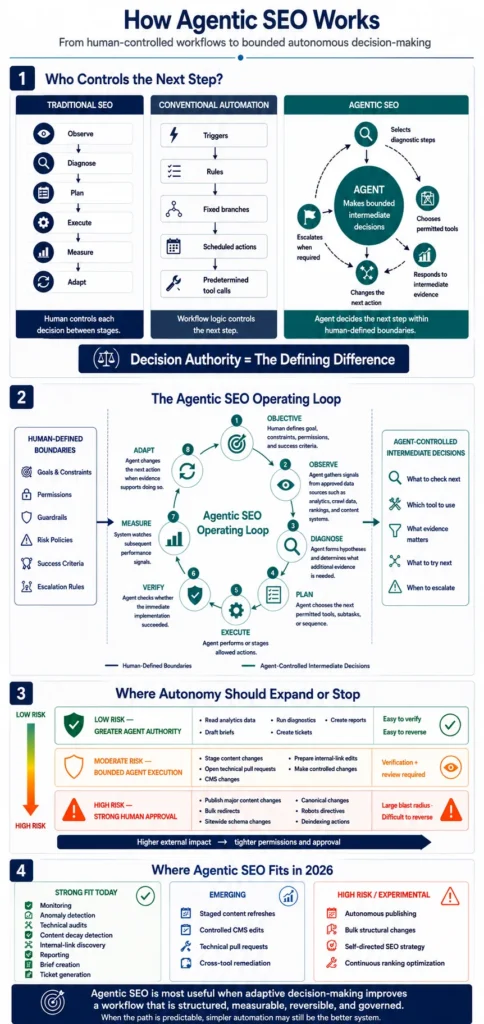
SEO becomes agentic when an AI system receives enough delegated authority to decide meaningful intermediate steps toward a defined objective. Traditional SEO keeps those decisions with people. Conventional automation embeds them in code. Agentic execution allows the model to select among permitted actions using evidence it observes during the process.
Decision Authority Is the Defining Difference
The useful distinction is where control of the execution path resides. A human, software developer, or AI agent may perform similar SEO tasks, but they reach those actions differently.
- Humans choose each meaningful diagnostic and execution step.
- Automation follows developer-authored conditions and predefined branches.
- Agents select actions within their permitted operating boundaries.
- Humans still define objectives, permissions, and escalation conditions.
That separation prevents sophisticated automation from being mislabeled simply because an LLM appears inside it.
“Unlike a standard AI integration in which application code controls the workflow, an agent reasons about goals and autonomously determines its own execution path” — Microsoft Azure.
| Operating Model | Decision Authority | Tool Selection | Response to Feedback | Execution Capability | Human Role |
| Traditional SEO | Human operator | Human-selected | Human interprets results | Human or manually triggered | Directs and executes |
| Conventional automation | Predefined software logic | Predetermined | Follows coded rules | Executes defined actions | Designs workflow and exceptions |
| Agentic SEO | Model within constraints | Dynamically selected | Adapts intermediate steps | Can investigate and act | Sets objectives, limits, and approvals |
For this article, “agentic SEO” is a synthesized operational definition, not a settled industry standard.
AI Assistance Does Not Automatically Create Agency
An LLM can accelerate research, clustering, writing, analysis, or technical diagnosis while leaving every consequential decision with a person. That makes the workflow AI-assisted, but not necessarily agentic.
- Prompting an LLM remains a human-directed task execution.
- AI-written briefs can still follow fixed instructions.
- Automated summaries do not create independent decision authority.
- Human-selected next steps keep control with operators.
The practical test is not whether AI contributed, but whether the system decided what to do next.
Agentic Does Not Mean Fully Autonomous
Agency exists on a spectrum. An agent can exercise bounded discretion while humans retain authority over high-impact changes, exceptions, and final approval.
- Objectives can remain explicitly defined by human operators.
- Permissions can restrict available tools and actions.
- Approval gates can precede consequential production changes.
- Escalation rules can return uncertainty to humans.
The agentic model therefore should not be reduced to fully autonomous operation.
How Is Agentic SEO Different From SEO Automation?
SEO automation executes predetermined logic; an agent can choose among possible next steps based on what it discovers. A workflow may automate research, analysis, drafting, routing, and publishing without becoming agentic if developers have already specified its sequence, conditions, and permitted branches from beginning to end.
Predetermined Branching Is Still Automation
Complexity does not create agency by itself. A workflow can include triggers, conditional routing, multiple APIs, multiple LLM calls, and automated publishing, all governed by developer-authored logic.
- Scheduled triggers can start complex multi-stage workflows.
- Conditional rules can route different input types.
- LLM stages can operate inside predefined sequences.
- Automated publishing can follow fixed approval conditions.
The workflow may be advanced, but its next move remains predetermined before execution begins.
Agents Can Choose What Happens Next
An agent receives an objective and evaluates intermediate evidence before selecting its next permitted action. That discretion changes the architecture even when humans retain boundaries around the task.
- It may first investigate an unexpected traffic decline.
- It may choose between crawl and ranking data.
- It may reorder diagnostic steps as evidence changes.
- It may stop and escalate unresolved contradictions.
Model-controlled next-step selection is what separates agentic execution from fixed orchestration.
Tool Access Turns Reasoning Into Action
Tool access allows an agent to move beyond recommendations into direct interaction with the systems where SEO work happens, including analytics platforms, crawlers, repositories, CMS environments, and project management tools.
- Read permissions enable evidence gathering across systems.
- Write permissions allow controlled changes to external state.
- APIs connect reasoning directly with operational workflows.
- Tool results provide feedback for subsequent decisions.
“AI agent systems are capable of planning and taking autonomous actions that impact real-world systems or environments” — NIST.
Tool access strengthens this article’s operational definition, but it is not presented as a universal requirement for every theoretical definition of an AI agent.
One SEO problem, three operating models:
- Assistant: A human notices a drop in traffic and asks an LLM for possible causes.
- Automated workflow: A traffic threshold triggers predefined checks, generates a report, and routes it to an analyst.
- Agentic execution: The system detects the decline, selects diagnostic tools, investigates likely causes, gathers evidence, and proposes or stages an allowed response.
The outputs may look similar. The control architecture underneath them is different.
What Can Agentic SEO Realistically Do Today?
The model is most practical in bounded workflows where inputs are structured, actions are reversible, verification is inexpensive, and success conditions are observable. Monitoring, diagnosis, coordination, internal linking, reporting, and staged technical work fit those conditions better than unrestricted autonomous optimization across an entire search program.
Monitoring and Diagnosis Are Already Strong Fits
Recurring observation gives agents a defined problem space without immediately exposing production systems to unnecessary risk. They can inspect signals, identify deviations, and escalate findings for validation.
- Monitor changes in ranking, traffic, crawl, and visibility.
- Detect content decay or unusual performance patterns.
- Identify coverage gaps across existing topic clusters.
- Compare recurring crawl and indexation diagnostics.
Observation is relatively easy to verify; selecting the right intervention creates more uncertainty.
Agents Can Coordinate Multi-Step SEO Work
Coordination becomes valuable when an SEO task crosses several systems and requires intermediate decisions. Agents can gather inputs, prepare outputs, route work, and adapt sequencing without manual orchestration at every step.
- Generate internal-link recommendations from site-wide evidence.
- Assemble briefs from approved research and requirements.
- Create tickets for validated technical problems.
- Coordinate staged refreshes across content operations.
- Produce recurring reports from multiple data sources.
“An AI SEO agent is software that actually does the SEO work, as opposed to just describing it” — Ahrefs.
That practitioner framing demonstrates implementation feasibility, not independently proven superiority in search performance.
Execution Readiness Depends on Verifiability
The safest candidates for greater agent authority have objective checks and limited consequences when something goes wrong.
- Low-risk metadata drafts remain easy to inspect.
- Staged edits preserve a human review boundary.
- Pull requests create visible records of technical change.
- Validation can catch deterministic implementation failures.
Production-wide changes deserve tighter controls because the potential consequences are larger.
| Workflow Category | Representative Uses | Current Practical Position |
| Production-ready under supervision | Monitoring, recurring audits, reports, briefs, ticket creation, internal-link suggestions | Strong fit |
| Emerging | Staged refreshes, controlled CMS edits, technical pull requests, cross-tool remediation | Useful with verification |
| Experimental/high risk | Broad autonomous publishing, bulk structural changes, self-directed ranking optimization | Requires substantial control |
This is a practical maturity grouping for the article, not an industry-standard model.
If your operation needs to produce 20–50+ articles per month without sacrificing compliance or quality, Content Ops Lab builds the infrastructure to make that possible. Contact us to discuss your content production requirements.
How Much Autonomy Should SEO Agents Have?
SEO-agent autonomy should expand according to verification quality, reversibility, permission scope, and potential blast radius. Human involvement does not need to interrupt every intermediate action. It should focus on situations where an incorrect decision can materially affect traffic, indexation, brand quality, compliance, or production systems.
Read Access and Write Access Carry Different Risks
An agent that inspects data can usually operate with broader scope than one capable of altering external systems. Permissions should reflect the consequence of an incorrect action.
- Read-only analytics access creates limited operational exposure.
- Draft creation changes artifacts without publishing them.
- Staging access enables controlled implementation and validation.
- Production write access creates direct business consequences.
Governance should therefore scale with what the agent is actually allowed to change.
Human Approval Can Coexist With Agentic Execution
Approval gates do not cancel agency. An agent can independently diagnose, select tools, prepare changes, run checks, and adapt its work before requesting authorization.
- Agents can prepare changes before human review.
- Pull requests preserve inspection before production deployment.
- Preview environments expose errors before publication.
- Escalation can handle ambiguous or high-risk decisions.
“Tool Approval is a framework feature that lets you gate tool invocations through a human-in-the-loop decision before the model receives the result” — Microsoft.
Supervision changes the degree of autonomy, not whether intermediate decision-making is delegated.
Agent Errors Can Become Operational Errors
The consequences change once an agent can modify external state. Repeated incorrect production actions can compound across pages, templates, repositories, or indexing controls.
- Every production action should remain attributable and logged.
- High-impact changes need reliable rollback mechanisms.
- Repeated tool calls can amplify early mistakes.
- Wider permissions increase the potential blast radius.
“Agents use tools across many turns, modifying state in the environment and adapting as they go—which means mistakes can propagate and compound” — Anthropic.
Autonomy is therefore a governance decision as much as a capability decision.
| Action | Suggested Authority | Primary Control |
| Read data | Broad agent access | Access logging |
| Create analysis | Agent execution | Evidence verification |
| Draft tickets | Agent execution | Human prioritization |
| Stage changes | Bounded agent access | Automated validation |
| Publish content | Conditional approval | Human or policy gate |
| Bulk redirects | Restricted | Mandatory review and rollback |
| Robots, canonical, deindexing changes | Highly restricted | Senior approval and staged testing |
This permission model is an editorial governance recommendation informed by agent-security principles, not a NIST or Microsoft SEO standard.
Related: How Do You Build a Scalable Content Production Workflow?
Why Can’t Agentic SEO Replace Traditional SEO Strategy Yet?
Agent-based execution cannot reliably replace strategic SEO judgment because search lacks the immediate, objective feedback available in many automation problems. Ranking effects can emerge slowly, interact with unrelated algorithmic or competitive changes, and remain causally ambiguous. Agents can perform more work without necessarily determining the cause of the outcome.
SEO Has a Weak Feedback Loop
Closed-loop optimization works best when an action produces a rapid, attributable result. SEO often provides neither, creating a difficult environment for autonomous learning from ranking outcomes alone.
- Search effects may appear long after implementation.
- Algorithm changes can distort apparent cause and effect.
- Competitors alter the environment during measurement periods.
- Seasonality can move demand independently of optimization.
“Some changes can take effect in a few days, but it could take several months for our systems to learn and confirm” — Google Search Central.
Delayed confirmation weakens the assumption that an agent can quickly learn which intervention caused a change in ranking.
More Autonomy Does Not Guarantee Better Performance
Additional discretion introduces evaluation, observability, review, and infrastructure costs. Predictable tasks may still be cheaper and more reliable through deterministic automation.
- Complex agents require stronger evaluation and monitoring.
- Additional tool calls increase operational cost.
- Exception handling can create substantial review burden.
- Predictable processes may favor deterministic workflow logic.
Agentic complexity should earn its place by outperforming a simpler method on the task that matters.
Strategic Objectives Are Harder to Automate Than Tasks
SEO strategy involves choices among imperfect proxies and competing business outcomes. Traffic, rankings, brand authority, lead quality, revenue, and conversion performance do not always move together.
- Ranking gains may attract commercially weak traffic.
- Volume targets can conflict with editorial quality.
- Brand constraints may override short-term search opportunities.
- Cross-channel priorities can change SEO resource allocation.
Reliable long-horizon strategy-to-ranking optimization is not established by the available evidence.
A useful decision path:
Can the result be verified immediately?
→ Yes: consider greater agent authority.
Can an incorrect action be reversed cheaply?
→ Yes: staged agent execution may be appropriate.
Does success depend on delayed search behavior?
→ Yes: preserve stronger human evaluation.
Would failure affect indexing, revenue, compliance, or brand integrity?
→ Yes: require tighter permissions and approval.
That decision path is more useful than treating human-led and agent-based SEO as mutually exclusive models.
How Does Agentic SEO Change the SEO Operating Model?
This operating model shifts human work away from prescribing every task and toward defining objectives, context, permissions, evaluation criteria, and exception rules. People spend less time directing each intermediate step and more time designing the environment in which the system can act safely and produce verifiable business value.
SEO Leaders Move From Tasks Toward Objectives and Constraints
Traditional workflows often begin with a detailed human instruction. Agentic systems require leaders to specify the desired outcome and define the boundaries within which intermediate decisions can occur.
- Define measurable objectives before delegating execution authority.
- Supply context needed for sound operational decisions.
- Set explicit permissions for tools and environments.
- Establish thresholds for escalation and human review.
The management burden does not disappear; it moves upward from individual tasks to system design.
Search Fragmentation Increases the Coordination Burden
SEO teams increasingly need to observe more surfaces, reports, and discovery environments. That increases the value of recurring monitoring, routing, synthesis, and exception detection.
- Conventional search still requires continuous performance monitoring.
- Generative visibility adds another measurement surface.
- Cross-platform reporting increases recurring analytical workload.
- Fragmented evidence creates greater coordination requirements.
“Today, we’re excited to announce the launch of new Search Generative AI performance reports in Search Console” — Google Search Central.
More surfaces strengthen the case for automated observation and orchestration more clearly than they prove superior results from agentic optimization.
Agentic Complexity Has to Earn Its Place
The right operating model depends on economics, accuracy, speed, review burden, and consequences. Deterministic processes remain preferable when the path is predictable.
- Compare agent cost against deterministic workflow cost.
- Measure review time created by autonomous decisions.
- Track errors by task type and permission level.
- Evaluate speed gains against actual business outcomes.
Adaptive decision authority only makes sense when it creates enough value to justify its additional operating requirements.
Before: “Audit these 50 pages, identify broken internal links, and create a spreadsheet of recommended replacements.”
Bounded agent objective: “Monitor this content cluster for internal-link failures and orphaned pages. Investigate detected issues, select relevant replacement destinations using approved criteria, prepare proposed changes, validate them, and route anything below the confidence threshold for review.”
The second instruction delegates the intermediate path without surrendering governance over the outcome.
What Does Agentic SEO Mean for Content Operations?
Content operations demonstrate why systems matter before autonomous execution enters the equation. Content Ops Lab scaled production through repeatable operating infrastructure, defined evidence requirements, quality controls, and consistent production handoffs.
5x increase in monthly output (10 → 50+ articles/month)
That result supports the value of systematic production architecture. It does not prove performance from AI agents or any particular agent architecture.
Content Ops Lab’s production infrastructure includes:
- Research-first production built around verified source material.
- Citation verification for statistics and factual claims.
- One unified system governing repeatable production workflows.
- Multi-stage quality control before final content delivery.
- Scaling without proportional increases in production headcount.
- 23 months of live production-system iteration.
- 1,000+ articles and pages delivered with verified citations.
- Zero compliance issues across the full engagement.
The Content Ops Lab Production System
The Content Ops Lab Production System uses four defined stages:
- Research: Build assignments from verified evidence before drafting begins.
- Verification: Confirm statistics, claims, citations, and source fidelity.
- Optimization: Structure content for search, extraction, and reader utility.
- Delivery: Complete QA and hand off production-ready content.
Agentic capabilities can operate inside governed infrastructure; they do not remove the need for it.
Ready to build content infrastructure that scales without the compliance risk? Get in touch — we’ll assess your current content operation and outline what a systematic approach would look like for your organization.
FAQs About Agentic SEO
Is Agentic SEO Just Another Name for SEO Automation?
No. SEO automation can execute an entire process while following a path predetermined by developers. The agentic model begins when the system receives meaningful discretion over intermediate decisions, such as which diagnostic step to perform, which tool to use, or how to respond to new evidence. The distinction is who controls what happens next.
When Does Agentic SEO Justify the Added Cost and Complexity?
It makes the strongest case when workflows contain recurring decisions that cannot be efficiently captured through fixed rules. High-volume monitoring, investigation, orchestration, and reversible multi-step work are stronger candidates. If the process is predictable, inexpensive deterministic automation may deliver the same business result with less evaluation, infrastructure, and operational risk.
What SEO Tasks Should Still Require Human Approval?
High-impact, difficult-to-reverse actions should retain stronger approval controls. Bulk redirects, robots directives, canonical changes, deindexing actions, production-wide template edits, and consequential publishing decisions can create substantial downstream effects. Agents can still investigate, prepare, stage, and validate those changes while humans retain authority where production risk materially increases.
Is Agentic SEO Better Than Traditional SEO for Every Workflow?
No. Agentic complexity should solve a real operational problem. Traditional human execution remains useful for strategic judgment, ambiguous decisions, and infrequent high-consequence work. Deterministic automation remains efficient for stable, repeatable processes. Agentic execution fits situations in which adaptive intermediate decisions provide sufficient speed, coverage, or coordination value to justify additional governance and evaluation.
Does a Company Need to Build Its Own SEO Agents to Use This Operating Model?
No. The operating model matters more than whether the underlying agent was built internally. Companies can use commercial platforms, vendor systems, custom agents, or hybrid workflows. Leadership still needs to define objectives, permissions, evidence requirements, approval gates, evaluation criteria, and escalation rules. Buying an agent does not remove the need for operational architecture.
Key Takeaways
- Agentic execution begins when AI controls meaningful intermediate decisions rather than simply assisting a human-directed workflow.
- Automation can span the entire SEO process while remaining non-agentic, provided every execution path is predetermined.
- Current practical value centers on supervised monitoring, diagnosis, orchestration, reversible execution, and verification rather than unrestricted autonomous optimization.
- Content Ops Lab achieved a 5x increase in monthly output (10 → 50+ articles/month) through systematic production infrastructure rather than autonomous SEO agents.
- Research, verification, optimization, and delivery provide the governed foundation that higher levels of automation require.
- Marketing leaders should test agentic complexity where adaptive decisions outperform deterministic workflows on cost, speed, accuracy, or coverage.
How Should Marketing Leaders Think About Agentic SEO?
The agentic model represents a genuine operating shift when AI gains meaningful authority over observation, diagnosis, tool selection, execution, and adaptation. It is not defined by adding an LLM to an SEO workflow, automating more steps, or removing humans completely. The practical 2026 model is bounded agency: clear objectives, controlled permissions, reversible actions, verification, and human intervention where consequences rise.
For marketing leaders, the next question is not whether to make SEO autonomous. It is where delegated decision authority creates measurable operational value that simpler automation cannot. Content Ops Lab’s production experience points to the prerequisite: build the system, evidence standards, controls, and repeatable workflows first. Agentic capability becomes useful when that infrastructure provides a disciplined environment in which to operate.
Related: SEO vs AEO vs GEO – How Multi-Location Businesses Should Think About Modern Search