

How AI Content Strategy Differs From Traditional SEO
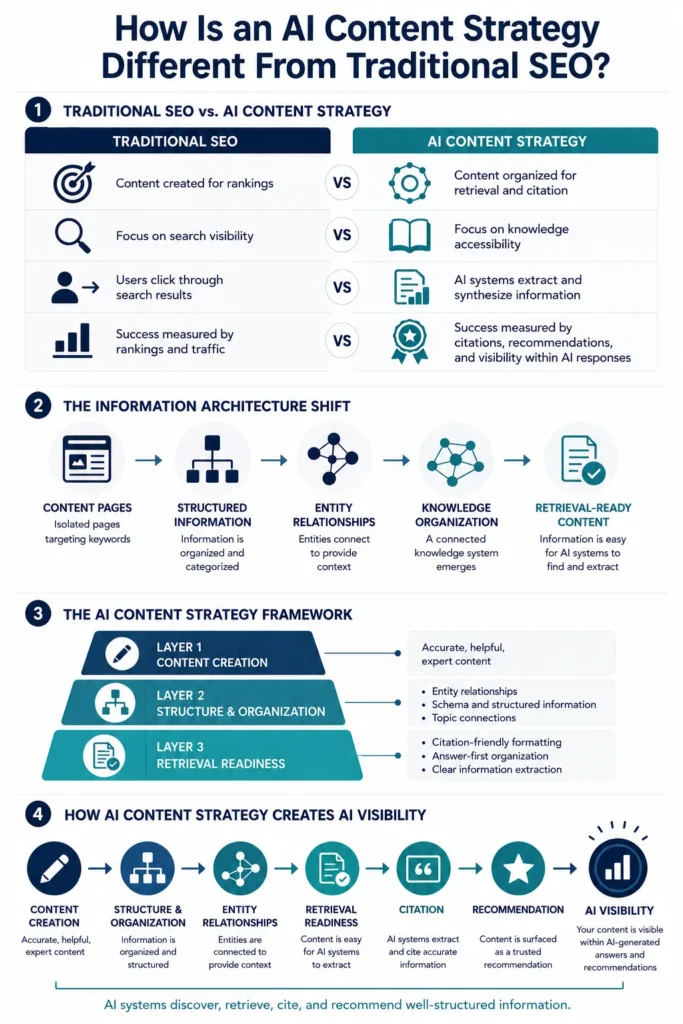
An AI content strategy differs from traditional SEO by adding a citation layer on top of ranking: instead of optimizing only for blue-link position, you’re building content that retrieval pipelines can pull, trust, and quote inside ChatGPT, Perplexity, Copilot, and Google’s AI Overviews.
“Is SEO still relevant for generative AI search? In short, yes! The best practices for SEO continue to be relevant as we introduce generative AI features like AI Overviews and AI Mode in Search,” — Google Search Central. That confirms SEO isn’t dead, but it’s no longer the finish line. For multi-location operators managing dozens of service and location pages, the operational question isn’t whether to abandon SEO — it’s what additional infrastructure AI search now requires.
Content Ops Lab built its answer to that question inside a 12-location regulated healthcare organization — 1,000+ citation-verified articles delivered with zero compliance violations over 23 months.
Related: Ranking vs Being Cited – What Actually Drives Visibility in AI Search?
What Breaks When a Content Strategy Built for Keyword Rankings Hits AI Search?
A keyword-ranking content strategy breaks against AI search because it was never built for retrieval — it optimizes for position on a results page, not for being the passage an AI system pulls, verifies, and cites in a synthesized answer. Ranking #3 for a target keyword means nothing if the page isn’t structured for extraction.
Ranking Without Being Retrieved
Traditional SEO content can rank well and still get bypassed by AI answer engines that select a narrow set of citable sources. Retrieval pipelines don’t reward position alone — they reward extractability.
- Long narrative pages without answer-first framing
- No clear entity signals tie content to specific locations or services
- Thin structured data, leaving AI systems to guess at meaning
- Position in the top 10 is still common, citation inclusion is still missed
Ranking and retrieval are correlated, not identical — and that gap is where most content approaches fail operators.
The Hallucination Risk Inside Generic AI Output
Most “AI content” gets generated from a model’s memory, not from verified research — a pattern that introduces real enterprise exposure once that content reaches regulated audiences. “AI hallucinations have emerged as one of the most significant barriers to enterprise AI adoption. As organizations embed AI into customer communications, financial workflows, compliance processes, and decision-making systems, the cost of incorrect output rises dramatically” — Airia.
- Fabricated statistics with no source trail
- Invented or broken citation URLs
- Generic claims that don’t reflect proprietary expertise
- Compliance exposure multiplied across every location page
Unverified AI content poses the same risk across all locations simultaneously, not just on a single page at a time.
Why Volume Alone No Longer Wins
Publishing more articles used to be the lever. Under a retrieval-focused production approach, volume without verification produces more unreliable pages, not more citations.
- More pages mean more potential compliance gaps
- Generic output dilutes entity clarity across the portfolio
- AI systems narrow hundreds of candidates to a handful of passages
- Quality and structure now outweigh raw publishing cadence
Traditional agencies handle scale, but citation verification rarely survives the production process.
What Are the Real Options for Building an AI-Optimized Content Program?
Operators evaluating this shift generally choose between three paths: internal teams stretching existing capacity, traditional agencies adding AI tools to legacy workflows, or generic AI platforms without verification infrastructure — each with a different failure mode.
Internal Teams Optimizing for Keywords Alone
Internal marketing teams often understand the brand and the compliance landscape better than anyone. However, they’re typically still running 2019-era SEO playbooks. Capacity is the binding constraint.
- Strong brand and compliance knowledge
- Limited bandwidth — usually 4-8 articles/month
- No current tracking of AI citation events
- Keyword research without retrieval-layer planning
Internal capability is real, but it caps out before meeting multi-location demands.
Traditional Agencies Bolting AI Onto Old Workflows
Agencies frequently market “AI-powered” content while still optimizing exclusively for rankings, treating citation visibility as an afterthought rather than a structural requirement.
- Template-driven structure across all clients
- Surface-level research with limited source verification
- Pricing model built around volume, not citation outcomes
- Little to no AI platform performance monitoring
Agencies solve the production bottleneck but rarely rebuild their process around retrieval and citation.
Generic AI Tools Without Verification Infrastructure
Tools like raw ChatGPT output can generate text quickly. Still, without a research-first workflow, the output carries unverified claims into a regulated content environment.
- Content generated from model memory, not source documents
- No line-level citation tracking
- No governance layer for regulated industries
- Fast production, unmanaged risk
Generic AI tools accelerate production, but they don’t address the verification gap required by regulated industries.
How Does This Approach Actually Differ From Traditional SEO in Practice?
The practical difference is structural: traditional SEO designs pages to rank in link lists. In contrast, a citation-focused content system designs pages to survive a retrieval pipeline that synthesizes an answer from a handful of sources and shows its work. “AI Overviews use a four-step retrieval-augmented-generation pipeline: query eligibility, source retrieval from Google’s organic index, Gemini synthesis with grounding, and per-query delivery that regenerates each time” — AI-Advisors.
Citation Visibility vs. Ranking Visibility
Classic SEO measures impressions, average position, and CTR. This newer discipline measures something different — whether the page gets pulled into the cited source panel beneath a generative answer.
- Position #1 no longer guarantees citation inclusion
- AI systems intentionally diversify across multiple domains
- Citation events are now a tracked, distinct KPI
- Assisted AI-referral conversions require their own attribution
The position remains relevant, but it’s no longer the only signal determining whether content gets used.
Answer-First Structure for Retrieval Pipelines
Across platforms, answer engines synthesize from a narrow set of retrieved passages rather than full pages. “Search results typically include 3 to 6 numbered citations, which users can click to view the original sources” — DataStudios.
- Direct 40-60 word answers ahead of supporting detail
- Question-based H2s mapped to real search behavior
- Lists, tables, and FAQ blocks built for extraction
- Chunked sections instead of a long, unstructured narrative
Pages built for skimming readers were never built for retrieval pipelines that extract single passages.
Entity Clarity Across Multi-Location Pages
For operators managing multiple locations, AI systems need to confidently map a query like “Charlotte chiropractic clinic” back to the correct entity — something keyword optimization alone doesn’t solve.
- Schema markup for organizations, locations, and services
- sameAs links connecting pages to verified Business Profiles
- One location, one canonical URL — no duplicate templates
- Consistent NAP data enforced across the full location network
Generic location pages rank locally, but without entity clarity, they rarely get reused inside AI-generated answers.
If your operation needs to produce 20-50+ articles per month without sacrificing compliance or quality, Content Ops Lab builds the infrastructure to make that possible. Contact us today to discuss your content production requirements.
What Does a Governed Production Model Require That Traditional SEO Doesn’t?
A governed, AI-optimized content production model requires verification infrastructure that traditional SEO workflows never needed — source logging, citation audit trails, and editorial QA built specifically to prevent hallucinated claims from reaching regulated audiences. “To be eligible to be shown as a supporting link in AI Overviews or AI Mode, a page must be indexed and eligible to be shown in Google Search with a snippet, fulfilling the Search technical requirements” — GEO Glossary.
Source Logging and Editorial QA
Every claim needs a traceable path back to a verified source — not a generalized sense that the AI model “knows” the topic.
- Research-first production before any drafting begins
- Line-numbered source documentation for every stat and claim
- Editorial review focused on factual accuracy, not just grammar
- Audit trail available for compliance review at any time
This is the layer that traditional SEO workflows never built, because ranking never required source-level proof.
Schema and Entity Mapping at Scale
Structured data gives AI systems explicit signals about what a page means, reducing the guesswork that retrieval pipelines otherwise have to do.
- FAQPage, Article, and LocalBusiness schema implementation
- Entity mapping across organizations, services, and locations
- Canonical registry of names, addresses, and identifiers
- Enforcement across web, GBP, and third-party listings
Schema isn’t a ranking requirement, but it’s the connective tissue that helps AI systems trust an entity across hundreds of pages.
Chunking Standards for RAG Extraction
Retrieval-augmented pipelines extract content in chunks, not whole documents — which means page architecture has to account for how that segmentation actually works.
- Answer-first headers sized for single-passage extraction
- 2-4 paragraph sections with clear topical boundaries
- Discrete tables and bullet blocks aligned to real questions
- Consistent formatting patterns repeated across the content library
Chunking discipline is invisible to a human reader but decisive for whether a passage gets selected at all.
Related: The AI Citation Economy – Why Visibility Matters More Than Rankings
How Do You Measure Whether This Approach Is Working?
Measuring a retrieval-focused content program means tracking citation behavior alongside traditional rank data — not replacing one measurement system with another, but running both simultaneously to see the full picture.
Citation Share Across AI Engines
Rank tracking alone can’t tell you whether ChatGPT, Perplexity, or Google AI Overviews are actually citing your content when a relevant question gets asked.
- Spot-checks across AI Overviews, Copilot, and Perplexity citations
- Citation share tracked by query cluster, not just by domain
- Monitoring for which specific pages get pulled into answers
- Comparison against the organic ranking position for the same queries
Citation tracking is still manual in most organizations — which is exactly why it gets skipped.
Assisted Conversions From AI-Referred Sessions
AI-referred sessions behave differently from typical organic traffic. That difference shows up directly in conversion data once it’s properly attributed.
- UTM strategy built specifically for AI referral sources
- Conversion tracking segmented by AI platform
- Session duration and engagement compared to the site baseline
- Revenue attribution tied back to specific cited content
Without dedicated attribution, AI-referred conversions get buried inside generic “referral” or “direct” traffic buckets.
Overlap Between Rankings and AI Citations
Tracking where ranking position and AI citation diverge reveals exactly which pages need restructuring — and which are already working as intended.
- Pages ranking well but never appearing in AI answers
- Pages with strong AI citation despite modest ranking position
- Content gaps where neither ranking nor citation is happening
- Prioritization framework built from that overlap analysis
This overlap data becomes the single clearest signal for where the content system needs the next investment.
Is It Time to Build a Dedicated AI Content Strategy or Extend Your Current SEO Program?
The decision usually comes down to a capacity and risk assessment: can your current team add governed, retrieval-focused production on top of existing SEO work, or does the volume and compliance burden require dedicated infrastructure?
Signals You’re Already Behind
Several operational patterns reliably indicate that an organization’s content approach hasn’t kept pace with how AI search actually works.
- No current tracking of AI citation events at all
- Content production capped at 4-8 articles/month internally
- Recent compliance flags tied to unverified claims
- Location pages built from a single duplicated template
Any one of these signals on its own is manageable — multiple together point to a structural gap.
What Changes Operationally First
Building a dedicated, citation-focused production model doesn’t mean discarding existing SEO work — it means adding research, verification, and structure layers on top of it.
- Research-first production replaces writing from memory
- Citation verification added as a mandatory production step
- Schema and entity mapping implemented across the location network
- AI citation monitoring has been added alongside existing rank tracking
These additions extend the existing SEO program rather than replacing it outright.
Where Done-For-You vs. System Build Fits
Operators choosing between engagement models are really choosing who will operate the new infrastructure once it exists.
- Done-For-You: managed production, your team reviews deliverables
- System Build: full infrastructure handoff, your team operates it
- Both models include citation verification and AI optimization
- Choice depends on internal capacity and long-term ownership goals
The volume problem is solvable — the compliance problem requires an entirely different infrastructure.
How Content Ops Lab Builds Content Infrastructure
Content Ops Lab didn’t develop this methodology in theory — it was built and stress-tested inside a 12-location regulated healthcare organization over 23 months, producing 1,000+ citation-verified articles and pages with zero compliance violations. That production environment is where the approach described above was refined into a repeatable system.
- 23-month production test inside a 12-location regulated healthcare organization
- 1,000+ citation-verified articles delivered with zero compliance violations
- 45% of all leads from organic search — outperforming paid search nearly 2:1
- AI search converting at 21.4% average vs. 3.32% site baseline — a 6.4x performance multiplier
- 887% ChatGPT traffic growth in 7 months (July 2025–February 2026)
- 653% impression growth and 1,700% click growth for an emerging brand in 14 months
- 5x production scale: 10 articles/month to 50+ without adding headcount
- Dual-brand methodology has proven to be effective for both mature brand maintenance and emerging brand growth
The Content Ops Lab Production System
The system runs on four connected stages, each designed to prevent the failure points left open by generic AI content workflows.
- Research: Verified sourcing from credible documents before any generation begins
- Verification: Line-by-line citation cross-checking with STAT vs. CLAIM labeling
- Optimization: Built simultaneously for Google, ChatGPT, Perplexity, Claude, and Gemini
- Delivery: Publish-ready output staged in WordPress or packaged for client review
Operators considering whether to build this internally or hand it off can see exactly what that decision involves below.
Ready to build a content infrastructure that scales without the compliance risk? Get in touch — we’ll assess your current content operation and outline what a systematic approach would look like for your organization.
FAQs About AI Content Strategy
Why can’t we keep doing traditional SEO and skip a dedicated AI content strategy?
Traditional SEO remains the foundation — Google confirms its best practices still apply to AI Overviews and AI Mode. But ranking eligibility isn’t citation eligibility, and without a retrieval-focused structure, your content keeps ranking while AI systems cite competitors instead.
How long does it take to see AI citation results after implementing this approach?
Most operators see measurable shifts within one to two quarters once research-first production, structured formatting, and entity mapping are consistently applied. A 12-location regulated healthcare organization saw 887% growth in ChatGPT traffic over 7 months.
How does an AI content strategy handle hallucination and compliance risk in regulated industries?
It treats verification as a mandatory production step, not an afterthought — every claim traced to a source document with a line number. That structure produced 1,000+ articles with zero compliance violations across a 23-month regulated healthcare engagement.
How is this approach different from what a traditional SEO agency offers?
Most agencies still optimize exclusively for ranking position and add “AI” as a marketing label rather than a structural change. This methodology rebuilds the production workflow around retrieval, citation verification, and entity clarity — not just keyword targeting.
Is Done-For-You or System Build the better fit for building this kind of system?
Done-For-You suits operators who want the system managed externally while reviewing deliverables. System Build suits operators who want full internal ownership of the infrastructure after a guided handoff — both include the same verification and optimization standards.
Key Takeaways
- An AI content strategy adds a citation layer on top of traditional SEO — it doesn’t replace ranking fundamentals, it extends them toward retrieval and extraction.
- Generic AI content carries hallucination risk that compounds across every location page in a multi-location operation, making verification non-negotiable.
- Answer-first structure, schema, and entity clarity are now requirements for AI retrieval pipelines, not optional formatting choices.
- A 12-location regulated healthcare organization delivered 1,000+ citation-verified articles with zero compliance violations and 887% ChatGPT traffic growth in 7 months.
- AI search traffic converted at an average of 21.4% — 6.4x the site baseline — proving the methodology’s commercial impact, not just its technical soundness.
- Operators behind on citation tracking, schema, and verification infrastructure are already exposed to the gap that competitors are closing first.
- The path forward is to add governance and retrieval structure to existing SEO work, not to start over from scratch.
Build Content Infrastructure That Compounds: AI Content Strategy
A modern content approach isn’t a separate discipline from SEO — it’s what SEO becomes once ranking eligibility is no longer the only signal determining visibility. “There are no additional requirements to appear in AI Overviews or AI Mode, nor are any other special optimizations necessary” — GEO Glossary.
That means the operators who win the citation layer are the ones who already had the foundation right — and added research, verification, and structure on top of it. Wait another quarter, and the competitive window for first-mover citation advantage narrows further.
Content Ops Lab built this exact methodology within a regulated healthcare operation, producing measurable AI search conversions before most competitors even began tracking citations.




2 Comments
Comments are closed.