

How Do You Get Cited by ChatGPT?
You get cited by ChatGPT by making your content easy for its retrieval system to find, trust, and extract — not by ranking well in Google. “Through rigorous evaluation, we demonstrate that GEO can boost visibility by up to 40% in generative engine responses” — arXiv.
For multi-location operators managing dozens of location pages, that gap between “ranking well” and “getting cited by ChatGPT” is now a budget conversation, not a technical footnote. Content Ops Lab built its citation verification infrastructure inside a 12-location regulated healthcare organization — 1,000+ articles delivered with zero compliance violations over 23 months of live production.
Related: How AI Search Engines Decide Which Sources to Cite
Why Don’t Most Multi-Location Brands Get Cited by ChatGPT?
Most multi-location brands don’t get cited by ChatGPT because AI visibility operates on a fundamentally different selection logic than local search rankings — and the vast majority of locations never clear that bar. “1.2% of locations were recommended by ChatGPT, 11% by Gemini, and 7.4% by Perplexity” — Search Engine Land.
AI Visibility vs. Local Rankings Gap
Operators who built strong local SEO programs are discovering that those signals don’t transfer to AI citation rates. The data shows a stark divergence between the two systems.
- 1.2% of locations recommended by ChatGPT vs. 35.9% in Google’s local 3-pack
- AI visibility is documented as 3-30x harder to achieve than traditional ranking
- Citation ordering is driven primarily by semantic relevance, not link authority
- Freshness and traditional SEO signals play secondary, platform-specific roles
Local search success no longer predicts AI citation success, and most marketing budgets haven’t kept pace with that split.
Why Most Locations Never Get Mentioned
The selectivity isn’t random — it reflects a retrieval system that’s far more conservative than a search index. ChatGPT’s web-connected modes retrieve a small set of candidates, then synthesize from within it.
- Retrieval favors a narrow set of highly trusted entities
- Most locations lack the entity completeness to enter the candidate pool
- Citation patterns vary sharply by platform, query type, and industry
- No universal optimization transfers cleanly across ChatGPT, Gemini, and Perplexity
For multi-location brands, this means the majority of locations are functionally invisible to AI search unless the gap is addressed directly.
The Entity Completeness Threshold
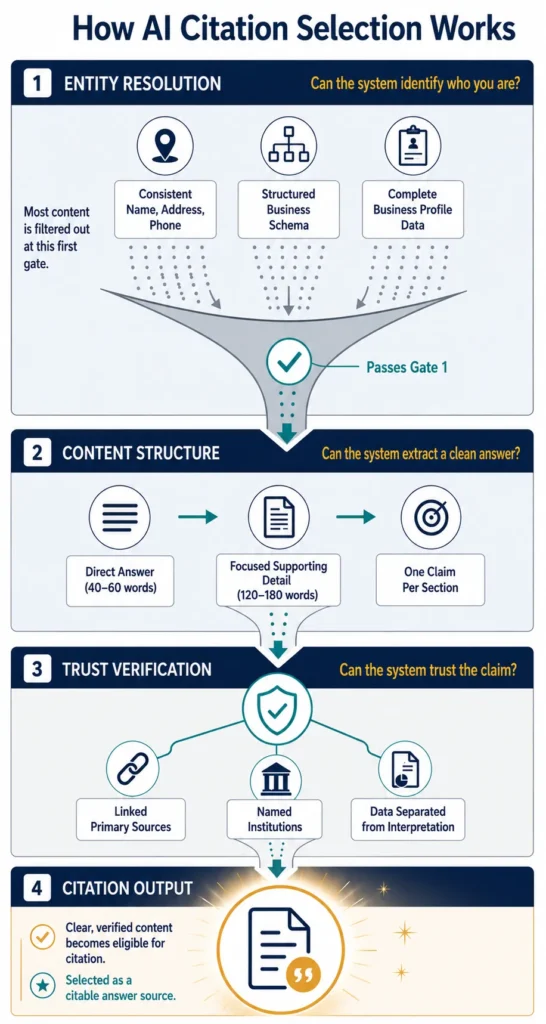
Entity completeness — not content volume — determines which locations clear the retrieval bar. ChatGPT needs to resolve who you are before it can decide whether to cite you.
- Clean LocalBusiness schema delivers measurable visibility lifts
- NAP consistency across sites, schema, and directories is foundational
- Google Business Profile completeness functions as a gating factor
- Review quality and substance outweigh raw review count
Entity data quality determines whether a location even enters the conversation — content quality only matters after that.
What Are Operators’ Real Options for Earning AI Citations?
Operators evaluating how to earn ChatGPT citations generally choose among three approaches: internal teams managing it ad hoc, traditional SEO agencies retrofitting old playbooks, or generic AI tools generating unverified content — each with real trade-offs worth understanding before committing budget.
Internal Teams Managing Citations Ad Hoc
Internal marketing teams often have the deepest brand knowledge but lack the dedicated bandwidth to build the entity and citation infrastructure required for AI visibility. This is a legitimate starting point for smaller operations.
- Strong brand and product knowledge already in-house
- No dedicated citation monitoring or entity audit process
- Schema and NAP consistency are typically handled reactively
- Limited capacity to track volatility across multiple AI platforms
Internal teams can produce credible content, but citation monitoring rarely survives the competition from competing operational priorities.
Traditional SEO Agencies Chasing Rankings
Traditional agencies bring proven SEO processes, but most are still optimizing for a ranking system that has measurably decoupled from AI citation behavior. That’s a structural mismatch, not a competence gap.
- Deep expertise in traditional ranking factors and link building
- Domain Authority remains a core optimization target
- 88% of AI citations come from sources outside the organic top 10
- Reporting stacks rarely include dedicated AI citation tracking
Agencies built for Google rankings aren’t necessarily wrong — they’re solving an adjacent problem with a different scoring system.
Generic AI Content Tools Without Verification
Generic AI tools can produce volume quickly, but volume without verification creates exposure, especially where claims must withstand scrutiny in regulated industries.
- Fast content generation without research verification
- No systematic citation cross-checking against source documents
- Entity and schema work is typically left entirely unaddressed
- Compliance risk compounds across dozens of location pages
Each approach solves part of the AI visibility problem — none alone closes the verification and entity gap.
If your operation needs to produce 20-50+ articles per month without sacrificing compliance or quality, Content Ops Lab builds the infrastructure to make that possible. Contact us today to discuss your content production requirements.
What Actually Makes Content Citation-Worthy to ChatGPT?
Content becomes citation-worthy for ChatGPT through three compounding factors: an answer-first structure that’s easy to extract, verifiable citations that are easy to trust, and a neutral, evidence-dense tone that reduces the model’s burden of rephrasing. “Namely Cite Sources, Quotation Addition, and Statistics Addition, achieved a relative improvement of 30-40% on the Position-Adjusted Word Count metric and 25-35% on the Subjective Impression metric compared to the baseline” — OpenReview.
Answer-First, Fact-Dense Structure
Retrieval systems favor passages in a specific length band, with clear topical focus and minimal noise — essentially pre-formed snippets ready to drop into an answer.
- Lead sections with 40-60 word direct-answer blocks
- Keep supporting paragraphs in the 120-180 word range
- One subtopic per paragraph, no mixed claims
- Clear H2/H3 headings that name exactly what follows
Structure alone won’t earn a citation, but poor structure guarantees the passage never gets extracted.
Verifiable Citations to Primary Sources
Citing primary sources isn’t a stylistic preference — it’s a trust signal the retrieval system is explicitly built to detect and weight.
- Link to .gov, .edu, peer-reviewed, or official data sources
- Name the institution or study directly in the text
- Separate the interpretation clearly from the sourced data
- Publish methodology notes for proprietary or original data
Verifiability compounds: each properly sourced claim makes the next one more credible to the model.
Neutral, Evidence-Centered Tone
Generative engines consistently favor neutral, encyclopedic prose over sales-driven language, which increases what researchers describe as the model’s cognitive load during rephrasing.
- Avoid promotional or persuasive phrasing in body content
- Use precise technical terminology where relevant
- State facts plainly before drawing conclusions
- Keyword stuffing shows no positive effect on citation rate
Tone isn’t cosmetic here — it directly affects whether a passage is easy or hard for the model to reuse.
Related: Structured Content for AI Search – How It Gets You Cited by AI
What Do AI Citation Datasets Actually Show About What Gets Cited?
Large-scale citation datasets — covering hundreds of millions of AI citations — show that brand-managed properties dominate citation sources, domain authority barely predicts citation rank, and citation patterns shift significantly month to month across platforms. “86% of citations come from sources marketers can directly manage or strongly influence — like a brand’s website, listings, and reviews” — Yext.
Brand-Managed Sources Dominate Citations
The dominant share of citations comes from properties operators already control, which reframes AI visibility as an operations problem rather than a media-buying problem.
- 86% of citations trace to brand-managed properties
- Includes brand websites, business listings, and reviews
- Earned media still outperforms owned content per citation
- The directory and listing completeness function as core levers
This shifts the AI visibility conversation from acquiring new authority to properly operating the authority you already have.
Domain Authority’s Weak Correlation
Operators trained on a decade of link-building instinct will find this counterintuitive: traditional authority metrics don’t reliably predict AI citation behavior.
- “Across most platforms, Domain Authority, Domain Power, and Domain Rating show negative correlations with LLM ranking position” — SearchAtlas
- Higher-authority domains don’t consistently out-cite smaller competitors
- E-E-A-T-style signals outpredict generic authority metrics
- Semantic relevance to the query dominates over backlink volume
This finding alone justifies rethinking budget allocation away from pure authority-building tactics.
Citation Volatility Across Platforms
Citation behavior isn’t static — large-scale analyses document substantial month-to-month drift, meaning today’s citation footprint isn’t a stable asset.
- Month-to-month citation drift can exceed 50%
- No universal top source exists across AI engines
- Patterns shaped by intent, platform, vertical, and time
- Optimization for ChatGPT doesn’t automatically transfer to Gemini or Perplexity
Volatility this high means citation monitoring has to be ongoing, not a one-time audit.
How Do Entity Clarity and Local Data Drive AI Visibility?
For multi-location operators, entity clarity and local data quality directly determine which locations ChatGPT will ever recommend — clean schema, consistent NAP data, and complete Google Business Profiles function as gating factors rather than incremental SEO improvements.
NAP Consistency and LocalBusiness Schema
Name, address, and phone consistency across every platform gives retrieval systems a clean, unambiguous entity to resolve and cite.
- Canonical entity registry synced across CMS, schema, and directories
- LocalBusiness schema implemented on every location page
- Geo-coordinates and service area data included where relevant
- NAP inconsistencies are audited and corrected regularly
Inconsistent entity data doesn’t just confuse customers — it actively excludes locations from AI consideration.
Google Business Profile Completeness
A fully built-out Google Business Profile gives AI systems structured operational data they can map directly to user questions.
- Hours, services, specialties, and insurance details kept current
- Profile completeness treated as a gating factor, not a checkbox
- Direct linkage between GBP and location-specific content
- Regular audits to catch drift across dozens of locations
Profile completeness compounds with schema and NAP work — none of the three substitutes for the others.
Review Quality as a Trust Signal
Review substance, not review volume, correlates with stronger AI citation performance for individual locations.
- Specific, detailed reviews mentioning services and outcomes preferred
- Review quality is treated as a measurable input, not background noise
- Vertical directory profiles are maintained with consistent data
- Earned media and expert mentions reinforce entity-level trust
Review strategy belongs in the same operational stack as schema and GBP work, not a separate reputation-management silo.
Is Your Content Operation Built to Earn AI Citations?
Whether your content operation is built to earn AI citations comes down to one test: can you currently produce verified, entity-consistent, answer-first content across every location at the volume your growth plan requires — and can you prove it when a citation drifts, or a claim gets questioned?
Auditing Your Current Citation Footprint
Before building anything new, operators need a clear baseline of where they currently stand across AI platforms.
- Run fixed prompt panels across ChatGPT, Gemini, and Perplexity
- Log which domains and locations get cited, and where competitors dominate
- Cross-reference citation gaps against schema and NAP audits
- Treat the audit as a recurring process, not a one-time snapshot
An honest baseline audit usually reveals the gap is bigger — and more fixable — than expected.
What Systematic AI Visibility Requires
Closing the gap requires treating AI visibility as infrastructure: research, verification, entity management, and monitoring working together continuously.
- Research-first content with verified, traceable citations
- Entity and schema consistency are maintained across every location
- Citation monitoring integrated into standard reporting cadence
- Governance standards that encode an answer-first structure by default
None of these levers works in isolation — they compound only when operated as a single system.
Choosing the Right Implementation Path
Operators generally have two paths: build the system internally with guidance, or have it run for them while infrastructure matures.
- System Build hands off full ownership to your internal team
- Done-For-You runs the complete system as a managed service
- Both paths require the same underlying verification infrastructure
- Path choice depends on internal bandwidth, not strategic priority
The right path depends less on budget and more on whether your team has the capacity to operate the system once it’s built.
How Content Ops Lab Builds Content Infrastructure
Content Ops Lab built its citation and entity verification infrastructure inside an active 12-location regulated healthcare deployment — not a theoretical framework. Over 23 months, that system delivered 1,000+ citation-verified articles and pages with zero compliance violations, while AI search referral traffic converted at rates far exceeding the site’s average conversion rate.
- 23-month production test inside a 12-location regulated healthcare organization
- 1,000+ citation-verified articles delivered with zero compliance violations
- AI search converting at 21.4% average — 6.4x the site baseline
- 887% ChatGPT traffic growth in 7 months (July 2025–February 2026)
- 45% of all leads from organic search — outperforming paid search nearly 2:1
- 653% impression growth and 1,700% click growth for an emerging brand in 14 months
- 5x production scale achieved without adding headcount
- Dual-brand methodology has proven to be effective for both mature and emerging brand growth
The Content Ops Lab Production System
The system runs on four connected stages, each designed to satisfy both compliance reviewers and AI retrieval systems.
- Research: Verified sources retrieved before any content generation begins
- Verification: Line-by-line citation cross-checking with full audit trail
- Optimization: Structured simultaneously for Google, ChatGPT, Perplexity, Claude, and Gemini
- Delivery: Publish-ready output staged in WordPress or packaged for client review
This is the same infrastructure that earns AI citations at scale — built once, then operated continuously across every location.
Ready to build a content infrastructure that scales without the compliance risk? Get in touch — we’ll assess your current content operation and outline what a systematic approach would look like for your organization.
FAQs About Getting Cited by ChatGPT
Why can’t our internal marketing team optimize for ChatGPT citations themselves?
Internal teams often have strong brand knowledge but lack dedicated bandwidth for ongoing entity audits, schema maintenance, and cross-platform citation monitoring. AI visibility requires continuous operational infrastructure, not a one-time project — which is where most internal efforts stall.
How long does it take to start showing up in ChatGPT citations?
Timeline depends on the completeness of the starting entity and the volume of content, but citation volatility means visibility is never a one-time achievement. Operators should expect an initial build phase focused on entity consistency and content structure, followed by ongoing monitoring as platforms shift.
How does citation-worthy content stay compliant in regulated industries like healthcare and legal?
Compliance requires the same verification rigor AI citations demand: every claim traced to a primary source, with line-by-line audit trails. Content Ops Lab’s methodology was built and tested inside a 12-location regulated healthcare organization with zero compliance violations over 23 months.
How is optimizing for ChatGPT citations different from traditional SEO?
Traditional SEO optimizes for ranking signals like Domain Authority and backlinks, while AI citation research shows that those metrics have weak or negative correlation with citation rank. ChatGPT’s visibility instead depends on entity clarity, evidence density, and an answer-first structure.
Is Done-For-You or System Build the better fit for building AI citation visibility?
Done-For-You suits operators who need the infrastructure to run immediately and lack internal bandwidth to manage it. System Build fits teams that want full ownership of the entity, research, and verification workflow once it’s built and trained.
Key Takeaways
- AI citation visibility runs on retrieval and trust, not traditional ranking — only 1.2% of locations get recommended by ChatGPT versus 35.9% in Google’s local 3-pack
- Domain Authority shows weak or negative correlation with citation rank, while entity clarity and evidence density predict citation behavior far more reliably
- 86% of AI citations trace to brand-managed properties, reframing AI visibility as an operations problem rather than a media acquisition problem
- Content Ops Lab’s methodology delivered 1,000+ citation-verified articles with zero compliance violations across a 23-month regulated healthcare deployment
- AI search referral traffic converted at 21.4% average — 6.4x site baseline — validating that citation-worthy infrastructure drives measurable revenue, not just visibility
- Citation patterns drift over 50% month to month, meaning AI visibility requires ongoing monitoring rather than a one-time optimization push
- Operators should audit their current citation footprint first, then decide between System Build and Done-For-You based on internal bandwidth
Build Content Infrastructure That Compounds: Cited by ChatGPT
Getting cited by ChatGPT isn’t a checklist item — it’s the output of an entity, verification, and content system operating continuously across every location. “There is no universal top source. There are only patterns shaped by intent, platform, industry, and time” — Jaxon Parrott.
Operators who treat AI visibility as infrastructure now will hold a compounding advantage as competitors catch up to a moving target. Content Ops Lab built this methodology inside a 12-location regulated healthcare organization, delivering 1,000+ verified articles with zero compliance failures across 23 months of live production.
Related: How AI Search Engines Evaluate Source Trust and Credibility