

How Is AI Search Optimization Different From Local SEO?
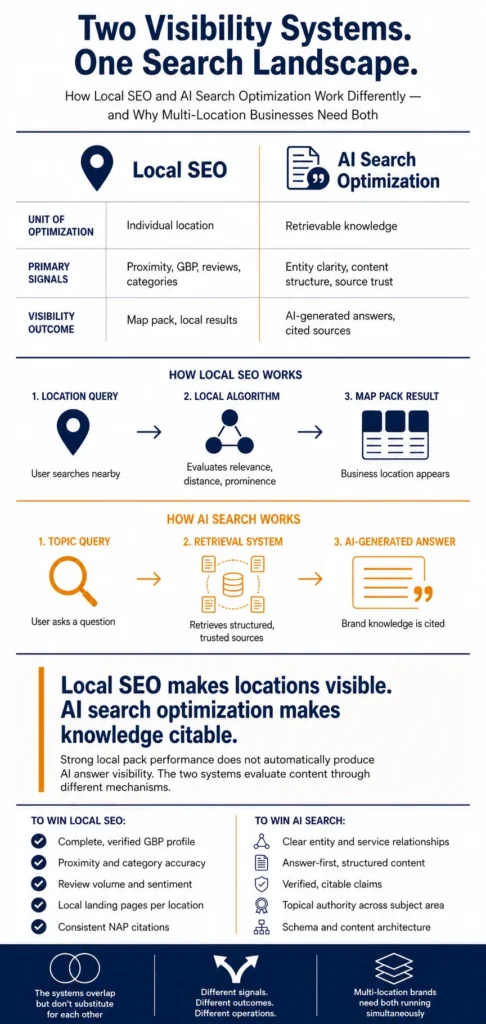
AI search optimization and local SEO are not the same system — they solve different visibility problems, evaluate content through different mechanisms, and require different operational responses. Google defines local visibility through “relevance, distance, and popularity” — Google Business Profile Help. That framework is location-first. AI search engines retrieve, synthesize, and cite sources based on retrieval quality, source trust, and answer usefulness — not physical proximity.
Multi-location businesses face a two-system reality. Letting go of local SEO costs Maps placement, GBP-driven calls, and proximity-driven discovery. Ignoring AI search optimization means ceding answer visibility to competitors who invested in structured, citation-worthy content.
Content Ops Lab has spent over 23 months building content infrastructure that performs in both environments — producing 1,000+ citation-verified articles and pages across 12 healthcare locations with zero compliance violations.
Related: How AI Content Strategy Differs From Traditional SEO
What Is the Main Difference Between Local SEO and AI Search Optimization?
Local SEO determines whether a business location appears in search results for nearby locations. AI search optimization determines whether a brand’s content gets retrieved, trusted, and cited when an answer engine synthesizes a response. They solve different visibility problems driven by different signals.
Local SEO Is Built Around Location-Level Evaluation
Google’s local algorithm evaluates each business location independently, using proximity and location-specific signals to determine local pack placement.
- GBP categories, address, and verification drive initial eligibility
- Proximity to the searcher influences ranking position
- Reviews, ratings, and local citations build prominence signals
- Local landing pages connect location-specific queries to individual branches
- Phone calls, directions, and bookings measure local search success
This system answers one question: which nearby business matches this query?
AI Search Is Built Around Retrieval and Citation
AI Overviews synthesize information from multiple sources, including content from across the web and Google’s Knowledge Graph, which can be especially helpful for generative responses — Google Search Central. That retrieval process favors content that is structured, verifiable, authoritative, and useful as a cited source.
- Answer engines evaluate content for retrievability, not proximity
- Topical authority and entity clarity drive citation likelihood
- Structured, answer-first content is easier to retrieve and cite
- Trust signals come from source credibility, not location data
- AI referral traffic and citation appearances measure AI search performance
This system answers a different question: which source best explains this topic?
The Systems Overlap but Don’t Substitute for Each Other
Strong local SEO signals — complete GBP, high ratings, verified proximity — do not automatically translate into AI answer visibility. A business can perform well in the local pack even if its content is never retrieved in an AI Overview or cited on Perplexity.
- Local pack visibility depends on location-level optimization
- AI citation depends on content quality and source trust
- Domain authority and on-page quality support both, but serve different functions
- Multi-location businesses need both systems operating simultaneously
- Operational gaps in either system create measurable visibility losses
The clean mental model: local SEO makes locations visible. AI search optimization makes knowledge citable.
How Does Traditional Local SEO Decide Which Businesses Appear?
Google determines local visibility through relevance, distance, and prominence — three criteria that together determine which locations appear in Maps, the local pack, and localized search results. Proximity filters first; prominence and relevance determine competitive position.
Relevance, Distance, and Prominence Each Do Different Work
Each factor evaluates a different dimension of the business-to-query match, which is why GBP optimization is not optional for multi-location brands.
- Relevance measures how well a Business Profile matches what someone is searching for — Google Business Profile Help
- Distance evaluates how far each business is from the customer searching — Google Business Profile Help
- Prominence measures how well-known a business is, using links, articles, and reviews —Google Business Profile Help
- All three operate together — no single factor overrides the system
- BrightLocal confirms proximity, relevance, and prominence remain the current local algorithm model — BrightLocal
Understanding which factor you’re under-optimizing is what separates reactive local SEO from systematic local search management.
GBP Completeness and Location Signals Drive Pack Eligibility
Pack rankings depend on location-specific signals that exist at the branch level, not the corporate level.
- Primary GBP category is the top-ranked local pack factor — Search Engine Land
- Physical address in the city of search consistently ranks among the top signals — Search Engine Land
- GBP verification status affects eligibility before any other signals apply
- High numerical ratings improve prominence scores across all locations
- Gaps at even a few locations can suppress network-wide performance
Location-level accuracy cannot be managed centrally without location-level data quality systems.
Reviews Become More Decisive in Competitive Positions
Review signals become more influential as positions grow more competitive, which changes how multi-location brands should prioritize their review strategy.
- Proximity influences 55% of local pack decisions across positions 1–21 — Search Engine Journal
- In the top 10, proximity’s influence drops to 36% while review count rises to 26% — Search Engine Journal
- Review keyword relevance reaches 22% influence in top positions — Search Engine Journal
- Review volume and sentiment affect prominence, not just conversion rates
- Regulated industries face additional compliance risk in how they solicit and respond to reviews
Reviews, proximity, and GBP completeness — however strong — do not make content retrievable for AI answers.
How Do AI Search Systems Choose Which Sources to Cite?
AI search engines retrieve, synthesize, and cite content based on whether it can construct a grounded, reliable answer — a process technically distinct from the proximity-and-prominence logic that governs Maps.
Retrieval-Augmented Generation Is the Technical Foundation
RAG is why content architecture matters for AI search. It enhances the accuracy and credibility of AI-generated answers by incorporating knowledge from external databases, particularly for knowledge-intensive tasks — arXiv.
- RAG systems access external knowledge rather than relying solely on training data
- External retrieval improves answer accuracy and allows continuous knowledge updates — arXiv
- Structured content with clear entities and claims retrieves more cleanly than dense prose
- Citation-worthy content answers a question directly before elaborating
- Unverified or vague claims reduce confidence in the source as a retrieval candidate
Content written for AI search retrieval looks different from content written to rank in the local pack.
Major AI Platforms Are Centering Their Design Around Citations
The citation pattern is the design philosophy across the leading answer engines — not a feature of any single platform.
- OpenAI frames its retrieval approach around answers grounded in data, with citations and evaluations for reliability — OpenAI
- Microsoft Copilot now includes more prominent, clickable citations and aggregated source views — Microsoft
- Perplexity defines its model around real-time search with sources and citations in every answer — Perplexity
- AI Overviews synthesize from across the web and the Knowledge Graph — Google Search Central
- Citation prominence signals to users and systems which sources are considered reliable
Each platform differs in retrieval logic but shares a common dependency on content that can be sourced, verified, and attributed.
Google’s Own Guidance Clarifies the Operational Implication
Google states that creators need nothing special to do for AI Overviews beyond following standard Search guidance — Google Search Central. That means foundational quality standards apply — meeting them is the baseline, not the ceiling.
- Foundational search quality remains the prerequisite for AI visibility
- AI Overviews are retrieved from the same indexable web that traditional search evaluates
- Meeting SEO fundamentals qualifies content for consideration; it does not guarantee citation
- Content structure, entity clarity, and answer usefulness determine retrieval outcomes
- The operational change is in how content teams build and verify content at scale
Mistaking “no special tricks required” for “no operational changes needed” is where multi-location brands lose AI visibility to competitors who understood the distinction.
If your operation needs to produce 20–50+ articles per month without sacrificing compliance or quality, Content Ops Lab builds the infrastructure to make that possible. Contact us to discuss your content production requirements.
Why Can a Business Rank Locally but Still Be Invisible in AI Search?
A business can hold strong local pack positions and still fail to appear in AI-generated answers. Local pack performance depends on location-level signals that AI retrieval systems evaluate differently or ignore entirely.
Local Pack Signals Do Not Transfer to AI Retrieval
The signals that win Maps placement are not the signals AI systems use to evaluate source reliability or answer usefulness.
- GBP proximity is irrelevant to an AI system retrieving a trusted explanation
- Review volume builds local prominence but does not make content citable
- Category optimization helps match transactional queries, not knowledge retrieval
- Citation consistency (NAP) is a local trust signal, not an AI source trust signal
- Strong local performance can coexist with near-zero AI search visibility
A healthcare business with 500 five-star reviews may still produce content that answer engines cannot retrieve, trust, or cite.
AI Systems Evaluate Content Differently Than Google Evaluates GBP
The unit of evaluation shifts from location data to content quality, entity clarity, and structured usefulness — qualities that require intentional content production rather than location management.
- Answer engines need content that directly addresses questions before elaborating
- Entity relationships — what a business is, what it offers, where it serves — must be unambiguous in the content itself
- Topical depth and internal linking signal authority over a subject area
- Schema markup helps systems classify content, but is not sufficient on its own
- Compliance and factual accuracy matter because citation risk is real for AI systems
Supporting AI search visibility requires a separate operational plan from local SEO management.
Measurement Confirms the Gap Is Real
One AEO benchmark found that approximately 3.2% of AEO-optimized B2B content was cited in AI responses in 2024, and reported a 127% average increase in AI search visibility following AEO implementation — The Starr Conspiracy. Read these as directional, not definitive — methodological uncertainty applies.
- AI citation rates vary by industry, content quality, and query type
- Local SEO metrics — calls, directions, bookings — do not capture AI-driven referrals
- Businesses without AI-specific measurement cannot identify whether they have AI visibility
- Tracking AI citations, AI referral traffic, and entity coverage requires different tools than GBP Insights
- The measurement gap itself is part of the operational problem
Businesses that are not measuring AI visibility cannot manage it.
Related: Why Most Websites Are Invisible to AI Search
What Should Multi-Location Businesses Optimize Differently for AI Search?
Multi-location businesses need two parallel content systems: one that maintains location-level local search performance, and one that builds domain-level authority for AI search. Local SEO optimizes locations. AI search optimization optimizes retrievable knowledge, entity clarity, and citation trust.
Entity Clarity and Service-Location Architecture Are the Starting Point
AI search systems need to understand what a brand is, what it offers, and where it operates — expressed in content, not just location data.
- Entity modeling defines the brand clearly: name, type, specialties, and service areas
- Service pages must connect offerings to locations in a structured, unambiguous way
- Avoid orphaned service content that has no clear location or entity relationship
- Consistent language across all pages reduces confusion for retrieval systems
- Schema markup helps classify entities, but requires accurate underlying content first
Inconsistent entity signals reduce AI retrieval confidence the same way conflicting NAP data reduces local SEO trust.
Citation-Ready Content Requires a Different Writing Model
Content that earns AI citations answers questions directly, with verifiable claims and structured formats that retrieval systems can parse.
- Answer-first structure: lead with the direct answer before elaborating
- Short paragraphs and bullets improve extractability for retrieval systems
- Every factual claim should be traceable to a verifiable source
- Knowledge pages, FAQ content, and educational explainers build retrieval surface area
- Avoid vague claims, aspirational language, and unsupported statistics
Content teams need explicit production standards, not just SEO guidelines.
Centralized Governance Is What Makes This Operational
A local SEO case study from a large healthcare enterprise showed a 71% increase in website clicks from local listings, a 51% increase in phone calls, and a 35% increase in total actions — with nearly one third of all appointment bookings originating from local search within six months — Wheelhouse DMG. AI search visibility requires the same discipline applied to content governance, not just location data.
- Centralized content governance ensures consistent entity signals across all locations
- Compliance review must apply to AI search content, especially in regulated industries
- Citation verification prevents factual errors from appearing in AI-cited responses
- Content calendars must account for topical authority, not just local keyword coverage
- Quality standards must be consistent enough to scale across many locations simultaneously
Multi-location brands that treat AI search as a one-off content task will not build the retrieval surface needed to compete.
How Should You Measure AI Search Optimization Compared With Local SEO?
Local SEO and AI search optimization require different metrics because they produce different types of visibility. Applying local SEO metrics to AI search produces false negatives — gaps that appear to be underperformance but are actually tracking failures.
Local SEO Measurement Is Built Around Location-Level Actions
Local SEO performance shows up in actions users take from Maps and local results — high-intent, location-specific conversions.
- GBP Insights tracks calls, direction requests, and website clicks by location
- The Providence enterprise case study shows how action data scales across a large network — Wheelhouse DMG
- Review volume and sentiment reflect the local prominence trajectory
- Local pack position tracking by keyword and location identifies ranking gaps
- Competitive proximity analysis reveals where new location strategies add visibility
These metrics tell a clear operational story: which locations are performing, which are lagging, and which signals need improvement.
AI Search Measurement Requires a Different Instrument Set
AI search visibility requires monitoring tools and analytics configurations that most local-first teams don’t yet have in place.
- AI referral traffic appears in analytics as direct or via AI-specific referral sources
- Citation tracking tools monitor brand mentions in AI-generated answers
- Entity coverage audits assess whether AI systems understand the brand’s offerings and location structure
- Conversion quality from AI referrals — not just volume — indicates retrieval trust
- AI search visibility benchmarks are still maturing; treat industry figures as directional
One benchmark reported a 127% average increase in AI search visibility following AEO implementation, with article schema associated with higher citation rates — The Starr Conspiracy. Treat these as context, not confirmed benchmarks.
Measurement Expansion Is Itself an Operational Decision
Adding AI search measurement is a strategic decision about what the content operation is accountable for producing.
- Measurement choice defines what the team optimizes toward
- Teams tracking only GBP actions will continue investing only in GBP performance
- AI citation tracking creates accountability for content quality, not just volume
- Conversion quality from AI referrals often differs from other traffic sources — worth isolating
- Multi-location brands need dashboards showing both local and AI search performance simultaneously
Without measurement covering both systems, informed decisions about content investment are not possible.
Why Does This Require a Content Operations System?
AI search optimization requires repeatable production: consistent research, claim verification, entity modeling, structured writing, compliance review, and measurement — not a one-time audit.
Content Ops Lab spent 23 months developing and validating that system in healthcare, where content errors carry real compliance consequences. That performance came from production infrastructure: research-first processes, citation verification at every stage, structured content architecture built for retrieval, and governance standards that maintained accuracy across a high-volume pipeline.
- 1,000+ articles and pages delivered with verified citations across 12 locations
- Zero compliance violations over 23 months in a regulated healthcare environment
- AI search traffic converting at 21.4% average — 6.4x the site baseline
- 887% ChatGPT traffic growth in seven months
- Content production scaled from ~10 to 50+ articles per month
- Dual-system content architecture serving both local SEO and AI search visibility
- Research-first production model with citation verification at every stage
- Knowledge-to-strategy-to-production workflow built for multi-location content governance
The Content Ops Lab Production System
Every article and page moves through a structured production pipeline designed to support both traditional search performance and AI retrieval quality.
- Research: Topic modeling, entity mapping, and evidence sourcing before any writing begins
- Verification: Citation-level fact-checking and compliance review before publication
- Optimization: Structured formatting, answer-first architecture, and schema alignment for retrieval
- Delivery: Multi-location content governance with consistent standards across every location
Multi-location brands that need AI search performance at scale should expect to operate this system continuously rather than deploy it once.
Ready to build a content infrastructure that scales without the compliance risk? Get in touch today — we’ll assess your current content operation and outline what a systematic approach would look like for your organization.
Frequently Asked Questions
Is AI search optimization replacing local SEO?
No. Local SEO remains essential for Maps placement, GBP-driven calls, direction requests, and proximity-based discovery. AI search optimization adds a second layer of visibility focused on retrieval, citations, and answer inclusion. A multi-location brand that abandons local SEO to focus entirely on AI search will lose Maps performance that it cannot quickly recover from. Both systems require investment and dedicated measurement.
How should a multi-location business start with AI search optimization?
Start with entity clarity: make sure your brand’s identity, services, and location relationships are stated unambiguously in your content — not just your GBP data. Build a service-location content architecture, create citation-worthy knowledge pages with verified claims, apply schema markup, and add AI-driven referral tracking and citation monitoring to your measurement stack. AI search optimization compounds over time as topical authority and citation trust build.
Why does citation verification matter for AI search content?
Answer engines retrieve and cite content they consider reliable — unverified claims and factual errors directly undermine retrieval quality. For regulated businesses, this is compounded by compliance risk: AI-generated content that repeats an unsupported claim creates defensibility problems if a regulator or patient relies on it. In regulated industries, citation verification is a compliance requirement built into the production workflow, not a quality preference.
Why can a business rank locally but still miss AI search visibility?
Local rankings depend on location-level signals — GBP completeness, proximity, review volume, and category accuracy. AI answer engines retrieve based on topical authority, source trust, content structure, and answer usefulness. A business with perfect GBP completeness may still produce content that answer engines cannot confidently retrieve and cite. The distinction lies in the unit of evaluation: local SEO evaluates location data. In contrast, AI search evaluates content quality and entity clarity.
Can Content Ops Lab help with both local SEO content and AI search optimization?
Yes — that dual-system approach is the architecture COL built for its multi-location client. Local SEO content includes location-specific service pages and structured content that builds location-level relevance and prominence. AI search optimization includes knowledge pages, FAQ content, citation-verified educational articles, and entity-clear content architecture. Both run through the same production infrastructure: research-first, citation-verified, compliance-reviewed, and governed consistently across all locations.
Key Takeaways
- Local SEO and AI search optimization solve different visibility problems: local SEO makes individual locations discoverable; AI search optimization makes brand knowledge citable and retrievable in generated answers
- Google’s local algorithm evaluates relevance, distance, and prominence — location-specific signals that do not automatically transfer to AI retrieval performance
- AI search systems retrieve and cite content based on source trust, topical authority, structured formatting, and answer usefulness — not proximity
- Multi-location businesses that treat AI search as “local SEO with AI keywords” will miss the operational shift: centralized content governance, entity clarity, and citation verification are the actual requirements
- AI referral traffic converting at 21.4% average (6.4x site baseline) across the multi-location system demonstrates the business impact of content built for both systems
- Measurement must expand beyond GBP actions and local rankings to include AI citations, AI referral traffic, entity coverage, and downstream conversion quality
- Building AI search performance at scale requires a repeatable production system — not a one-time audit or scattered content improvements
What Operators Need to Understand Before the Window Narrows
AI search optimization and local SEO are parallel operating requirements for any multi-location business that depends on search visibility. Local SEO controls whether individual locations appear for nearby, transactional searches. AI search optimization determines whether the brand’s knowledge is retrieved and cited across Google AI Overviews, Perplexity, Copilot, and ChatGPT. Running only one system creates a measurable visibility gap in the other.
Content Ops Lab built this system when AI search was in its early stages — scaling from 10 to 50+ citation-verified articles per month across 12 locations, resulting in 887% growth in ChatGPT traffic in seven months with zero compliance violations. Early investment in a structured, verified content architecture builds topical authority and citation trust that compound over time and are harder to displace once established.
Content Ops Lab builds production infrastructure for multi-location operators who need both systems to work simultaneously — without the compliance risk associated with unverified, high-volume AI content. That is a production standard, not a promise.
Related: How Do You Get Cited by ChatGPT?