

How Do You Improve Brand Visibility in AI Search?
Brand visibility in AI search depends on whether AI systems can clearly identify, retrieve, and confidently cite your brand — not just whether your pages rank. According to BrightLocal, use of ChatGPT and other generative AI tools for local business recommendations rose from 6% to 45% in a single year — BrightLocal.
That shift means your brand is now being evaluated by systems that read differently from humans. A business can rank on page one and still be absent from every AI-generated recommendation if its entity signals are scattered, inconsistent, or machine-unreadable. This is not a content volume problem. It is a brand clarity problem.
Content Ops Lab builds the content infrastructure that makes brands easier for AI systems to recognize, retrieve, and trust — drawn from a 21-month production deployment across a 12-location regulated healthcare client.
Related: Why Most Websites Are Invisible to AI Search
What Does Brand Visibility in AI Search Mean?
Brand visibility in AI search means your business appears in AI-generated answers, recommendations, summaries, citations, or supporting links when users ask relevant questions — across platforms including ChatGPT, Perplexity, Gemini, Copilot, and Google AI Overviews.
Visibility Takes Multiple Forms
AI search visibility is broader than a blue-link ranking. A brand can surface in several ways:
- Cited as a source in a Perplexity or ChatGPT answer
- Recommended by name when a user asks for service providers near a location
- Used as supporting evidence in a Google AI Overview
- Summarized or compared when a user asks Gemini to evaluate options in a market
- Referenced as an authority in multi-source synthesis answers
The Evaluation Happens Before the Answer Appears
By the time an AI platform returns a recommendation, a series of internal decisions has already occurred. The system has assessed its ability to identify your brand, locate relevant content, and verify its trustworthiness. Brands that fail any of those assessments are simply left out — even if they hold strong organic rankings. This upstream evaluation is where most multi-location businesses lose visibility without realizing it.
Why AI Search Differs From Traditional Search
Traditional search surfaces pages. AI search constructs answers from entities. The distinction matters because a page can rank even if the brand is not clearly understood as an entity, whereas AI systems need both. OpenAI documentation shows web citations as structured response annotations, meaning the AI has already determined that a source is citable before surfacing it. Getting on that list requires more than indexation.
Why Does AI Search Visibility Start With Entity Clarity?
Brand visibility in AI search starts with a question the system asks before any answer is returned: can it clearly understand what your brand is, where it operates, what services it provides, which locations it owns, and what external sources confirm those facts? Without that clarity, the system defaults to recommending whoever is easier to interpret.
What Entity Clarity Requires
For a brand to be clearly understood by AI systems, several signals need to align:
- Consistent naming across parent brand, locations, directories, and schema
- Defined service scope per location, not just at the corporate level
- Verifiable relationships between the parent brand and individual locations
- Matching signals across GBP profiles, location pages, and structured data
- Third-party corroboration from directories, reviews, and industry references
The Multi-Location Entity Problem
Multi-location brands do not have one visibility problem. They have many small-entity problems, multiplied across markets. Search Engine Land defines the Knowledge Graph as structured data that describes relationships among entities such as people, places, things, and concepts. For a 10- or 50-location brand, that means each location, service line, department, and practitioner is its own entity — and each needs consistent, verifiable signals. When those signals conflict, AI systems may confuse locations, recommend a competitor with a cleaner footprint, or avoid the brand entirely.
The Core Principle
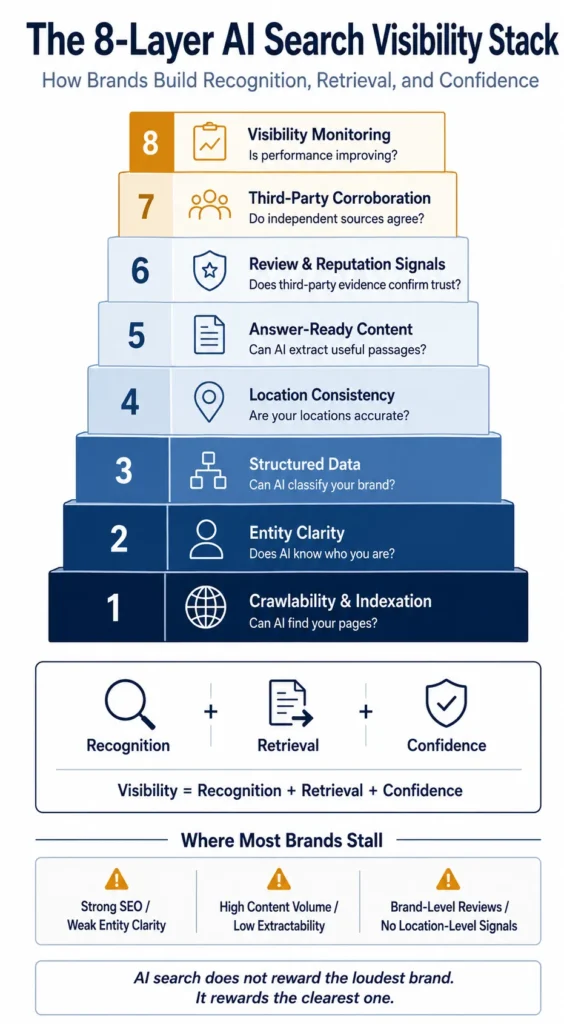
AI search does not reward the loudest brand. It rewards the clearest one. A multi-location brand can be visible at the corporate level yet invisible at the local decision point — where the user is actually choosing a provider. Entity clarity has to exist at every layer, not just at headquarters.
How Does Traditional SEO Support AI Visibility?
Traditional SEO remains the eligibility layer for AI search. Google states that AI features follow the same foundational requirements as Search: crawlability, indexation, snippet eligibility, and helpful content — Google Search Central. Pages do not need separate AI-specific technical requirements to appear as supporting links in AI Overviews or AI Mode. That is both reassuring and clarifying.
SEO Gets the Page Into the Pool
The foundational work still matters:
- Crawlability and indexation — AI systems cannot retrieve content they cannot find
- Mobile performance and page speed — eligibility thresholds are the same
- Snippet eligibility — structured, answer-forward content increases AI retrieval likelihood
- Helpful content standards — thin, generic, or duplicated pages remain liabilities in AI search
Where AI Search Adds New Requirements
Traditional SEO helps pages become eligible. AI search visibility depends on whether those pages contain useful, extractable, trustworthy answers. A page can be fully indexed and still fail the AI retrieval test if the content buries its answers, uses vague brand language, or lacks verifiable claims. The gap between “indexed” and “citable” is where most content falls short.
The Four-Layer Framework
Think of AI visibility as a sequence, not a single tactic:
- SEO gets the page into the eligible pool
- Entity clarity helps AI understand who the brand is
- Answer-ready content gives AI something it can extract and use
- Third-party proof gives AI a reason to trust what it retrieves
All four layers are required. Optimizing only one does not move the needle on the others.
If your operation needs to produce 20–50+ articles per month without sacrificing compliance or quality, Content Ops Lab builds the infrastructure to make that possible. Contact us to discuss your content production requirements.
What Do AI Systems Need Before They Recommend a Brand?
Before any AI platform mentions or cites a brand, it completes a recognition and verification process. That process has four distinct requirements — and failing any one of them is enough to be left out.
Recognition
Can the system identify the brand as a real organization with a defined scope?
- Consistent brand name across all digital touchpoints
- Clear category and service definitions that match how users describe their needs
- An organization schema that establishes the parent brand as a named entity
- A directory presence that confirms the brand exists across multiple sources
Disambiguation
Can the system distinguish the brand from its locations, competitors, and similarly named businesses?
- Unique location identifiers — address, phone, URL — distinct per location
- Accurate GBP categories that match actual services, not aspirational ones
- LocalBusiness schema per location, not just one corporate-level Organization tag
- Parent-to-location relationships are established in the schema using sub-organization properties
Retrieval
Can the system find clear, answer-ready passages about the service or topic?
- Direct answers near the top of each service or FAQ section
- Question-format H2s and H3s that match the language users actually search
- Location-specific service details that differentiate each location from boilerplate
- Cited claims that signal the content is evidence-backed, not self-promotional
Confidence
Can the system verify the brand through reviews, directories, citations, and other third-party evidence?
- Review volume and recency across Google, Yelp, and industry-specific platforms
- Consistent NAP (name, address, phone) across all directory listings
- Third-party industry profiles that co-cite the brand alongside relevant services
- Structured data alignment between what the schema says and what the page actually contains
If any of these four inputs is weak or contradictory, the brand becomes a confidence risk, and AI systems avoid confidence risks when stronger alternatives exist.
Why Do Multi-Location Brands Have a Larger AI Search Problem?
Multi-location brands face a structural disadvantage in AI search that single-location businesses do not: every location is its own entity, and every entity needs its own clean signals. Brand visibility in AI search degrades fast when scale outruns operational discipline — producing exactly the kind of messy footprint AI systems are built to avoid.
Common Multi-Location Entity Problems
These are the patterns that erode AI visibility across distributed brands:
- Location pages that are too similar — generic copy reused across markets with only the city name changed
- Inconsistent GBP categories — different locations categorized differently for the same core service
- NAP variation across directories — suite numbers missing in some listings, phone formats inconsistent in others
- Uneven review profiles — brand-level average looks strong, while individual locations have sparse or stale ratings
- Disconnected parent-to-location linking — corporate pages do not clearly point to individual location pages
- Schema gaps — some locations have structured data, others do not; none reference the parent organization
- Service ambiguity — no location-level pages specify which services are offered at which address
The Local Decision Point Problem
A multi-location brand can be clearly recognized at the parent level and still fail at the local decision point. When a user asks an AI system for the best provider near a specific address, the system has to match that query to a specific location — not the corporate entity. If the location-level signals are weak, the recommendation defaults to whoever has cleaner local data. That is usually a competitor.
What Operational Discipline Requires
Improving brand visibility in AI search for multi-location brands is not a content project. It is a governance project. Location names, GBP profiles, schema, directory listings, and review operations all have to be managed as a system — not addressed on a per-location basis as problems arise. The brands winning in AI local search are not necessarily the largest. They are the most consistent.
Related: How Do You Get Cited by ChatGPT?
How Do Reviews and Third-Party Evidence Influence AI Recommendations?
Reviews are not just social proof for human readers. They are structured and semi-structured evidence that AI systems can summarize, compare, and use as confidence signals when deciding which brands to recommend.
Why Review Data Matters to AI Systems
BrightLocal reports that 97% of consumers read reviews for local businesses — BrightLocal. AI systems are doing something similar: using review signals to assess whether a business is legitimate, active, and trusted by real people. The specific signals that matter include:
- Volume — a meaningful number of reviews per location, not just the brand aggregate
- Recency — consistent review activity within the last 90–180 days
- Average rating — BrightLocal reports 31% of consumers will only consider businesses with 4.5 stars or higher — BrightLocal
- Platform diversity — presence across Google, Yelp, and industry-specific platforms
- Review response rate — signals active management and accountability
Location-Level Review Strength Is What Counts
A 4.8-star parent brand does not help much if the specific location a user is asking about has sparse, stale, or inconsistent signals. AI systems that surface local recommendations are evaluating the location, not the corporate average. Multi-location brands that centralize their review strategy at the brand level — without managing each location’s review health individually — have a gap that directly costs them AI visibility.
The Broader Third-Party Footprint
Beyond reviews, AI systems can draw on a wider set of external signals:
- Industry directory profiles — healthcare, legal, home services, and franchise directories
- Local citations — consistent NAP references across local business databases
- Earned mentions — references in relevant publications, association sites, and local media
- Co-citations — appearing alongside known brands in third-party content signal context and credibility
The goal is not only to build links. It is to build a corroborated brand footprint that repeatedly connects the business to its services, markets, and expertise — so that when an AI system searches for evidence, it finds consistent agreement from multiple independent sources.
What Is the AI Brand Visibility Stack?
Brand visibility in AI search is built in layers. Each layer enables the next. A brand that skips lower layers cannot compensate by optimizing higher ones.
The Eight-Layer Framework
Layer 1: Crawlability and Indexation: The foundation. If AI systems cannot find and access your pages, nothing above this layer works. Standard technical SEO applies: clean crawl paths, accurate sitemaps, no indexation blocks on content you need cited.
Layer 2: Entity Clarity: AI systems need to understand what the brand is. Organization and LocalBusiness schema, consistent naming, and clear parent-to-location relationships establish the brand as a recognizable entity.
Layer 3: Structured Data: Google structured data documentation states that Search uses structured data to understand page content and gather information about the web, including companies — Google Structured Data. Schema for Organization, LocalBusiness, Service, Review, and FAQ types reinforces what the brand is, where it operates, and what it offers.
Layer 4: Location Data Governance: Google Business Profile guidelines require businesses to represent themselves consistently as they are known in the real world — Google Business Profile. GBP profiles are structured location records that feed Search, Maps, and AI local systems. Inconsistent profiles introduce ambiguity that AI systems are designed to avoid.
Layer 5: Answer-Ready Content: AI systems retrieve passages, not full pages. Content that opens sections with direct answers, uses clear H2/H3 architecture, and avoids burying key information is more likely to be extracted and cited.
Layer 6: Review and Reputation Signals: Per-location review health, rating quality, recency, and platform diversity give AI systems verified evidence of real-world trust.
Layer 7: Third-Party Corroboration: Directory listings, industry profiles, earned mentions, and co-citations confirm the brand’s scope and authority from sources independent of the brand itself.
Layer 8: Ongoing AI Visibility Audits: AI search is not a one-time optimization. Prompt sampling, citation tracking, competitor monitoring, and content performance reviews make visibility measurable and improvable over time.
How Content Ops Lab Builds Content Infrastructure for AI Search
A 12-location regulated healthcare client came to Content Ops Lab with a content operation producing inconsistent volume and quality, and zero visibility into AI-generated local recommendations. Over 21 months of production, the client achieved 653% impression growth and 1,700% click growth — with zero compliance violations across all published content. That result came from systematic infrastructure, not campaign-level effort.
What the production system delivered:
- 50+ articles per month at consistent quality across all locations and service lines
- Zero compliance violations in a regulated healthcare environment over 21 months
- 20–32% AI search conversion rates on optimized content formats
- 653% impression growth from a structured entity and content build-out
- 1,700% click growth from answer-ready content designed for AI retrieval
- Structured citation verification using Claude, Perplexity, and Gemini in production
- Location-level content differentiation that eliminated duplicate content across markets
- Operational governance that maintained consistency across a distributed brand
The Content Ops Lab Production System
Every article we produce passes through a four-stage system designed for AI retrievability and compliance accuracy.
- Research: Source verification, citation accuracy, and entity signal alignment for every claim
- Verification: Compliance review, fact-checking, and structured data consistency checks
- Optimization: Answer-first structure, H2/H3 architecture, and passage-level extractability
- Delivery: Final QA against editorial standards, performance benchmarks, and location-specific requirements
The system exists because scale without governance produces exactly the kind of messy, inconsistent content AI systems are built to deprioritize.
Ready to build a content infrastructure that scales without the compliance risk? Get in touch today — we’ll assess your current content operation and outline what a systematic approach would look like for your organization.
Frequently Asked Questions About Brand Visibility in AI Search?
Is AI search visibility just SEO with a new name?
Not exactly. Traditional SEO helps pages become eligible for AI retrieval by ensuring crawlability, indexation, and snippet eligibility. But AI visibility adds a second requirement: the content must be answer-ready, entity-clear, and corroborated by third-party evidence that AI systems can use with confidence. SEO gets the page into the pool. Entity clarity and content structure determine whether it gets cited. Brands that treat AI search as a simple SEO extension are optimizing for eligibility, not recommendation.
How long does it take to see AI search visibility improvements?
Timeline depends on the starting state of your brand’s entity signals, content quality, and review health. For brands with inconsistent GBP profiles, schema gaps, or thin location pages, foundational cleanup can produce measurable changes in AI citation frequency within 60–90 days. Brands with strong foundational signals but weak answer-ready content typically see faster improvement. A 12-location regulated healthcare client saw 653% impression growth over a 21-month systematic build — meaningful gains appeared well before the full timeline concluded.
Does improving AI search visibility create compliance risk?
Only if the process is unmanaged does AI search optimization require publishing structured, specific, evidence-backed content — which, in regulated industries, means every claim must meet accuracy and compliance standards. The same system that makes content AI-retrievable also makes it more precise and verifiable, which reduces compliance risk rather than increasing it. The risk comes from high-volume, unverified content production — not from structured content operations designed with compliance in mind.
How does this compare to just running more paid search?
Paid search delivers traffic while the budget runs. AI search visibility, once built, delivers citations and recommendations with no ongoing media spend per impression. The asset is the brand’s entity clarity, structured content, and third-party footprint — which compounds over time rather than resetting when a campaign ends. Paid search and AI visibility serve different functions; brands that invest only in paid search build nothing that endures in the AI recommendation layer.
Does Content Ops Lab work with brands outside healthcare?
Yes. The production infrastructure, compliance frameworks, and entity-building systems developed in a regulated healthcare environment apply directly to legal, home services, financial services, franchise brands, and any multi-location business operating under brand standards or industry guidelines. The regulated-industry origin means the system was stress-tested at the most demanding end of content-accuracy requirements — making it well-suited for any brand where consistency and verifiability matter.
Key Takeaways
- Brand visibility in AI search depends on entity clarity, answer-ready content, and third-party verification — not page rankings alone
- Multi-location brands face a compounding entity problem: each location, department, and service line needs its own consistent, verifiable signals
- Traditional SEO remains the eligibility layer — AI visibility adds a second requirement: extractable, trustworthy, answer-first content
- Reviews and third-party corroboration function as confidence signals for AI systems evaluating which brands to recommend — location-level review health matters more than brand-level averages
- A 12-location regulated healthcare client achieved 653% impression growth and 1,700% click growth through a systematic content infrastructure built for AI retrievability
- AI visibility measurement is still indirect — prompt sampling, citation audits, and competitor tracking are the current standard; no single universal dashboard exists
- Brands that win in AI search will be the ones whose digital footprint gives AI systems the least reason to hesitate — consistency and clarity, not content volume, are the competitive advantage
AI Visibility Is Built Through Consistency
AI search visibility is not won by publishing more content or chasing platform-specific tricks. It is built by making your brand easier to understand, verify, and recommend — across every location, every service line, and every external signal that AI systems use to evaluate trust.
BrightLocal’s finding that AI tool usage for local recommendations grew from 6% to 45% — BrightLocal, signals how quickly the recommendation layer is shifting. For multi-location brands, that shift means the work has to move beyond individual page optimization. Entity governance, structured data, location-level content differentiation, GBP management, review operations, and third-party validation have to be managed as a system — not addressed in isolation as tactical projects. The brands that build that system now will hold a structural advantage that becomes harder for competitors to close over time.
Content Ops Lab helps multi-location businesses build exactly that infrastructure — drawn from 21 months of production-tested results in one of the most compliance-demanding environments in healthcare.
Related: What Makes a Source Citation-Worthy to AI Search Engines?