

How Do You Convert AI Traffic Into Booked Appointments?
You convert AI traffic into booked appointments by treating it as pre-qualified, decision-stage traffic from the moment it’s identified — not by running it through the same generic funnel built for cold organic clicks. “ChatGPT users relied primarily on AI-generated results, with only 12% visiting external websites” — NIM.
For multi-location operators, this means the comparison shopping your team used to capture on-site now happens inside the AI conversation itself — and your booking system has to be ready the instant that visitor lands on your page.
Content Ops Lab built its conversion methodology within a 12-location regulated healthcare organization, where AI search traffic converted at 21.4% over eight months, compared to a 3.32% site average — a gap most operators trying to convert AI traffic haven’t yet closed.
Related: Why Does AI Referral Traffic Convert Higher Than Organic Search?
Why Does AI-Referred Traffic Convert Better, But Still Go Uncaptured By Most Operators?
AI-referred traffic converts better because users arrive pre-qualified by the AI system itself. However, most operators still route it through generic funnels built for cold, top-of-funnel visitors. “Across the data set, AI visitors converted at an average rate of 14.2%” — Opollo. Google’s organic conversion rate sits at just 2.8% by the same measure — a gap most marketing teams haven’t restructured their systems to capture, let alone convert AI traffic at scale.
The Volume-Versus-Value Mismatch
AI referral traffic remains a small share of overall sessions for most operators today, often in the low single digits of total traffic. That scarcity leads marketing teams to deprioritize the segment rather than build dedicated capture systems for it.
- Still, 1-6% of total traffic for most sites currently
- Small session volume masks outsized per-visit conversion value
- Deprioritization compounds the missed revenue opportunity
Treating AI traffic as too small to matter ignores the fact that a small, highly qualified segment can routinely outproduce a much larger, generic one in revenue per session.
The Compressed Research Journey
AI platforms collapse the multi-tab comparison process that used to happen across your website and three competitors’ sites simultaneously. The decision work increasingly happens before the click ever reaches your domain.
- ChatGPT users visit external sites only 12% of the time
- Google users click through multiple sites the majority of the time
- Comparison shopping now happens almost entirely inside the AI conversation
If the evaluation already happened in the chat window, your landing page has exactly one job left: confirm the decision, not justify it from scratch.
Why Generic Funnels Miss Decision-Stage Visitors
Most booking funnels are built to educate, qualify, and nurture a visitor — a sequence of decision stages AI visitors have already completed before they click through. Forcing them back through that sequence introduces friction at the exact moment they’re ready to act on a decision.
- Generic funnels assume low intent by default for every visitor
- Decision-stage visitors need confirmation, not repeated education
- Extra form fields and steps cost conversions disproportionately here
That mismatch between actual visitor intent and generic funnel design is where most of the conversion value quietly leaks out of the system.
What Are The Real Options For Capturing And Converting AI Traffic?
Operators have three real paths available to convert AI traffic into appointments: internal teams bolting tracking onto existing systems, traditional agencies optimizing for legacy SEO, or generic AI tools without citation infrastructure. Each approach addresses part of the underlying problem — none solves it completely on its own.
Internal Teams Bolting On Tracking
Internal marketing teams can often configure basic GA4 channel groupings to separate AI referral sources from generic organic and direct traffic. The gap shows up in what happens operationally after that data is actually captured.
- Tracking setup is genuinely achievable in-house with existing tools
- Segmentation alone doesn’t change landing page or funnel design
- Most internal teams lack bandwidth for ongoing optimization work
Visibility into AI traffic without a system built to act on it produces reporting dashboards, not additional booked revenue.
Traditional Agencies Optimizing For 2019-Era Search
Most agencies remain structured around keyword density and backlink volume — metrics that have limited bearing on whether an AI system cites you or on how a referred visitor ultimately converts. This isn’t a knock on agency competence; it’s a fundamental mismatch in what they’re optimized to deliver for clients.
- Standard SEO retainers rarely address AI citation logic directly
- Agency reporting often excludes AI referral segmentation entirely
- Optimization targets haven’t caught up to where qualified traffic now originates
Agencies built around legacy search ranking metrics aren’t structurally positioned to address a citation-driven discovery layer that didn’t exist when their service model was designed.
Generic AI Tools Without Citation Infrastructure
AI writing tools can produce content quickly, but speed without verification introduces a distinct category of risk — especially in regulated industries, where a single fabricated statistic can create a compliance exposure spanning dozens of pages.
- Generic AI content lacks citation verification by default
- Unverified claims compound risk rapidly across multi-location pages
- Fast production without a verification infrastructure doesn’t scale safely
Acknowledging what each option gets right matters for credibility — but none of them, used alone, builds the verification and conversion infrastructure decision-stage AI traffic actually requires to convert AI traffic into revenue.
If your operation needs to produce 20-50+ articles per month without sacrificing compliance or quality, Content Ops Lab builds the infrastructure to make that possible. Contact us to discuss your content production requirements.
How Does Trust Transfer From an AI Citation To A Booked Appointment?
Trust transfers from AI citation to booked appointment because users treat AI-generated shortlists as pre-vetted recommendations rather than starting points for further independent research. “88% of users selected brands directly from AI-generated recommendation lists” —Citation Labs/Kevin Indig. With the clear majority choosing the first option, the AI system presented to them.
AI Shortlists As Pre-Qualification
When an AI system synthesizes an answer and presents a short list of options, it has effectively completed the qualification work that a website’s content and proof points would otherwise handle on their own.
- AI shortlists function as a powerful trust-transfer mechanism
- Users treat curated lists as already-vetted, credible options
- Less independent verification happens after the recommendation arrives
That shift means your inclusion on the AI shortlist now matters more than your traditional ranking position once did.
Citation-Driven Trust Mechanics
“Because accuracy is paramount in Search, AI Overviews are built to only show information that is backed up by top web results” — Google. Both OpenAI and Microsoft highlight clickable source citations as a core trust-building design choice in their respective AI products.
- Citations function as the new primary credibility signal
- Platforms are explicitly designed to reward citation-worthy content
- Sourced, data-rich content consistently outperforms unsupported claims
This is platform-level reinforcement by design: being cited isn’t incidental traffic; it’s an explicit mechanism that every major AI system optimizes for.
Why Being Cited First Outweighs Ranking First
“74% chose the first recommendation in AI-generated rankings.” — Citation Labs/Kevin Indig. This makes first-position citation the closest modern analog to the old #1 organic ranking — within a fundamentally different selection mechanism.
- First-cited position carries outsized conversion weight now
- Traditional ranking position no longer reliably predicts AI selection
- Citation-friendly content structure becomes the new optimization target
Winning visibility inside AI systems now depends on a different set of structural content choices than winning a traditional SERP position ever did.
What Does Converting AI Traffic Actually Look Like At The Multi-Location Level?
For multi-location operators, converting AI traffic into appointments increasingly happens on Google Business Profiles before a visitor ever reaches your website directly. “Healthcare facilities with higher Reputation Scores have 838% more action clicks on their Profiles than those with lower Reputation Scores” — Reputation.com.
Google Business Profile As The First Landing Page
For many AI-referred and local search users, the Google Business Profile now serves as the actual point of decision, not a directory listing that points elsewhere.
- GBPs are increasingly the de facto first landing page
- AI Overviews integrate local results directly from profile data
- Profile quality now influences both AI visibility and final conversion
That shift means profile optimization carries weight roughly equivalent to landing page optimization for most multi-location operators today.
Reputation Score And Profile Action Volume
Profile strength compounds in a measurable way: facilities with stronger reputation signals don’t just rank better in local results, they generate dramatically more direct actions from people who find them.
- Higher Reputation Scores drive disproportionate profile action volume
- Physicians with higher scores see substantially more profile actions too
- Review volume and response quality directly affect conversion rates
Reputation management has moved from a brand-perception concern into a direct, measurable conversion lever for every location.
Direct Booking Surfaces Outperforming Click-Through Flows
“The ‘Book’ button on your Google Business Profile can convert 3-4x better than sending people to your website or having them call” — Drawbridge Marketing. That removes an entire step between AI recommendation and a confirmed appointment.
- Native GBP booking buttons convert several times better than standard flows
- Nearly half of new bookings now skip the website entirely
- Phone handling from profiles requires equivalent operational readiness
The primary conversion surface for AI-referred visitors is shifting away from your own domain, and your systems need to follow that shift deliberately.
Related: What Does AI Referral Traffic in GA4 Look Like?
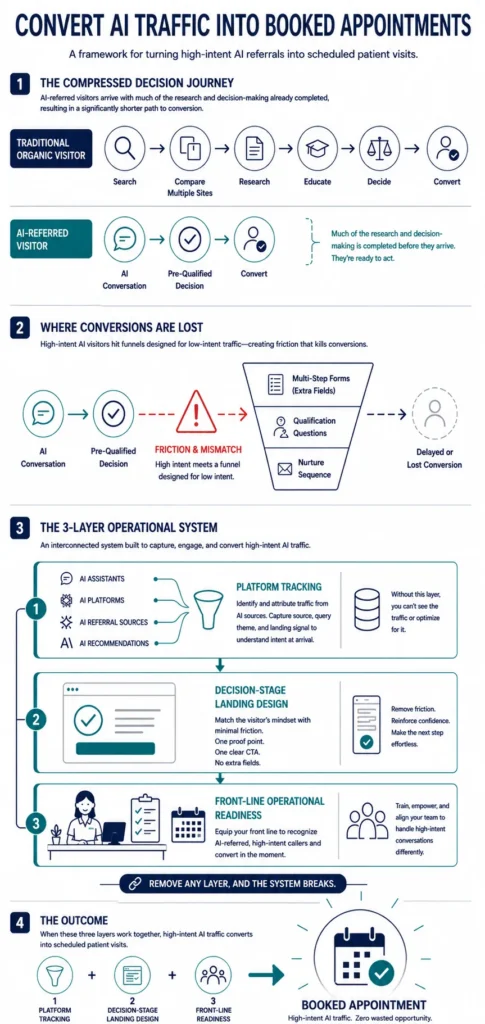
What Does A System To Convert AI Traffic Actually Require Operationally?
Converting AI traffic into appointments requires three coordinated layers working together: platform-level tracking, decision-stage landing experiences, and front-line operational readiness. Treating AI traffic as a decision-stage from the moment it’s identified changes how every downstream system in your operation should be built.
Segmented Tracking By AI Platform
Lumping AI referral sources into generic “Direct” or “Referral” channels in GA4 hides meaningful performance differences between platforms — and the optimization opportunities that come with them. “Seer Interactive’s analysis of a single B2B client covering Oct 2024 – Apr 2025 found ChatGPT referral traffic converting at 15.9% and Perplexity at 10.5% — compared to 1.76% for Google Organic on the same site” — Nadia Mohamed.
- Isolate ChatGPT, Perplexity, Gemini, and Claude as distinct channels
- Track conversion rate and appointment confirmations by individual platform
- Performance varies meaningfully across different AI sources
Without platform-level segmentation, you can’t tell which AI sources are actually producing your booked appointments versus generating noise.
Decision-Stage Landing And Booking Design
AI-referred visitors don’t need re-education when they arrive — they need proof, risk reduction, and an immediate path to action that matches the urgency they showed up with.
- Lead landing pages with outcomes and proof, not introductions
- Minimize form fields and friction for decision-stage sessions specifically
- Surface booking and call options prominently above the fold
Every additional step between landing and booking costs you disproportionately more with visitors already this far along their decision journey.
Operational Playbook Updates For AI-Referred Callers
Front-desk and call-center scripts built around educating cold callers actively work against visitors who arrive already informed by a detailed AI conversation.
- Update scripts to assume baseline education is already complete
- Train staff to recognize AI-referred callers as high-intent leads
- Capture the language callers use to refine future content strategy
Operational readiness must match digital readiness, or the conversion gap simply moves further down your funnel rather than closing.
Is Your Current Operation Set Up To Convert AI Traffic Into Appointments?
Most multi-location operators are still running a content and conversion system built for the 2019-era Google, while their highest-converting traffic source goes largely unmeasured and uncaptured. A systematic audit of tracking, the landing experience, and local profile readiness reveals exactly where the gap lies within your operation.
Auditing Your Current AI Traffic Handling
Before building anything new, an honest audit shows whether AI referral traffic is even being identified correctly, let alone optimized for conversion.
- Check GA4 for AI platform segmentation by specific name
- Review whether AI-referred sessions hit generic or dedicated pages
- Assess GBP booking and review response status across every location
Most operators find the honest answer is “we don’t actually know” — which is itself the diagnostic that matters most.
Where Most Multi-Location Systems Break Down
The breakdown point is rarely the content itself — it’s the disconnect between AI citation, local profile readiness, and booking execution spread across locations. AI conversion performance has also shifted quickly as platforms have matured, with traffic that once underperformed other sources moving to outperform them within roughly a year.
- Inconsistent NAP data across locations confuses AI entity mapping
- Generic landing pages ignore decision-stage visitor needs entirely
- Local profiles get optimized inconsistently across the network
Fixing one layer without fixing the others relocates the same conversion gap elsewhere in the system.
What A Systematic Approach Changes
A coordinated system — content built for AI citation, profiles optimized for local action, and operations trained for decision-stage traffic — closes the gap that a piecemeal approach to convert AI traffic never fully can.
- Citation-ready content increases AI shortlist inclusion rates
- Optimized profiles increase direct booking conversion volume
- Trained front-line staff convert the appointments that reach them
That three-layer coordination is what separates operators who capture this channel’s full value from those who still measure it as an afterthought.
How Content Ops Lab Builds Content Infrastructure
Content Ops Lab’s AI search optimization methodology was built and proven inside a 12-location regulated healthcare organization, where AI search traffic converted at 21.4% over eight months — 6.4 times the site’s overall average. That production environment is where the citation verification and conversion infrastructure behind this article’s methodology was developed and stress-tested.
- 23-month production test inside a 12-location regulated healthcare organization
- 1,000+ citation-verified articles delivered with zero compliance violations
- AI search traffic converting at 21.4% vs. 3.32% site average — a 6.4x performance multiplier
- 887% growth in ChatGPT-referred sessions over seven consecutive months
- 95+ confirmed AI search conversions across an eight-month measurement window
- 45% of all leads generated from organic search, outperforming paid search nearly 2:1
- 653% impression growth and 1,700% click growth for an emerging brand within the same network
- Dual-brand methodology proven across both mature-brand maintenance and emerging-brand growth
The Content Ops Lab Production System
Every engagement runs on a single unified system spanning four coordinated stages, refined across 23 months of live production rather than built from theory alone.
- Research: Verified sources gathered before any content generation begins
- Verification: Line-by-line citation cross-checking with full audit trail
- Optimization: Built simultaneously for Google, ChatGPT, Perplexity, Claude, and Gemini
- Delivery: Publish-ready content staged in WordPress or packaged for client review
Ready to build a content infrastructure that scales without the compliance risk? Get in touch today — we’ll assess your current content operation and outline what a systematic approach would look like for your organization.
FAQs About How To Convert AI Traffic
Why can’t we track AI referral traffic the same way we track organic search?
Standard GA4 channel groupings lump ChatGPT, Perplexity, Gemini, and Claude referrals into generic “Direct” or “Referral” buckets, hiding platform-level performance differences. Isolating each AI source as its own channel is required to see which platforms are actually converting and at what rate.
How long does it take to build a system that converts AI traffic into appointments?
A full system build — covering tracking segmentation, decision-stage landing pages, and local profile optimization — typically takes 12 weeks to implement, followed by a 90-day support period. Done-For-You engagements can show measurable AI referral improvements faster, since the production team handles execution directly from week one.
Does optimizing to convert AI traffic create compliance risk for regulated, multi-location operators?
Optimizing for AI traffic doesn’t inherently create risk — but using unverified AI tools to generate the content that earns those citations does, if claims aren’t checked against source research. A citation verification protocol with line-level audit trails is what keeps AI-optimized content compliant in healthcare, legal, and other regulated industries.
How is converting AI traffic different from standard conversion rate optimization?
Standard CRO assumes visitors need education and gradual qualification before converting; AI-referred visitors have typically completed that process inside the AI conversation already. Converting AI traffic means removing the qualification steps a generic funnel still includes, not adding more of them on top.
Is Done-For-You or System Build better for converting AI traffic into booked appointments?
Done-For-You fits operators who want the full production and optimization system managed for them, including ongoing AI platform tracking and content refinement. System Build fits operators with internal teams who want to own the infrastructure long-term after a guided 12-week implementation and 90-day support period.
Key Takeaways
- AI-referred visitors convert at meaningfully higher rates than organic search because the comparison and qualification work happens inside the AI platform before the click occurs.
- Generic funnels built for top-of-funnel education actively work against decision-stage AI visitors by introducing unnecessary friction at the wrong moment.
- Google Business Profiles function as a primary conversion surface for AI-referred and local traffic — optimization there carries the same weight as landing page optimization.
- A 12-location regulated healthcare organization saw AI search traffic convert at 21.4% over eight months, 6.4 times the site average, using systematic citation and conversion infrastructure.
- Converting AI traffic requires three coordinated layers: platform-level tracking, decision-stage landing design, and operational readiness at the front desk or call center.
- Most multi-location operators are still measuring AI referral traffic as an afterthought rather than building dedicated systems to capture and convert it.
Build Content Infrastructure That Compounds: How To Convert AI Traffic
AI-referred traffic converts better not by accident, but because the qualification work has already happened by the time a visitor clicks through — a structural difference your booking systems either account for or don’t. Most users choose the first AI-generated recommendation they’re shown, which means operators who close the gap to convert AI traffic now will compound that advantage as referral volume continues growing across every platform.
Operators who wait risk building reactive fixes once the channel matures and competitors have already captured the first-mover citation advantage in their markets. Content Ops Lab’s methodology converted AI search traffic at 21.4% — 6.4 times the site average — within a 12-location regulated healthcare organization, proving the infrastructure works under real production conditions rather than theoretical ones.