

How Do You Track AI Referral Traffic?
You track AI referral traffic by building a two-layer measurement system in GA4: a custom channel group with an AI-specific regex filter that pulls ChatGPT, Perplexity, Claude, Gemini, and Copilot sessions out of generic Referral, plus a behavioral segmentation layer that infers AI influence in the Direct traffic where stripped referrer headers hide it.”AI search referral traffic converts at 4.4x to 23x the rate of organic search visitors. Yet, only 14% of marketers actually track AI search performance” — AuthorityTech.
For multi-location operators, the highest-converting traffic in your network is likely invisible in your current reporting stack. Content Ops Lab built its content infrastructure inside a 12-location regulated healthcare organization over 23 months, generating 95+ confirmed AI search conversions at a 21.4% average CVR — 6.4x the site baseline. The tracking came second. The citation-worthy content architecture came first.
Related: Why AI Referral Traffic Converts Higher Than Organic Search
Why Does GA4 Make AI Referral Traffic So Hard to See?
GA4 was not designed to distinguish AI referral traffic from any other external website click. When AI platforms send clean referrer data, the session lands in a generic Referral bucket alongside directory links and forum mentions. When they don’t — which happens frequently — the session disappears into Direct with no recoverable fingerprint.
“If the AI sends a referrer header (e.g., chatgpt.com, perplexity.ai, claude.ai), GA4 files it under generic Referral alongside forum backlinks, directory listings, and random linking domains. If the AI strips the referrer (mobile apps, in-app browsers, certain sandboxed link handlers), GA4 records it as Direct — indistinguishable from someone typing your URL into a browser” — MO Agency.
The Referral Bucket Problem
GA4’s Default Channel Grouping classifies external traffic that isn’t a recognized search engine or social network as Referral. AI platforms fall into this bucket by default.
- ChatGPT, Perplexity, Claude, and Gemini sessions all land in the generic Referral
- AI sources are buried among dozens of unrelated domains
- No first-class channel for AI without manual configuration
- Default reports show no meaningful AI signal without intervention
The referral bucket problem isn’t a GA4 bug — it’s a classification gap that predates the AI referral era.
How Mobile Apps Strip Referrer Data
Desktop browser clicks from AI platforms typically pass referrer headers. Mobile app clicks often don’t — the app-to-browser transition suppresses the referrer before GA4 sees it.
- iOS and Android AI app links frequently open in webview sandboxes
- Webview environments strip referrer headers before GA4 sees them
- Copilot referrals split between copilot.microsoft.com and bing.com/chat
- Gemini iOS traffic is nearly invisible in standard GA4 reporting
The mobile attribution gap is significant enough to distort any AI traffic analysis built exclusively on GA4 session data.
What Gets Misclassified as Direct
Direct is the catch-all for sessions GA4 cannot attribute — branded navigation, bookmark clicks, email links without UTMs, and AI referrals that lost their referrer in transit.
- New users landing on deep content pages via Direct may be AI-driven
- Spikes in Direct engagement with non-homepage URLs are an AI signal worth investigating
- Long session durations and multi-page visits differentiate AI-influenced Direct from navigation traffic
- No analytics configuration alone recovers what the referrer header doesn’t send
Understanding misclassification is a prerequisite for building a measurement infrastructure that accurately captures this channel.
What Are the Real Options for AI Referral Traffic Tracking Today?
No single method captures the full picture. Every current approach involves trade-offs between precision and coverage. Growth leaders need to understand what each option captures — and where it breaks down — before committing infrastructure resources.
“By default, visits from ChatGPT (chatgpt.com), Perplexity (perplexity.ai), Gemini (gemini.google.com), and Claude (claude.ai) are grouped into general referral traffic alongside hundreds of other sources” — Sunil Pratap Singh.
Native GA4 Capability
Out of the box, GA4 can surface AI referrals if you know where to look. The Traffic Acquisition report filtered by Session source/medium will show rows like chatgpt.com / referral when platforms pass referrer headers.
- Filter by source containing ChatGPT, Perplexity, Claude, Gemini, Copilot
- Useful for spot-checking whether AI referrals exist in your data
- No dedicated AI channel — results scattered across Referral and Direct
- Cannot retroactively reclassify historical traffic once custom channels are built
Native GA4 gives a directional read on visible AI traffic — not the structured reporting that executive dashboards require.
Custom Channel Groups and Regex Filters
The most documented approach builds a custom GA4 channel group isolating AI source domains from generic referral noise, positioned above the default Referral rule to create a first-class “AI Assistants” channel.
- Requires Editor-level GA4 access; estimated 10-minute setup per property
- Regex covers: chatgpt.com, chat.openai.com, perplexity.ai, claude.ai, gemini.google.com, bard.google.com, copilot.microsoft.com, bing.com/chat
- Must be applied to each property separately — a manual process at scale
- Custom channels only affect reporting going forward, not historical data
For multi-location operators managing 10+ GA4 properties, standardizing this configuration requires a coordinated rollout and documented governance, not a one-time setup.
Third-Party Attribution Platforms
A subset of organizations extends tracking to server log analysis and CRM-connected event pipelines to capture what GA4 misses.
- Server-log analysis identifies AI-specific user agents invisible to GA4
- UTM conventions (utm_medium=assistant, event=assistant_click) enable CRM attribution
- Specialized tools track citation share and AI visibility signals beyond session data
- Enterprise platforms align GA4 AI channel definitions with downstream revenue reporting
Third-party attribution adds coverage for the dark AI traffic layer, but it requires deliberate architectural decisions before implementation.
How Do You Build a Two-Layer Measurement System?
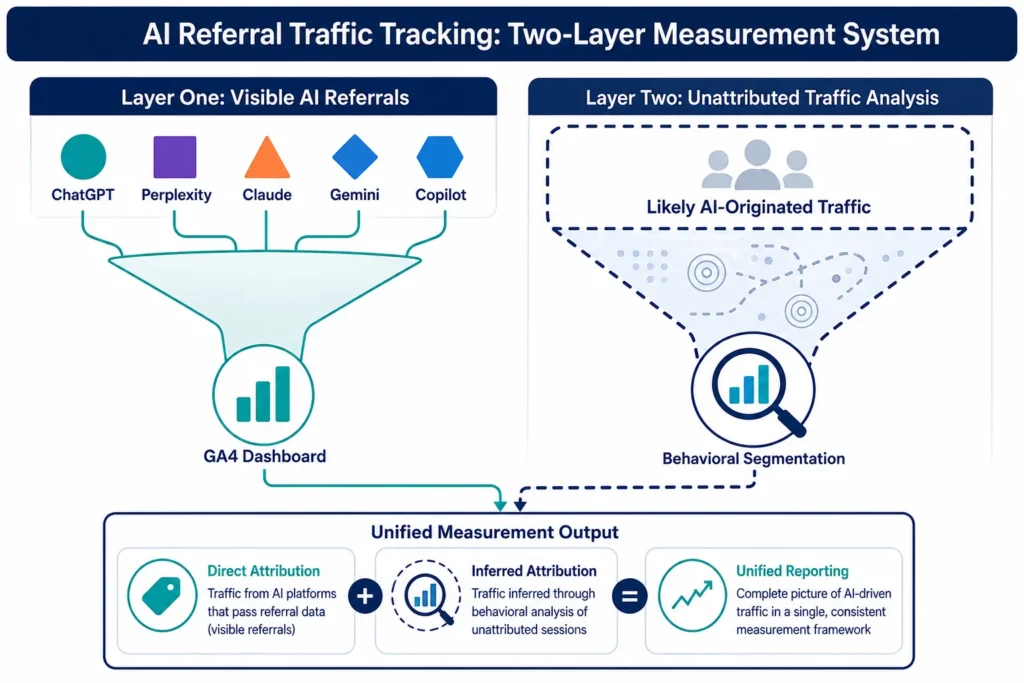
The most defensible architecture treats observable referrals and dark AI influence as separate problems, each requiring its own instrumentation. Layer one captures sessions with AI source data. Layer two infers AI influence in unattributed traffic through behavioral patterns. Neither layer alone gives a complete picture.
Layer One — Visible AI Referrals
Layer one is the GA4 configuration work: custom channel groups, regex filters, and UTM standardization. The goal is to pull every session that passes AI referrer data into a named, reportable channel.
- Create “AI Assistants” custom channel group with maintained regex for all active platforms
- Position the AI channel above Referral in the rule priority order
- Standardize UTM conventions: utm_source=chatgpt, utm_medium=assistant
- Track core KPIs: sessions, engaged sessions, conversion rate, revenue per session, share of pipeline
OpenAI appends utm_source=chatgpt.com to ChatGPT Search referrals automatically. Perplexity, Claude, and Gemini rely on standard HTTP referrer headers. Copilot splits across copilot.microsoft.com and bing.com/chat. Regex filters must account for all active variants, or AI sessions continue leaking into generic Referral.
Layer Two — Dark AI Inference
Layer two addresses AI-influenced sessions that arrive without source data, using behavioral segmentation rather than direct attribution.
- Build a GA4 segment: Direct sessions from new users landing on deep content pages with above-average engagement
- Monitor for spikes in this segment correlated with increased AI citation activity
- Compare Direct segment behavior against AI Referral behavior — meaningful similarity signals AI influence
- Track branded search volume trends alongside AI visibility data
Layer two produces directional evidence of AI-influenced demand arriving through other channels — a more accurate picture of how AI search works in a zero-click environment.
Standardizing Across Locations
For operators managing multiple GA4 properties, the infrastructure challenge is governance, not just configuration. A custom channel group needs to be replicated and maintained across every property in the network.
- Document the AI channel regex as a living standard updated when platforms change behavior
- Assign ownership for maintaining the AI source list as new platforms emerge
- Use Looker Studio to create a cross-property AI traffic dashboard with location-level filtering
- Establish a monthly AI traffic review cadence aligned with organic search performance reporting
Operators who skip governance end up with inconsistent tracking across properties. Some locations appear to have no AI traffic, while others capture it incompletely.
If your organization is producing content at scale but lacks a framework for tracking which of it is cited by AI platforms, Content Ops Lab builds the infrastructure to make that visibility possible. Contact us today to discuss your content production and attribution requirements.
What Does AI Referral Data Actually Look Like in a Production Environment?
The gap between how AI referral traffic tracking is theorized and how it behaves in live GA4 data is significant. Platform behavior is inconsistent, sample sizes are small, and attribution gaps are larger than most growth leaders expect.
“Our server log analysis found GA4 captured only 9% of actual Gemini iOS visits”— Wheelhouse DMG.
Platform-by-Platform Behavior
Each AI platform handles referral data differently, and behavior shifts as platforms update their architectures. Current production patterns:
- ChatGPT: Appends utm_source=chatgpt.com on Search referrals; most reliably trackable platform
- Perplexity: Standard HTTP referrer; appears as perplexity.ai / referral; mobile referrers are frequently stripped
- Gemini: Sends gemini.google.com; legacy Bard traffic under bard.google.com; iOS app traffic largely invisible
- Copilot: Splits between copilot.microsoft.com and bing.com/chat; recently improved GA4 visibility
- Claude: Referrer header claude.ai; treated as standard referral; included in most AI regex patterns
No platform provides complete, consistently attributable referral data. ChatGPT is the closest to being reliable. Gemini iOS is nearly invisible.
Conversion Rate Evidence
Conversion rate data for AI referrals shows wide variance across studies. The directional signal is that AI referrals often convert well — but the magnitude depends on vertical, content architecture, and intent alignment.
- ChatGPT referral traffic is converting at 15.9% — compared to 1.76% for Google Organic on the same site. — Nadiamohamed
- Ahrefs observed 0.5% of visitors arriving from AI search driving 12.1% of total signups — a 23× conversion multiplier for that specific product — AuthorityTech
- Organic traffic converted at an average rate of 4.60%, while LLM referrals converted at 4.87%,” and concluded that “LLM traffic did not convert significantly differently from organic traffic overall,” with a p-value of 0.794. — CoSEOM
- Regulated healthcare production data: 21.4% average AI search CVR vs. 3.32% site average over 8 months — 6.4x performance multiplier
High multipliers are real but site-specific. At current AI traffic volumes — typically under 1% of total sessions — aggregate CVR lift is hard to demonstrate at scale.
The Attribution Gap in Practice
The gap between actual AI traffic and what GA4 records is a structural limitation of how AI referral traffic is tracked today, not a configuration error.
- Mobile AI app traffic systematically undercounts in GA4 regardless of configuration
- UTM parameter stripping undermines ChatGPT attribution on some browsers and extensions
- Zero-click AI interactions generate no GA4 session at all
- Total AI influence on demand is materially larger than what attribution systems currently capture
Treat your GA4 AI channel data as a floor, not a ceiling.
Related: What Is a Good AI Traffic Conversion Rate?
Why Will AI Traffic Measurement Get Harder Before It Gets Easier?
The current tracking problem is a referrer-header problem — incomplete but addressable. The emerging problem is structural. As AI systems move from passive answer engines toward active research agents, the click-to-session model that underpins web analytics will capture a shrinking fraction of AI’s actual influence on demand.
“Dark AI traffic does not — it arrives later through direct visits, branded search, copied links, or untagged journeys. Forrester’s March 2026 analysis confirmed that zero-click behavior is accelerating, with answer engines and genAI tools becoming ‘the primary way buyers gather information’ — and the signals they generate rarely surface in standard analytics” — AuthorityTech.
Zero-Click Environments
AI Overviews and AI assistants are absorbing click volume that previously drove organic sessions — answering questions inside the platform without requiring a site visit.
- AI Overviews answer questions inside Google; citation links are rarely clicked
- ChatGPT, Perplexity, and Claude answer conversational queries without requiring a site visit
- Demand still forms — but the attribution signal never fires
- Content earning AI citations without generating measurable traffic is still doing strategic work
Zero-click visibility is where citation share becomes a more important upstream metric than session count.
Agentic AI and Server-Side Actions
AI agents that autonomously research and transact on behalf of users interact with web content through mechanisms that bypass standard browser-based analytics.
- Agentic systems may fetch pages server-to-server, leaving no GA4 session
- Multi-step agent workflows touch your content without triggering a measurable visit
- The session model of measurement breaks down when agents act without human click paths
For growth leaders planning 2026–2027 measurement infrastructure, agentic AI is already affecting how platforms interact with web content.
The Shift to Citation Share Metrics
As session-based attribution captures a shrinking fraction of AI influence, forward-looking organizations are supplementing GA4 with upstream proxy metrics.
- Answer Inclusion Rate (AIR): How often your content appears as a cited source in AI answers
- Citation Share of Voice (C-SOV): Your citations relative to competitors’ across a defined query set
- Assistant Mentions: How frequently your brand appears in AI-generated answers, regardless of click-through
- Branded search correlation: Whether AI citation activity correlates with branded search volume lift
These metrics frame session data — providing the upstream context that explains why AI-influenced Direct traffic behaves differently.
What Does a Mature Tracking Infrastructure Actually Require?
Mature tracking requires treating measurement as an ongoing operational system rather than a one-time GA4 configuration. Organizations with reliable AI attribution data over the past 12 months are building governance structures now.
Taxonomy and Governance
A shared taxonomy — documented definitions of visible AI referrals, dark AI traffic, and AI-influenced demand — is the prerequisite for consistent reporting across locations.
- Define “AI Assistants” channel: sessions with confirmed AI source data in GA4
- Define “Shadow AI” segment: Direct sessions behaviorally consistent with AI referrals
- Define “AI-influenced demand”: branded or offline conversions correlated with AI citation visibility
- Assign ownership for maintaining the AI source regex as platforms evolve
- Document platform-specific behavior so that reporting anomalies are understood, not re-investigated each cycle
Multi-location enterprises managing dozens of GA4 properties cannot maintain consistent tracking without governance documentation.
Dashboard Design for Executives
Executive dashboards need to answer three questions: how much AI traffic is arriving, where it is converting, and whether the trend is improving.
- Acquisition layer: AI sessions as a percentage of total traffic by platform, trended monthly
- Engagement layer: Engaged sessions, average session duration, pages per session — AI vs. organic
- Outcome layer: Conversion rate, macro-conversion count, revenue per session, share of leads from AI
- Location layer: AI traffic and conversion breakdown by location — aggregate numbers mask location-level variation
Looker Studio, connected to GA4, is a practical tool for cross-property dashboards. Consistent data inputs across properties is where the real work lies.
CRM Attribution and Pipeline Reporting
Session-level tracking in GA4 is the starting point. Growth leaders need AI referral data integrated into the pipeline to quantify the value of AI-sourced leads downstream.
- Implement event naming (assistant_click, assistant_lead) that carries the AI source into CRM
- Map utm_medium=assistant flags through lead forms to CRM contact records
- Track AI-sourced leads through close stages to calculate channel revenue contribution
- Build attribution models accounting for AI’s role in multi-touch journeys — AI often influences demand that converts through Direct or branded search later
CRM-connected attribution is the point at which the ROI case for content investment becomes defensible at the executive level.
How Content Ops Lab Builds Content Infrastructure That Gets Cited
Content Ops Lab’s AI search data from a 23-month production deployment inside a 12-location regulated healthcare organization validates a core principle: tracking AI referral traffic starts with content architecture, not analytics configuration. The 95+ confirmed AI search conversions, with an average CVR of 21.4%, came from citation-worthy content that AI platforms wanted to reference.
- 23-month production test inside a 12-location regulated healthcare organization
- 1,000+ citation-verified articles delivered with zero compliance violations
- 887% ChatGPT traffic growth in 7 months (8 sessions → 79 sessions, July 2025–February 2026)
- 21.4% average AI search CVR vs. 3.32% site average — 6.4x performance multiplier
- 95+ confirmed conversions from AI platforms over 8 months
- 45% of all leads from organic search — outperforming paid search nearly 2:1
- 653% impression growth and 1,700% click growth for an emerging brand in 14 months
- 5x production scale: 10 articles/month to 50+ without adding headcount
The Content Ops Lab Production System
Every article is built to earn AI citations — not just rank in Google. The system runs four stages before publication:
- Research: Verified sources and client knowledge base — no AI writing from memory
- Verification: Line-by-line citation cross-check with STAT vs. CLAIM labeling and full audit trail
- Optimization: Multi-platform architecture — Google, ChatGPT, Perplexity, Claude, and Gemini simultaneously
- Delivery: WordPress staging or Google Docs packages — publish-ready, compliance-reviewed, citation-structured
Content architecture that earns citations is the prerequisite that makes measurement worth doing.
Ready to build a content infrastructure that produces trackable AI referral results? Get in touch — we’ll assess your current content operation and outline what a systematic approach would look like for your organization.
FAQs About AI Referral Traffic Tracking
Can’t we just use the Referral channel in GA4 to track AI traffic?
The generic Referral channel mixes AI sources with hundreds of unrelated domains. Without a custom AI channel group positioned above the default Referral rule, ChatGPT and Perplexity sessions are buried and never surface in executive dashboards. Systematic AI referral traffic tracking requires deliberate configuration rather than passive monitoring of existing reports.
How long does it take to set up AI tracking in GA4?
The GA4 configuration — a custom channel group with the core AI domain regex — takes approximately 10 minutes per property with Editor-level access. For multi-location operators managing 10+ properties, the harder work is governance: documenting the regex standard, assigning update ownership, and standardizing configuration so that AI traffic reports are consistent across the network.
How do we accurately report AI traffic to executives when the data is incomplete?
Acknowledge the measurement floor explicitly. GA4 captures visible AI referrals but not dark AI traffic arriving as Direct, zero-click influence, or mobile app referrals that bypassed the browser session layer. Frame GA4 data as a minimum baseline, supplement it with behavioral segmentation of Direct traffic, and track upstream citation metrics alongside session data.
How is this different from traditional SEO reporting?
Traditional SEO reporting centers on session counts, rankings, and organic channel conversions. AI referral traffic tracking adds a layer that session analytics cannot fully capture: citation share, answer inclusion frequency, and the influence of zero-click demand. Tracking AI referral traffic adds a layer that session analytics cannot fully capture: citation share, answer inclusion frequency, and the influence of zero-click demand. It requires a parallel measurement system with upstream visibility metrics, not a modification to existing organic search reports.
How does Content Ops Lab incorporate AI traffic tracking into its content infrastructure?
Content Ops Lab builds content architecture designed to generate AI citations from the first article published — question-based H2 structure, answer-first formatting, verified citations, and bullet-heavy content optimized for AI parsing. A multi-location healthcare deployment generated 537+ AI search sessions and 95+ confirmed conversions over 8 months because the content was structured to earn citations from ChatGPT, Perplexity, Claude, and Gemini simultaneously.
Key Takeaways
- Systematic AI referral traffic tracking requires custom GA4 channel groups with AI-specific regex, positioned above the default Referral rule and standardized across every property in your network
- A material portion of AI-influenced traffic arrives without referrer data — dark AI inference through behavioral segmentation is a required second layer
- GA4 can capture as little as 9% of actual mobile AI visits; treat GA4 AI channel data as a floor, not a complete picture
- Conversion rates for AI referrals range from negligible to 23x organic benchmarks — multipliers are real but site-specific, not universal
- Zero-click AI environments and agentic AI are accelerating the gap between AI’s influence on demand and what session analytics can measure — citation share metrics will become primary, not supplementary
- Multi-location operators need governance infrastructure, not just per-property configuration — ownership of the regex standard and reporting cadence matters as much as the technical setup
- Content architecture that earns AI citations is the upstream prerequisite — measurement becomes strategically meaningful only when the content produces citations worth tracking
Build Measurement Infrastructure That Compounds: AI Referral Traffic Tracking
Tracking AI referral traffic is an infrastructure problem, not an analytics problem. The organizations with reliable AI referral traffic tracking data in 12 months are building citation-worthy content now— because you cannot track AI referrals you are not generating. Only 14% of marketers are systematically tracking AI search performance. That gap is the first-mover opportunity.
Content Ops Lab builds content infrastructure designed to generate AI citations at scale — the same system that produced 887% ChatGPT traffic growth and 21.4% average AI search CVR across a 23-month regulated healthcare deployment. The window to build citation dominance before competitors enter this channel is measured in quarters, not years.


One Comment
Comments are closed.