

Why Does AI Search Buyer Intent Matter?
AI search buyer intent explains why a small fraction of your traffic is generating a disproportionate share of your conversions. When buyers use AI platforms to research providers, compare options, and build shortlists before ever visiting a website, the visitors who click through arrive pre-qualified — further along the decision journey than any top-of-funnel organic visitor.
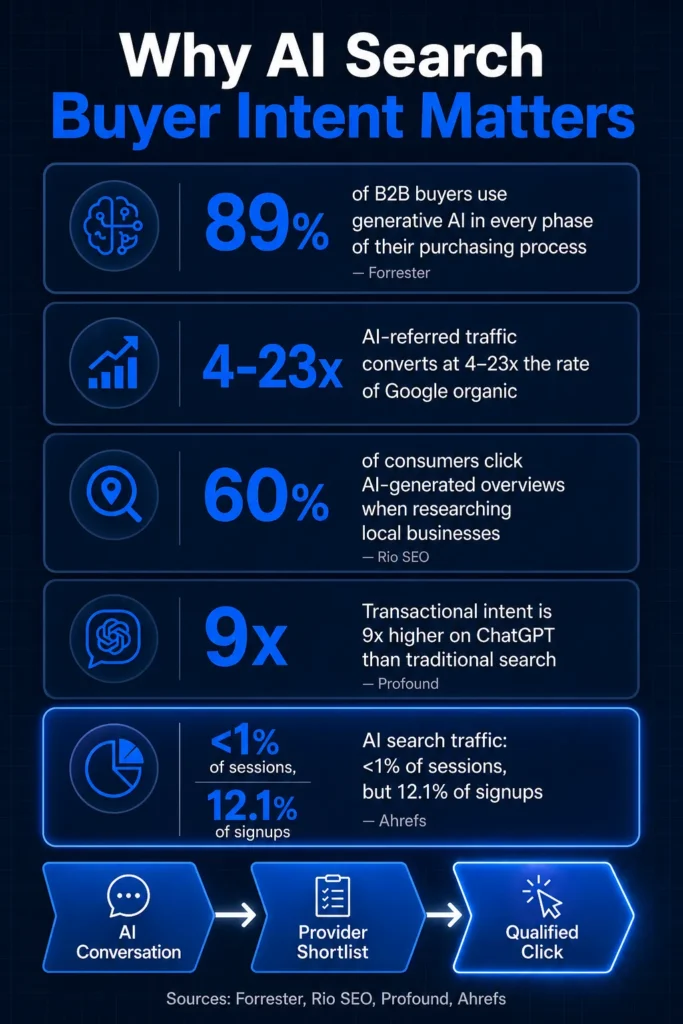
“In less than two years, 89% of B2B buyers have adopted generative AI (genAI), naming it one of the top sources of self-guided information in every phase of their buying process” — Forrester. For multi-location operators in healthcare, legal, and home services, the qualification work that used to happen across multiple sessions and provider pages is now happening inside AI conversations — before your site ever enters the picture.
Content Ops Lab built its production methodology within a 12-location regulated healthcare organization specifically to capture this channel: 95+ confirmed AI search conversions over 8 months, with an average conversion rate of 21.4% against a 3.32% site baseline.
Related: How AI Search Engines Evaluate Source Trust and Credibility
What Breaks in Your Analytics When Buyer Intent Shifts to AI Conversations?
AI search buyer intent disrupts traditional analytics models because most measurement infrastructure was built to track journey progression across sessions, and AI search collapses that journey into a single conversation before the first click. When buyers arrive having already completed research and shortlisting inside an AI environment, the signals your analytics were designed to read are already gone.
The Traffic Volume Trap
Traffic volume has been the default proxy for content performance for over a decade. Applying that proxy to AI search produces systematically wrong conclusions.
- AI-referred traffic represents under 1% of total sessions for most sites
- Volume metrics flag this channel as statistically insignificant
- Conversion rate — not session count — is the correct evaluation metric
- Teams optimizing for volume systematically undervalue their highest-converting source
Without deliberate GA4 configuration isolating ChatGPT, Perplexity, Gemini, and Claude as distinct referral sources, the channel is invisible regardless of performance.
Intent Signal Loss in Traditional Metrics
Traditional analytics interprets user behavior as a proxy for intent: time on site, pages per session, scroll depth. These signals break down when visitors arrive mid-funnel rather than at the top.
- AI-referred visitors arrive later in the journey — less browsing, more action
- Short session times can be misread as low engagement when they reflect high confidence
- Multi-page browsing in AI traffic signals, active verification, not confusion
- Bounce rate loses meaning when the visit purpose is confirmation, not discovery
Applying organic benchmarks to AI-referred visitors yields incorrect conclusions because the intent state differs.
What You’re Actually Measuring Now
Most multi-location operators are running measurement built for 2019-era search behavior — a model that assumes buyers arrive early and convert after progressive engagement across sessions.
- Current model: session volume → engagement signals → conversion
- AI search model: AI conversation → qualified arrival → conversion on first visit
- The gap between these models is where attribution failures happen
- Revenue from your highest-converting channel goes uncredited
Without clean AI referral attribution in GA4, you can’t evaluate the channel, optimize for it, or defend investment in it.
How Do Traditional Search Intent Frameworks Compare to AI Search Behavior?
Traditional intent frameworks divide search behavior into four categories — informational, navigational, commercial, and transactional — and organize them into a funnel. That model was accurate when buyers progressed through multiple sessions across days. AI search compresses the funnel, often completing multiple intent stages in a single conversational thread.
The Four-Bucket Intent Model and Its Limits
The four-bucket framework was built on SERP behavior and assumes a linear journey that AI search has disrupted.
- Informational queries (52.7% of traditional search) reflect early-stage research
- Commercial queries (14.5%) signal comparison and evaluation
- Transactional queries (0.6%) indicate purchase readiness
- These distributions were measured before AI platforms entered the research workflow
“Buyers now use AI for tasks they once completed by searching, such as researching product information (54%) or making product comparisons (55%)” — Forrester.
The tasks that generated informational and commercial query volume in traditional search now occur within AI conversations, not in SERPs.
How AI Collapses the Research Journey
Profound’s analysis of tens of millions of ChatGPT interactions found that traditional search distributions no longer map onto AI behavior. The dominant intent category in AI search isn’t informational — it’s generative, accounting for 37.5% of interactions. Informational intent dropped by 20 percentage points compared with traditional search. Navigational intent collapsed from 32.2% to 2.1%. Transactional intent increased 9x, from 0.6% to 6.1% — Profound.
- Buyers use AI to synthesize, recommend, and decide — not just inform
- Generative intent (“compare these,” “recommend a provider”) indicates action orientation
- Transactional intent jump signals buyers arriving at AI with purchase readiness already formed
- Multi-tab research sessions compress into single AI conversations
For multi-location service operators, the informational and comparative work that once drove organic traffic now occurs within AI platforms that may not send visitors to your site at all.
Where Traditional and AI Intent Overlap
The buyer’s underlying need hasn’t changed — they still need to identify a problem, evaluate options, and take action. AI search accelerates and concentrates that process.
- High-stakes decisions (healthcare, legal, financial) still involve cross-checking
- Buyers use AI alongside reviews, directories, and provider sites — not instead of them
- Transactional queries (booking, scheduling) remain primarily in traditional search
- Credibility infrastructure still matters because AI platforms cite sources
Operators who understand which stages now happen inside AI environments can build content architecture that captures citations at the right moment.
Why Does AI Search Buyer Intent Convert at Rates Traditional SEO Can’t Match?
AI search buyer intent converts at higher rates because the qualification process has already happened by the time a visitor arrives. The AI environment completes research, comparison, and shortlisting on the buyer’s behalf. What looks like a first visit is often the final step in a decision that was mostly made during a chat session.
Pre-Qualification Inside the AI Environment
When a buyer asks ChatGPT for a provider recommendation, they’re often ending a research process — not beginning one. Provider shortlists form inside AI before any website is visited.
- AI platforms act as digital advisors, synthesizing and recommending rather than indexing
- Click-through from AI represents a qualified referral, not curiosity-driven discovery
- Buyers enter AI conversations to decide, not just retrieve information
- Options are surfaced, compared, and ranked before a single site visit occurs
“For informational queries, AI Overviews were triggered 98% of the time, versus 40% for commercial, 35% for navigational, and 0% for transactional” — Medill Spiegel Research Center.
AI systems are most active during informational and comparative stages — the stages that determine shortlist composition before purchase intent fully surfaces.
The Advisor Trust Transfer
AI citations function differently from traditional search listings. A blue link in a SERP is one of ten options. An AI recommendation is a synthesized judgment, and buyers treat it accordingly.
- 79% of global B2B buyers say AI search has changed how they conduct research — G2
- Trust transfer from an AI citation to the provider is measurably stronger than organic click trust
- AI recommendations carry implicit authority similar to a trusted colleague’s referral
- Buyers who click through from AI arrive with fewer objections already in place
A visitor who arrives because an AI platform recommended your practice has a fundamentally different psychological state than someone who found you fourth in an organic results list.
Session Behavior Differences That Signal Readiness
Independent analytics studies consistently show that AI-referred visitors behave like late-funnel arrivals rather than early-stage explorers.
- Ahrefs: 0.5% of traffic from AI search, but 12.1% of signups — a 23x conversion multiplier — T.J. Robertson
- Seer Interactive: ChatGPT visitors converted at 15.9% vs. 1.8% for Google organic — Shashi Bellamkonda
- TripleDart: 8.6% CVR vs. 2.1% for Google organic, with 2.3 pages per session vs. 1.2 — Hall
- Forrester: AI-referred B2B buyers spend 300% more time on site than Google organic arrivals — Forrester
The pattern holds across independent analytics cases, B2B and consumer contexts, and multiple AI platforms.
If your operation is producing content for traditional search but not yet capturing AI citations, you’re missing the highest-converting channel in your marketing mix. Contact us to discuss how Content Ops Lab builds the infrastructure that gets cited.
What Does AI Search Conversion Data Actually Look Like in Production?
Production-level AI search data now provides a consistent picture across independent case studies and industry surveys. AI-referred traffic converts at 4–23x the rate of Google organic across business types, geographies, and content categories.
Industry Benchmarks Across Independent Studies
“TripleDart observed ChatGPT traffic converting at 8.6% compared to Google organic traffic’s 2.1%… ChatGPT visitors view an average of 2.3 pages per session compared to Google’s 1.2 pages” — Hall.
- Ahrefs internal data: 23x conversion rate versus Google organic (0.5% of traffic, 12.1% of signups)
- Seer Interactive: 15.9% ChatGPT CVR vs. 1.8% Google organic for the same property
- TripleDart: 8.6% vs. 2.1%, with deeper per-session engagement
- Forrester: B2B AI-referred buyers spend 300% more time on the site and close larger deals
The range (8x–23x) reflects differences in industry, content quality, and AI optimization maturity — the direction is consistent across every measured case.
Healthcare and Local Service Performance Patterns
For regulated service businesses, AI search conversion data maps directly to pre-qualification behavior. Healthcare, legal, and professional service decisions are high-stakes and trust-dependent — exactly the conditions under which AI advisory behavior drives the strongest lift in conversion.
- Rio SEO: 60% of consumers click AI-generated overviews when researching local businesses — Rio SEO
- Rio SEO: 89% say up-to-date online information influences their choice of healthcare provider — Rio SEO
- Press Ganey: consumers increasingly use AI tools to aggregate options and streamline provider selection — Press Ganey
- Multi-location service operators face AI-mediated discovery, whether or not they’ve optimized for it
The question isn’t whether AI search is influencing decisions. It already is. The question is whether your content is positioned to be cited when those decisions happen.
The Production Results From a Regulated Healthcare Deployment
A 12-location multi-brand healthcare organization built a content infrastructure optimized for AI citation over a 23-month production period, validating the industry conversion data at operational scale.
- 21.4% average AI search CVR vs. 3.32% site average — a 6.4x performance multiplier
- 95+ confirmed conversions from AI platforms over 8 months (July 2025–February 2026)
- 887% ChatGPT session growth in 7 months (July 2025–February 2026)
- Peak ChatGPT CVR: 40% in January 2026, with 52 sessions that month
- Under 0.3% of total traffic delivers a disproportionate conversion share
Small by volume, dominant by performance — a ratio that characterizes AI search across every independent data source that has measured it.
Related: Why Does AI Referral Traffic Convert Higher Than Organic Search?
What Content Architecture Gets Cited by AI Systems?
AI systems don’t cite content randomly. They select sources structured for extraction, authoritative in tone, and verifiable in their claims. Content built for traditional SEO — keyword-dense, narrative-heavy, citation-light — is systematically less likely to be cited than content built to answer specific questions with verified evidence.
Structured Formatting for AI Extraction
AI systems look for clear question-answer pairings, scannable structure, and extractable data points. Content that buries answers in paragraphs gets passed over.
- Answer-first H2 structure: 40-60-word direct answer before any elaboration
- Question-based H2 formatting matches how users phrase AI queries
- 40-60% bullet ratio makes content machine-parseable at scale
- Short, specific bullets (6-10 words) provide extractable claim units
Medill’s study found brand-controlled properties captured 47% of AI Overview sources — meaning owned content has a direct path to citation when structured correctly.
Citation Integrity as a Trust Signal
AI systems evaluate credibility, not just content. Fabricated citations actively damage citation candidacy.
- Every statistic must trace to a credible, verifiable source
- Exact quotes from source material are safer than paraphrased summaries
- STAT vs. CLAIM distinctions matter — numeric data requires a different verification rigor
- Hallucinated citations cause AI systems to treat the entire source as lower credibility
Content that makes unsourced assertions in regulated industries is more likely to be filtered out than cited.
Answer-First Design for Recommendation Capture
When a buyer asks an AI system for a provider recommendation, the AI searches for content that directly and confidently answers the underlying question. Content structured for that search gets cited; content built for keyword density gets ignored.
- H1 and H2 questions should mirror the exact queries buyers ask AI platforms
- Opening paragraphs must deliver the direct answer before any setup or context
- FAQ blocks with concise, snippet-ready answers give AI an explicit extraction target
- Confident, definitive language outperforms hedged or conditional statements
The structural principles that produce featured snippet capture in traditional search produce citation capture in answer engines.
How Should Multi-Location Operators Build a Strategy Around AI Search Buyer Intent?
Building an AI search buyer intent strategy requires three sequential investments: measurement infrastructure to see the channel clearly, content infrastructure to earn citations consistently, and timing discipline to capture the first-mover window before mainstream adoption closes it.
Measurement Infrastructure First
Most multi-location operators have AI referral traffic in GA4 right now — misclassified as direct or aggregated into organic — with no visibility into its conversion performance.
- Configure GA4 channel groupings to isolate ChatGPT, Perplexity, Gemini, and Claude as distinct referral sources
- Build custom segments comparing AI referral session quality against organic and paid baselines
- Track AI referral CVR separately from aggregate organic CVR — the numbers will diverge significantly
- Establish a monthly reporting cadence, surfacing AI citation volume and conversion independently
Fixing attribution clarifies the ROI case for content infrastructure investment and reveals conversions already happening that current reporting misses.
Content Infrastructure That Captures Citations
Citation capture is a systems outcome, not a one-article outcome. Consistent architecture, verified citations, and answer-first formatting at 20-50 articles per month earn citations systematically.
- “AI is reshaping how business buyers discover providers, compare options, and make decisions — often long before they ever click through to your site” — Forrester
- Research-first workflows prevent the hallucinated citation problem that disqualifies content from AI trust systems
- Multi-location operators need location-specific content with consistent architecture — not generic articles replicated across pages
- The volume requirement (20-50+ articles/month) is the load-bearing constraint most internal teams can’t satisfy
The First-Mover Window Closing
Fewer than 5% of healthcare practices and fewer than 10% of legal firms are currently optimizing for AI search. That window is measured in months, not years.
- Early citation patterns compound: AI systems reinforce existing citation sources
- Competitors who establish citation authority now will be harder to displace later
- The 12-18 month window before mainstream agency adoption is the strategic entry point
- First-mover advantage in AI search follows the same compounding logic as domain authority in traditional SEO
Operators treating AI search buyer intent as a “wait and see” channel are watching competitors claim citations that become harder to displace each quarter.
How Content Ops Lab Builds Content Infrastructure for AI Search
A 12-location regulated healthcare organization running a dual-brand operation produced 1,000+ citation-verified articles over 23 months using the Content Ops Lab methodology — with zero compliance violations and AI search converting at 21.4% average, a 6.4x multiplier over the site baseline.
- 23-month production test inside a 12-location regulated healthcare organization
- 1,000+ citation-verified articles and pages delivered with zero compliance violations
- 21.4% average AI search CVR vs. 3.32% site average — 6.4x performance multiplier
- 95+ confirmed conversions from AI platforms over 8 months
- 887% ChatGPT session growth in 7 months (July 2025–February 2026)
- 45% of all leads from organic search — outperforming paid search nearly 2:1
- 5x production scale: 10 articles/month to 50+ without adding headcount
- Dual-brand methodology: validated on both mature brand maintenance and emerging brand growth
The Content Ops Lab Production System
The methodology sequences four stages that traditional agencies skip or collapse.
- Research: Verified sources before generation — no AI writing from memory, no hallucinated citations
- Verification: Line-by-line citation cross-check, STAT vs. CLAIM labeling, full audit trail
- Optimization: Structured for Google, ChatGPT, Perplexity, Claude, and Gemini simultaneously
- Delivery: WordPress staging or Google Docs — publish-ready, compliance-reviewed, AI-extractable
The gap between generic AI content and citation-worthy content is the verification infrastructure. Any team can run an article through ChatGPT. Very few have built the quality control mechanisms that make that content trusted by AI systems in regulated industries.
Ready to build content infrastructure that earns AI citations at scale? Get in touch today — we’ll assess your current content operation and outline what a systematic approach would look like for your organization.
FAQs About AI Search Buyer Intent
Isn’t AI search traffic too small to justify a dedicated content strategy?
The volume objection applies the wrong metric. AI search traffic accounts for under 1% of sessions for most sites — but independent studies from Ahrefs, Seer Interactive, and TripleDart show it converts at 8–23x the rate of Google organic. At a multi-location healthcare practice where each appointment is worth $1,500–$3,000, a channel converting at 21% doesn’t need high volume to generate meaningful revenue.
How long does it take to start generating conversions from AI search?
Content infrastructure takes 3-6 months to produce measurable AI citation volume. Early citations can appear within weeks of publishing well-structured, answer-first content — but consistent capture requires a library of articles with verified architecture. Configuring GA4 to isolate AI referral sources often reveals conversions already happening that most operations are misattributing to direct or organic.
How do you ensure AI systems cite your content accurately without misrepresenting claims?
Citation accuracy is a content architecture problem. Content built with exact quotes from verifiable sources — not paraphrased summaries or fabricated statistics — gives AI systems accurate material to cite. A research-first workflow with line-by-line citation verification eliminates the inputs that produce misrepresentation in regulated industries.
How is optimizing for AI search buyer intent different from traditional SEO keyword targeting?
Traditional SEO targets keyword phrases and ranking position. AI search optimization targets question structures and answer quality — because AI systems synthesize recommendations rather than ranked lists. The architecture requirements overlap significantly, but citation verification is the critical addition: traditional SEO doesn’t require it, but AI trust systems reward it.
Does Content Ops Lab’s Done-For-You model include AI search, citation tracking, and optimization?
Yes. Both service models optimize for AI citation capture — question-based H2 architecture, answer-first formatting, citation verification, and multi-platform distribution across Google, ChatGPT, Perplexity, Claude, and Gemini. AI citation tracking requires GA4 configuration, which we assess during onboarding. For most multi-location operations, this reveals AI search conversions that are already occurring but that current reporting isn’t capturing.
Key Takeaways
- AI search buyer intent explains why AI-referred visitors convert at 4–23x the rate of traditional organic traffic: qualification happens inside AI conversations before the first click
- Most multi-location operators have AI search conversions occurring right now that their GA4 configuration isn’t capturing — measurement infrastructure is the first investment
- Traditional intent frameworks no longer map onto AI behavior; generative and transactional intent dominate AI sessions, compressing multi-session research journeys into single conversations
- Content architecture built for AI citation — answer-first structure, question-based H2s, verified citations, 40-60% bullet ratio — is the mechanism that captures citations consistently
- A 12-location regulated healthcare organization produced 21.4% average AI search CVR over 8 months — a 6.4x multiplier over the site baseline
- Fewer than 5% of healthcare practices are currently optimizing for AI search citations; the first-mover window is open but closing as mainstream agency adoption accelerates
- The strategic imperative is sequential: configure measurement first, build content infrastructure second, capture citation authority before competitors establish it
Why AI Search Buyer Intent Requires Systems, Not Shortcuts
AI search is not a traffic optimization problem. It’s a buyer behavior shift that changes where qualification happens, which changes what conversion rates are achievable, which changes how content infrastructure should be built. Independent data from Forrester, G2, Ahrefs, and Seer Interactive all point to the same conclusion: buyers completing research inside AI environments arrive further along the decision journey, with narrower shortlists and stronger purchase readiness.
The operators who benefit are the ones whose content is cited when those shortlists are formed. That’s not a function of publishing volume or keyword targeting — it’s a function of content architecture, citation integrity, and verification infrastructure built to earn AI trust in regulated industries.
Content Ops Lab’s methodology was developed and production-tested in a live, regulated environment over 23 months: the difference between content that gets cited and content that gets ignored is the system behind it.