
What Does AI Referral Traffic in GA4 Look Like?
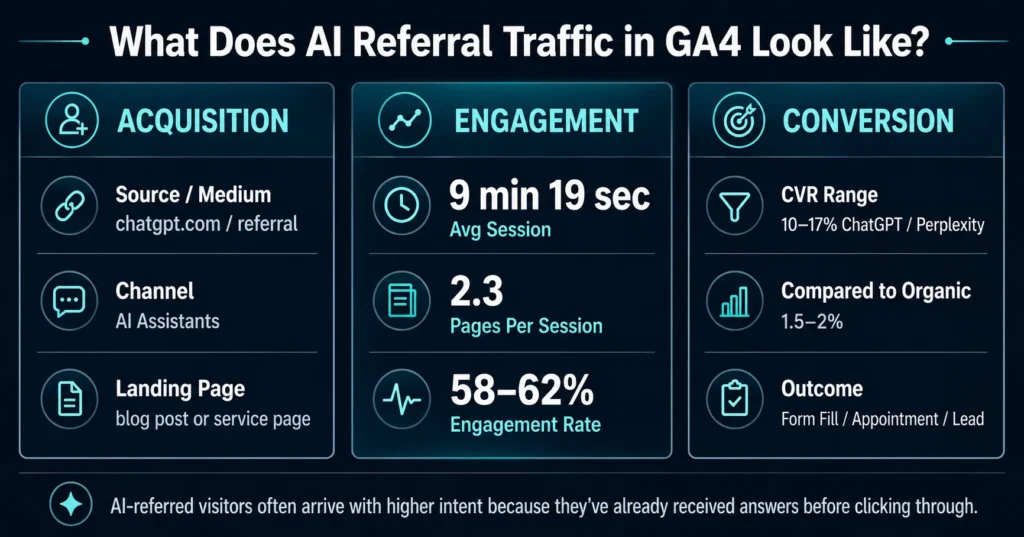
AI referral traffic in GA4 appears across four places: the new AI Assistants default channel group, the Referral channel (e.g., chatgpt.com / referral), Direct / (none) when referrer headers are stripped, and Organic Search when AI Overview clicks are tagged identically to standard search traffic.
“By default, visits from ChatGPT (chatgpt.com), Perplexity (perplexity.ai), Gemini (gemini.google.com), and Claude (claude.ai) are grouped into general referral traffic alongside hundreds of other sources” — Sunil Pratap Singh. For VPs of Marketing managing multi-location operations, that default setup means your highest-converting acquisition channel is buried in a generic bucket with coupon sites and news directories.
A 12-location regulated healthcare organization that ran Content Ops Lab’s methodology tracked 95+ confirmed conversions from AI search platforms over 8 months — at an average CVR of 21.4%, 6.4x the site baseline. That performance only became actionable because the team built the infrastructure to see it.
Related: How Do You Track AI Referral Traffic?
Why Is AI Referral Traffic So Hard to Find in GA4’s Default Reports?
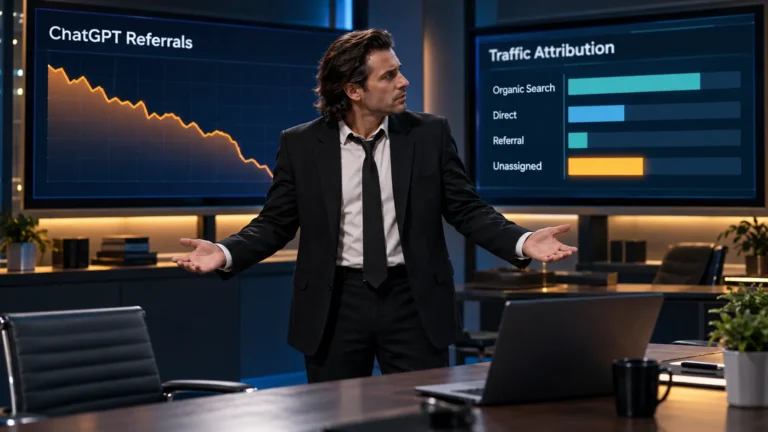
AI referral traffic in GA4 is hard to find because its default channel structure was built before ChatGPT, Perplexity, and Claude existed as referral sources. The system has no native category for AI-referred sessions, so visits scatter across Referral, Direct, Organic, and Unassigned depending on whether the referrer header survives the handoff.
The Four Buckets Where AI Traffic Hides
GA4 now includes a dedicated AI Assistants channel — “AI Assistants is the channel by which users arrive at your site from sources like ChatGPT, Gemini, Deepseek, Copilot, or Grok” — but this only captures sessions where the referrer is recognized and correctly mapped — Google Analytics Help. Beyond that channel, AI sessions scatter into three additional buckets:
- Referral: chatgpt.com / referral or perplexity.ai / referral when the referrer header passes through
- Direct / (none): when AI apps or Overviews suppress the referrer entirely
- Organic Search: when AI Overviews send clicks tagged identically to standard search traffic
- Unassigned: when none of GA4’s channel rules match the session
A single AI platform can appear across multiple channels simultaneously, so aggregating your AI traffic requires checking all four places.
The New AI Assistants Channel and Its Limits
Google’s May 2026 update was a meaningful step. GA4 now assigns a new AI-assistant medium and campaign value when a recognized AI chatbot sends a referral, surfacing those sessions in Default Channel Group reports without manual configuration. The limits are real, however:
- Coverage depends on referrer visibility — stripped referrers still land in Direct
- AI Overviews and AI Mode are excluded — embedded Google search AI clicks appear as Organic
- Historic data is not retroactively classified — only future sessions benefit
- Less common platforms (You.com, Phind, Qwen) may not yet appear in the recognized domain list
Why Direct Traffic Spikes Can Signal AI Demand
When AI apps suppress the referrer header — common in mobile environments — GA4 records the visit as (direct) / (none). If your Direct traffic is climbing while Referral holds flat, AI platforms are a plausible explanation. Cross-referencing Direct traffic growth against your AI-adjacent content publishing cadence is a low-cost first diagnostic before building more formal attribution infrastructure.
How Much of Your AI Referral Traffic Is GA4 Actually Capturing?
Less than most operators assume — and sizing that gap starts with understanding how AI referral traffic in GA4 is classified by default.”Server-log analysis consistently finds that GA4’s visible AI sessions represent a fraction of actual AI-driven visits — and the attribution gap is largest for mobile AI apps, where referrer headers are frequently stripped before the session reaches your property.
The Server-Log Gap: What Studies Show GA4 Misses
The most concrete measurement of the attribution gap comes from enterprise analytics research comparing server logs against GA4 session data: “GA4 captured only 9% of actual Gemini iOS visits” — Wheelhouse DMG. The same research found visible AI referral sessions growing 163% year-over-year. At the same time, Direct traffic climbed by tens of thousands of sessions. What the server-log data shows:
- Mobile AI apps frequently strip AI referrer headers before reaching GA4
- The resulting sessions are classified as Direct with no path back to the originating platform
- AI Overviews add a second layer of invisibility — clicks tagged identically to standard organic
- Actual AI influence on your pipeline is larger than your labeled AI channel reports suggest
AI Overviews and the Invisible Click Problem
When a user clicks a citation link inside a Google AI Overview, Google often passes a no-referrer attribute — or categorizes the click in the same way it does for traditional organic. The result: AI-assisted discovery that drives a website visit gets credited to Organic Search, not to any AI channel. For multi-location operators running local SEO strategies, this means citation inclusions in AI Overviews produce real traffic gains that are systematically misattributed in default reporting.
The 93/23 Paradox: Low Volume, High Stakes
“AI search research documents a pattern worth building reporting infrastructure around: 93% of AI Mode searches end without a click to any external website, but the clicks that do occur convert at 23x the rate of standard organic traffic” — ZipTie.dev. For VPs evaluating whether AI referral traffic deserves a dedicated reporting lane:
- Small absolute session volumes mask large conversion rate advantages
- A channel converting at 15-20% deserves executive visibility even at 0.3% of total traffic
- Attribution gaps mean true contribution is larger than GA4 reports indicate
- Early measurement infrastructure creates the baseline needed to track channel growth
How Do You Build a GA4 Setup That Surfaces AI Referral Traffic?
The foundation for tracking AI referral traffic in GA4 is to treat AI as a named channel in your reporting stack rather than a subset of Referral. That means building custom channel groupings, using the right report dimensions, and complementing GA4 with Explorations and cross-tool signals for the attribution gaps GA4 can’t close on its own.
Custom Channel Groupings and Regex Segments
The AI Assistants’ default channel captures recognized chatbot referrals going forward. For historic data and unrecognized platforms, custom channel groupings fill the gap:
- Create a custom channel group where the Session source or Page referrer matches a regex of AI domains
- Include at minimum: chatgpt.com, chat.openai.com, perplexity.ai, gemini.google.com, claude.ai, copilot.microsoft.com
- Add you.com, phind.com, and emerging platforms as your tracking scope expands
- Apply the same regex logic to build an AI Traffic segment in Explorations for conversion analysis
The result: your Traffic Acquisition report gains an AI row that aggregates across Referral, Direct, and Unassigned instead of forcing you to check each bucket separately.
Traffic Acquisition Reports and the Right Dimensions
Once channel groupings are configured, the Traffic Acquisition report becomes your primary AI monitoring surface. Key dimension switches:
- Set the primary dimension to Session source/medium to see chatgpt.com / referral and the ai-assistant medium as distinct rows
- Add Page referrer as a secondary dimension in Explorations to catch sessions where the referrer passed through, even if channel classification didn’t
- Filter by Landing page to identify which content is generating AI citations and driving visits
- Compare the AI Assistants channel metrics to Organic Search on engagement rate, pages per session, and conversions in the same report
Explorations, BigQuery, and Cross-Tool Triangulation
For multi-location operators where attribution gaps materially affect reporting accuracy, additional tools provide depth:
- Build a free-form Exploration with Page referrer as a dimension to surface AI domains appearing in Direct and Organic
- Export to BigQuery to identify session patterns correlating with AI referral behavior
- Layer server logs against GA4 session counts to size the gap for your specific property
- Add “How did you find us?” intake questions with AI platform options to capture demand GA4 never registers
No single tool closes the attribution gap — the correct approach is cross-tool triangulation across all available signals.
If your operation needs to produce 20-50+ articles per month without sacrificing compliance or quality, Content Ops Lab builds the infrastructure to make that possible. Contact us today to discuss your content production requirements.
What Do Engagement Metrics Actually Look Like for AI-Referred Visitors?
AI-referred visitors engage more deeply than organic visitors across every standard GA4 metric — session duration, pages per session, and engagement rate all outperform or match Google organic. The pattern holds across B2B, SaaS, healthcare, and ecommerce studies.
Session Duration and Page Depth Benchmarks
The engagement advantage is most visible in session duration: “Sessions run long. AI visitors average 9 minutes 19 seconds per session, 67.7% longer than organic visitors (SE Ranking). Claude referrals top the chart at over 18 minutes. ChatGPT and Perplexity hover around 9 minutes” — Gorilla Marketing USA. Page depth compounds the advantage:
- ChatGPT visitors average 2.3 pages per session vs. 1.2 pages for organic search
- Claude referrals show the longest sessions across platforms — over 18 minutes on average
- Higher page depth indicates visitors moving through your content hierarchy, not landing and exiting
- For multi-location sites, this suggests AI visitors are evaluating service and location pages, not just entry content
Bounce Rate Comparison: AI vs. Organic
Cross-industry data puts ChatGPT traffic bouncing around 35% and Perplexity at 32%, compared to Google organic at 48%. A separate case study found ChatGPT engagement rate at 67.74% — nearly double Google organic in the same study. In GA4, engagement rate is the primary metric replacing Bounce Rate. For AI traffic benchmarking:
- Target engagement rate baseline: 58-62% for ChatGPT, Perplexity, and Gemini
- Sessions above that threshold indicate visitors are consuming content intentionally
- Low engagement rate for a specific AI platform may indicate a landing page mismatch, not a content problem
What High Engagement Signals About Pre-Arrival Intent
High engagement metrics reflect the qualification process AI platforms conduct before referring a visitor. A user asking an AI system for a healthcare provider recommendation has already received a synthesized answer, evaluated cited sources, and chosen to click through with a defined objective. Landing pages optimized for AI extraction — answer-first, structured, citation-verified — produce the engagement benchmarks documented across studies.
Related: Why Does AI Referral Traffic Convert Higher Than Organic Search?
What Conversion Rates Should You Expect from AI Referral Traffic in GA4?
AI referral traffic converts at substantially higher rates than organic search across every study with sufficient data. The gap is consistent enough to be treated as a planning assumption. “Conversion rates blow organic out of the water. Seer Interactive’s data puts ChatGPT at 15.9% conversion rate versus 1.76% for organic. Perplexity clocks in at 10.5%, Claude at 5%, Gemini at 3%” — Gorilla Marketing USA.
Platform-by-Platform Conversion Benchmarks
Published conversion benchmarks cluster in a consistent range:
- ChatGPT: 12-16% in most studies; one SaaS case clocked 14.7% vs. 1.9% for Google organic
- Perplexity: 10-17% in available data; one case study reported 17.2% vs. 1.9% organic in direct comparison
- Claude: ~5% in cross-study synthesis; the highest session duration of any platform suggests deep research intent
- Gemini: ~3% in cross-study data; traffic volumes growing as platform adoption increases
- Aggregate: One synthesis reports AI-referred traffic converting at 23x the rate of standard organic
Why AI Visitors Convert at a Higher Rate
The conversion advantage reflects a structural pre-arrival qualification process. A visitor arriving from ChatGPT has submitted a specific query, received an AI-synthesized response citing your content, evaluated whether that content matched their need, and chosen to visit with a defined objective. That process filters out low-intent visitors before they arrive, producing the conversion rates benchmarks reflect.
How a Regulated Healthcare Operation’s AI Search Performance Compares
The Content Ops Lab methodology was built inside a 12-location regulated healthcare organization over 23 months. Their AI search performance tracked at the higher end of published benchmarks — 21.4% average CVR across 8 months (July 2025 – February 2026), versus a 3.32% site baseline. CVR improved as citation-optimized content volume expanded, not in a single jump:
- August 2025: 9.5% CVR
- December 2025: 32.8% CVR
- January 2026: 40% CVR (peak, 52 ChatGPT sessions)
- February 2026: 19.23% CVR maintained despite session volume fluctuation
Perplexity reached 25.7% CVR during peak periods. The trajectory is consistent with how AI citation patterns compound — early content establishes presence, and volume accelerates returns as AI systems incorporate more of your published work.
What KPIs Should Operators Track for AI Referral Traffic in GA4?
AI referral traffic deserves a dedicated KPI set, not a subset of Referral or Organic reporting. The goal is executive visibility into a channel that is currently small in volume but disproportionately high in quality — and growing.
Channel-Level Metrics: Sessions, Share, and Growth Rate
Establish AI as a named channel with its own session count, share of total traffic, and growth trajectory:
- AI sessions by platform: Monthly totals for ChatGPT, Perplexity, Claude, Gemini — tracked separately to monitor platform mix shifts
- AI share of total sessions: 0.3% of sessions converting at 20%+ is a different business story than 0.3% converting at 3%
- Month-over-month AI session growth rate: The indicator most likely to justify expanded content investment — 887% ChatGPT traffic growth over 7 months in a regulated healthcare context was trackable before it moved aggregate metrics
- Platform concentration: Reducing ChatGPT dependency (currently 60-80%+ of AI referrals across most properties) is a risk indicator worth monitoring quarterly
Quality Metrics: Engagement Rate, Pages Per Session, CVR
Session volume without quality context is misleading. Pair every AI volume metric with:
- Engagement rate: 58-62% is the documented baseline; below that signals a landing page mismatch
- Pages per session: 2+ pages is a healthy benchmark for AI-referred visitors
- Average session duration: 9+ minutes is consistent with documented AI referral behavior
- AI CVR vs. organic CVR: This ratio — not the absolute AI CVR figure — is the metric that makes the business case for increased citation-optimization investment
For multi-location operators, break these metrics out by location when session volumes allow. AI citation patterns are not uniform across locations.
Outcome Metrics: AI-Assisted Conversions and CRM Integration
The highest-value reporting layer connects GA4 sessions to downstream CRM outcomes:
- AI-assisted conversion rate: Goal completions attributed to AI sessions — your primary ROI metric
- AI-assisted revenue or lead value: Dollar values assigned to AI conversions using average patient, client, or deal value
- Show rate by source: In healthcare and legal, a high booking-to-show rate for AI referrals validates the pre-qualification thesis
- Dark AI proxy metrics: Form responses (“How did you find us?”) and call tracking capture demand GA4 never labels as AI
How Content Ops Lab Builds Content Infrastructure That Gets Cited
Content Ops Lab built and production-tested its methodology within a 12-location regulated healthcare organization over 23 months. That client tracked 95+ confirmed AI search conversions over 8 months, with an average CVR of 21.4% — 6.4x their site baseline. The measurement infrastructure only matters if the content it’s measuring is citation-worthy, and citation-worthiness requires the verification infrastructure Content Ops Lab was built to deliver.
- 23-month production deployment inside a 12-location regulated healthcare organization
- 1,000+ citation-verified articles and pages delivered with zero compliance violations
- 45% of all leads from organic search — outperforming paid search nearly 2:1
- AI search converting at 21.4% average vs. 3.32% site baseline — 6.4x better performance
- 887% ChatGPT traffic growth in 7 months (July 2025 – February 2026)
- 653% impression growth and 1,700% click growth for an emerging brand over 14 months
- 5x production scale: 10 articles/month to 50+ without adding headcount
- Dual-brand methodology: proven on both mature brand maintenance and aggressive growth
The Content Ops Lab Production System
Content that earns AI citations requires verification infrastructure at every stage.
- Research: Verified sources before generation — no AI writing from memory or fabricating citations
- Verification: Line-by-line citation cross-check with STAT vs. CLAIM labeling and audit trail
- Optimization: Structured for Google, ChatGPT, Perplexity, Claude, and Gemini simultaneously
- Delivery: WordPress staging or Google Docs — publish-ready, compliant, and Grammarly-reviewed
The content architecture that produces AI referral traffic worth tracking is the same architecture that makes GA4 AI reporting meaningful.
Ready to build a content infrastructure that scales without the compliance risk? Get in touch — we’ll assess your current content operation and outline what a systematic approach would look like for your organization.
FAQs About AI Referral Traffic in GA4
Can’t we just wait for GA4 to track AI referrals automatically without any custom setup?
GA4’s AI Assistants channel will handle recognized chatbot referrals in the future. Still, it doesn’t cover AI Overviews, AI Mode, or sessions where the referrer is stripped. Server log analysis found that GA4 captured as little as 9% of actual AI platform visits for some properties. Waiting for native GA4 coverage means accepting systematic underreporting of your highest-converting channel. Custom channel groupings, Explorations filtered by AI domains, and intake questions fill the gaps that automatic attribution can’t.
How long does it take to see meaningful AI referral traffic volume in GA4?
AI referral volumes start small — under 0.5% of total sessions is typical today. Meaningful volume usually requires 3-6 months of consistent citation-optimized publishing. In a documented 23-month regulated healthcare deployment, ChatGPT sessions grew 887% over 7 months once citation-ready content reached sufficient scale. Growth is nonlinear — early months establish baseline presence, and volume accelerates as AI systems incorporate more of your content.
Is AI referral traffic data in GA4 accurate enough to make budget decisions in regulated industries like healthcare or legal?
AI referral traffic in GA4 should inform budget decisions directionally, not serve as precise channel attribution. The attribution gap means GA4 figures understate actual AI-driven demand. Cross-reference GA4 AI sessions against intake form responses and call tracking to size the full impact. In regulated verticals, tying AI session data to downstream CRM outcomes — such as show rates, closed cases, and revenue — produces the evidence-based budget decisions required.
How is the new GA4 AI Assistants channel different from building custom channel groupings?
The AI Assistants channel is a default classification applied automatically when GA4 recognizes a known AI chatbot domain as the referrer. Custom channel groupings let you define the classification rules — including platforms not yet on GA4’s recognized list, historical sessions that predate the May 2026 update, and sessions that appear in Direct or Referral. Both should run simultaneously: the default channel provides out-of-the-box coverage; custom groupings provide comprehensive coverage, including gaps the default channel can’t address.
Can Content Ops Lab help us build the content infrastructure needed to grow and track AI referral traffic?
Yes. Content Ops Lab builds systematic content production infrastructure — research-first methodology, citation verification, and multi-platform optimization — that produces content AI systems reference. Our Done-For-You model runs the complete content operation; our System Build model implements the infrastructure and trains your team to operate it. Both are built on methodology production-tested across 23 months in a regulated healthcare environment.
Key Takeaways
- AI referral traffic in GA4 defaults to Referral, Direct, Organic, or Unassigned — GA4’s new AI Assistants channel captures recognized chatbots but leaves significant attribution gaps unaddressed
- Server-log analysis found GA4 capturing as little as 9% of actual AI-platform visits, meaning total AI-driven demand is systematically underreported in standard reports
- AI-referred visitors average 67.7% longer session durations and lower bounce rates than organic visitors — engagement rate benchmarks cluster between 58-62%, matching or exceeding Google organic
- Conversion benchmarks for AI referral traffic range from 10-17% for ChatGPT and Perplexity versus 1.5-2% for organic search — a documented 6-23x advantage across studies and verticals
- A 12-location regulated healthcare organization achieved 21.4% average AI search CVR over 8 months and 887% ChatGPT traffic growth in 7 months through systematic citation-optimized content production
- Custom channel groupings, AI-domain Explorations, and intake form attribution fill the gaps GA4’s default configuration leaves open — cross-tool triangulation is the correct measurement approach
- Fewer than 10% of legal firms and 5% of healthcare practices are actively tracking or optimizing for AI referral traffic today — the first-mover window is measured in quarters
Build Content Infrastructure That Compounds: AI Referral Traffic in GA4
GA4’s attribution gaps don’t change the underlying performance reality. AI-referred visitors arrive pre-qualified, engage more deeply, and convert at rates that outperform organic search by 6x or more. The measurement challenge is real — but it’s a configuration problem, not a reason to wait. Building the reporting infrastructure to surface AI traffic is a one-time setup. Building the content infrastructure that earns citations is a 3-6-month commitment that compounds over time. Organizations that complete both steps now will have a citation position, a measurement baseline, and conversion data that competitors starting 12 months from now can’t quickly replicate.
Content Ops Lab’s methodology was built inside a live production environment — 1,000+ citation-verified articles, zero compliance violations, 23 months of iteration — specifically to earn that position before the first-mover window closes.