

Why Does AI Search for Multi-Location Businesses Matter?
AI search for multi-location businesses matters because it has become a parallel decision layer that filters, summarizes, and recommends a small fraction of local providers — often before a prospect ever reaches your website. “Local Consumer Review Survey data finds that the proportion of consumers using AI to find local business recommendations has climbed from 6% in 2025 to 45% today” — BrightLocal.
For regulated industries — healthcare, legal, home services — that shift means your locations either appear in AI-generated answers or they don’t exist in that decision layer at all. Content Ops Lab built its AI search methodology inside a 12-location regulated healthcare organization, producing 1,000+ citation-verified articles and pages with zero compliance violations over 23 months.
Related: What Are Multi-Location Content Systems?
Why Is AI Search Harder to Win Than Traditional Local Search for Multi-Location Businesses?
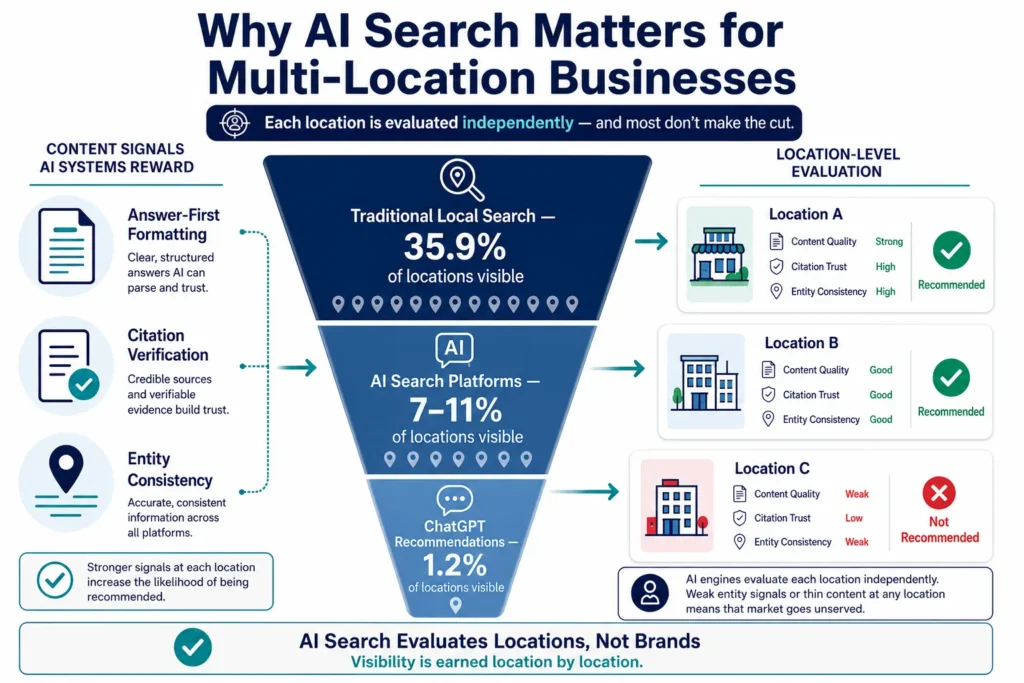
AI search is harder to win than traditional local search because the selection filters are fundamentally more restrictive. Google’s local 3-pack surfaces roughly a third of competing locations. AI answer engines surface a fraction of that — and the gap compounds across every location in your network.
The AI Visibility Gap vs. Google’s Local 3-Pack
“1.2% of locations were recommended by ChatGPT, 11% by Gemini, and 7.4% by Perplexity. By comparison, brands appeared in Google’s local 3-pack 35.9% of the time” — Search Engine Land. That analysis covered nearly 350,000 locations across 2,751 multi-location brands. AI visibility is three to thirty times harder to achieve than traditional local ranking.
- ChatGPT recommends 1.2% of analyzed locations
- Gemini recommends 11% — the most permissive of the major platforms
- Perplexity recommends 7.4%
- Google local 3-pack surfaces 35.9% — the baseline most operators are optimizing for
The gap isn’t a rounding error. It’s a structural difference in how AI engines select sources.
How AI Selectivity Magnifies Multi-Location Risk
AI systems select based on different criteria than traditional search, and the factors that determine inclusion aren’t evenly distributed across your network. A location with inconsistent NAP data, thin content, or missing schema can be invisible to AI recommendation engines, regardless of how strong your other locations are performing. That’s a multi-location risk that traditional local SEO doesn’t surface.
- Review sentiment below threshold → excluded from AI recommendations
- Inconsistent NAP data across platforms → entity confusion for AI retrieval systems
- Generic boilerplate content → no extractable answer passages
- Missing schema → retrieval systems can’t parse services or credentials
Traditional local SEO strength doesn’t automatically transfer to AI visibility. Fewer than half of the brands leading in Google local visibility also appeared among the most visible brands in AI results.
Why Classic Local SEO Doesn’t Translate to AI Recommendations
Traditional local SEO optimizes for ranking signals such as citations, backlinks, Google Business Profile completeness, and keyword relevance. AI recommendation engines optimize for something different — the ability to extract a confident, defensible answer from your content and attribute it to your location without risk of inaccuracy.
- Keyword density ≠ answer-first formatting
- Backlink volume ≠ citation-worthy content structure
- GBP completeness ≠ entity consistency across AI retrieval systems
- Ranking #1 organically ≠ appearing in AI-generated recommendations
The operators who will capture AI search citations are building different infrastructure than the operators who ranked well in 2019.
What Are the Real Options for Getting Your Locations Found in AI Search?
The realistic options for AI search visibility fall into three categories: traditional SEO adapted for AI, internal team production scaled to meet AI requirements, or a systematic content infrastructure built specifically for citation-ready output. Each has genuine trade-offs, and the right choice depends on how seriously your organization is approaching AI search for multi-location businesses as a channel.
Organic SEO vs. AI Citation Optimization
Traditional SEO agencies can improve your organic rankings — and that still matters, since Google’s AI Overviews draw from its existing index. But organic ranking and AI citation are not the same outcome. AI citation optimization requires answer-first formatting, question-based H2 architecture, structured entity signals, and verified citations within the content itself — outputs most traditional SEO deliverables aren’t built to produce.
- Strong organic rankings can support AI visibility — but don’t ensure it
- Content structure for AI extraction differs from content structure for ranking
- Citation verification requirements exceed what traditional SEO quality control checks do
- Multi-location content at scale needs governance, not just optimization
Managed Content Services vs. Internal Teams
Internal teams typically cap out at 4-8 articles per month before quality degrades or bandwidth collapses — insufficient to build AI search visibility across 10+ locations. Traditional agencies can produce volume, but optimize for keyword density and article count rather than the structured, citation-verified output AI systems require.
- Internal teams: high-quality ceiling, low-volume ceiling
- Traditional agencies: high volume, low extractability, citation risks
- AI-native managed services: designed for the output AI systems actually reward
Generic AI Tools vs. Systematic Content Infrastructure
Generic AI tools accelerate content production but don’t solve the verification problem. Most AI writing from memory produces fabricated citations, invented statistics, and hallucinated URLs — a compliance risk in healthcare, legal, or financial content. Systematic content infrastructure uses AI for generation, paired with research-first sourcing and line-by-line citation verification, making the output defensible.
How Does AI Search Actually Decide Which Local Businesses to Recommend?
AI search systems select local businesses through a multi-stage retrieval and synthesis process that rewards structured, fact-rich content with clear entity signals. “AI Overviews are built to only surface information that is backed up by top web results, and include links to web content that supports the information presented in the overview” — Google. Understanding that the pipeline enables operators to build content that qualifies for inclusion.
Query Fan-Out and RAG Retrieval Mechanics
When a user asks an AI search engine a local-service question, the system decomposes it into multiple subqueries, each retrieving results from a different index. Google’s AI Mode uses this “query fan-out” technique across the web, Knowledge Graph, YouTube, and other indexes before a synthesis layer selects corroborated passages — michalgawel.com. Perplexity averages 8.2 cited sources per answer — the highest citation density of any mainstream AI search engine — Margen.
- Query fan-out generates multiple subqueries from one user question
- Each subquery retrieves from different indexes (web, Knowledge Graph, local data)
- The synthesis layer selects passages that are corroborated and clearly structured
- Multi-source retrieval means the presence on multiple authoritative pages compounds
Citation Density and Answer-First Formatting
AI engines check whether your content is extractable — meaning a clear, concise answer to a specific question appears early in the page, not buried in the fourth section. Answer-first formatting places a direct 40-60 word answer at the top of each section, and bullet-heavy formatting (40-60% of content) allows retrieval systems to parse discrete facts rather than dense paragraphs.
- Answer-first paragraphs (40-60 words) provide citation-ready passages
- Question-based H2s match how AI systems parse conversational queries
- Bullet structure enables passage-level extraction without paraphrasing risk
- Statistical backing with credible citations builds AI confidence in sourced claims
Entity Consistency and Data Quality Signals
AI systems build recommendations based on entity signals — consistent, parseable facts about your business across the web, maps, directories, schema, and reviews. Inconsistent NAP data creates entity ambiguity; missing schema makes service information difficult to parse. For multi-location operators, entity consistency is an ongoing governance requirement across every location in the network.
- Consistent NAP data across all directories and platforms
- LocalBusiness schema with service areas, categories, and credentials
- Location-specific service descriptions, not city-name substitutions
- First-party reviews with response patterns that signal active management
If your operation needs to produce 20-50+ articles per month without sacrificing compliance or quality, Content Ops Lab builds the infrastructure to make that possible. Contact us today to discuss your content production requirements.
What Content Infrastructure Does AI Search Visibility Actually Require at Scale?
AI search for multi-location businesses requires content infrastructure — not content tactics. Page-level optimizations don’t scale across 10 or 50 locations. What scales is a governed system with centralized standards, controlled local customization, and verification workflows that apply consistently across every location in the network.
Centralized Governance with Controlled Local Customization
The content governance model that works for AI search at scale is a two-layer architecture: a centralized layer that owns brand rules, templates, schema scaffolding, and compliance standards, and a location layer that supplies verified local inputs. Corporate teams shouldn’t write every location page from scratch, nor hand off templates for local teams to fill unchecked.
- Centralized layer: brand voice, H2 structure, schema scaffold, compliance standards
- Location layer: named staff, local photography, first-party reviews, NAP data
- Governance standards: content QA, update SLAs, high-risk content review paths
- Outcome: AI-parseable entity signals at every location, not just flagship markets
Location-Level Entity Signals AI Systems Can Parse
Every location needs to be a coherent, well-documented entity across the systems AI engines query — consistent NAP, LocalBusiness schema with verified service areas, and location pages that answer the practical questions AI systems need to assemble a recommendation. Generic location pages with swapped city names don’t qualify. AI systems have gotten good at distinguishing templated boilerplate from genuinely localized content.
- Consistent NAP data across all directories and platforms
- LocalBusiness schema with service areas, categories, and credentials
- Location-specific service descriptions, not city-name substitutions
- First-party reviews with response patterns that signal active management
Citation Verification as a Compliance Requirement, Not a Nice-to-Have
For regulated industries, citation verification is a compliance requirement that shapes whether content can be published at all. Systematic citation verification means every statistic is traced to a source document, every claim is labeled by evidence type, and every URL is confirmed live before publication — which also makes the content more citation-worthy to AI engines.
- Every statistic is traced to the source document with a line-number audit trail
- STAT vs. CLAIM labeling for different evidence types
- URL verification before publication — no hallucinated or broken links
- Compliance-ready output for healthcare, legal, and financial content standards
Related: Content Systems vs Content Teams – Why Structure Wins at Scale
What Does AI-Optimized Content Deliver in Production for Multi-Location Operations?
The proof isn’t theoretical. It comes from 23 months of production within a 12-location regulated healthcare organization operating under strict compliance requirements, during the period when AI search moved from early-adopter curiosity to a mainstream decision layer.
AI Search CVR vs. Organic Baseline
“The data is unambiguous: 55% of AI Overview citations come from the top 30% of a page. A further 24% come from the middle section (30–60%), while the bottom of the page (everything after the 60% mark) accounts for just 21% of citations” — CXL.
AI search traffic from that 12-location regulated healthcare organization converted at an average of 21.4% over 8 months — against a 3.32% site average. That’s a 6.4x performance multiplier from a channel that represented less than 0.3% of total traffic.
- 21.4% average AI search CVR vs. 3.32% site baseline — 6.4x multiplier
- 95+ confirmed conversions from AI search platforms over 8 months
- ChatGPT peak CVR: 40% in a single month
- Less than 0.3% of traffic delivers a disproportionate conversion share
Content Architecture That Earns Citations
Answer-first paragraphs (40-60 words) give retrieval systems a clean passage to extract information from. Question-based H2 structure maps content to query types that AI engines receive. Bullet-heavy formatting (40-60% of the content) allows parsing systems to read discrete facts. The same architecture that earns AI citations also ranks in traditional search — these are not competing objectives.
- Question-based H2 structure maps to AI query patterns
- Answer-first formatting enables passage-level extraction
- 40-60% bullet ratio allows AI parsing of discrete facts
- Verified citations with credible sources signal authority over unsourced content
First-Mover Results Before Competitors Enter the Channel
ChatGPT referral sessions to that same 12-location healthcare organization grew 887% over 7 months — from 8 sessions in July 2025 to 79 sessions in February 2026 — while fewer than 5% of comparable healthcare practices were optimizing for AI search. AI citation patterns compound: once an engine establishes a source as authoritative for a category, it reinforces that pattern across subsequent queries.
- 887% ChatGPT session growth in 7 months inside a regulated healthcare operation
- Fewer than 5% of healthcare practices are currently optimizing for AI search citations
- Early citation positions reinforce across subsequent AI queries
- Implementation of meaningful AI search presence: 3-6 months
Is Your Organization Ready to Compete for AI Search Citations?
Most multi-location marketing operations aren’t ready — not because they lack content, but because their existing content wasn’t built for AI extraction. The question is whether you have the infrastructure to address AI search systematically across all locations where you operate.
The Measurement Blind Spot Most Marketing Leaders Miss
“A new industry survey has found that 81% of B2B marketing leaders consider their brand’s visibility in AI-generated answers a blind spot, with 21% describing it as a ‘major blind spot'” — Mission Media. Of those who checked their AI presence, 46% found their positioning mixed or inaccurate — meaning competitors or aggregators may be defining your brand narrative inside AI systems even when your traditional metrics look strong.
- 81% of B2B marketing leaders can’t measure their AI answer visibility
- 46% who checked found their AI positioning mixed or inaccurate
- Traditional SEO dashboards don’t surface AI citation share or answer accuracy
- “Algorithmic mispositioning” risk: someone else defines your brand in AI answers
Signs Your Current Content Operation Won’t Scale to AI
The signals are consistent: thin location pages with swapped city names, internal teams capped at 4-8 articles per month, citations not verified against source documents, and no answer-first formatting. Adding volume won’t fix these problems. AI search rewards extractability, not quantity.
- Location pages with swapped city names, not genuine local differentiation
- Content production capped at 4-8 articles/month internally
- Citations not verified against source documents
- No answer-first formatting or question-based H2 architecture
When to Build vs. Buy the Infrastructure
The build vs. buy decision comes down to whether your internal team has the capacity to build a governed, multi-stage content production system from scratch. System Build delivers a fully transferable infrastructure — knowledge documentation, content templates, citation verification protocols, and trained internal team members. Done-For-You runs the system on your behalf. Both paths lead to the same outcome; the timeline to production-scale output is 3-6 months.
- System Build: infrastructure delivered, team trained, full ownership transferred
- Done-For-You: managed service, strategic oversight retained by client
- Timeline: 3-6 months from start to production-scale output
- First-mover window: closing as mainstream agency adoption accelerates
How Content Ops Lab Builds Content Infrastructure for AI Search
The methodology behind Content Ops Lab was production-tested within a 12-location regulated healthcare organization over 23 months, as AI search platforms moved from early-adopter curiosity to a mainstream decision layer. The proof is production data — not positioning — on the exact challenge AI search for multi-location businesses presents at scale.
- 23-month production test inside a 12-location regulated healthcare organization
- 1,000+ citation-verified articles and pages delivered with zero compliance violations
- 21.4% average AI search CVR vs. 3.32% site baseline — 6.4x performance multiplier
- 95+ confirmed AI search conversions over 8 months
- 887% ChatGPT session growth over 7 months
- 45% of all leads from organic search — outperforming paid search nearly 2:1
- 653% impression growth and 1,700% click growth for an emerging brand in 14 months
- 5x production scale: from 10 articles/month to 50+ without adding headcount
The Content Ops Lab Production System
Every article passes through the same four-stage workflow — verified before being published, structured for extraction, and optimized across platforms.
- Research: Verified sources before generation — no AI writing from memory
- Verification: Line-by-line citation cross-check with STAT vs. CLAIM labeling and full audit trail
- Optimization: Multi-platform formatting for Google, ChatGPT, Perplexity, Claude, and Gemini
- Delivery: WordPress staging or Google Docs — publish-ready, compliant, and editorially reviewed
Ready to build a content infrastructure that scales without the compliance risk? Get in touch — we’ll assess your current content operation and outline what a systematic approach would look like for your organization.
FAQs About AI Search for Multi-Location Businesses
Can’t we optimize our existing content for AI search without rebuilding our production system?
In some cases, yes — if your existing content has strong structure and verified citations, a formatting pass can improve AI citation rates. More often, multi-location operators have content built for traditional SEO: keyword-dense, paragraph-heavy, without answer-first formatting or question-based H2 architecture. Retroactively reformatting hundreds of location and service pages is a significant project. Building the right structure into a production workflow from the start produces better compounding results.
How long does it take to see AI search referral traffic after implementing a citation-optimized content strategy?
Meaningful AI referral traffic typically appears within 3-6 months of implementing structured, citation-verified content at sufficient volume. Early indicators — ChatGPT or Perplexity appearing in GA4 referral sources — often precede meaningful volume. In production data from a 12-location regulated healthcare organization, ChatGPT sessions grew 887% over 7 months once the content architecture was in place.
How does content infrastructure handle compliance requirements when producing location-level content at scale?
Systematic content infrastructure handles compliance through the verification layer. AI tools generate drafts; human reviewers cross-check every statistic against source documents, verify URLs, and label evidence types before content publishes. High-risk content routes through tighter review paths. That workflow produced 1,000+ articles and pages inside a regulated healthcare organization with zero compliance violations over 23 months.
How is AI search optimization different from what a traditional local SEO agency does?
Most operators conflate traditional local SEO with AI search for multi-location businesses — they’re related but not the same discipline. AI search optimization adds a second objective: building content that AI retrieval systems can extract, attribute, and cite with confidence. That requires answer-first formatting, verified citations within the content, and consistent entity signals across platforms — outputs that most traditional SEO agencies aren’t producing.
What’s the difference between Done-For-You content production and a System Build engagement for AI search?
Done-For-You is a managed service: Content Ops Lab runs the complete research, generation, verification, and optimization workflow while you maintain strategic oversight. System Build delivers the same infrastructure to your internal team — templates, verification protocols, style guides, and training — so they can operate the system independently. Both models produce the same citation-optimized output.
Key Takeaways
- AI search engines recommend a fraction of the locations that appear in traditional local search — 1.2% of locations in ChatGPT versus 35.9% in Google’s local 3-pack — making AI visibility three to thirty times harder to achieve
- Consumer AI adoption for local recommendations grew from 6% to 45% in a single year; the channel is no longer early-stage
- AI systems select based on structured content, entity consistency, and citation-worthy formatting — not keyword density or backlink volume
- 55% of AI Overview citations come from the first 30% of a page; answer-first formatting is the single highest-leverage structural change most operators haven’t made
- Production data from a 12-location regulated healthcare organization shows AI search converting at 21.4% average — 6.4x the organic baseline — with 95+ confirmed conversions over 8 months
- 81% of B2B marketing leaders can’t measure their AI answer visibility; the operators who build that measurement capability now will define the competitive benchmark before the rest of the market catches up
- The first-mover window is measured in quarters: implementation to production-scale output runs 3-6 months, and early citation positions compound
Build Content Infrastructure That Compounds: AI Search for Multi-Location Businesses
AI search for multi-location businesses isn’t a future consideration — it’s the current conversion channel that most growth leaders aren’t measuring. The case for AI search for multi-location businesses is now a consumer behavior story: AI adoption for local recommendations grew from 6% to 45% in twelve months.”AI engines recommend 1.2% to 11% of available locations. The organizations that build the content infrastructure to qualify for that fraction now will be difficult to displace once competitive intensity catches up.
Content Ops Lab exists because this problem has a proven solution. A 12-location regulated healthcare organization running citation-verified, structured content at scale built an AI search presence that converted at 21.4% while competitors weren’t in the channel at all. The methodology is transferable. The window to act before mainstream adoption closes is not.
Related: What Does Content Production Infrastructure Look Like in Practice?