

Content Systems vs Content Teams: Why Structure Wins at Scale
Content systems outperform content teams at scale because workflow, governance, and infrastructure determine output quality — not headcount. The content systems vs content teams debate resolves quickly in production: structure wins. “Forrester research from 2024 determined that companies that use a content supply chain solution could see a ROI of 310 percent” — Publicis Sapient.
Multi-location operators managing 10, 20, or 50+ articles per month don’t have a creativity problem. They have an orchestration problem.
Content Ops Lab built its production infrastructure inside a 12-location regulated healthcare organization — 1,000+ citation-verified articles delivered over 23 months with zero compliance violations.
Related: Why Do Internal Content Teams Hit a Production Ceiling?
Why Do Content Teams Hit a Ceiling When Multi-Location Businesses Try to Scale?
Content teams hit operational ceilings not because they lack talent, but because individual contributors cannot compensate for structural gaps. Approval bottlenecks, version conflicts, and inconsistent handoffs create friction that compounds as the number of locations grows. Adding writers to a broken system accelerates burnout without solving throughput.
The Headcount Trap
Most multi-location operators respond to content volume pressure by hiring. The instinct is logical — more writers, more output. The reality is different.
- Internal teams max at 4-8 articles/month before quality degrades
- Each new hire introduces style variance and onboarding overhead
- Output scales linearly while complexity scales exponentially across locations
- Quality becomes personality-dependent, not system-dependent
Headcount solves a capacity illusion while leaving the underlying orchestration problem intact.
Approval Bottlenecks That Don’t Resolve With More Writers
The constraint in most multi-location content operations isn’t creation — it’s review. “The 2024 Mentally Healthy Survey has revealed that 70 per cent of professionals in the media, marketing and creative sectors have experienced burnout in the past 12 months” — B&T.
That number doesn’t trace back to insufficient effort. It traces back to undefined roles, unclear decision rights, and manual handoffs that force skilled people to spend significant time on operational coordination rather than strategic work.
- Approval queues grow when review roles aren’t explicitly defined
- Compliance review in regulated industries creates centralized chokepoints
- Version conflicts multiply when no single source of truth exists
- Writers are idle while reviewers are backlogged — regardless of team size
More production upstream doesn’t clear a downstream approval jam.
Burnout as a Structural Signal
Burnout in content roles is a diagnostic, not a character flaw. When marketing professionals report burnout at rates higher than those of the general workforce, the data point to systemic strain — not insufficient resilience.
Respondents in the same survey identified “better ways of working” and clearer roles as the remedies, not more staff or longer hours. The signal is unambiguous: the system needs redesign before the headcount problem can be addressed.
What Are the Real Options When You’re Choosing Content Systems vs Content Teams for Multi-Location Production?
Multi-location operators have three realistic options for content production: internal teams, traditional agencies, and a systematic infrastructure that combines AI-generated content with human verification. Each has an honest performance profile. The question is which one holds up when volume, compliance, and consistency requirements all apply simultaneously.
Internal Teams and Their Honest Limitations
Internal teams have real advantages. They carry brand context, understand your service catalog, and don’t require extensive onboarding in your market. Those strengths matter. The ceiling matters more.
- Practical output cap: 4-8 publishable articles per month
- Quality variance increases with volume pressure
- Local optimization across 5+ locations requires coordination overhead that most teams can’t sustain
- Compliance review becomes the bottleneck, not creation
“Slow content publishing velocity, a lack of a single source of truth, workflow breakdowns, and difficulty scaling are often signs of content operations issues”— Agility CMS.
Internal teams working without structured workflows aren’t underperforming — they’re operating without the infrastructure needed to perform at scale.
Traditional Agencies and the Volume-Quality Trade-Off
Traditional content agencies can clear the volume bar. The compliance and customization bars are harder.
- Generic content at $300-500/article doesn’t reflect brand voice or proprietary knowledge
- No systematic citation verification — hallucinated URLs and fabricated stats are common
- AI search optimization is absent from most agency deliverables
- Template-driven production treats a 12-location healthcare network the same as a single-location retailer
Agencies scale by reusing structure across clients. That’s efficient for them. It produces undifferentiated output for you.
Generic AI Tools and the Verification Gap
AI writing tools accelerate production. They don’t verify what they produce. Unverified content in regulated industries — such as healthcare, legal, and financial — carries direct compliance exposure. A fabricated statistic published across 12 location pages is 12 compliance events. Generic AI tools introduce this risk without any systematic mechanism to catch it before publication.
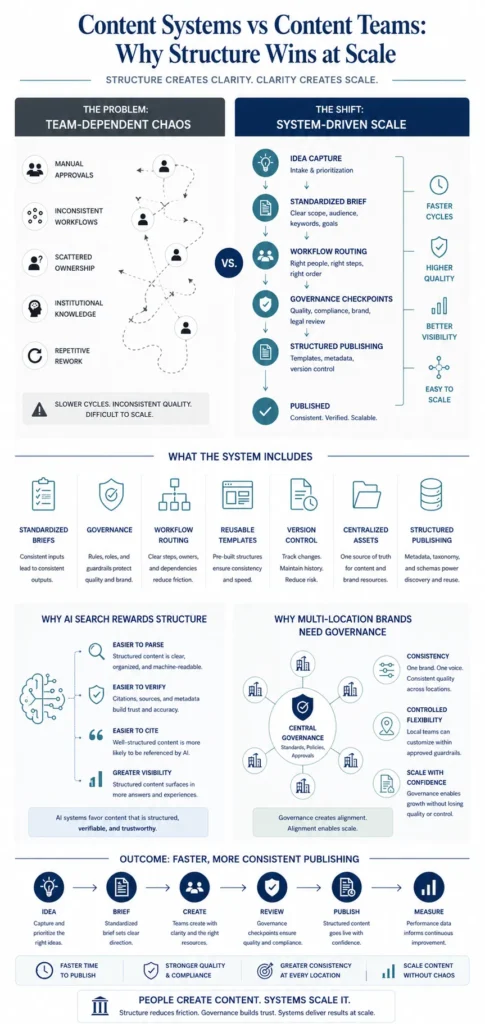
Content Systems vs Content Teams: What Does a System Actually Do That a Team Can’t?
A content system replaces personality-dependent production with repeatable, governed workflows that produce consistent output regardless of who executes them. The system carries the quality standard. The people plug into the system — they don’t carry it themselves. This distinction determines whether scale is achievable.
Standardized Workflows vs. Personality-Dependent Production
When production quality depends on which writer handles an article, you don’t have a content operation. You have a series of individual performances. That model breaks at scale because variance compounds.
- Standardized briefs define the output before writing begins
- Template structures eliminate format-level decision-making from every draft
- Quality checklists apply the same standard regardless of who’s producing
- Version control maintains a single source of truth across all active articles
The system enforces consistency. No individual writer has to carry that responsibility alone.
Single Source of Truth vs. Version Fragmentation
Multi-location content operations without centralized documentation accumulate version debt. Different writers use different stat vintages. Brand guidelines live in email threads. Approved claims conflict with each other across location pages. The result is inconsistent messaging at scale — the opposite of what a distributed brand needs.
- Centralized knowledge base stores approved claims, verified citations, and style standards
- Style guide integration ensures brand voice applies across all contributors
- Location-specific data (NAP, GMB links, service catalog) is maintained in one accessible reference
- Version control makes rollbacks and audits tractable
Fragmentation is the default. A single source of truth is a deliberate architectural choice.
Governance Architecture for Multi-Location Consistency
Governance determines who can create, review, localize, approve, and publish content — and what must stay standardized versus what can vary by location. Without explicit governance, these decisions get made informally, inconsistently, or not at all. The result is the brand inconsistency and duplicate content problems that undermine local SEO performance across distributed networks.
If your operation needs to produce 20-50+ articles per month without sacrificing compliance or quality, Content Ops Lab builds the infrastructure to make that possible. Contact us to discuss your content production requirements.
How Does Governance Infrastructure Solve the Compliance Problem at Scale?
Governance infrastructure solves the compliance problem by removing compliance decisions from individual judgment and embedding them into the production workflow itself. “Task bottlenecks frequently occur as teams wait for approvals from legal or compliance departments, for example” — MIT Sloan Management Review.
The bottleneck isn’t the compliance requirement — it’s the lack of predefined routing that maps content type to the review path before production begins.
Role-Based Permissions and Decision Rights
High-performing content operations define who owns what decisions—and embed that ownership in the system architecture.
- Mandatory vs. optional reviewers defined by content type and risk profile
- Decision rights separated from contribution rights — who creates vs. who approves
- Location-level operators work within centralized guardrails, not outside them
- Escalation paths are defined before edge cases arise
Ad hoc governance collapses under volume. Explicit decision rights hold.
Risk-Profiled Approval Routing
Not all content carries the same compliance risk. A blog post on office hours requires a different review than a page making clinical claims about treatment outcomes. Systems that route all content through identical approval paths create unnecessary bottlenecks on low-risk content while sometimes under-reviewing high-risk content. The fix is matching routing to risk profile — not uniformity.
- Healthcare content: clinical claims require source verification before publication
- Legal content: outcome language triggers compliance review
- Informational content: style review sufficient, compliance review bypassed
- Routing rules embedded in workflow, not left to individual judgment
The system decides the path. The human executes within it.
Citation Verification as Compliance Architecture
In regulated industries, the compliance failure mode isn’t usually intentional misrepresentation. It’s an unverified claim that made it through because no one had a systematic mechanism to catch it.
Citation verification — line-by-line cross-checking of every statistic against its source — is the operational mechanism that closes that gap. STAT vs. CLAIM labeling creates an audit trail for every data point, making the verification record available regardless of who produced the content.
Related: Why Does Cheap Content at Scale Fail?
What Does Structured Content Infrastructure Actually Deliver in Production?
Structured content infrastructure delivers measurable outcomes across three dimensions: AI search citation performance, organic lead channel results, and production velocity that doesn’t scale with headcount.
The content systems vs content teams question gets answered in production data — and the production data is unambiguous. The figures below come from a 23-month regulated healthcare deployment.
AI Search Citation Performance
“With AI Overviews, people are visiting a greater diversity of websites for help with more complex questions”— Google. That shift benefits operators who structure content for extraction — answer-first formatting, question-based H2 architecture, verified citations, and 40-60% bullet-heavy formatting that AI systems can parse and attribute.
- AI search traffic to a multi-location healthcare client converted at 21.4% average over 8 months
- That’s 6.4x the site’s baseline conversion rate
- ChatGPT sessions grew 887% in 7 months (July 2025–February 2026)
- 95+ confirmed conversions from AI platforms across the 8-month measurement period
AI search traffic isn’t a volume channel yet. It’s a conversion channel — and it rewards structured, citation-ready content.
Organic Lead Channel Results
Organic search, built on a systematic content infrastructure, outperforms paid search in both volume and ROI when the production system operates at scale.
- Organic search delivered 45% of all leads over 6 months at a 12-location healthcare organization
- Organic outperformed paid search nearly 2:1 in lead volume
- A 3-location emerging brand scaled from near-zero organic presence to primary lead source in 14 months
- 653% impression growth and 1,700% click growth over that period
Organic at this performance level isn’t a function of budget — it’s a function of systematic content production maintained over time.
Production Velocity Without Headcount Growth
The core operational proof point: 5x production scale — from 10 articles/month to 50+ — achieved without proportional headcount growth. The system carries the quality standard. Adding volume means increasing execution capacity within the existing infrastructure, not rebuilding it for each new hire or location.
Content Systems vs Content Teams: How Do You Know Whether Your Operation Needs a System Build or a Managed Service?
The right engagement model depends on your team’s capacity to operate a content system once it’s built, not on whether you want to own the infrastructure. Both Done-For-You and System Build deliver the same production standard — the difference is who runs it after implementation.
Signs Your Current Model Has Hit Its Ceiling
Before evaluating service models, a more useful diagnostic is whether your current approach is actually scaling.
- Output quality varies by writer — no consistent production standard
- Articles per month are capped below what your location count requires
- Compliance review is a bottleneck, not a checkpoint
- AI search citations aren’t being tracked or optimized
- Local pages are thin, duplicate-adjacent, or inconsistently structured
Any three of these indicate the ceiling has been reached. The question shifts from “should we fix this?” to “how.”
Done-For-You vs. System Build Fit Criteria
Done-For-You fits operators who need production capacity immediately and don’t have internal team bandwidth to operate a content system. Content Ops Lab runs the complete production workflow — research, generation, verification, optimization, delivery — as a managed service.
System Build fits operators who want full ownership of the infrastructure and have team members who can operate it after a structured 12-week implementation and 90-day support period.
- Done-For-You: fastest path to publication-ready content at scale
- System Build: highest long-term leverage if internal capacity exists
- Both models deliver citation-verified, AI-optimized, compliance-ready output
- Neither requires a linear relationship between headcount and article volume
What Implementation Actually Involves
System Build runs across five phases: discovery and design, knowledge documentation, template development, training and implementation, and 90-day post-launch support. Done-For-You starts with a content audit, keyword strategy, and calendar planning before moving into weekly production batches.
In both cases, the first 90 days establish the infrastructure. After that, the system compounds — each piece of content reinforcing the citation authority and topical coverage built by the pieces before it.
How Content Ops Lab Builds Content Infrastructure
A multi-location healthcare client scaled from 10 articles/month to 50+ over 23 months — 1,000+ citation-verified articles and pages delivered with zero compliance violations across a 12-location regulated operation.
That result didn’t come from hiring more writers. It came from building a systematic infrastructure and running it consistently. Content Ops Lab productizes that infrastructure for other multi-location operators facing the same scale problem.
- 23-month production test inside a 12-location regulated healthcare organization
- 1,000+ citation-verified articles and pages delivered — zero compliance violations
- 45% of all leads from organic search, outperforming paid search nearly 2:1
- AI search converting at 21.4% average vs. 3.32% site baseline — 6.4x performance multiplier
- 653% impression growth and 1,700% click growth for an emerging brand over 14 months
- 5x production scale achieved without proportional headcount growth
- 887% ChatGPT traffic growth in 7 months (July 2025–February 2026)
- Dual-brand methodology validated on both mature brand maintenance and emerging brand growth
The Content Ops Lab Production System
The system runs as a single unified workflow that replicates across clients, content types, and locations without rebuilding from scratch for each engagement.
- Research: Verified sources pulled before generation — no AI writing from memory
- Verification: Line-by-line citation cross-check, STAT vs. CLAIM labeling, complete audit trail
- Optimization: Structured simultaneously for Google, ChatGPT, Perplexity, Claude, and Gemini
- Delivery: WordPress-staged or Google Docs-packaged — publish-ready, compliant, reviewed
The system is the asset. Once built, it compounds — every article reinforcing the citation authority and topical coverage infrastructure that AI search systems reward.
Ready to build a content infrastructure that scales without the compliance risk? Get in touch today — we’ll assess your current content operation and outline what a systematic approach would look like for your organization.
FAQs About Content Systems vs Content Teams
Can’t we hire one more content manager and solve this problem?
Hiring solves a capacity perception problem, not an orchestration problem. Internal teams without systematic workflows consistently cap at 4-8 publishable articles per month, regardless of headcount. Adding a writer to a fragmented approval process increases the volume of content waiting in review — it doesn’t clear the bottleneck. The constraint is structural. Governance architecture, standardized workflows, and a single source of truth address it. Headcount alone does not.
How long does it take for a content system to outperform a traditional team-based approach?
Implementation runs 12 weeks for a System Build engagement, with 90 days of post-launch support. Measurable organic search performance typically follows 3-6 months after consistent publication begins — the same timeline that applies to any content investment. The difference is compounding: a system-based operation builds citation authority and topical coverage that accumulates over time. Team-based production without systematic infrastructure tends to plateau or require constant reinvestment to maintain.
How does a content system handle regulated-industry compliance better than an internal team?
A content system embeds compliance into the production workflow rather than relying on individual writers to catch compliance issues at the draft stage. Citation verification cross-checks every statistic against its source before publication. Risk-profiled approval routing matches content type to the appropriate review path — clinical claims trigger source verification; informational content bypasses that step. The audit trail created by STAT vs. CLAIM labeling makes every data point traceable. Compliance becomes an architectural feature, not a final-step check.
How is a content systems vs content teams approach different from what a content agency delivers?
Traditional agencies produce content. A content operations system produces content and the infrastructure that governs how it’s created, verified, optimized, and delivered. Agencies scale by reusing templates across clients — efficient for them, generic for you. A systematic infrastructure integrates your SME knowledge, your compliance requirements, and your brand voice into a replicable production workflow. Citation verification, multi-platform optimization, and governance architecture are not standard agency deliverables. They’re the operational layer that makes content defensible in regulated industries and citation-worthy to AI search systems.
When evaluating content systems vs content teams, is Done-For-You or System Build the right starting point for a multi-location operation?
Done-For-You fits operators who need production capacity immediately or who lack internal team bandwidth to operate a system after implementation. System Build fits operators who want full ownership of the infrastructure and have team members positioned to run it after a 12-week implementation. Both deliver the same production standard — verified, optimized, compliant content at scale. The distinction is operational: who runs the system after it’s built. Most operators evaluate this based on internal capacity, not on which output they want.
Key Takeaways
- Content scale problems in multi-location businesses trace to workflow, governance, and infrastructure — not headcount — and adding writers to a broken system accelerates burnout without solving throughput
- A content system replaces personality-dependent production with repeatable workflows that enforce a consistent quality standard regardless of who executes them
- Governance architecture — defined decision rights, risk-profiled approval routing, and citation verification — solves the compliance problem that breaks team-based approaches in regulated industries
- AI search traffic converts at 21.4% average against a 3.32% site baseline in production, confirming that structured, citation-ready content delivers measurable ROI beyond traditional organic rankings
- Organic search built on systematic content infrastructure delivered 45% of all leads at a 12-location healthcare organization — outperforming paid search nearly 2:1 over 6 months
- The first-mover window for AI search citation dominance is measured in quarters: fewer than 5% of multi-location healthcare practices are currently optimizing for this channel
- The decision between Done-For-You and System Build is an operational fit question — both deliver the same production standard, the difference is who runs the system after it’s built
Why Content Systems vs Content Teams Requires Systems, Not Shortcuts
The content scale problem is not a creativity problem or a talent problem. It’s an orchestration problem — and adding people to an unstructured process doesn’t improve it. Research consistently identifies failure points in fragmented workflows, unclear ownership, and manual handoffs that create bottlenecks at the review and compliance stages, regardless of how many contributors exist upstream.
A content operations system addresses those failure points structurally, not through individual effort. Content Ops Lab built that system inside a regulated healthcare environment and ran it for 23 months. The production data — 45% organic lead share, 21.4% AI search conversion rate, 1,000+ verified articles without a compliance violation — reflects what systematic infrastructure delivers at scale.
Operators who build this infrastructure now capture citation authority before competitors enter the channel. Those who wait inherit the harder problem of displacing established citation patterns once the competitive window closes.