
Why Does a Multi-Location Content Strategy Fail?
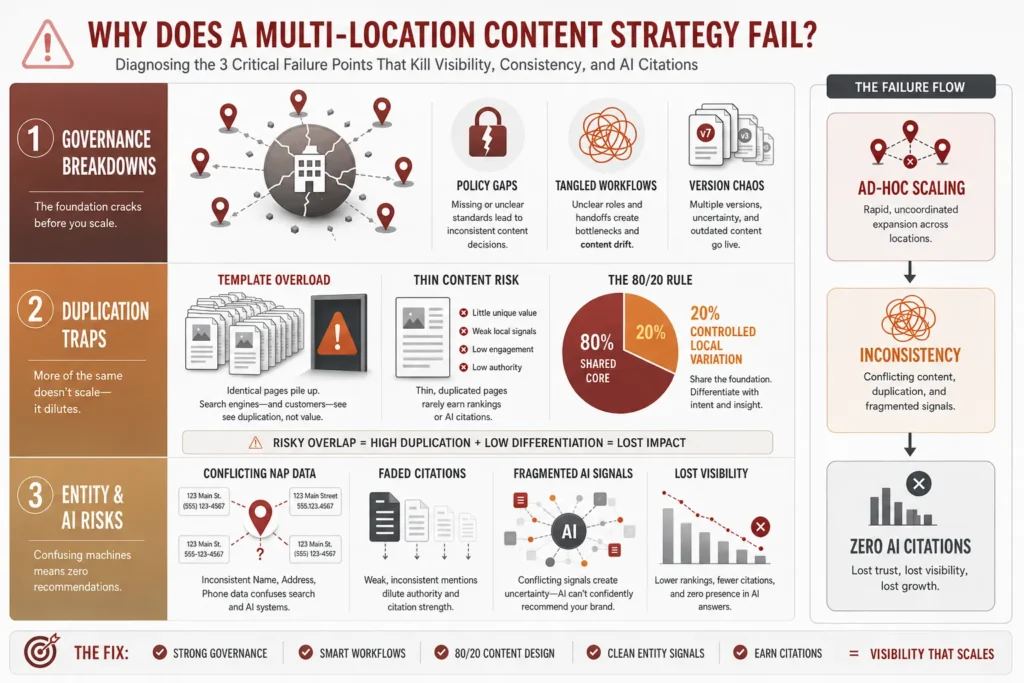
A multi-location content strategy fails when it is never built as a system. The production model that works across 3 locations — a mix of internal writing, agency output, and ad-hoc AI tools — breaks at 10 because there’s no governance to hold it together. “This is the defining tension of multi-location marketing: the faster you scale, the harder it becomes to maintain the brand consistency and strategic coherence that made you worth scaling in the first place” — This Is LD.
The failure is structural, not tactical: no single source of truth for brand standards, no verification of citations to prevent compliance exposure, no multi-platform optimization to capture AI search citations.
Content Ops Lab built its production infrastructure within a 12-location regulated healthcare organization — delivering 1,000+ articles with zero compliance violations over 23 months — because the answer to that structural problem is a governed content operating system, not more content.
Why Do Multi-Location Content Programs Break Down as Brands Scale?
Multi-location content programs collapse under their own weight when built on ad hoc processes rather than on governed systems. The failure isn’t tactical — it’s structural. Each new location multiplies the surface area for inconsistency, compliance risk, and brand drift. The result is a network of location pages that look different, say different things, and perform differently — not because the content is bad, but because no system manages them.
The Compliance Fragmentation Point
In regulated industries, the compliance failure mode is almost always the same: someone at the location level produced content independently, contradicting approved messaging or citing an unverifiable statistic.
- No central style guide is enforced at the local level
- Inconsistent disclaimers across location pages
- Fabricated or unverified statistics in locally produced content
- No audit trail when a claim gets challenged
Without a verification infrastructure connecting every output to a single source of truth, compliance becomes a matter of luck rather than governance.
Brand Voice Drift Across Locations
Brand voice is the first casualty of decentralized content production. When each location produces its own content — or when agencies produce content location-by-location without a unified system — output diverges in ways that compound over time.
- Tone ranges from clinical to conversational, depending on who wrote it
- Service descriptions contradict each other across locations
- Core differentiators are missing or phrased differently per page
- No versioning mechanism to push updated messaging network-wide
Brand drift is slow enough to avoid triggering a crisis, but fast enough that a 20-location network looks like 20 different brands within 18 months.
Volume Without Verification
The production volume multi-location networks require — 20 to 50+ articles per month — is operationally impossible to sustain through manual processes. Internal teams burn out. Agencies cut corners. AI tools write from memory without verification.
- Internal teams cap at 4–8 articles/month before quality degrades
- Traditional agencies produce at scale, but citation verification rarely survives the process
- Generic AI tools accelerate output without closing the verification gap
The volume problem is solvable. The compliance problem requires a completely different infrastructure.
What Content Production Options Are Actually Available to Multi-Location Operators?
“Operational efficiency (cost savings and time to market) is the third-most pressing concern for 52% of CMOs” — Pica9. Multi-location operators typically have three options: internal teams, traditional agencies, and generic AI tools. Each solves part of the problem — none solves all of it — and the gaps they leave are where content programs fail at scale.
Internal Team Capacity Ceilings
Internal teams understand the brand, compliance requirements, and service nuances. They’re also the most resource-constrained option for scaling production.
- Hard ceiling at 4–8 articles/month before quality degrades or the team burns out
- Deep brand knowledge, but no systematic workflow to replicate it
- Compliance awareness, but no verification infrastructure to enforce it
- Location-specific expertise with no mechanism to distribute it across 10+ locations
The institutional knowledge lives in the team. The system to scale that knowledge doesn’t.
Traditional Agency Trade-Offs
Agencies solve the volume problem but typically don’t provide the verification infrastructure that regulated industries require or the AI search-optimization that modern content demands.
- Template-driven production delivers volume, not local differentiation
- Citation verification is an exception, not a standard
- AI search optimization is absent from most agency workflows
- Pricing at $300–500/article makes 50+ articles/month prohibitively expensive
Scale without verification is a compliance liability, not a content asset.
Generic AI Content Limitations
AI tools have made content production faster. They haven’t made it more reliable in regulated industries. The core failure mode is consistent: AI writes from memory, citations get fabricated, and nobody catches it before publication.
- Hallucinated statistics and fake URLs are the default risk
- No quality control between the AI output and publication
- Generic output doesn’t reflect brand voice or location-specific context
- AI content is rarely optimized for AI search platforms — leaving conversion on the table
Generic AI tools accelerate the wrong part of the production process and skip verification entirely.
What Does a Systematic Multi-Location Content Strategy Actually Require?
A systematic multi-location content strategy requires three things working together: a central governance model that sets standards, a local execution layer that applies them, and a verification protocol that confirms every output meets both. The infrastructure isn’t complicated — but it has to be built deliberately, before scale exposes the gaps.
Central Governance With Local Execution
The governance model that works at scale is hybrid: central teams own standards, templates, and verification controls; local operators own facts, service nuances, and community context.
- Central ownership: brand standards, style guides, approved messaging, compliance frameworks
- Local ownership: NAP data, hours, location-specific services, neighborhood context
- Shared infrastructure: content templates, research protocols, approval workflows
- Version control: every update pushed from the center, no location operating on outdated standards
The governance model defines what’s fixed and what’s variable. Everything else is execution.
Citation Verification as a Compliance Control
In regulated industries, citation verification is not an editorial preference—it’s a compliance requirement. Every statistic, claim, and data point either traces to a verifiable source or it’s a liability.
- STAT vs. CLAIM labeling distinguishes data points from sourced assertions
- Line-number documentation creates an audit trail for every citation
- Exact quote extraction prevents paraphrasing errors that introduce inaccuracies
- Zero-hallucination standard is enforced before the content reaches any location page
Verification infrastructure is what separates AI-assisted content production from AI-generated compliance risk.
Multi-Platform Optimization Architecture
A content system built only for traditional search is already behind. AI search platforms — ChatGPT, Perplexity, Claude, Gemini — generate referral traffic that converts at materially higher rates than organic search.
- Answer-first formatting (40–60 words) optimized for AI extraction
- Question-based H2 structure aligned with conversational query patterns
- 40–60% bullet-heavy content for machine parsing
- Structured data and entity signals are reinforced across all location pages
Multi-platform optimization is the baseline for content that performs in the current search environment.
If your operation needs to produce 20–50+ articles per month without sacrificing compliance or quality, Content Ops Lab builds the infrastructure to make that possible. Contact us today to discuss your content production requirements.
How Does AI Search Change the Multi-Location Content Strategy Equation?
“86% of AI citations for local search queries come from brand-influenced sources, such as websites and business listings”— Charlotte Observer / Stacker. For multi-location operators, that statistic reframes where content investment compounds. The brands that systematically govern their assets are cited. The ones operating ad hoc are invisible.
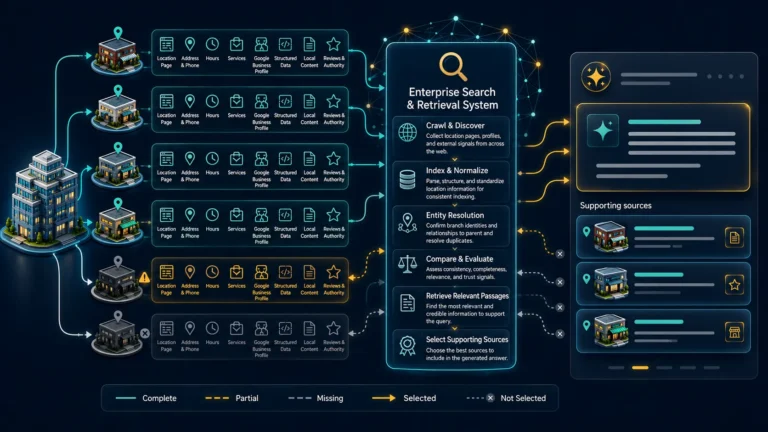
Brand-Controlled Sources Dominate Local AI Citations
The assumption that AI search favors authoritative third-party sources doesn’t hold for local queries. For location-based searches, the citation behavior inverts: brand-owned and brand-influenced properties dominate.
- Business website content accounts for the majority of local AI citations
- Google Business Profiles and structured listings are primary citation sources
- Social profiles and local directory listings round out brand-influenced share
- Third-party forums are a secondary signal, not the primary one
Multi-location operators have more direct control over their AI search visibility than most assume — if their brand assets are governed and consistent.
Entity Consistency Across Locations
AI systems build knowledge graphs from consistent signals about entities. When NAP data, service descriptions, and location details conflict across platforms, AI confidence in citing that business drops. “NAP inconsistencies across platforms signal unreliability to local algorithms, directly harming rankings” — Rocket Clicks.
- Mismatched NAP creates entity ambiguity for AI systems
- Inconsistent service descriptions reduce AI confidence in accurate citation
- Schema markup connecting locations to the parent brand reinforces entity coherence
- Cross-platform consistency — website, GBP, directories — is the foundation of AI visibility
Entity consistency is a content governance problem, not just a technical one.
Structured Data as AI Visibility Infrastructure
A Search Engine Land experiment found a 47% higher AI citation rate for pages with quality structured data — Sydekar. For a 10-location network, that’s not a marginal gain — it’s the difference between being cited and being invisible.
- LocalBusiness schema exposes address, phone, and hours in machine-readable format
- Service schema defines offering categories that precision AI systems can parse
- The FAQ schema provides extractable answer blocks for conversational queries
- Branded web mentions now correlate more strongly with AI Overview appearances (0.664) than backlinks (0.218), per Position Digital’s research across 300,000 keywords
The brands that systematically implement structured data across every location page are building an AI citation infrastructure.
Related: Content at Scale – Why Volume Without Verification Fails in AI Search
How Should Multi-Location Operators Structure Location Pages for Scale?
“The 80/20 Rule: You don’t need 100% unique text. It is highly effective to use a high-quality ‘boilerplate’ for services while customizing 10–20% for the specific city,”— Sterling Sky.
Multi-location operators don’t need to write fully unique pages for every location. They need excellent shared content and the right local signals at each address. The duplication fear is one of the most persistent myths in local SEO and one of the most operationally damaging.
The 80/20 Localization Framework
The practical standard for multi-location page production is 80% shared, 20% localized. The 80% covers service descriptions, methodology, compliance language, and brand messaging. The 20% carries the local weight.
- Core service content: shared template, governed centrally, updated network-wide
- Location facts: address, phone, hours, GMB link — unique to each location
- Neighborhood context: 3–5 nearby community references and local landmarks
- Local social proof: location-specific reviews, team bios, and local examples where available
The 80/20 model isn’t a compromise — it’s the deliberate operating pattern that makes systematic production feasible.
What Separates Safe Location Pages From Doorway Risk
Google’s spam policies define doorway risk narrowly: pages that exist primarily to rank and funnel users to an intermediate destination. These pages do not use shared templates for real local destinations.
“Duplicate content on a site is not grounds for action on that site unless it appears that the duplicate content intends to be deceptive and manipulate search engine results”— Google Search Central.
- Safe location pages: real NAP, genuine local content, clear conversion path to that specific location
- Doorway risk: pages that swap only the city name or redirect to a central page
- Thinness — not duplication — is the primary risk trigger
- Substantial, locally helpful content can carry significant shared copy without penalty
The distinction is quality and intent, not template use.
Local Signals That Drive Both Search and AI Performance
Location pages perform well in both traditional and AI search when they carry signals of local relevance and entity coherence.
- Accurate NAP data matching GBP, directory listings, and schema markup
- 15+ natural location mentions throughout the article body
- Neighborhood-level specificity: nearby communities, landmarks, local context
- Direct GMB link for that specific location
- Location-specific internal links to services and conditions pages
The pages that rank in Google and get cited by AI systems are the ones that serve real users at real locations.
What Does Building a Multi-Location Content Strategy Actually Involve?
Building a multi-location content infrastructure is a 3–6 month process of establishing the governance model, documentation system, and production workflow before scaling volume. Operators who skip the infrastructure phase and go straight to volume create the exact problems they were trying to avoid: inconsistency, compliance risk, and content that doesn’t perform.
System Build vs. Done-For-You for Multi-Location Operations
Content Ops Lab offers two engagement models. System Build constructs the complete production infrastructure and hands it off for internal operation. Done-For-You runs the system as a managed service.
- System Build: Right for operators with an internal team to run the system once built
- Done-For-You: Right for operators who need volume production immediately without internal capacity
- Both models deliver the same output: citation-verified, multi-platform optimized content at scale
- The choice is operational — how much of the production work do you want to own?
The infrastructure is the same. The question is who runs it.
Implementation Timeline and Complexity
A 12-week System Build covers discovery, knowledge documentation, template development, and team training — with 90 days of post-launch support.
- Weeks 1–3: Content audit, keyword strategy, workflow design
- Weeks 4–6: SME knowledge capture, style guide integration, research library
- Weeks 7–9: Template build, citation verification protocols, QA checklists
- Weeks 10–12: Team training, live production, refinement
- 90-day post-launch: quality review, workflow optimization, template refinement
Implementation takes longer than most operators expect. Launching without infrastructure takes much longer to fix.
Scaling Signals That Indicate Readiness
Most operators know they need a content system when the current approach starts visibly breaking.
- Internal team at capacity, quality declining as volume increases
- Agency content arriving generic, unverified, or inconsistent across locations
- AI-generated content producing compliance flags or citation errors
- Location pages are performing inconsistently, with no diagnostic visibility
- No single owner for content standards across the network
When three or more of these are present, tactical fixes won’t close the gap.
How Content Ops Lab Builds Multi-Location Content Infrastructure
Content Ops Lab built and operates a governed production infrastructure inside a 12-location regulated healthcare organization — delivering 1,000+ citation-verified articles with zero compliance violations over 23 months.
The system that made that possible wasn’t a collection of AI tools. It was a research-first, verification-driven content operating system that scaled from 10 articles per month to 50+ articles per month without adding headcount.
- 23-month production test inside a 12-location regulated healthcare organization
- 1,000+ citation-verified articles and pages delivered with zero compliance violations
- 5x production scale: 10 articles/month to 50+ without adding headcount
- Organic search delivering 45% of all leads — outperforming paid search nearly 2:1
- AI search converting at 21.4% average vs. 3.32% site baseline — 6.4x performance multiplier
- 653% impression growth and 1,700% click growth for an emerging brand over 14 months
- 887% ChatGPT traffic growth in 7 months (July 2025–February 2026)
- Dual-brand methodology validated on both mature brand maintenance and emerging brand growth
The Content Ops Lab Production System
The same workflow powers every engagement — Done-For-You or System Build — because the infrastructure requirements don’t vary by client size.
- Research: Verified sources before generation — no AI writing from memory, no hallucinated citations
- Verification: Line-by-line citation cross-check, STAT vs. CLAIM labeling, complete audit trail
- Optimization: Multi-platform alignment across Google, ChatGPT, Perplexity, Claude, and Gemini
- Delivery: WordPress staging or Google Docs — publish-ready, compliant, Grammarly-reviewed
The system scales without adding headcount because the infrastructure does the work that personality-dependent processes can’t sustain.
Ready to build a content infrastructure that scales without the compliance risk? Get in touch today — we’ll assess your current content operation and outline what a systematic approach would look like for your organization.
FAQs About Multi-Location Content Strategy
Can’t we have each location manage its own content to keep it locally relevant?
Decentralized content production creates compliance and consistency risk at exactly the locations you can’t monitor closely. Individual locations produce content that contradicts approved messaging or cites unverified statistics — often without flagging it. A governed multi-location content strategy enables local execution within central standards, giving you local accuracy without sacrificing brand control or compliance coverage.
How long does it take to see results from a systematic multi-location content strategy?
Production results — consistent volume, verified citations, compliant output — are visible within the first 30–60 days of a functioning system. Search performance follows the standard organic curve: meaningful traction in 3–6 months, compounding returns at 6–12 months. AI search citations can appear faster when content architecture is optimized from the start. Meaningful ROI data typically arrives in the second quarter.
How does a content governance system protect against compliance violations across multiple locations?
Governance protects compliance through three mechanisms: centralized source control (approved messaging from verified templates only), citation verification (every statistic traces to an auditable source), and version control (updates push network-wide, no location operating on outdated standards). This eliminates the primary failure mode — locally produced content that bypasses review — without creating bottlenecks that slow production.
How is a content operating system different from hiring a multi-location SEO agency?
A content operating system is infrastructure — templates, verification protocols, and production workflows that produce consistent output regardless of who operates them. An agency is a service relationship where output quality depends on the team assigned to your account. Agencies typically optimize for traditional search, don’t verify citations against source research, and don’t optimize for AI platforms. A governed system does all three and can transfer ownership to your team if you want.
Is Done-For-You or System Build better for a brand building a multi-location content strategy across 10+ locations?
Done-For-You is better when you need immediate volume production without the internal capacity to operate a governed system. System Build is better when you have — or plan to build — an internal team to run the infrastructure after delivery. Both produce the same governed output. For operators managing active content debt alongside new production at 10+ locations, Done-For-You typically provides faster time-to-results.
Key Takeaways
- Multi-location content programs fail structurally, not tactically — the root cause is ad-hoc processes that can’t scale without governance infrastructure in place
- The 80/20 localization framework — 80% governed boilerplate, 20% localized signals — is the production model that makes scale feasible without compliance risk
- 86% of AI citations for local queries come from brand-controlled sources, meaning multi-location operators have direct control over AI search visibility if their assets are governed consistently
- A multi-location regulated healthcare organization achieved 21.4% AI search CVR versus a 3.32% site baseline — a 6.4x performance multiplier — using citation-verified, multi-platform optimized content architecture
- Citation verification is a compliance control, not an editorial preference — every statistic either traces to a verifiable source or it’s a liability
- The first-mover window for AI search citation dominance is measured in quarters, not years — most multi-location operators in healthcare, legal, and home services have not yet entered the channel
- Operators who build infrastructure before scaling volume avoid the compliance, consistency, and quality failures that define ad-hoc content operations at 10+ locations
Build Content Infrastructure That Compounds: Multi-Location Content Strategy
The central finding from 23 months of production in a regulated multi-location environment is that content quality is an infrastructure problem, not a talent problem. Most operators discover this after the ad-hoc approach breaks. When compliance gaps open, brand consistency degrades, and AI search citations go to competitors who built the system first.
The first-mover window for AI citation dominance is measured in quarters, not years. Content Ops Lab builds the governed production infrastructure that closes that gap. The 12-location, 23-month proof of concept is the methodology. What’s available now is the system that produced it.
Related: AI Search Content Strategy for Multi-Location Businesses – What Actually Works