

Content Infrastructure for Multi-Location Businesses: What Growth Leaders Need to Build Before They Publish
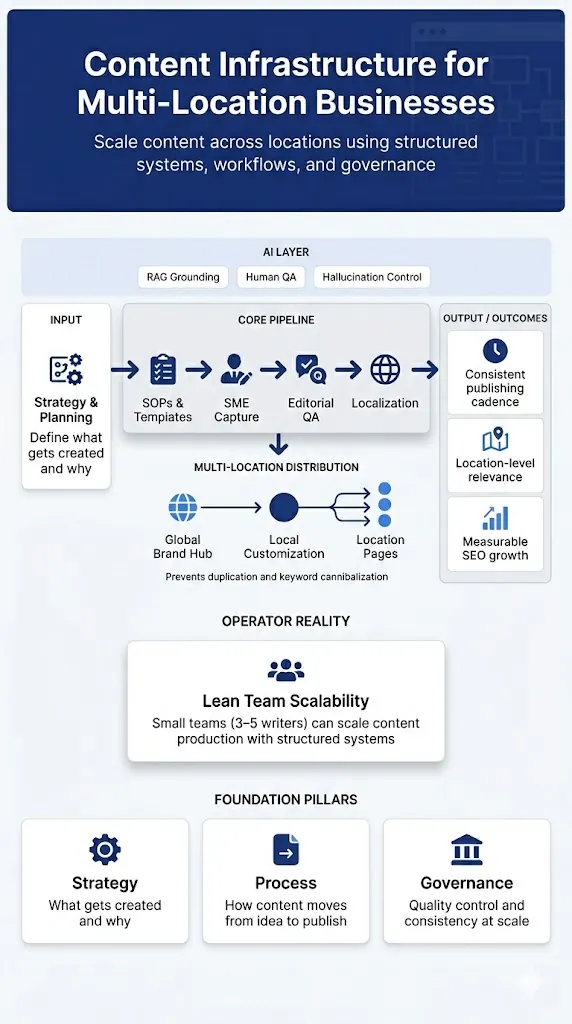
Content infrastructure for multi-location businesses is the operational foundation that enables consistent, compliant, and scalable content production across all locations — without rebuilding the system whenever headcount changes, or a campaign ends. As one practitioner put it: “Content marketing is a tactic. Content infrastructure is a system.”
Most multi-location operators are running tactics when they need a system. The result is fragmented output, inconsistent brand voice, compliance exposure, and content that stops compounding the moment a campaign budget runs out.
Content Ops Lab built its production infrastructure inside a dual-brand, multi-state healthcare operation — 1,000+ citation-verified articles delivered with zero compliance violations over 23 months.
Related: The AI Citation Economy – Why Visibility Matters More Than Rankings
Why Does Content Production Break Down When Multi-Location Businesses Try to Scale?
Content production breaks down at scale because most multi-location organizations treat content as a series of individual tasks rather than a governed production system. Without documented workflows, standardized templates, and centralized knowledge management, output depends entirely on who is doing the work — and that dependency becomes a liability the moment volume increases, staff turns over, or a second location needs coverage.
The Tribal Knowledge Trap
Most content operations start the same way: one or two people who know the brand, the tone, and the compliance requirements produce everything. That works at low volume. It breaks at 20+ articles per month across multiple locations.
- Knowledge lives in email threads and Slack messages, not documented systems
- New contributors produce inconsistent output requiring heavy revision
- Critical context — service-specific claims, compliance language, local nuance — never gets captured in reusable formats
- Onboarding a new writer takes weeks because there is no single source of truth
When the person who knows everything leaves, the institutional knowledge leaves with them. A content infrastructure converts tribal knowledge into documented SOPs, versioned templates, and knowledge bases that any qualified contributor can follow.
Distributed Team Bottlenecks
Multi-location teams face a coordination problem that single-location businesses rarely encounter. Briefs start in one tool, feedback arrives in another, and final drafts live in a third — with no visibility into where any given article stands.
- Review cycles stall when one approver is unavailable
- Context gets lost every time a file moves between systems
- Duplicate content surfaces across locations because no one tracks what has been published
- A single delayed review cascades into weeks of missed publishing cadence
When Campaigns Replace Systems
Campaign-based content thinking produces visibility that resets rather than compounds. Each new campaign starts from scratch.
- Traffic spikes during campaigns, then declines when they end
- Location-specific pages get created reactively, not systematically
- AI search platforms have nothing consistent to cite without a sustained publishing cadence
Infrastructure thinking produces the opposite outcome. Consistent publication builds citation authority across Google and AI platforms simultaneously — and that authority compounds over time.
What Happens When Multi-Location Content Runs Without Governance?
Ungoverned content at multi-location scale creates three specific failure modes: duplicated content that cannibalizes search performance, brand inconsistency that erodes trust across locations, and listing inaccuracies that suppress local visibility.
Research confirms the structural reality: “Each location needs its own SEO strategy: unique pages, localized content, and targeted keywords.” Organizations that skip this discipline pay in suppressed rankings, inconsistent conversion rates, and compliance exposure.
Duplication and Cannibalization at Scale
The fastest way to undermine multi-location SEO is to publish near-identical content across locations. Google treats duplicate content as low-value, and when multiple location pages compete for the same keywords, none rank effectively.
- Templated city pages with swapped location names create duplication at scale
- Keyword cannibalization occurs when multiple pages target the same query without differentiation
- Without a content tracking system, the same topic gets written multiple times across locations
Fixing duplication retroactively is expensive. Building differentiation into the production system from the start eliminates the problem before it compounds.
Brand Consistency vs. Local Customization
The governance challenge is not choosing between brand consistency and local relevance — it is building a system that delivers both simultaneously.
- Centralized brand standards (tone, claims, compliance language) must be enforced at the system level
- Local customization — neighborhood references, community mentions, location-specific services — must be built into the production workflow, not treated as optional
- Without governance guardrails, local teams produce content that drifts from brand standards
Governance at the workflow level scales. Governance at the review level creates bottlenecks.
The Cost of an Ungoverned Listing Ecosystem
NAP inconsistency — mismatched name, address, and phone data across Google Business Profiles, location pages, and directories — is a structural suppressor of local search performance and a direct consequence of ungoverned content operations.
- Inconsistent listing data signals to Google that location information is unreliable
- Multi-state operations face compounding inconsistency as the location count grows
- One case study documented a nearly 2,000% increase in Google Maps visibility and roughly 400% more phone calls after governing multiple listings consistently — growth that enabled the client to expand to additional locations state-wide
NAP governance belongs inside a content infrastructure system, not a one-time cleanup project.
What Are the Real Options for Multi-Location Content Infrastructure?
Multi-location operators have three realistic options: build an internal team, hire a traditional agency, or deploy generic AI tools. Each solves part of the problem. None solves it all without a systematic infrastructure underneath.
Internal Teams at Scale
Internal teams offer brand knowledge, familiarity with compliance requirements, and direct access to SMEs. The ceiling is volume.
- Most internal teams sustain 4-8 articles per month before quality degrades or burnout sets in
- Scaling requires linear headcount investment — more articles means more writers
- Knowledge stays inside individual contributors rather than being documented in systems
- Internal teams rarely have bandwidth for multi-platform optimization across Google, ChatGPT, Perplexity, and Gemini simultaneously
Traditional Agency Models
Traditional agencies solve the volume problem. They do not solve the verification or AI optimization problems.
- Agencies optimize for article count, not citation verifiability
- Generic research produces generic output that does not reflect brand expertise or SME knowledge
- Optimization targets traditional Google rankings, not AI search citation or AEO
- Cost scales linearly: more volume means more spend, with no compounding return
Generic AI Content Without Verification
Generic AI tools compress production time. Without a verification infrastructure, they introduce compliance risk.
- AI models write from training data, not verified current sources
- Fabricated statistics and hallucinated citations appear plausible and are rarely caught without a systematic review
- Content without a research foundation does not qualify for AI search citations
- In regulated industries, one unverified claim published across 12 location pages is a 12-location compliance incident
The tools are not the problem. The absence of verification infrastructure around those tools is.
If your operation needs to produce 20-50+ articles per month without compliance exposure, Content Ops Lab builds the infrastructure to make that possible. Contact us today to discuss your content production requirements.
What Does Content Infrastructure for Multi-Location Businesses Actually Require?
Functional content infrastructure requires three components working together: documented workflows that remove production dependency on individual contributors, verification systems that make AI-assisted content trustworthy, and a multi-platform optimization architecture that targets Google and AI search simultaneously. That standard requires building the system before scaling the volume.
Documented Workflows and SOPs
A content workflow is not a checklist. It is a documented production sequence — from research intake through publication — that any qualified contributor can follow without asking how things are done.
- SOPs convert institutional knowledge into reusable operational assets
- Staged workflows (intake → research → draft → verify → optimize → stage → publish) create visibility into where each article stands
- Version-controlled templates eliminate the “which draft is current?” problem that stalls distributed teams
- Documented systems survive personnel changes — a new contributor follows the same workflow on day one that a veteran follows on day 500
Verification Systems for AI-Assisted Production
AI-assisted production without verification is not a content system — it is a liability generator. The operational definition is direct: “A hallucination is any statement that cannot be traced back to a known, approved source inside the workflow.” That standard applies to every statistic and every data point in every article.
- Verification checkpoints must be built into the production sequence, not added as a final review step
- Every statistic requires source attribution specific enough to audit — document references, line numbers, original source URLs
- STAT vs. CLAIM labeling applies appropriate verification standards to numerical data versus sourced statements
- In regulated industries, an unverified claim is not a quality issue — it is a compliance incident
Multi-location operators publishing at scale need a verification infrastructure that scales with output volume. Manual spot-checking does not scale to 50 articles per month.
Multi-Platform Optimization Architecture
Content optimized only for Google misses the fastest-growing, highest-converting traffic channel available to multi-location businesses. AI search platforms reward content structured for extraction, backed by verified citations, and formatted for direct answer delivery.
- Question-based H2 architecture aligns with how users query AI platforms — conversationally, not with keyword strings
- Answer-first paragraph structure (40-60 words) provides citation-ready snippets that AI systems extract directly
- 40-60% bullet ratio makes content parseable for both AI systems and scanning readers
- Local SEO (NAP consistency, neighborhood-level geographic references, GMB alignment) must be integrated into the production workflow, not treated as a separate workstream
Related: How AI Search Engines Decide Which Sources to Cite
What Does Systematic Content Infrastructure Deliver in Production?
The business case is measurable. Multi-location operators with governed production systems achieve higher organic lead share, better AI search conversion rates, and growth that compounds rather than resets. The data from a 23-month deployment inside a dual-brand, multi-state healthcare operation provides a direct performance baseline.
Multi-Location Revenue Impact
Organic search is not a brand awareness channel for operations that run a systematic content infrastructure. It is the primary lead generation channel.
- A dual-brand, multi-state healthcare operation generated 12,487 total leads over six months in H2 2025
- Organic search delivered 45% of all leads — outperforming paid search by nearly 2:1
- An emerging brand within the same operation scaled from near-zero organic presence to primary lead channel: 653% impression growth and 1,700% click growth over 14 months
- A new market expansion delivered 15.36% CVR — 4.6x the site average — validating that the methodology scales to new geographic markets without performance degradation
AI Search Conversion Advantage
AI search platforms convert at rates traditional organic traffic cannot match.
- Over eight months (July 2025 – February 2026), AI search delivered a 21.4% average CVR versus a 3.32% site baseline — a 6.4x performance multiplier
- 95+ confirmed conversions were tracked from AI search platforms during this period
- ChatGPT traffic grew 887% in seven months as citation frequency increased
- Peak CVR reached 40% in a single month from a channel representing less than 0.3% of total traffic
The conversion differential exists because AI search users arrive pre-qualified. They have already received a citation and followed it — the trust transfer happens before the first page view.
The Compounding Visibility Effect
Infrastructure-based content produces compounding results. Each article builds on the citation authority established by the previous one.
- 188 question-based keywords ranking with 83% in positions 1-10 reflect accumulated authority across a governed production system
- 2.3M monthly impressions across a multi-location network (February 2026) is the product of 23 months of consistent, structured publishing
- AI citation patterns reinforce themselves: platforms that cite an organization consistently are more likely to continue citing it as query volumes increase
- First-mover advantage in AI search citation is time-limited — organizations building authority now are establishing patterns that later entrants have to overcome
How Do You Know If Your Organization Needs Content Infrastructure for Multi-Location Businesses vs. More Content?
The signal is not content volume — it is a system failure. If publishing more articles is not producing proportional growth in organic visibility, leads, or AI citations, the constraint is not output. It is infrastructure.
Volume Without Systems
The operational symptoms of scaling without infrastructure are consistent across industries.
- Publishing cadence depends on individual availability, not a production system
- Quality varies significantly by contributor, creating editorial debt requiring ongoing remediation
- Location-specific content is either absent or duplicated across locations with minimal differentiation
- AI platforms are not citing the content because it lacks an extraction-ready structure, verified sources, or a consistent publishing cadence
- Compliance incidents occur because there is no systematic verification step before publication
If three or more of these apply to your current operation, the problem is infrastructure, not headcount.
The Done-For-You vs. System Build Decision
Content Ops Lab offers two engagement models. The right choice depends on whether your organization wants to own and operate the production system or have it managed externally.
- Done-For-You: The right model when internal bandwidth is the constraint — consistent, verified, multi-platform-optimized content published at volume without redirecting internal resources
- System Build: The right model when your team has the capacity to operate a system but lacks the infrastructure — full ownership of workflows, templates, and knowledge documentation with a handoff at implementation close
- Both models deliver the same outcome: a governed production system producing citation-verified content across all locations
What Implementation Actually Looks Like
Building content infrastructure takes 12 weeks. The stages move from discovery and workflow design through knowledge documentation, template development, team training, and 90-day post-launch support.
- Discovery establishes keyword strategy, content gaps, and workflow structure before a single article is written
- Knowledge documentation converts SME expertise into reusable content assets — the foundation that makes every subsequent article faster to produce and more authoritative to cite
- Template development creates the production system that removes per-article decision-making from the workflow
- Post-launch support covers the first 90 days of live production, refining based on real output rather than theoretical design
How Content Ops Lab Builds Content Infrastructure for Multi-Location Businesses
Content Ops Lab built and iterated its production methodology inside a dual-brand, multi-state healthcare operation over 23 months — in active production under regulated industry compliance requirements, not in a testing environment.
The result scales from 10 articles per month to 50+ articles per month without adding headcount, without compliance incidents, and without quality degradation.
- 23-month production test inside a 12-location regulated healthcare organization
- 1,000+ citation-verified articles and pages delivered with zero compliance violations
- 45% of all leads from organic search — outperforming paid search nearly 2:1
- 21.4% average AI search CVR versus 3.32% site baseline — 6.4x performance multiplier
- 887% ChatGPT traffic growth in seven months as AI citation frequency increased
- 653% impression growth and 1,700% click growth for an emerging brand built from near-zero organic presence
- 5x production scale — 10 articles/month to 50+ — using a single unified system, not additional headcount
- Dual-brand methodology validated on mature brand maintenance and emerging brand growth simultaneously
The Content Ops Lab Production System
Every engagement follows the same four-stage production sequence, tailored to each client’s industry, compliance requirements, and location footprint.
- Research: Verified sources before generation — no AI writing from memory, no hallucinated citations
- Verification: Line-by-line citation cross-check with STAT vs. CLAIM labeling and documented audit trail
- Optimization: Simultaneous multi-platform targeting — Google, ChatGPT, Perplexity, Claude, and Gemini — in every article
- Delivery: WordPress staging or Google Docs packaging — publish-ready, compliance-reviewed, Grammarly-verified
Any operator can access the same AI tools. Very few have built the verification and governance infrastructure that makes those tools produce content defensible in regulated industries and citation-worthy to AI search platforms.
Ready to build content infrastructure that scales without compliance risk? Get in touch — we’ll assess your current content operation and outline what a systematic approach would look like for your organization.
FAQs About Content Infrastructure for Multi-Location Businesses
What’s the difference between a content strategy and content infrastructure for multi-location businesses?
A content strategy defines what to publish, who to target, and why. Content infrastructure for multi-location businesses is the operational system that enables consistent, compliant, and scalable execution. Strategy answers the what and why. Infrastructure answers the how — workflows, verification protocols, templates, governance, and multi-platform optimization that run regardless of who is executing production on any given week.
How long does it take to build content infrastructure for multi-location businesses?
A full System Build runs for 12 weeks from discovery through team training, followed by 90 days of post-launch support. Done-For-You engagements can begin delivering content within weeks of kickoff, with infrastructure building in parallel to active production. Either path requires three to six months before the effects of compounding visibility become measurable.
How does content infrastructure handle compliance requirements in regulated industries?
Compliance is built into the production workflow, not added at the review stage. Citation verification — tracing every statistic to a confirmed, documentable source — is a production step. STAT vs. CLAIM labeling applies different verification standards to different evidence types. A 23-month regulated industry deployment — 1,000+ articles, zero compliance incidents — validates that this approach holds at scale.
What does citation verification actually involve in production?
Citation verification means tracing every statistic and data point to its source before publication. Research is conducted before generation begins, exact quotes are extracted with source attribution, and AI-generated drafts are cross-checked against source research before delivery. This eliminates hallucinated statistics, fabricated URLs, and sourcing errors — the three most common compliance failure points in AI-assisted content production.
Is Done-For-You or System Build better for a growing multi-location practice?
Done-For-You is the right fit when internal bandwidth is the constraint. System Build is the right fit when your team has the capacity to operate a system but lacks the infrastructure to do so consistently. Both deliver a governed production system producing citation-verified, multi-platform-optimized content across all locations. The deciding factor is operational: who owns execution after the build is complete?
Key Takeaways
- Content infrastructure for multi-location businesses is not a content strategy — it is the operational system (workflows, governance, verification, optimization) that makes consistent, scalable production possible regardless of which contributors are executing it
- Multi-location businesses without governed systems accumulate specific failure modes: duplication, cannibalization, brand inconsistency, NAP inaccuracies, and compliance exposure — all of which compound as location count grows
- Internal teams, traditional agencies, and generic AI tools each solve part of the problem; none solves it completely without a systematic verification infrastructure underneath
- A dual-brand, multi-state healthcare operation delivered 45% of all leads from organic search, outperforming paid 2:1, and achieved a 21.4% average AI search CVR — 6.4x the site baseline — over 23 months of systematic production
- AI search platforms convert at 6x the rate of traditional organic traffic because users arrive pre-qualified; capturing that channel requires structured, citation-verified content published at a consistent volume
- The first-mover window for AI search citation authority is open now and closing — organizations that build systematic content infrastructure in 2025-2026 will establish citation patterns that late entrants have to overcome, not match
Build Content Infrastructure That Compounds: Content Infrastructure for Multi-Location Businesses
Most multi-location businesses are still running campaign-based content tactics in a search landscape that has changed structurally. Operators who build systematic production infrastructure now are accumulating citation authority that compounds over time. Operators who wait are accumulating operational debt, making catching up more expensive.
Content Ops Lab builds this infrastructure for multi-location businesses that need to compete in both traditional search and AI platforms — without the compliance exposure that ungoverned production creates.
Related: Content at Scale – Why Volume Without Verification Fails in AI Search