

How Do You Measure Success in AI Search Beyond Rankings and Traffic?
Most operators running a content program right now are measuring the wrong things. To measure success in AI search, you need a framework built for a search landscape where 58.5% of U.S. Google searches in 2024 resulted in no click at all, with roughly 37% leading to no action whatsoever.
If your performance dashboard still centers on rank position and organic traffic volume, you’re optimizing for a channel delivering a diminishing share of total search influence. Content Ops Lab built its measurement infrastructure inside a 12-location regulated healthcare organization — 1,000+ articles delivered over 23 months, with AI search traffic converting at 21.4% average versus a 3.32% site baseline.
Related: Zero-Click Search – Why Informational Queries No Longer Drive Website Traffic
Why Are Traditional SEO Metrics Failing to Capture AI Search Performance?
Traditional SEO metrics are failing because the behavioral assumptions underlying them no longer hold. Rankings predict clicks less reliably than they did three years ago. Organic sessions exclude a growing category of AI-influenced visits. And CTR data increasingly reflects a search environment where user intent is resolved before anyone reaches your site.
The Zero-Click Structural Shift
Zero-click behavior is the current baseline, not an emerging trend. Industry data shows that top-10 Google positions accounted for 82.5% of CTR in 2021; by 2024, that figure dropped to 71.6%. AI Overviews accelerate the dynamic, organic CTR for affected queries, reducing it from 1.76% to 0.61%. In comparison, brands cited in those overviews earn 35% more organic clicks and 91% more paid clicks than brands that are absent from them.
- Zero-click searches: ~58–65% of all Google queries in 2024
- Organic CTR with AI Overview present: 0.61% vs. 1.76% without
- AI Overview citation = 35% more organic clicks, 91% more paid clicks
- Only ~1% of users click citation links inside AI summaries
The decision is made within the AI’s response, not on your site. Measuring only what reaches your domain misses where most of your content’s influence actually operates.
Rankings Decoupled From Business Impact
A 16-month GSC analysis found clicks fell 23% and CTR dropped from 3% to 2.3% as AI Overview impressions grew, while average ranking position held steady. Strong average positions can coexist with declining business impact, and traditional reporting won’t surface that gap until lead volume has already fallen.
- Rank stability and traffic decline can occur simultaneously
- 23% click decline even as ranking positions held
- CTR: 3.0% → 2.3% over the same period, AI Overviews expanded
Organic Traffic as an Incomplete Signal
When users copy a URL from a ChatGPT response and paste it into a new tab, GA4 records a “Direct” session — with no referrer and no connection to the AI platform that sent it. AI assistants also frequently summarize brand content without linking, meaning influence happens without any trackable session.
- AI copy-paste visits arrive in GA4 as “Direct,” no referrer
- AI assistants often summarize without linking — zero sessions generated
- Organic session counts systematically undercount AI-influenced demand
Why Can’t GA4 and Google Search Console Measure AI Search Traffic?
GA4 and GSC can’t accurately measure AI search traffic because both platforms predate AI assistants as a meaningful source of referral traffic. “AI tools like ChatGPT, Perplexity, and Claude are sending real traffic to websites. The problem is that Google Analytics 4 doesn’t separate these visits from generic referrals or direct traffic, making them essentially invisible.”
GA4’s Attribution Gap
GA4 has no native AI channel — ChatGPT traffic lands in the generic “Referral” channel, Claude and others register as “Direct,” and GSC reports nothing in the AI Overview for impressions or LLM citation frequency.
- No native AI channel in GA4 default definitions
- ChatGPT referrals land in “Referral” if referrer passes; “Direct” if not
- Claude, Gemini, and Copilot traffic regularly unattributed
- GSC: no AI Overview impression data, no LLM citation tracking
Fragmented Referral Data by Platform
Each AI platform passes referral data differently, so even operators looking for AI traffic are working with incomplete numbers. Perplexity is the most consistent; ChatGPT requires UTMs; Gemini and Copilot land in undifferentiated “Referral.”
- Perplexity: most consistent referral passing of any AI platform
- ChatGPT: reliable referrers require UTM parameters
- Gemini and Copilot: referrers present but typically miscategorized
What Gets Misclassified as Direct
The “Direct” channel absorbs AI-influenced traffic arriving without referrer headers — copy-paste visits from ChatGPT, app-based sessions, and any interaction where no referrer string passes. Isolate new users landing on informational pages and correlate spikes with model updates to approximate the volume.
- Direct channel absorbs copy-paste AI referrals at scale
- New user + direct session + informational landing page = likely AI-driven visit
- Correlation with model update dates is a practical diagnostic proxy
How Do Operators Measure Success in AI Search With Current Tools?
Operators have three available approaches: configure GA4 to isolate known AI referrers, deploy dedicated AI citation-tracking tools, or use proxy metrics to infer influence when direct attribution is missing. The right approach depends on program maturity and the extent of measurement gaps operators can tolerate in early-stage implementation.
Custom GA4 Channel Configuration
The baseline fix is a custom GA4 channel group with regex rules for known AI referrer domains — chatgpt.com, perplexity.ai, gemini.google.com, copilot.microsoft.com — ordered above generic “Referral” so AI traffic stops being misattributed.
- Create regex rules for all known AI referrer domains in GA4
- Order the AI channel above “Referral” in the channel group priority
- Segment AI referral audiences to compare engagement and conversion behavior
- Treat this as the floor, not the ceiling
AI Visibility and Citation Tracking Tools
Platforms including Peec AI, Profound, Scrunch AI, and Otterly run scheduled prompts across AI engines, extract cited sources, and measure citation frequency, share of voice, sentiment, and citation drift — the layer of measurement GA4 can’t provide.
- Key metrics: citation frequency, AI share of voice, sentiment index, citation drift
- Enterprise benchmark: ≥15–30% AI share of voice in priority topic categories
- Monthly citation drift ~55% — AI citations change rapidly
Proxy Metrics When Direct Attribution Is Missing
Before dedicated tooling is in place, three proxy signals provide structured inference: direct new-user spikes on informational pages after model updates, AI crawler visits in server logs, and CTR declines in GSC on informational queries.
- Direct channel spikes on informational pages → likely AI copy-paste visits
- Server log AI crawler visits → indicator of citation candidacy
- GSC CTR declines on informational queries → AI Overview absorption signal
If your operation needs to produce 20-50+ articles per month while building the citation-ready content structure and AI measurement frameworks AI requires, Content Ops Lab builds the infrastructure to make that possible. Contact us today to discuss your content production requirements.
What Does AI Search Traffic Actually Deliver When You Can Measure It?
When operators isolate AI search traffic, the conversion data justifies the measurement investment. A 12-month analysis of 94 ecommerce brands found that ChatGPT referral traffic converted at 1.81% compared to 1.39% for non-branded organic — a 31% higher conversion rate across 135,000 ChatGPT sessions and 9.46 million organic sessions.
A multi-location regulated healthcare operation running Content Ops Lab’s methodology recorded 95+ confirmed conversions from AI search platforms over 8 months, with AI traffic converting at 21.4% average versus a 3.32% site baseline — a 6.4x performance multiplier from less than 0.3% of total sessions.
Conversion Rate Benchmarks Across Platforms
Conversion data varies by vertical and platform, but the directional signal across multiple studies points toward meaningful outperformance versus non-branded organic:
- ChatGPT referral: 1.81% CVR vs. 1.39% non-branded organic (31% higher) — 94-brand ecommerce study
- Perplexity: 10.5% CVR in B2B cases vs. 1.76% Google organic in the same analysis
- Ahrefs (SaaS): AI search visitors converting at 23x the rate of traditional organic
- Adobe Digital Economy Index: AI-driven retail visits converted 42% better than non-AI traffic in March 2026
- Multi-location regulated healthcare operation: 21.4% average AI search CVR vs. 3.32% site baseline
Counterpoint: a controlled Amsive study found no statistically significant conversion advantage for LLM traffic overall (p = 0.794). Brand-specific testing is the only reliable validation.
Engagement Quality Indicators
AI-referred sessions consistently show deeper engagement than organic — roughly 2x pages per session, 27% lower bounce rates, and higher micro-conversion completion even when macro CVR is similar. One large ecommerce study found ChatGPT AOV was 14.3% lower than non-branded organic, so evaluate both conversion rate and revenue per session.
- ~2x pages per session vs. organic for AI-referred visitors
- 27% lower bounce rates in documented case studies
- AOV ~14.3% lower in one large ecommerce study — evaluate rate and value together
Where Conversion Data Conflicts
The evidence isn’t universal. One study found that organic search converting 13% higher than ChatGPT referral traffic. The Amsive study found no statistically significant difference between organic and LLM rates. AI search converts significantly better in high-consideration B2B and regulated service categories — inconsistently elsewhere.
Related: How AI Search Engines Decide Which Sources to Cite
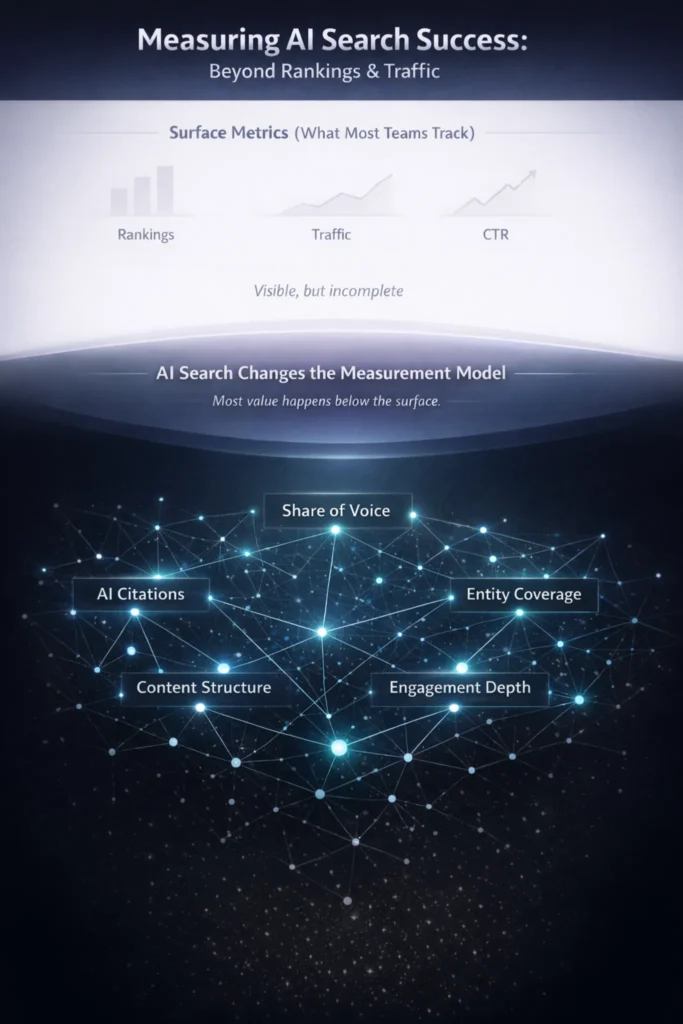
What Content Signals Drive AI Citation Frequency and Help You Measure Success in AI Search?
Research shows that brand search volume — not backlinks — is the strongest quantitative predictor of LLM citations, with a correlation of 0.334 between Google brand search volume and AI visibility. Traditional link equity shows weak or neutral correlation with AI citation likelihood.
Recency and Structural Formatting
AI systems strongly favor current, structured content — approximately 65% of AI bot hits target content published within the past year, and AI-extractable formatting boosts visibility by 30–40% in controlled experiments.
- 65% of AI bot hits target content published within the past year
- Structured formatting → 30–40% AI visibility improvement
- 700%+ YoY AI referral growth documented through structured content
Brand Signals and Cross-Platform Presence
Sites active on four or more major platforms are 2.8x more likely to appear in ChatGPT responses than those with narrower digital footprints — brand prominence outweighs link equity as an AI citation signal.
- 4+ platform presence: 2.8x more likely to appear in ChatGPT responses
- Brand search volume: strongest predictor of LLM citations (0.334 correlation)
- Backlinks: weak or neutral correlation with AI citation likelihood
Citation-Backed Content and AI Visibility Gains
The content signals that drive AI citation frequency mirror compliance-grade production standards — verified citations, statistics, and quotations are both audit protection and AI ranking signals.
- Citations in content: +115% AI visibility for mid-ranked pages
- Statistics in content: +22% AI visibility improvement
- Quotations in content: +37% AI visibility improvement
How Should Operators Build a Measurement Framework to Measure Success in AI Search Long-Term?
Building a framework to measure success in AI search requires three sequential phases: establishing baseline visibility with existing tools, adding dedicated citation tracking as the program matures, and reframing how search performance is reported to leadership.
Early-Stage vs. Mature Measurement Programs
Early-stage programs focus on attribution hygiene: custom GA4 AI channel group, isolated AI referral sessions, and manual prompt checks across ChatGPT, Perplexity, and Gemini for key branded and topical queries. Mature programs layer in dedicated platforms tracking share of voice, citation drift, and funnel-stage segmentation.
- Stage 1: Custom GA4 AI channel + manual prompt sampling
- Stage 2: Dedicated AI visibility tools tracking share of voice and citation drift
- Stage 3: Prompt-level funnel segmentation, pipeline correlation
- Enterprise: Centralized AI visibility benchmarks + localized GEO execution
Reframing the Success Conversation With Leadership
The reporting question shifts from “how much traffic did organic deliver?” to “how often do AI systems recommend us, and how does that correlate with lead quality and revenue?” GEO vendors document AI visibility improvements correlating with 31% shorter sales cycles and 23% higher lead quality.
- Reframe success: AI share of voice → pipeline quality → sales cycle efficiency
- AI visibility improvements correlate with 31% shorter sales cycles
- Connect AI visibility metrics to outcomes that leadership already measures
Budget Allocation Between SEO and AI Optimization
AI referrals grew from 0.02% to ~1% of web traffic in 2025, with ChatGPT holding 78–87% of that share and the channel growing 3–10x year-over-year. The first-mover window — estimated at 12–18 months — closes before volume justifies the investment. Build the measurement infrastructure now.
- AI referrals: 0.02% → ~1% of web traffic in 2025, growing 3–10x YoY
- ChatGPT: ~78–87% of current AI referral share
- First-mover window: ~12–18 months before mainstream agency adoption
How Content Ops Lab Builds Content Infrastructure
A multi-location regulated healthcare operation running Content Ops Lab’s production methodology recorded 95+ confirmed AI search conversions over 8 months — with AI traffic converting at 21.4% average versus a 3.32% site baseline.
Every structural element that drives AI citation frequency — verified citations, answer-first formatting, question-based architecture, statistical backing — is a standard production requirement in this system, not an optimization layer added afterward.
- 23-month production test inside a 12-location regulated healthcare organization
- 1,000+ citation-verified articles and pages delivered with zero compliance violations
- 95+ confirmed conversions from AI search platforms over 8 months (July 2025 – February 2026)
- 21.4% average AI search CVR vs. 3.32% site baseline — 6.4x performance multiplier
- 887% ChatGPT traffic growth in 7 months
- 45% of all leads from organic search, outperforming paid search nearly 2:1
- 653% impression growth and 1,700% click growth for an emerging dual-brand operation
- 5x production scale: 10 articles/month to 50+ without adding headcount
The Content Ops Lab Production System
Citation verification, structured formatting, and answer-first architecture aren’t separate workstreams — they’re the same production requirements executed through a single unified system.
- Research: Verified sources before AI generation — no hallucinated citations
- Verification: Line-by-line citation cross-check, STAT vs. CLAIM labeling, full audit trail
- Optimization: Simultaneous build for Google, ChatGPT, Perplexity, Claude, and Gemini
- Delivery: WordPress staging or Google Docs — reviewed, compliant, and publish-ready
The measurement framework only captures results when the content architecture is built to generate them.
Ready to build a content infrastructure that scales without the compliance risk? Get in touch — we’ll assess your current content operation and outline what a systematic approach would look like for your organization.
FAQs About How to Measure Success in AI Search
What is AI’s share of voice, and how does it help you measure success in AI search?
AI share of voice measures the percentage of AI-generated answers in a defined topic set that mention or cite your brand versus competitors. Run representative prompts across ChatGPT, Perplexity, and Gemini, capture responses, and count brand appearances relative to total answers. Platforms like Peec AI, Profound, and Scrunch AI automate this at scale. Enterprise benchmarks target ≥15–30% share of voice in priority topic categories.
How do I know if my GA4 setup is missing AI search traffic?
If your GA4 account lacks a custom channel group with regex rules for AI referrer domains — chatgpt.com, perplexity.ai, gemini.google.com, copilot.microsoft.com — AI traffic is almost certainly absorbed into generic “Referral” or “Direct.” Diagnostic signal: unexplained spikes in new-user direct sessions landing on informational and FAQ pages, particularly after known AI model updates.
Does AI search traffic convert better than organic search?
In high-consideration categories — B2B, regulated services, healthcare — AI-referred traffic consistently outperforms non-branded organic. ChatGPT referrals converted 31% higher than non-branded organic across a 94-brand ecommerce study. A multi-location regulated healthcare operation achieved 21.4% AI search CVR versus a 3.32% site baseline. At least one controlled study found no statistically significant conversion advantage overall — brand-specific measurement is the only reliable validation.
What tools are available to measure success in AI search through citation tracking?
The leading platforms include Peec AI, Profound, Scrunch AI, Otterly, and Quattr. They run scheduled prompts across AI engines, extract cited sources, and measure citation frequency, sentiment, share of voice, and citation drift. Custom GA4 channel configuration is the baseline — dedicated AI visibility tools are the next layer for operators ready to go beyond referral traffic.
How does Content Ops Lab structure content to get cited by AI systems?
Every article follows answer-first formatting, question-based H2 architecture, 40–60% bullet-heavy structure, and explicit statistical citations verified line-by-line against source research. Adding citations increases AI visibility by 115% for mid-ranked pages, statistics by 22%, and quotations by 37%. These formatting requirements double as compliance requirements—the same production standards that mitigate audit risk also drive AI citation performance.
Key Takeaways
- Traditional SEO metrics are structurally blind to AI-influenced demand; 58.5% of U.S. searches now result in no click, and that share is growing
- GA4 and GSC have no native AI channel — a custom channel group with regex rules for known AI referrer domains is the baseline fix
- AI search traffic converts at meaningful premiums in high-consideration categories: 31% higher than non-branded organic in large ecommerce data, and 6.4x site baseline in a regulated multi-location healthcare operation
- Brand search volume — not backlinks — is the strongest predictor of LLM citations; adding citations, statistics, and quotations to content increases AI visibility by 22–115%
- Measurement framework maturity follows three stages: custom GA4 configuration → dedicated AI visibility tools → prompt-level segmentation and pipeline correlation
- The first-mover advantage window is estimated at 12–18 months before mainstream agency adoption closes the gap — measurement infrastructure needs to be in place before the volume arrives
The Operator’s Path Forward on Measuring AI Search Success
The challenge to measure success in AI search isn’t that data doesn’t exist — it’s that default tools weren’t built to capture it. Rankings and organic sessions will retain value, but they no longer represent the full scope of how content influences decisions. AI platforms are resolving a growing share of user intent before any click happens, and that influence is invisible without deliberate measurement infrastructure.
Content optimized for AI citation frequency — structured, verified, answer-first — also performs well in traditional search. The dual optimization isn’t a tradeoff. Content Ops Lab’s methodology was built and validated within a live, regulated industry operation, not assembled from industry observations. That distinction matters when your content strategy needs to perform, not just look credible on paper.
Related: Why AI Referrals Convert Better Than Regular Search
One Comment
Comments are closed.