

Done-for-You vs In-House Content Systems: Which Scales for Multi-Location Brands?
When evaluating the decision between a done-for-you vs. in-house content system, most operators are asking the wrong question. The right question is whether your current infrastructure supports the volume your competitive position actually requires. Research shows scaling from 10 to 50+ pieces per month typically requires 6–7 months of process and structure changes, not just adding headcount.
Most multi-location businesses are running workflows designed for 4-8 articles, while their markets demand 20-50+. Content Ops Lab built its production methodology inside a 12-location regulated healthcare operation — 1,000+ citation-verified articles delivered with zero compliance violations over 23 months.
Related: Why Content at Scale for Multi-Location Businesses Fails
Why Does In-House Content Production Break Down Before Operators Realize It?
In-house content operations don’t collapse suddenly — they degrade gradually. Output stays manageable until a growth threshold triggers structural failure: one senior editor reviewing everything, one writer who “knows the voice,” one person coordinating research, approvals, and publishing simultaneously.
The Real Per-Article Capacity Ceiling
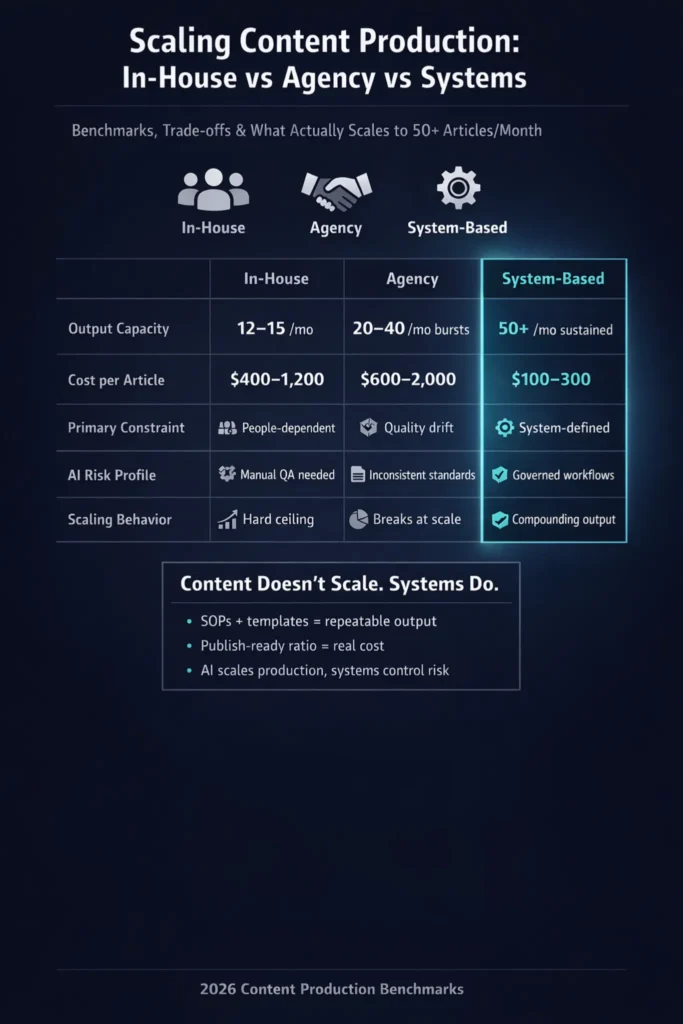
A skilled content writer produces 1,500–2,000 quality words per day, translating to 12–15 comprehensive articles per month once research, SEO, SME interviews, and revisions are factored in. That’s one writer, fully deployed, hitting a ceiling most multi-location brands cleared before they started looking for a solution.
- Single writer: 12–15 articles/month maximum under realistic conditions
- True article cost includes research, editing, coordination, and formatting — not just writing time
- “Quick” posts regularly consume 12–15 hours of combined team time
- Editorial capacity, not writing capacity, is typically the first constraint to break
How Tribal Knowledge Becomes a Throughput Cap
When quality standards live in one person’s head, throughput is capped at whatever that person can personally review and approve. Any absence, competing priority, or departure takes the production system down with it.
- Brand voice understood by 1-2 people, not encoded in documented standards
- Approval queues are backed up when key reviewers are pulled into other work
- New writers require extended onboarding because standards aren’t documented
- Quality inconsistency across locations when tribal knowledge doesn’t transfer
This isn’t a people problem. It’s an infrastructure problem — and the primary reason most in-house teams top out at volumes that can’t compete in multi-location markets.
Where Burnout Enters the Production Chain
When a small team is asked to produce 20+ articles per month without workflow redesign, research depth is the first casualty. Citation verification follows. Then QA. Content ships faster and thinner until performance data flags the degradation — often 3-6 months after the damage accumulates.
- Research shortcuts normalize under deadline pressure
- Citation accuracy degrades when verification steps are compressed
- Compliance exposure rises in regulated industries as production speed increases
What Are the Real Options for a Done-For-You vs In-House Content System?
The done-for-you vs in-house content system question has more options than the binary framing suggests, and each model has legitimate strengths worth understanding before ruling anything out.
In-House Team Economics
Building internal content capacity gives operators maximum control over brand voice, positioning, and institutional knowledge. Structural economics, however, is challenging at scale.
- Senior in-house writers: $200–600 per article at 5–10 hours per piece
- Adding writers without expanding editorial capacity creates backlogs, not more output
- Scaling from 10 to 50+ articles/month takes 6–7 months of process redesign minimum
- Full operational control — but full operational cost and complexity
In-house teams are strongest in owning strategy, voice, and SME relationships. They’re weakest when asked to carry production volume and QA simultaneously.
Agency and Done-For-You Models
Content agencies typically charge $500–2,000 for a 1,500-word post, with all-in costs including editing, SEO, design, and publishing often landing in the $600–2,000 range per piece. They offer immediate scale without hiring, but quality and compliance verification vary significantly by agency, and generic output is a persistent structural risk when production incentives prioritize margin over depth.
- Burst capacity available without permanent headcount
- Cross-client playbooks accelerate ramp-up
- Compliance verification is often absent or inconsistent
- Brand depth is limited without systematic knowledge integration
System-Based Infrastructure Approaches
System-first models treat content as infrastructure — encoding briefs, SOPs, voice standards, SEO patterns, and QA requirements into a governed production workflow. Any execution partner operates inside the same framework. This decouples quality from headcount and allows output to scale without proportional cost growth.
- Standards encoded in artifacts, not individuals
- AI tools embedded inside governed workflows with verification checkpoints
- Research-first + citation verification built into the production sequence
- System is transferable — owned by the client, not dependent on a single vendor
What Does a Systematic Content Production System Actually Require?
The right evaluation metric isn’t per-article cost or output volume — it’s whether the system produces publication-ready content consistently at scale without creating compliance exposure. Three infrastructure components separate systematic production from both agency and in-house models.
The Shift from People Dependency to Process Dependency
A governed content system replaces individual judgment with codified standards. When a senior editor leaves a people-dependent operation, the quality standards they set leave with them. When a governed system loses an editor, the standards remain in the infrastructure.
- Structured briefs replace ad-hoc topic direction
- Style guides eliminate writer-to-writer inconsistency
- Editorial checklists replace judgment calls on quality thresholds
- Acceptance criteria define “done” without senior reviewer involvement per piece
What “Single Source of Truth” Means in Production
When briefs, style guidelines, keyword targets, and compliance notes live in separate documents, every article requires manual coordination. That coordination time is real cost — it just doesn’t appear on a per-article invoice.
- A single versioned system document eliminates conflicting standards
- Research repositories reduce per-article research time
- Knowledge base captures SME expertise in reusable form
- Version control ensures methodology improvements propagate consistently
Citation Verification as a Non-Negotiable Infrastructure Layer
For regulated industries, citation verification is a compliance infrastructure. In 2024, a tribunal held a company liable for inaccurate information provided by its AI system — and “the AI said so” won’t mitigate liability going forward.
- Every statistic is verified against the source material before publication
- STAT vs CLAIM labeling applies different verification standards by evidence type
- Line number documentation creates an audit trail for every data point
- Direct quote extraction eliminates interpretation errors
Any content model operating at volume in a regulated industry without a verification layer is accumulating compliance risk at publication cadence.
If your operation needs to produce 20-50+ articles per month without sacrificing compliance or quality, Content Ops Lab builds the infrastructure to make that possible. Contact us today to discuss your content production requirements.
What Does Production Data Show About Volume, Quality, and Outcomes?
Operator decisions about content model and volume targets should be grounded in what production data actually shows — not content marketing generalities about “more is better.”
The Diminishing Returns Curve Above 20 Articles/Month
A LinkedIn analysis of 200 B2B SaaS and e-commerce sites found that organic traffic growth peaks at 12–20 articles per month. Beyond that, performance drops as quality suffers and cannibalization increases. Teams publishing 50+ unfocused posts underperformed teams publishing 15–20 targeted posts by 2.3x in organic traffic.
- The ceiling isn’t volume — it’s quality-per-article at volume
- Brute-force content without a quality framework destroys ROI at any publication rate
- Systematized production maintains quality at 50+ by encoding standards, not limiting output
The Publish-Ready Ratio as a True Cost Predictor
The most predictive cost metric isn’t the hourly rate — it’s the publish-ready ratio: the share of drafts that reach publication without substantial rewrites. Cheap drafts requiring multiple revision rounds often become the most expensive articles once editorial labor is fully accounted for.
- Strong briefs reduce the total article cost more than any other single factor
- In-house and agency models both hide rewrite costs in general overhead
- System-first operations surface publish-ready ratio as a leading quality metric
What AI Search CVR Data Reveals About Content Architecture
A multi-location healthcare client operating a 23-month content production system saw AI search platforms deliver an average conversion rate of 21.4% over 8 months — 6.4x the site average. An emerging brand in the same network built from near-zero organic presence achieved 653% impression growth and 1,700% click growth over 14 months.
- Content architecture built for AI extraction drives citation frequency across platforms
- The same system that produces compliant healthcare content also produces AI-citable content
- AI search CVR compounds — early citation patterns reinforce as AI systems build reference models
Related: Why Content at Scale for Multi-Location Businesses Fails
How Does AI Change the Done-For-You vs In-House Calculation?
AI alters the economics of every content model — but not in the direction most operators assume. The upside is real. The downside is less frequently disclosed by vendors selling AI content services.
AI Augmentation vs AI Generation — a Critical Distinction
AI augmentation means AI handles mechanical work while humans retain control of strategy, voice, verification, and final editing. AI generation means AI produces the final output with minimal oversight. These produce categorically different content and categorically different risk profiles.
- AI-assisted workflows (human edited): $100–300 per article at comparable quality to in-house
- Unedited AI output: $10–40 per article at significantly lower quality and higher compliance risk
- Teams using AI augmentation inside structured operations see 34% more content at equivalent quality
The Verification Gap That Unstructured AI Use Creates
AI can cut creation time by roughly 60% and reduce manual workflows by about 50%. What that benchmark doesn’t capture: the cost of hallucinations and fabricated citations that appear plausible and ship undetected.
- AI systems write from training data memory — not from verified source research
- Fabricated statistics look credible enough to pass a casual editorial review
- At volume, one unverified claim per article becomes dozens of compliance exposures per month
The verification gap isn’t a flaw in AI tools. It’s a gap in the workflow architecture surrounding them.
Where AI Fits Inside a Governed Production System
In a governed system, AI tools occupy specific workflow positions: Perplexity Pro for research with citation tracking, Claude for long-form generation with verified inputs, ChatGPT for meta tags and H1 structure, and Gemini for deep topic analysis. Each tool operates inside defined parameters with human verification checkpoints between stages.
- Multi-LLM deployment matches tool strengths to workflow stages
- Research verification happens before AI generation, not after
- Human review at citation checkpoints catches fabrication before publication
Done-For-You vs System Build: Which Model Fits Your Operation?
Once a systematic infrastructure is established as a requirement, the decision shifts to which delivery model fits your organizational structure and growth timeline.
Indicators That Done-For-You Is the Right Starting Point
Done-For-You is appropriate when the gap between current output and required output is too large to close with internal resources, and when internal bandwidth can’t support both building a production system and hitting near-term publishing targets.
- Current production at 4-8 articles/month with a 20-50+ target
- No existing content operations infrastructure (briefs, style guides, QA protocols)
- Compliance requirements in healthcare, legal, or financial services
- VP of Marketing focused on strategy and distribution, not production management
When a System Build Makes Strategic Sense
System Build is a fit when internal capacity exists, and the operator wants to own production infrastructure long-term — building institutional knowledge rather than maintaining vendor dependency.
- Internal team in place, but operating without documented workflows
- Plan to scale content as a core competency, not outsource it indefinitely
- Multi-location complexity makes a transferable system valuable long-term
System Build delivers a complete production system in 12 weeks with 90 days of post-launch support. The deliverable is owned infrastructure, not a service relationship.
The Handoff Question: Infrastructure Ownership vs Managed Execution
The strategic question is whether content production is a core competency your organization wants to own, or an operational function you want executed systematically by a managed service. Both are legitimate positions.
- Done-For-You: COL runs the system, delivers publish-ready content, and manages QA
- System Build: COL builds the system, trains your team, and transfers full ownership
- Both models deliver the same production architecture — the difference is who operates it
How Content Ops Lab Builds Content Infrastructure
Content Ops Lab built its production methodology inside a 12-location regulated healthcare organization — delivering 1,000+ citation-verified articles over 23 months. That system generated 12,487 leads in six months for a dual-brand, multi-state operation, with organic search delivering 45% of all leads and outperforming paid search nearly 2:1. The methodology is now productized for operators in healthcare, legal, and home services.
- 23-month production test inside a 12-location regulated healthcare organization
- 1,000+ citation-verified articles delivered with zero compliance violations
- 45% of all leads from organic search — outperforming paid search nearly 2:1
- AI search converting at 21.4% average vs. 3.32% site average — 6.4x performance multiplier
- 653% impression growth and 1,700% click growth for an emerging brand (14-month period)
- 5x production scale: 10 articles/month to 50+ without adding headcount
- 887% ChatGPT traffic growth in 7 months
- Dual-brand methodology validated on both mature brand maintenance and emerging brand growth
The Content Ops Lab Production System
Governed production at volume requires a sequenced workflow, not just writing capacity.
- Research: Verified sources before generation — Perplexity Pro workflow, no AI writing from memory
- Verification: Line-by-line citation cross-check, STAT vs CLAIM labeling, full audit trail
- Optimization: Simultaneous multi-platform targeting — Google, ChatGPT, Perplexity, Claude, Gemini
- Delivery: WordPress staging or Google Docs — Grammarly-reviewed, compliant, publish-ready
Whether you need managed execution or infrastructure, your team operates independently, and the architecture is the same.
Ready to build a content infrastructure that scales without the compliance risk? Get in touch — we’ll assess your current content operation and outline what a systematic approach would look like for your organization.
FAQs About Done-For-You vs In-House Content System
How long does it take to scale content production from 10 articles/month to 50+?
Scaling typically takes 6–7 months across three phases: documenting processes, building or engaging a production team, and systematizing workflows to reduce per-article cost by 30–40%. Done-For-You compresses this by deploying an existing system rather than building one from scratch. The constraint is infrastructure design, not writing capacity.
What’s the difference between a done-for-you vs in-house content system approach?
A done-for-you service delivers articles against a retainer. A content production system delivers articles through a governed workflow — verified research, citation cross-checking, multi-platform optimization, and QA enforced at every stage. Agency execution is people-dependent; quality varies with the team. System execution is infrastructure-dependent; quality is encoded in the process. The distinction matters most at volume and in regulated industries.
How does citation verification work inside a managed content production operation?
Every data point is extracted as an exact quote from source research, labeled as a STAT or CLAIM, and cross-checked against the original before publication. Each citation includes a line number reference for audit-trail purposes. This runs on every article as an embedded workflow step — not a separate QA pass — making AI-generated content defensible in healthcare, legal, and financial environments.
Is it more cost-effective to build an in-house content team or use a done-for-you content system?
In-house writers run $200–600 per article (loaded hourly). AI-assisted human-edited workflows deliver comparable quality at $100–300 per article. The more important variable is rewrite burden: cheap drafts requiring extensive revision often cost more in total than well-produced first drafts. Done-For-You services with systematic production infrastructure typically deliver lower true cost per publish-ready article because the system eliminates late-stage revision load.
Can a done-for-you vs in-house content system comparison account for compliance requirements?
Yes — with the qualifier that the system must include citation verification as a structural component, not an optional review step. Content Ops Lab’s methodology was developed inside a regulated healthcare environment, delivering 1,000+ articles with zero compliance violations over 23 months. Compliance is built into how the system operates — research-first production, verified citations, no AI writing from memory — not layered on as a feature.
Key Takeaways
- Scaling content from 10 to 50+ articles/month takes 6–7 months of process redesign — adding writers without infrastructure produces worse bottlenecks, not more output
- In-house models offer brand depth but top out structurally without documented SOPs and editorial systems that encode standards beyond individual judgment
- Traditional agencies provide burst capacity, but compliance verification and content depth degrade when production incentives prioritize volume over governance
- Teams publishing 50+ unfocused articles underperform teams publishing 15–20 targeted articles by 2.3x — volume without infrastructure destroys ROI
- AI cuts drafting time 60–70% inside governed systems; without verification infrastructure, it scales hallucinations and compliance exposure at the same rate it scales output
- A multi-location healthcare client’s governed content system delivered 21.4% AI search CVR — 6.4x the site average — validating that structured content architecture drives measurable business outcomes
- The done-for-you vs system build decision is about who operates the infrastructure — both models require the same governed production architecture to perform
Build Content Infrastructure That Compounds: Done-For-You vs In-House Content System
Research across 2,100+ B2B marketers shows that teams that invest the first 1–2 months in process documentation before scaling volume are the ones sustaining 50+ posts in months 6–7. Operators who skip that infrastructure phase run harder and get less.
For multi-location businesses in regulated industries, unverified AI content at scale isn’t underperforming content — it’s a compliance liability that accumulates at publication cadence.
Content Ops Lab’s methodology was stress-tested inside a 12-location healthcare operation for 23 months before it was productized. If your current content model wasn’t built to support what your market now requires, the infrastructure question is overdue.