

Why Do Internal Content Teams Hit a Production Ceiling?
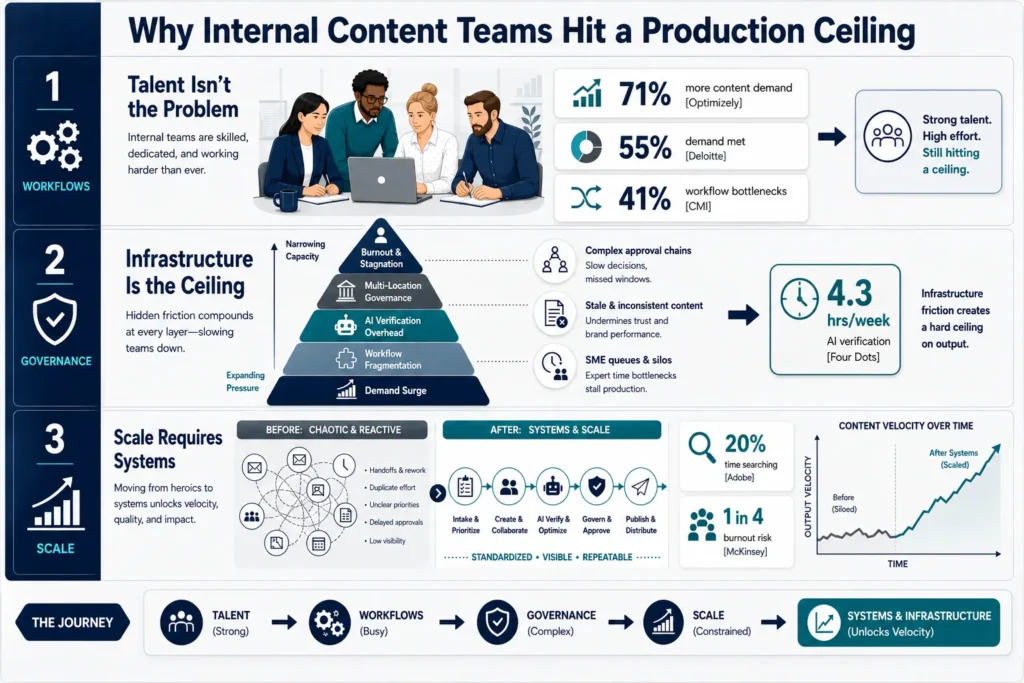
Internal content teams hit a production ceiling when demand outpaces the systems built to support them—not because the teams lack talent. Content demand grew by 1.5x in 2023, yet marketing teams met that demand only 55% of the time — a structural capacity gap that no amount of individual effort can close. — Deloitte Digital.
For multi-location operators, that gap compounds with each additional location. Internal content teams need production infrastructure built to scale — not more writers or better tools in isolation. Content Ops Lab built that infrastructure inside a 12-location regulated healthcare organization over 23 months, delivering 1,000+ citation-verified articles with zero compliance violations.
Related: Why Does AI-Generated Content Fail Without Verification?
Why Do Internal Content Teams Hit a Production Ceiling Even When They’re Performing Well?
Internal content teams reach production ceilings because the systems around them — not the people in them — aren’t built for the volume modern multi-location operations require. The ceiling is structural. Talented writers, capable strategists, and committed managers all hit the same wall when workflows, governance, and verification infrastructure haven’t scaled with demand.
The Structural Demand Gap
“Fewer than 30% of marketers feel they have the tools and systems to manage content effectively across their organization” — Optimizely. That finding doesn’t describe a talent problem — it describes a systems maturity problem that shows up the moment organizations push volume.
- Demand is growing faster than operational capacity to deliver
- AI adoption is accelerating content volume requirements
- Systems designed for 10 articles/month failing at 30+
- Internal teams absorbing coordination costs, the infrastructure should handle
The gap between what the business needs and what the team can produce closes when the production system catches up to the demand.
Workflow Bottlenecks That Compound at Scale
Single-location content operations can survive fragmented workflows. At five or ten locations, those fragments become production blockers. Each additional location multiplies the coordination surface — review cycles, location-specific compliance, brand consistency checks — without adding the governance layer that keeps it organized.
- Review cycles stretching from days into weeks
- Approval chains routing through siloed stakeholders
- Brand consistency enforcement is happening manually, per article
- Location-specific requirements are managed ad hoc rather than systematically
At scale, the bottleneck isn’t the writing — it’s the infrastructure surrounding it.
What the Production Ceiling Actually Looks Like
The ceiling shows up gradually, then all at once. Publish cadence slips. Quality inconsistencies appear across locations. A compliance flag surfaces on a location page that no one reviewed closely. The team isn’t underperforming — they’re operating at full capacity inside a system not designed for this volume.
- Output plateaus despite team investment
- Quality variance is increasing across locations
- Compliance risk exposure is growing with volume
- Strategic work is crowded out by production firefighting
Recognizing the ceiling as a systems problem — not a headcount problem — is the first step toward solving it correctly.
What Breaks First When Internal Content Teams Try to Scale Without Infrastructure?
When internal teams push volume without building infrastructure first, three specific failure points surface: approval chains seize up, SME access dries up, and context switching quietly destroys capacity. None of these is a talent failure — all three are predictable consequences of scaling production without scaling the systems that support it.
Approval Chain Failure Points
“Forty-one percent say they have issues with workflow/content approval, and 39% say they have difficulty accessing subject matter experts” — Content Marketing Institute. In regulated industries, approval complexity is greater — legal, brand, and compliance stakeholders each need sign-off, often in sequence and without shared systems.
- Content sitting in inboxes waiting for reviewers to notice it
- Conflicting feedback from disconnected stakeholders requires additional revision cycles
- Version control failures when reviews are routed through email and shared drives
- Review timelines measured in days when publication cadence requires hours
One compliance-sensitive piece waiting five days for legal review delays the entire publishing schedule — not just that article.
SME Access as a Structural Chokepoint
Subject matter experts have full-time jobs that don’t include content production. When internal teams depend on SME input for technically accurate articles — and SMEs deprioritize content requests — production queues build quickly.
- SME availability is becoming the rate-limiting step in content velocity
- Unstructured requests are generating delays and incomplete responses
- Tribal knowledge is locked inside experts, with no documentation system
- Content accuracy suffers when teams write around missing SME input
The fix isn’t badgering SMEs — it’s a documentation system that captures their expertise once and deploys it systematically across all future content.
The Hidden Cost of Context Switching
A 2022 Harvard Business Review study found that the average digital worker toggles between applications and websites nearly 1,200 times per day and spends almost four hours per week reorienting after switching apps — equivalent to roughly five working weeks lost per year — Conclude.io.
For content teams managing keyword research, drafting, verification, approval routing, and publishing across disconnected tools, that overhead is constant.
- Tool sprawl fragments attention across research, drafting, review, and publishing platforms
- Reorientation time after each workflow stage consumes production hours
- Strategic work crowded out by operational navigation
Context switching isn’t a time-management problem — it’s a systems-design problem.
What Are the Real Options When Internal Teams Can No Longer Keep Up?
When an internal team’s production ceiling becomes undeniable, three options are typically on the table: hire more writers, engage a traditional agency, or adopt AI tools. All three can produce results in specific circumstances. None of them solves the underlying infrastructure problem without an accompanying governance and verification layer.
Hiring More Writers
Adding headcount is the most intuitive response to a volume problem — and it works up to a point. New writers require onboarding, alignment with the style guide, and quality control oversight. In regulated industries, compliance training is also required before any content is published.
- Onboarding timelines are delaying the capacity gain
- Quality variance increases as team size grows
- Compliance review burden scales with every new contributor
- Management overhead is consuming the VP’s strategic bandwidth
Headcount solves a volume problem temporarily. It doesn’t solve the system’s problem driving the ceiling.
Traditional Agency Outsourcing
Agencies provide external production capacity without onboarding overhead. The quality risk shifts from internal inconsistency to external generic output — content that doesn’t reflect brand voice, SME expertise, or compliance requirements. Most agencies optimize for 2019-era Google metrics, not AI citation readiness or location-specific search signals.
- Generic output requiring substantial internal editing before publication
- Citation verification is absent in most agency workflows
- Compliance exposure without internal sign-off processes
- No multi-location SEO specialization in standard agency deliverables
Agencies can scale volume. They rarely build infrastructure that makes content defensible in regulated industries or citation-worthy in AI search.
AI Adoption Without Governance
AI tools accelerate drafting — that’s well documented. Without a verification infrastructure, AI adoption moves the bottleneck upstream rather than eliminating it. “Many organizations default to human review of all AI outputs. This catches hallucinations but eliminates the efficiency gains that motivated AI adoption in the first place” — Contextual AI.
- Hallucination risk is forcing full human review on every output
- Verification overhead is consuming the time savings AI promised
- Compliance exposure is growing in proportion to volume
The gain from AI isn’t automatic — it depends entirely on the verification infrastructure surrounding it.
If your operation needs to produce 20-50+ articles per month without sacrificing compliance or quality, Content Ops Lab builds the infrastructure to make that possible. Contact us today to discuss your content production requirements.
How Does Verification Infrastructure Change What Internal Content Teams Can Actually Produce?
Verification infrastructure doesn’t slow production — it’s what makes production sustainable at scale. Teams that build citation verification, governance protocols, and multi-platform optimization into the workflow before scaling see compounding quality gains without the compliance exposure that comes from volume without oversight.
“Employees spend an average of 4.3 hours per week verifying whether AI-generated content is accurate” — Four Dots. That overhead is the cost of operating without a verification system.
Why AI Accelerates the Draft but Not the QA
AI generates content fast. It does not verify content accurately. 82% of AI production bugs stem from fabricated information — meaning the QA burden for unverified AI output is substantial, not marginal.
- Hallucinations appearing in statistics, source URLs, and attributed quotes
- Fabricated citations pass initial review when no verification system exists
- Compliance audits flagging unverified claims that are published at scale
The answer isn’t less AI — it’s a verification layer that ensures AI output is trustworthy before it’s published.
The Citation Verification Standard
A systematic verification protocol documents every statistic and attributed claim against its source, assigns a STAT or CLAIM label based on the type of evidence, and maintains an audit trail by line number. That standard eliminates hallucinations and produces content that AI search systems recognize as citation-worthy.
- Every statistic is traced to the source material with line-number documentation
- STAT vs. CLAIM labeling distinguishing data points from attributed assertions
- No paraphrasing — exact quotes prevent interpretation errors at the source
- Compliance-ready output that survives audit without additional research
Verification infrastructure is what separates AI-assisted content production from AI-enabled compliance risk.
Governance as a Production Multiplier
Governance enables production to scale without quality degradation. Clear ownership of each workflow stage, structured SME documentation, and standardized templates all compound over time. “Smart people trapped in the wrong system will still underperform.
The best AI tools in the world won’t deliver results when constrained by the wrong organization” — MarTech.
- SME knowledge is documented once and reused across all future content
- Approval routing is standardized, so reviewers know exactly what they’re approving
- Templates eliminating structural decision-making at the article level
Governance is the lever that converts individual effort into systematic output.
What Does a Systematic Content Infrastructure Deliver in a Multi-Location Operation?
Production data from a 23-month engagement inside a 12-location regulated healthcare organization answers this directly. The methodology scaled from 10 articles per month to 50+ articles per month, delivered 1,000+ citation-verified articles and pages, and generated organic search performance that outperformed paid channels by nearly 2:1 — without adding headcount or compromising compliance standards.
Production Scale Without Headcount Growth
The 5x increase in production — from 10 articles per month to 50+ — came from systematic infrastructure, not from additional writers. 278 blog articles were published in a tracked sub-window at approximately 13 per week across dual brands, validating that the methodology sustains velocity over time.
- 5x monthly output increase without proportional headcount growth
- 1,000+ citation-verified articles and pages delivered across 23 months
- Zero compliance violations across a regulated healthcare operation
- Dual-brand production is managed simultaneously under one unified system
Scale without infrastructure is a sprint. Scale with infrastructure is a production floor that holds.
AI Search as the High-Converting Channel
A multi-location healthcare client optimized for AI search citations saw AI-referred traffic convert at an average of 21.4% over eight months — compared to a 3.32% site baseline. That’s a 6.4x performance multiplier from a channel representing less than 0.3% of total traffic volume. ChatGPT traffic grew 887% over seven months, while overall traffic grew 1.5%.
- AI search converting at 21.4% average vs. 3.32% site baseline
- 6.4x conversion multiplier from AI-referred traffic
- 887% ChatGPT traffic growth in seven months
- Fewer than 5% of healthcare operators are currently optimizing for AI citations
The operators building systematic content infrastructure are now capturing AI citations before the channel becomes competitive.
Dual-Brand Proof Across Growth Stages
The same methodology applied to a mature brand and an emerging brand delivered comparable organic lead contribution in both cases — 40-45% of all leads from organic search. The emerging brand achieved 653% growth in impressions and 1,700% growth in clicks over 14 months.
- Organic search delivering 45% of all leads, outperforming paid search nearly 2:1
- 653% impression growth and 1,700% click growth for the emerging brand
- Mature brand maintaining dominant search presence during LLM search disruption
- Methodology validated for both defense and growth simultaneously
The infrastructure delivers across growth stages — it doesn’t require ideal starting conditions.
Is Building Content Infrastructure or Outsourcing It the Right Move for Your Operation?
The choice between building content infrastructure internally and outsourcing it isn’t primarily about budget — it’s about internal capacity and time horizon. Both paths produce the same outcome: a systematic, scalable production system optimized for traditional search and AI citation. The difference is who operates it.
When System Build Makes Sense
System Build is the right model when the organization has an internal team capable of operating a systematic workflow — but lacks the infrastructure to run at scale. The engagement delivers a complete production system, custom templates, knowledge base documentation, and training, then hands off to the internal team.
- Existing internal team with the capacity to operate a structured workflow
- Preference for owning the system rather than depending on an external operator
- Multi-location expansion creating urgency around scalable infrastructure
System Build works when the team is there, but the infrastructure isn’t.
When Done-For-You Is the Right Start
Done-For-You is the right model when the internal team is already at capacity and can’t absorb infrastructure-building alongside current production demands. Content Ops Lab runs the complete system — research, verification, optimization, and delivery — while the VP retains strategic direction.
- Internal team at production ceiling with no bandwidth for infrastructure work
- Compliance requirements demanding immediate verification of coverage
- Volume requirement (20-50+ articles per month) exceeds current internal capacity
Done-For-You starts delivering before the team has the capacity to build.
The Evaluation Criteria That Matter
The decision criteria that matter aren’t primarily cost-per-article or agency reputation — they’re about whether the production system the engagement delivers will still be functioning at scale in 12 months.
- Verification infrastructure: does the system eliminate hallucinations, or just accelerate drafts?
- Multi-location specialization: does the output include hyper-local SEO, NAP consistency, and location-specific optimization?
- Compliance track record: tested in a regulated industry at production scale?
- AI search readiness: built for ChatGPT, Perplexity, and Gemini citation — not only Google indexing?
The right engagement produces defensible, compounding content infrastructure.
How Content Ops Lab Builds Content Infrastructure for Multi-Location Operators
Content Ops Lab built its methodology inside a 12-location regulated healthcare organization over 23 months — scaling production from 10 articles per month to 50+, delivering 1,000+ citation-verified articles and pages, and generating AI search traffic that converts at 6.4x the site baseline. The system was iterated in live production, under compliance constraints, across dual brands at different growth stages.
- 23-month production test inside a 12-location regulated healthcare organization
- 1,000+ citation-verified articles and pages delivered with zero compliance violations
- 5x production scale: 10 articles/month to 50+ without adding headcount
- Organic search delivering 45% of all leads — outperforming paid search nearly 2:1
- AI search converting at 21.4% average vs. 3.32% site baseline — 6.4x better performance
- 653% impression growth and 1,700% click growth for an emerging multi-location brand (14 months)
- 887% ChatGPT traffic growth in seven months across the network
- Dual-brand methodology validated on both mature brand maintenance and emerging brand growth
The Content Ops Lab Production System
Every engagement — Done-For-You or System Build — runs on the same four-stage production infrastructure:
- Research: Verified sources before generation — Perplexity Pro workflow, no AI writing from memory
- Verification: Line-by-line citation cross-check, STAT vs. CLAIM labeling, audit trail for every data point
- Optimization: Multi-platform build — Google, ChatGPT, Perplexity, Claude, and Gemini simultaneously
- Delivery: WordPress staging or Google Docs — publish-ready, Grammarly-reviewed, compliance-confirmed
The system replicates systematically across every article, every location, every engagement.
Ready to build a content infrastructure that scales without the compliance risk? Get in touch — we’ll assess your current content operation and outline what a systematic approach would look like for your organization.
FAQs About Internal Content Teams
Can’t we hire more writers to address our internal content team’s capacity constraints?
Hiring more writers temporarily addresses volume but doesn’t resolve the system problem causing the ceiling. Each new writer adds onboarding time, compliance training, and quality oversight burdens—and in regulated industries, those requirements scale with headcount. The organizations that break through the ceiling consistently build systematic infrastructure, not just bigger teams.
How long does it take to see results after implementing a systematic content production system?
System Build engagements reach full deployment in 12 weeks, with a 90-day post-launch support period. Done-For-You engagements begin delivering published content within the first month. Measurable improvements in search performance typically emerge within 3 to 6 months. AI search citation results appear faster — the 887% ChatGPT traffic growth documented in our multi-location healthcare case study developed over seven months.
How does a systematic content approach address compliance in regulated industries such as healthcare and legal?
Every article produced through the Content Ops Lab system includes citation verification against source research, with line-number documentation for every statistic and attributed claim. STAT vs. CLAIM labeling applies different verification standards to data points versus assertions. Across 23 months in a regulated healthcare operation, the methodology delivered 1,000+ articles and pages with zero compliance violations.
How is Content Ops Lab’s approach different from a traditional content agency or a generic AI content tool?
Traditional agencies optimize for volume and keyword placement. Generic AI tools accelerate drafting. Neither includes the citation-verification infrastructure that regulated industries require, nor the multi-platform optimization that drives AI search citations. Content Ops Lab’s methodology was built and iterated inside a live production environment. Every component addresses a failure mode that appeared in actual production, not a hypothetical workflow.
When should a multi-location brand choose Done-For-You versus System Build for content infrastructure?
Choose Done-For-You when your internal team is already at capacity and can’t absorb infrastructure-building alongside current production demands. Choose System Build when you have a team capable of operating a systematic workflow but lack the templates, knowledge base, and governance structure to scale. Both deliver the same production system — the difference is ownership and operations model after launch.
Key Takeaways
- Internal content teams hit production ceilings because of systems limitations, not talent failures — demand has grown 1.5x while teams can meet it only 55% of the time
- The three primary failure points at scale are approval chain breakdown, SME access bottlenecks, and context-switching overhead — all infrastructure problems, not people problems
- AI adoption without verification infrastructure moves the bottleneck upstream: faster drafts plus unverified QA equals more compliance exposure, not less
- A systematic verification protocol — citation cross-checking, STAT vs. CLAIM labeling, audit trail documentation — makes AI-assisted content defensible in regulated industries
- A multi-location healthcare client running this methodology achieved 45% organic lead share, outperforming paid search nearly 2:1, with AI search converting at 6.4x the site baseline
- Done-For-You and System Build deliver the same infrastructure outcome — the right model depends on internal team capacity and time horizon
- The first-mover window for AI search citation is open now — fewer than 5% of operators in most regulated categories are optimizing for it
Build Content Infrastructure That Compounds: Internal Content Teams
Internal content teams don’t stall because they stop trying. They stall because the systems surrounding them weren’t built for the volume the business now requires. The structural demand gap is real, documented, and widening — and it doesn’t close by adding writers or adopting AI tools without governance. It closes when production infrastructure matches the scale of the operation.
Content Ops Lab built that infrastructure over 23 months in a regulated, multi-location environment — scaling without headcount growth, delivering without compliance exposure, and producing AI-citation-ready content that converts at rates that traditional organic traffic can’t match.
The operators who build this infrastructure now will be defending a compounding first-mover position when the rest of the market catches up.
Related: Done-for-You vs In-House Content Systems – Which Scales for Multi-Location Brands?