
SEO vs AEO vs GEO: How Multi-Location Businesses Should Think About Modern Search
The search landscape has fractured into three distinct optimization disciplines — SEO, AEO, and GEO — and operators running multi-location businesses need a strategy that addresses all three or risk going invisible in the channels that convert best.
According to McKinsey, about 50% of consumers now intentionally seek out AI-powered search, and 44% of AI search users rate it their primary source of insight — ahead of traditional search at 31%. Most multi-location content strategies are still built entirely around Google rankings. That’s not wrong — it’s incomplete.
The operators who understand how SEO, AEO, and GEO interact as a unified search stack are capturing traffic that converts at 3–6x the site average from channels their competitors aren’t tracking.
Content Ops Lab built its content infrastructure in a live production environment — 23 months, 1,000+ citation-verified articles, zero compliance violations — optimizing across all three layers of the modern search stack.
Related: Answer Engine Optimization: What Multi-Location Operators Need to Know
Why Is Your Traditional SEO Strategy Delivering Fewer Leads Even When Rankings Hold?
Rankings are holding. Traffic is flat. Leads are softer than the position warrants. The cause isn’t a Google penalty — it’s structural compression from zero-click behavior and AI summary displacement.
The Zero-Click Compression Effect
SparkToro’s 2024 zero-click study found that 59.7% of EU Google searches and 58.5% of U.S. Google searches resulted in zero clicks. For every 1,000 searches in the United States, only 360 clicks reach a non-Google-owned property.
- Zero-click rate has risen from ~50% in 2019 to ~60–65% by 2024
- Mobile zero-click rates exceed 75% as users rely on SERP features for answers
- AI Overviews can reduce organic CTR for position-one results by more than half in affected queries
Ranking #1 doesn’t mean what it meant three years ago. A top position in a zero-click SERP delivers a fraction of the traffic it once did.
SERP Feature Displacement
Featured snippets, PAA boxes, knowledge panels, local packs, and AI Overviews are absorbing clicks that previously flowed to organic blue links — and for informational queries, which drive the top of your acquisition funnel, the displacement is most acute.
- AI Overviews appear in approximately 13% of Google queries and are projected to expand
- PAA boxes extend SERP depth without increasing click-through to websites
- Informational queries — the ones that build brand awareness and intent — are most affected
What Holds Steady vs. What’s Broken
Transactional and navigational queries — “book appointment,” “chiropractor near me,” “law firm Charlotte NC” — still produce clicks. The disrupted category is the informational middle of the funnel: condition pages, service explainers, and comparison content. These are the content types that build trust and move prospects toward conversion — and they’re the most affected by zero-click and AI summary behavior.
- Transactional queries: largely stable
- Informational queries: significant compression, shifting to AI answer surfaces
- Consideration-stage content: highest displacement risk, highest opportunity for AEO/GEO capture
The answer isn’t to abandon SEO. It’s to add the layers that capture visibility where clicks are migrating.
What Is the Difference Between SEO, AEO, and GEO — And Why Does It Matter for Multi-Location Growth?
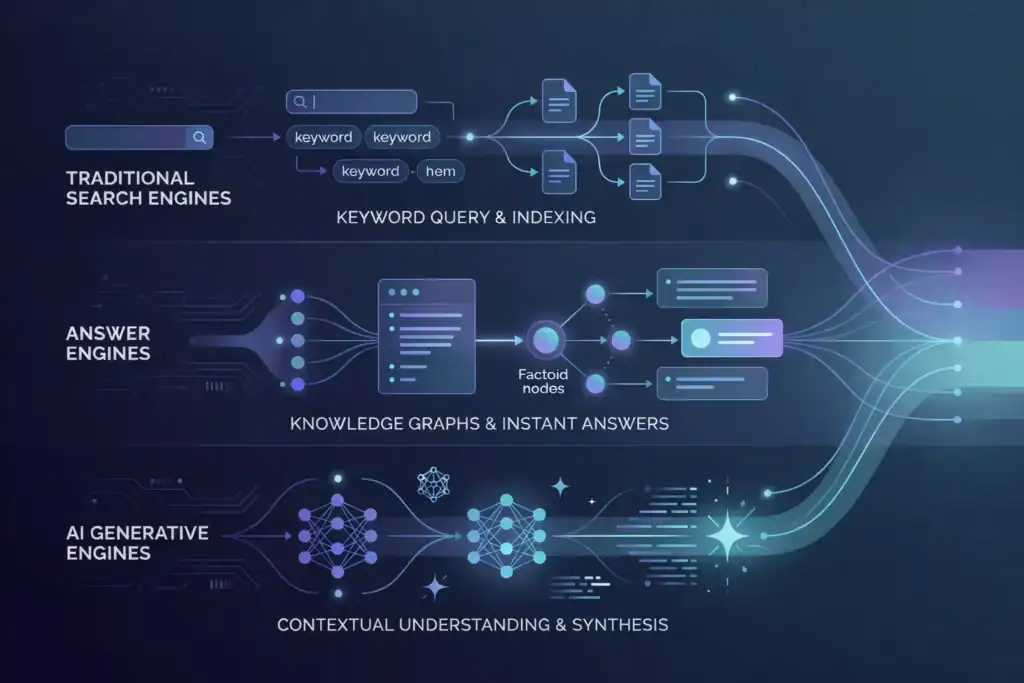
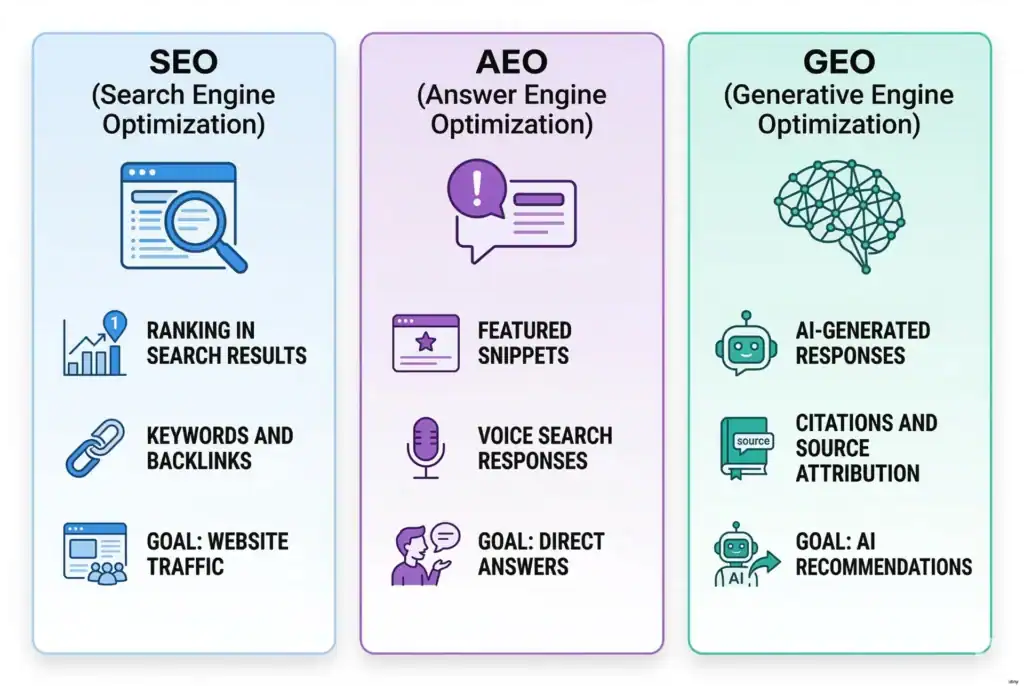
SEO, AEO, and GEO are not competing strategies — they’re a stack. Each layer addresses a different surface in the modern search landscape, and content built for all three simultaneously outperforms single-discipline approaches.
SEO as Foundation Layer
Traditional SEO governs how pages are discovered, indexed, and ranked in classical search engines. It remains non-negotiable — without this foundation, AEO and GEO have nothing to build on.
- Core signals: crawlability, technical performance, backlink authority, E-E-A-T
- Primary metrics: keyword rankings, organic traffic, CTR, conversions
- Query style: keyword-centric through long-tail variations
Google’s E-E-A-T framework is especially critical for YMYL industries — healthcare, legal, and financial services — where multi-location operators face the highest compliance stakes and the highest organic search returns.
AEO as Answer Architecture
Answer Engine Optimization structures content so that AI-powered systems — such as featured snippets, voice assistants, AI Overviews, and conversational AI platforms — can extract and present it as a direct answer.
- Core goal: become the answer, not just a ranked link
- Key structure: question-as-heading, 40–60 word direct answer, supporting detail below
- Success metrics: featured snippet wins, AI answer citations, voice search share
The same page that ranks in position 3 can win the featured snippet — capturing the top of the SERP above positions 1 and 2 — if it’s structured with answer-first formatting. For multi-location operators producing 20–50 articles per month, an AEO-optimized structure is a systematic multiplier, not a per-article tactic.
GEO as Citation Infrastructure
Generative Engine Optimization extends AEO into the LLM layer — optimizing how ChatGPT, Perplexity, Gemini, and other generative platforms understand, surface, and cite your content inside synthesized responses.
- Core goal: be the model’s trusted source when users ask questions in your category
- Selection signals: semantic completeness, entity clarity, recency, citation backing, topical depth
- Success metrics: AI citation share, referral traffic from AI platforms, brand representation quality
GEO selection mechanisms differ by platform. Perplexity heavily favors freshness and long-form guides. Google AI Overviews reward semantic completeness. ChatGPT draws disproportionately from pages that rank beyond position 20 in traditional results — LLM systems access a wider content pool than top-SERP optimization alone would capture.
The progression from “get clicked” (SEO) to “be the answer” (AEO) to “be the model’s trusted source” (GEO) isn’t a replacement sequence — it’s a layering sequence.
What Are Multi-Location Businesses Actually Doing About AI Search Right Now?
Almost nothing systematic. The competitive window is wide open in most categories — but it won’t stay that way.
The Agency Gap
Traditional content agencies are selling “AI content” — ChatGPT-generated articles from memory, without citation verification, AEO formatting, or GEO infrastructure. Agencies using AI to produce content have done almost nothing to make that content credible to AI systems.
- Template-driven approaches optimize for 2019-era keyword metrics, not AI extractability
- No answer-first structures, no question-based H2s, no entity consistency
- Fabricated statistics and hallucinated URLs reach publication without verification
For operators in regulated industries, unverified AI content isn’t just a performance problem — it’s a liability.
The Internal Team Ceiling
Internal teams cap out at 4–8 articles per month before quality begins to degrade. That ceiling is a bandwidth constraint, not a skill constraint.
- No systematic citation verification workflow at scale
- Quality varies with the writer when no unified production system exists
- Local SEO across multiple locations multiplies the customization burden
The Generic AI Tool Problem
Direct use of ChatGPT or Claude without a structured production system produces fast output that is unsystematic, unverified, and unoptimized for the platforms that matter.
- AI writes from training data, not verified current sources
- No AEO or GEO structural architecture
- No compliance safeguards for regulated content
Speed without infrastructure doesn’t build a competitive moat — it creates compliance exposure.
If your operation needs to produce 20–50+ articles per month without sacrificing compliance or quality, Content Ops Lab builds the infrastructure to make that possible. Contact us today to discuss your content production requirements.
What Does AI Search Traffic Actually Deliver in Conversion Performance?
The conversion data from AI search platforms is rewriting how operators think about traffic value. The story isn’t volume — it’s the conversion rate differential.
Pre-Qualification Advantage
AI platforms function as filters before referral. A user who asks ChatGPT or Perplexity a question, receives a synthesized answer recommending your organization, and then clicks through has already completed the consideration phase. They arrive pre-qualified.
- Trust transfer: an AI citation carries weight comparable to a peer recommendation
- Session durations for AI-referred visitors consistently exceed organic averages
- Visitors arrive with purchase intent, not just curiosity
Platform-by-Platform Conversion Data
A Seer Interactive case study found that ChatGPT referrals converted at approximately 16%, compared with 1.8% for Google organic — a 9x differential.
A synthesis of Semrush and Seer Interactive data shows AI search traffic has roughly 4.4x the conversion rate as organic for informational and consideration-stage queries.
Bubblegum Search’s analysis of 15 sites found that AI referral traffic outperformed organic traffic across all 10 sites with AI conversions, with a median uplift of ~2x and a weighted average of ~2.7x.
- ChatGPT: highest AI platform volume, strongest conversion driver in B2B data
- Perplexity: strong conversion performance, volume often undercounted
- Claude, Gemini: appearing in referral data with growing frequency
The channel represents 1–2% of typical organic session volume — but conversion density makes it disproportionately valuable in lead contribution.
The Volume-to-Value Reframe
McKinsey projects that by 2028, AI search visitors could surpass traditional search visitors in volume and are already more than four times as valuable in terms of conversion propensity. Operators treating AI search as a future consideration are making a timing error with compounding consequences.
- AI-referred conversion rates running 3–6x site averages across multiple independent studies
- Early citation dominance compounds: AI systems reinforce existing citation patterns over time
- First-mover window measured in quarters, not years
How Do You Optimize a Content System for SEO, AEO, and GEO Simultaneously?
The structural requirements for all three layers overlap significantly — a well-designed content system satisfies SEO, AEO, and GEO in a single production pass without separate content streams.
Structural Requirements for All Three Layers
- All three share: research-backed content with strong E-E-A-T signals
- AEO adds: question-as-heading structure, answer-first formatting, and FAQ schema
- GEO adds: semantic completeness, entity consistency (NAP, author credentials, organization data), citation infrastructure
- For multi-location operators: hyper-local entity specificity satisfies both local SEO and GEO entity requirements simultaneously
The content architecture that maximizes AI citation also tends to win featured snippets — and featured snippet content tends to rank well. Building for one layer strengthens the others.
Citation Verification as Competitive Moat
What makes content credible to AI systems — not just structured for them — is citation integrity. Content citing fabricated statistics or hallucinated research doesn’t build AI citation authority; it undermines it.
- Every claim requires traceable sourcing: exact quote, source, verification step
- STAT vs. CLAIM labeling creates different verification standards for quantitative vs. qualitative evidence
- In regulated industries, citation verification isn’t optional — it’s the compliance baseline
The content that makes you credible to AI systems is the same content that makes you defensible in a compliance review.
The Metrics That Replace Rank Tracking
- SEO metrics: keyword rankings, organic traffic, CTR, location-specific organic leads
- AEO metrics: featured snippet wins, PAA appearances, AI Overview inclusions
- GEO metrics: AI platform referral traffic (GA4 segmented by chatgpt.com, perplexity.ai, claude.ai, gemini.google.com), AI-referred CVR, brand mention frequency in AI answers
The reporting question shifts from “What position are we in?” to “How often and how well are we represented when AI answers questions in our category?”
Is Your Organization Ready to Build a Search Stack That Captures AI Citations?
The question isn’t whether AI search matters — the data has answered that. The question is timing and the resource model.
Implementation Sequencing and Resource Model
A systematic content infrastructure doesn’t start with volume — it starts with architecture.
- Month 1–3: Knowledge documentation, style guide development, content template architecture
- Month 3–6: Production ramp with citation verification standards and AEO formatting integration
- Month 6–12: Full velocity, AI citation tracking, performance-based refinement
Two engagement models apply: System Build (full infrastructure ownership, 10–12 week build, team training) or Done-For-You (immediate production capacity, managed quality control). Both deliver the same citation verification standards, AEO/GEO structural architecture, and multi-platform optimization. The decision turns on whether your organization has the internal bandwidth to operate a systematic production workflow or needs production capacity from day one.
First-Mover Window Calculus
McKinsey projects that $750 billion in U.S. consumer spending will flow through AI-driven search tools by 2028. Fewer than 5% of healthcare practices are currently optimizing for AI search citations, with similar adoption gaps in legal services and home services.
- Early citation dominance compounds: AI systems reinforce existing citation patterns
- Mainstream agency adoption is 12–18 months out — at that point, optimization becomes table stakes
- The operators establishing AI citation infrastructure in 2025–2026 are capturing the same first-mover window that early SEO adopters captured in 2012–2015
How Content Ops Lab Builds Content Infrastructure Across All Three Layers
Content Ops Lab’s production system has been iterated through 23 months of live deployment — 1,000+ citation-verified articles and pages, zero compliance violations — optimized simultaneously for traditional search, answer engines, and generative AI platforms.
- 23-month production test inside a regulated, multi-location organization — not a pilot, a live deployment
- 1,000+ citation-verified articles and pages with zero compliance violations
- 5x production scale — 10 articles/month to 50+ without adding headcount
- 45% of all leads from organic search — outperforming paid search nearly 2:1
- AI search CVR: 21.4% average vs. 3.32% site baseline — 6.4x performance multiplier
- 887% ChatGPT traffic growth in 7 months (July 2025 – February 2026)
- 653% impression growth, 1,700% click growth for an emerging brand built from near-zero organic presence
The Content Ops Lab Production System
- Research: Verified sources before generation — no AI writing from training memory
- Verification: Line-by-line citation cross-check, STAT vs. CLAIM labeling, full audit trail
- Optimization: Simultaneous multi-platform targeting — Google, ChatGPT, Perplexity, Claude, Gemini
- Delivery: WordPress staging or Google Docs — publish-ready, compliance-reviewed, Grammarly-verified
Any agency can use AI tools. Very few have built the verification infrastructure to make that content trustworthy, compliant, and citation-worthy across all three layers of the modern search stack.
Ready to build content infrastructure that ranks in Google, wins featured snippets, and gets cited by AI platforms? Get in touch today — we’ll assess your current content operation and outline what a systematic approach would look like for your organization.
FAQs About SEO vs AEO vs GEO
How is AEO different from just optimizing for featured snippets?
Featured snippet optimization is one component of AEO, not the whole discipline. AEO covers all AI-powered answer surfaces — Google AI Overviews, voice assistants, conversational platforms like ChatGPT and Perplexity, and PAA boxes. The structural tactics overlap (question-as-heading and 40–60-word direct answer), but AEO extends to off-SERP AI agents. A full AEO approach designs every content section as an extractable answer unit for any surface that processes natural language queries.
Does investing in GEO mean abandoning traditional SEO?
No. GEO builds on the SEO foundation. Sites must still be crawlable, technically sound, and authoritative to be indexed by classical ranking algorithms and AI systems alike. E-E-A-T signals — expert authorship, source citations, and content recency — are shared prerequisites for both. The incremental GEO investment is structural: comprehensive topical coverage, entity consistency across locations and platforms, and citation verification protocols.
How do you measure AI search citation performance if GA4 undercounts it?
Create custom GA4 segments for specific AI referrers (chatgpt.com, perplexity.ai, claude.ai, gemini.google.com, bing.com/chat), monitor referral reports for AI-specific subdomains, and implement UTM parameters on AI-cited content. Cross-reference conversion rates from those segments against the site baseline to establish the performance multiplier. Total AI traffic volume will still be undercounted — but the conversion rate signal is reliable enough to guide investment decisions.
How long does it take for AEO and GEO content changes to produce measurable results?
AEO results for existing high-ranking content can appear within 2–6 weeks as Google re-evaluates structured content during recrawl. GEO results take longer — typically 3–6 months before AI referral traffic becomes consistently measurable. New content built with AEO/GEO architecture from the start produces AI citation earlier than retrofitted content.
Can multi-location businesses with regulated content safely optimize for AI search?
Yes — and citation verification makes regulated content safer, not riskier. The compliance requirement in healthcare and legal content (every claim backed by a credible, verifiable source) is identical to what makes content credible to AI citation systems. A verification protocol that satisfies healthcare compliance standards simultaneously satisfies the evidence requirements AI platforms use to assess credibility.
Key Takeaways
- SEO, AEO, and GEO form a layered search stack — not competing strategies; content optimized for all three simultaneously outperforms single-discipline approaches
- Zero-click behavior now affects ~60% of Google searches, compressing the traffic value of traditional rankings and accelerating the shift to AI answer surfaces
- AI search traffic converts at 3–9x the rate of traditional organic across multiple independent studies, driven by pre-qualification that happens on AI platforms before referral
- The content architecture that wins AI citations — answer-first structure, question-based headings, citation verification, semantic completeness — also wins featured snippets and performs well in traditional search
- Citation verification is the competitive moat: any organization can use AI tools to generate content; very few have the infrastructure to make that content credible to AI systems and defensible in compliance reviews
- The first-mover window for AI citation authority is 12–18 months before mainstream adoption; operators who build infrastructure now establish compounding citation patterns that are harder to displace later
Build Content Infrastructure That Compounds: SEO vs AEO vs GEO
McKinsey projects $750 billion in U.S. consumer spending will flow through AI-driven search tools by 2028 — and half of consumers are already using AI-powered search as their primary research interface. Operators who treat SEO, AEO, and GEO as a unified content stack are building citation authority that compounds before competitors understand it exists.
Content Ops Lab’s production system was built to optimize all three layers simultaneously — not as a theoretical framework, but as a live methodology iterated over 23 months in a regulated-industry deployment. The first-mover window is open. The question is whether your organization builds that infrastructure before or after it closes.