

Generative Engine Optimization: How Brands Get Recommended by AI
Generative engine optimization (GEO) is the practice of structuring content and brand data so that AI systems — such as ChatGPT, Gemini, Claude, and Perplexity — can understand, quote, and recommend your business in their generated responses. It’s not a replacement for SEO. It’s the next layer operators need before their highest-converting traffic channel gets claimed by someone else. AI search traffic across a sample of 19 GA4 properties grew 527% year over year from early 2024 to early 2025 — and these visitors convert at rates 4–23x better than traditional organic traffic.
Most multi-location brands are still running a content strategy built for the 2019-era Google. Content Ops Lab built its GEO methodology inside a regulated, multi-location production environment — 1,000+ citation-verified articles delivered with zero compliance violations over 23 months, with AI search converting at 21.4% average against a 3.32% site baseline.
Related: SEO vs AEO vs GEO: How Multi-Location Businesses Should Think About Modern Search
What Is Happening to Traditional Search Traffic — and Why Does It Matter for Multi-Location Brands?
Traditional organic search is delivering less traffic per query than it did three years ago — and the gap is widening. The disruption isn’t coming from a competitor. It’s coming from the search interface itself.
The Zero-Click Acceleration
Zero-click behavior continues to rise, with SparkToro’s 2024 study estimating that 58.5% of U.S. Google searches and 59.7% of EU searches end without a click to any external site, and queries that trigger AI Overviews show zero-click rates exceeding 80%.. For multi-location brands generating lead volume from organic search, this is a structural reduction in traffic yield — not a temporary dip.
- AI Overviews now reach approximately 2 billion monthly users via Google’s AI Mode
- 83% zero-click rate on AI Overview queries vs. 60% for standard search
- Nearly 30% of U.S. clicks go to Google-owned properties, not third-party sites
- Traditional rank position matters less when users never reach the results
AI Overview Coverage Expansion
Google’s AI Overviews don’t appear on every query — location-specific searches currently trigger them at a lower rate (around 35%) than general informational queries (around 46%). But coverage is expanding, not contracting. Brands represented in those summaries have a structural visibility advantage over brands that appear only in traditional organic positions below the fold.
- AI Overview appearance rate: ~35% for explicit location queries, ~46% for informational queries
- Brands absent from AI summaries lose visibility even when ranking organically
- Early citation patterns in AI systems compound — first movers get reinforced
What This Means for Organic Lead Volume
The operators who see this clearly aren’t panicking about the decline in organic traffic. They’re identifying a strategic question: which brands will be represented in AI-generated answers when their prospective patients, clients, or customers ask? The answer depends on content architecture — not just keyword targeting. Ranking in position 3 no longer guarantees visibility if an AI summary answers the question before the user ever sees the SERP.
What Is Generative Engine Optimization and How Does It Differ From SEO and AEO?
Generative engine optimization is the discipline of making your content and brand data usable as source material for AI-generated answers — not the SERP, but the AI response itself.
The Three-Layer Search Stack
SEO, AEO, and GEO operate as layers on the same foundation:
| Dimension | Traditional SEO | Answer Engine Optimization (AEO) | Generative Engine Optimization (GEO) |
| Core goal | Rank pages in search results | Win featured snippets and answer boxes | Be cited inside AI-generated responses |
| Primary surfaces | Google/Bing SERPs | Featured snippets, People Also Ask, voice | ChatGPT, Claude, Perplexity, Gemini, Copilot |
| Query style | Short, keyword-based | Short questions, intent-driven | Conversational, multi-turn, task-based |
| Optimization focus | On-page, technical, links | FAQ structure, schema, concise answers | Entity clarity, credibility, machine-readable structure |
| Success metrics | Rankings, sessions, CTR | Snippet inclusion, share of answers | Branded citations, AI referral conversions |
SEO builds the authority baseline. AEO captures the answer box surfaces in traditional SERPs. GEO ensures that when a user asks an AI assistant about your category, brand, or location, your content is referenced.
How Generative Engines Select Sources
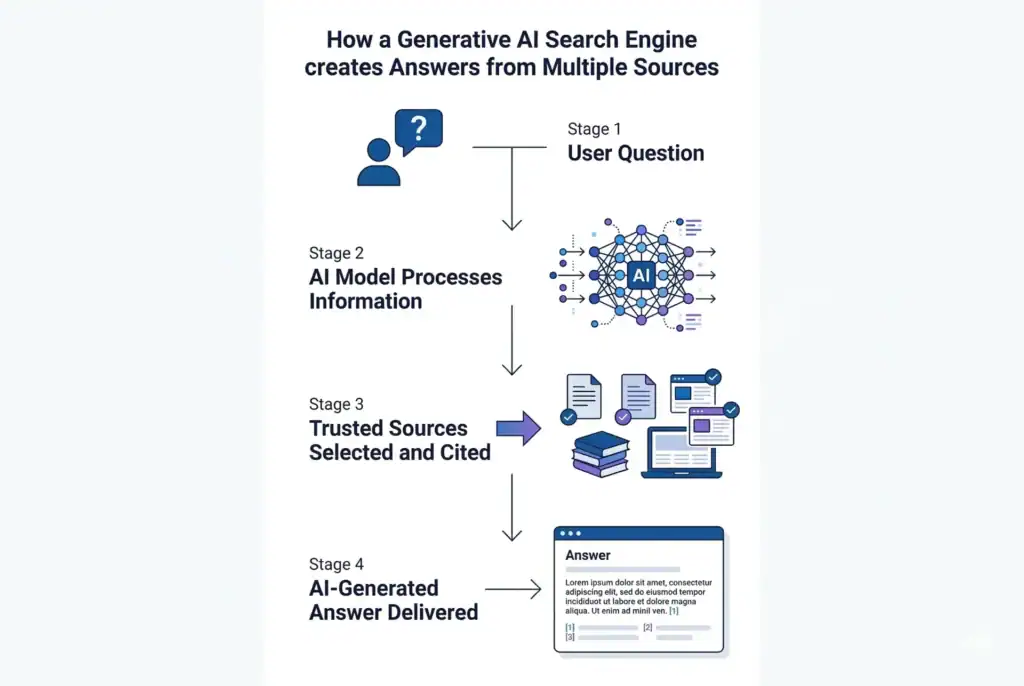
Modern AI assistants use retrieval-augmented generation (RAG) to answer queries — searching real-time web indices, retrieving candidate documents, and synthesizing answers while citing the sources that contributed most directly.
- Perplexity’s Pro and Deep Research modes read dozens to hundreds of sources per query
- Google’s AI Overviews pipeline retrieves 200–500 candidate documents, then filters to 5–15 cited sources
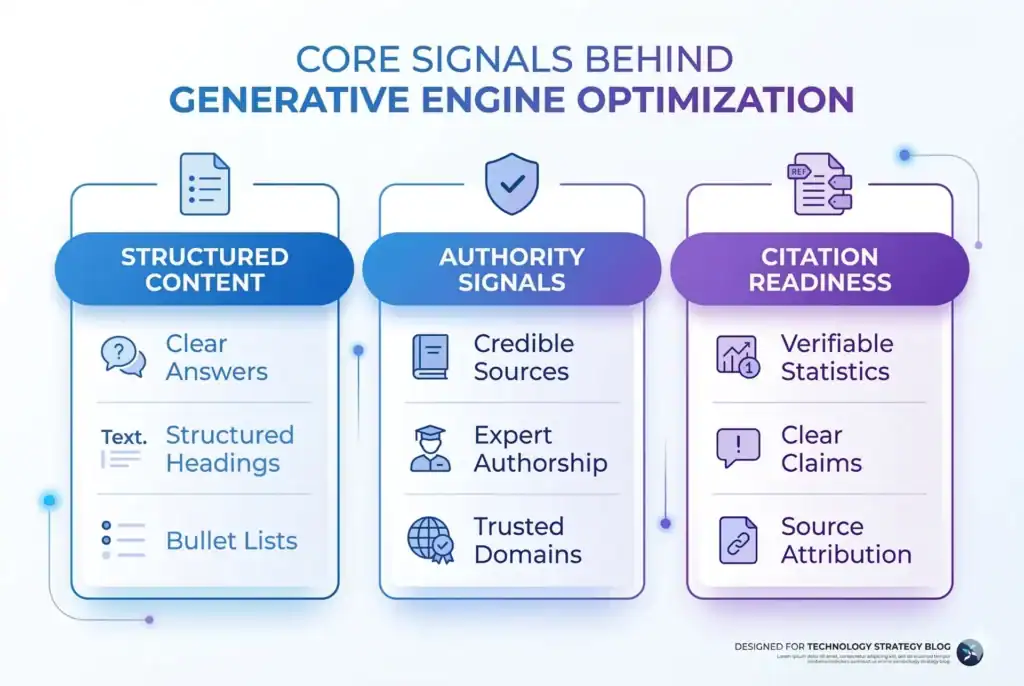
- Sources are selected based on topical relevance, authority signals, answer clarity, and structured formatting
- AI systems can influence an answer without visibly citing the source — not every contributing document receives a citation
What GEO Actually Optimizes For
Where AEO targets a specific answer box, GEO optimizes for a broader outcome: being recognized as a credible, citable entity across any AI system that discusses your category. That requires consistent brand identity, location-level data, service definitions, and content structure — authoritative and machine-readable at scale.
What Does It Take to Get Cited by ChatGPT, Perplexity, and Gemini?
AI citations follow consistent patterns — and those patterns map directly to content and entity decisions your team controls.
Content Formatting for AI Extraction
Content structure recommendations from across vendor documentation and independent analysis converge on the same principle: “leading each section with a short, self-contained answer in 40–60 words, followed by supporting detail, so models have a clean segment to quote or paraphrase.” This is the answer-first structure that Content Ops Lab builds into every article — not as an aesthetic choice, but because it’s what AI systems are engineered to extract.
Specific formatting signals that increase citation probability:
- Question-based headings: H2/H3 headings structured as natural-language queries align sections to user intent
- Answer-first paragraphs: 40–60-word direct answers that can be cited without additional context
- Bulleted and numbered lists: Step flows, benefits, and key points in list format map cleanly to AI output patterns
- Comparison tables: Tables present options in a structure that AI systems can parse and summarize directly
- Schema markup: FAQPage, HowTo, Organization, and LocalBusiness schema make entities and relationships explicit
Entity Clarity and Trust Signals
AI systems don’t just retrieve documents — they reason about entities. Your brand, locations, service lines, and credentials need to be defined consistently across your website, Google Business Profiles, directories, and structured data. Google’s AI Overviews pipeline includes an explicit E-E-A-T filtering stage — evaluating authorship, domain authority, backlinks, and site reputation — that eliminates low-trust candidates before the generative step begins.
- Consistent naming and category definitions across all brand and location touchpoints
- Visible authorship and credentials on content that addresses professional topics
- Strong backlink profiles and press coverage at the corporate brand level
- Review quality and volume at the location level — AI local summaries draw on this data directly
Citation Verification as a GEO Requirement
Here’s a GEO risk that most operators aren’t tracking: AI systems have significant problems with hallucination and citation accuracy. Research finds that only 40–75% of LLM citations fully support their associated claims.
Studies examining AI responses across news, health, and policy topics find significant factual or sourcing issues in 35–45% of answers. And the mere presence of citations increases user trust, even when those citations are low-quality or misaligned.
For multi-location brands in regulated categories, those with content structured for accurate citation are more likely to be cited accurately — and less likely to be displaced by competitors whose content is more extractable.
If your operation needs to produce content at the volume and structure required to compete for AI citations — without compliance risk — Content Ops Lab builds the infrastructure to make that possible. [Contact us] to discuss your content production requirements.
How Do Multi-Location Brands Compete in AI-Generated Local Answers?
Local search is being rebuilt. Queries that used to return a ranked list of links increasingly return a synthesized AI answer that blends reviews, map data, hours, and service details into a single response. Multi-location brands that treat each location as a content entity — not just a directory listing — are positioned to appear in those answers.
Store-Level Content at Scale
Informational, store-adjacent queries most frequently trigger AI Overviews — “does [brand] have parking in [city]?” or “how to return [product] to [brand]?” The brands that appear in these answers have clear, answer-first content that directly addresses these questions on store-level or FAQ pages. For a brand managing 15 or 50 locations, that means systematic content templates — consistent structure, localized details, question-based headings — applied at scale.
- Build rich location pages that address conversational questions about each site
- Apply consistent answer-first formatting templates across all locations
- Use location-specific FAQ content to capture long-tail conversational queries
- Informational, low-competition queries trigger AI summaries most frequently — capture this surface
NAP and Entity Consistency Across Locations
Inconsistent brand data — name, address, phone, categories, service descriptions — across directories prevents AI systems from confidently recognizing and referencing your locations. Inconsistencies hinder entity resolution and reduce citation probability across all platforms.
- Consistent NAP data across all directories, not just Google Business Profile
- Uniform service descriptions and category definitions at both the corporate and location levels
- Real-time GBP maintenance — hours, attributes, services, photos — updated across all locations
- Citation management tools (Yext, BrightLocal, Moz Local) remain relevant for AI reasoning, not just traditional local SEO
The Risk of Being Misrepresented by AI
Most GEO conversations focus on appearing in AI answers. Fewer address the risk of appearing incorrectly. AI systems can hallucinate location-specific details — wrong hours, inaccurate service descriptions, outdated policies — especially when first-party content is thin and third-party directory data is inconsistent.
In regulated industries, AI misrepresentation of what a location offers or how a service works creates legal and reputational exposure. Proactive AI auditing — querying major assistants about your brand and key locations, then adjusting first-party content and structured data based on their responses — is an operational practice, not a one-time exercise.
What Does AI Search Traffic Actually Convert At — and Is It Worth Prioritizing?
The volume of AI search is still modest relative to total organic traffic. The conversion numbers are not.
Conversion Rate Data Across Platforms
Ahrefs’ own conversion data shows that AI search visitors represented only about 0.5% of their total traffic but generated 12.1% of all sign-ups — an approximately 23x higher conversion rate than traditional organic search visitors.
Semrush data shows that ChatGPT visitors have a CVR of around 15.9% and Perplexity visitors have a CVR of 10.5% on certain sites. The same Semrush analysis that tracked 527% year-over-year growth in AI search sessions projects that AI traffic will surpass traditional search by 2028.
Why AI Visitors Are Pre-Qualified
The conversion premium isn’t accidental. Users who arrive via AI referral have already consulted an AI system, received a recommendation, evaluated options, and chosen to act. The platform completed a qualification step before the user reached your site — and session behavior reflects it. AI-referred visitors spend more time on site, have multiple page views, and consume deeper content, signaling decision-stage engagement rather than early research.
What the Conversion Gap Means for Budget Allocation
Most marketing operations aren’t tracking AI referral traffic as a distinct conversion channel — it’s misclassified in GA4, underreported, or not tracked at all. The operators who identify and prioritize this channel first gain a compounding advantage: citation patterns reinforce themselves, and early citation authority is harder to displace than organic ranking positions. A VP of Marketing who can demonstrate AI search conversion rates to leadership — even from a small base — has the data story that justifies infrastructure investment before competitors enter the channel.
Is Your Content Operation Ready to Compete for AI Citations?
GEO is an operational discipline, not a campaign. Most content operations aren’t built for it — which is both the risk and the opportunity.
The GEO Readiness Gap
80% of URLs cited by LLMs do not rank in Google’s top 100. A brand without dominant organic rankings can still be surfaced in AI answers if its content is well structured, authoritative, and intent-aligned. Traditional SEO performance is a weak proxy for GEO readiness — a brand with strong rankings and thin, poorly formatted content may be less citable than a brand with modest rankings and answer-first, entity-clear, schema-tagged pages.
Fewer than 5% of multi-location healthcare practices are currently optimizing for AI search citations. The gap is wider in legal services, home services, and franchise systems.
- GEO readiness depends on content structure and entity clarity, not just domain authority
- Strong rankings don’t guarantee AI citation — formatting and extractability matter independently
- Regulated industries face compliance exposure if AI misrepresents their services
- Content volume matters: more pages mean more surfaces where AI systems can find you
Why Ranking Alone No Longer Guarantees Visibility
Queries that trigger AI Overviews have a zero-click rate of around 83%. A brand ranking in position one receives meaningfully less traffic per query than it did two years ago — the AI summary above the fold answered the question first. The brands appearing inside those summaries hold the position that used to belong to rank one.
Building Infrastructure Before the Window Closes
The first-mover advantage window in AI search is measured in quarters, not years. ChatGPT referral traffic can grow by 887% in 7 months, but that growth is available to every brand in the category simultaneously. The brands that build content infrastructure now — verified citations, question-based architecture, entity-consistent data at the location level — establish citation patterns that AI systems will reinforce. Brands that wait for mainstream awareness of GEO will be competing against established citation authority rather than a clean slate.
Ready to build a content infrastructure that positions your brand for AI citation across every location? Get in touch today — we’ll assess your current content operation and outline what a systematic approach would look like for your organization.
How Content Ops Lab Builds Content Infrastructure for AI Search
Content Ops Lab’s methodology was built inside a live, multi-location production engagement in a regulated industry — 23 months, 1,000+ citation-verified articles, zero compliance violations. AI search from that deployment converts at an average of 21.4%, compared to a 3.32% site baseline — a 6.4x performance multiplier across eight months of tracked data.
- 1,000+ citation-verified articles with zero compliance violations across a 23-month engagement
- 21.4% average AI search CVR vs. 3.32% site baseline — 6.4x performance multiplier
- 887% ChatGPT traffic growth in 7 months (July 2025–February 2026)
- 45% of total leads from organic search — outperforming paid search nearly 2:1
- 653% impression growth and 1,700% click growth for an emerging brand in 14 months
- 5x production scale without adding headcount — 10 articles/month to 50+
- Dual-brand methodology validated on mature brand maintenance and aggressive growth scaling
The Content Ops Lab Production System
GEO readiness is a production infrastructure decision — the workflows, verification protocols, and formatting standards that determine whether content is structured for AI extraction at scale.
- Research: Verified sources before generation — no AI writing from memory, no hallucinated citations
- Verification: Line-by-line citation cross-check, STAT vs. CLAIM labeling, full audit trail for every data point
- Optimization: Simultaneous multi-platform targeting — Google, ChatGPT, Perplexity, Claude, Gemini
- Delivery: WordPress staging or Google Docs — publish-ready, compliance-reviewed, Grammarly-verified
Ready to build content infrastructure that scales without compliance risk? Contact us today — we’ll assess your current content operation and outline what a systematic approach would look like for your organization.
FAQs About Generative Engine Optimization
How is generative engine optimization different from traditional SEO?
SEO optimizes content to rank in search results and drive organic clicks. GEO optimizes content for selection as source material in AI-generated answers from ChatGPT, Perplexity, Claude, and Gemini. The signals overlap — authority, relevance, structured content. Still, GEO adds entity clarity, answer-first formatting, and citation-readiness as distinct requirements.
What content changes actually improve AI citation rates?
The highest-impact formatting changes: question-based H2 headings, 40–60 word answer-first paragraph openings, bullet and numbered lists for key points, comparison tables, and FAQ sections with concise, direct answers. Schema markup (FAQPage, Organization, LocalBusiness) makes entities and relationships explicit for AI parsing. Consistent entity data — brand name, location addresses, service categories — across all directories reduces confusion in AI entity resolution.
How do multi-location businesses track conversions from AI search platforms?
AI referral traffic appears fragmented across multiple GA4 channel classifications. Comprehensive attribution requires dedicated UTM tagging, custom channel groupings capturing referrals from ChatGPT, Perplexity, Claude, and Gemini domains, and periodic manual review of referral data. Total AI traffic volume is likely undercounted in most current setups — establishing clean tracking now gives you a baseline competitors won’t have.
Does GEO require separate content from what we already publish for SEO?
No — but it requires restructuring existing content and tightening formatting standards. The same article that ranks well on Google can be the one ChatGPT cites if it’s structured correctly. The primary changes: answer-first paragraph structure, question-based headings, bullet formatting for key points, and verified citations that AI systems can reference as credible source material.
How long does it take to start appearing in AI-generated answers?
Timelines vary by query type, competitive density, and content volume. Informational, low-competition queries trigger AI summaries most frequently and are the fastest path to citations. For brands building from a thin content base, three to six months of consistent, structured production typically generates measurable AI referral data. Early citation patterns are compound, making earlier investment disproportionately valuable.
Key Takeaways
- GEO is a distinct discipline from SEO and AEO — it optimizes for citation inside AI-generated answers and requires entity clarity, answer-first formatting, and verified citations as core inputs
- AI Overview zero-click rates reach ~83%, meaning traditional ranking positions deliver less traffic per query — being cited inside AI summaries is the new position one for many query types
- AI-referred visitors convert at 4–23x the rate of traditional organic visitors — a small but rapidly growing traffic channel delivering outsized conversion share
- Multi-location brands face both opportunity and risk — GEO can surface locations that don’t rank organically, but AI hallucinations can misrepresent services, requiring proactive monitoring
- 80% of URLs cited by LLMs don’t rank in Google’s top 100 — GEO readiness depends on content structure and entity consistency, not domain authority
- The first-mover window is measured in quarters — early citation patterns compound, and brands that build structured content infrastructure now establish authority that is difficult to displace
Build Content Infrastructure That Compounds: Generative Engine Optimization
Generative engine optimization isn’t a speculative bet on a future search landscape. AI Overview: zero-click rates are already above 80% for triggered queries. AI-referred visitors are already converting at 4–23x traditional organic rates. And 80% of URLs cited by AI systems don’t appear in Google’s top 100 — the brands showing up in AI answers aren’t necessarily the brands with the strongest traditional SEO.
For multi-location brands, the question isn’t whether to invest in GEO — it’s whether to build content infrastructure before the channel gets competitive, or after citation authority is already distributed.
Content Ops Lab builds that infrastructure. The methodology has been validated across a 23-month production engagement — 1,000+ articles, zero compliance violations, AI search converting at 6.4x the site baseline. Operators who act in the current window establish citation patterns that compound while competitors are still figuring out the playbook.
Related: Answer Engine Optimization: What Multi-Location Operators Need to Know