

How Is AI Topic Authority Different From Topical Authority in SEO?
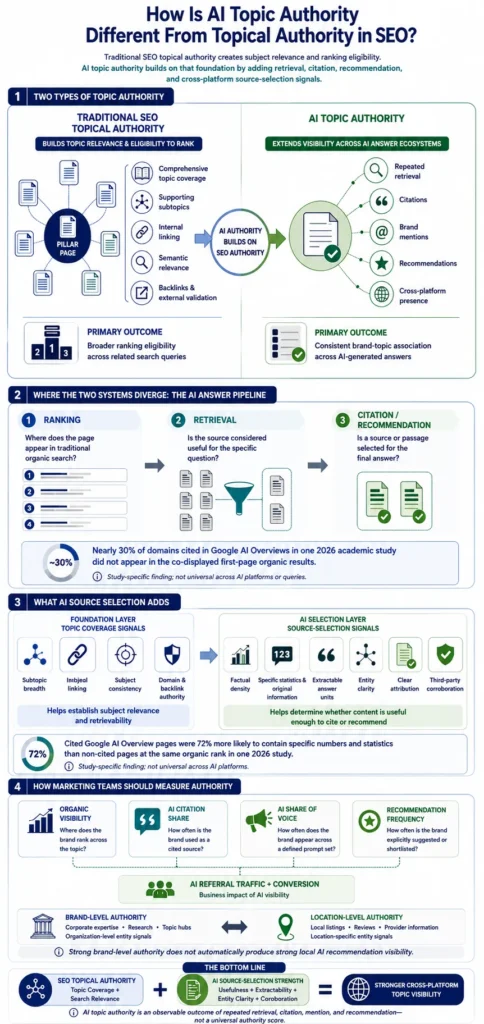
AI topic authority and traditional SEO topical authority are related but not interchangeable: topical authority measures whether search engines recognize a site as an expert source across a subject, while AI authority reflects whether a brand is consistently retrieved, cited, and recommended across AI platforms. Ahrefs frames the search-side concept this way: “Topical authority is when search engines recognize your site as the expert source on a specific subject, not just for individual keywords, but for the full range of related queries within a topic” — Ahrefs Blog.
Marketers may rank on page one yet remain absent from AI Overview responses on the same topics. Content Ops Lab’s production system treats these as separate but connected outcomes.
Related: Why Can a Brand Rank Well in Google but Have Low AI Share of Voice?
What Does Topical Authority Mean in Traditional SEO?
Topical authority describes a site’s recognized expertise across a subject rather than isolated keywords, built through comprehensive coverage, internal linking, semantic coherence, backlinks, and external validation. Google does not publish a universal score — the concept describes a pattern, not a documented metric.
How Does SEO Build Authority Across a Topic?
Search engines infer subject-level expertise from signals across a site’s content architecture, not any single page.
- Comprehensive coverage of core and adjacent subtopics
- Internal links connecting related pages across the cluster
- Semantic relationships between content structure and search intent
- Backlinks earned from relevant, authoritative external domains
- Consistent terminology and organization across the content set
None of these signals guarantee AI visibility, which is determined by a separate selection process.
Does Google Use a Topical Authority Score?
Google has never published a universal topical-authority score, though it operates a narrower, documented system for specific query types: “Google developed a system called topic authority that helps determine which expert sources are helpful to someone’s newsy query in certain specialized topic areas, such as health, politics, or finance” — Google Search Central Blog.
- Google’s documented system covers health, politics, and finance news
- No equivalent score exists for general subject rankings
- Industry topical-authority language remains a framework, not a metric
- Strong topic coverage still supports broader ranking eligibility
This narrower scope matters more once AI systems select and cite sources independently.
What Does Topical Authority Actually Help a Brand Achieve?
Despite lacking a universal score, topical authority produces measurable benefits by widening the set of queries a brand can compete for.
- Wider ranking eligibility across related query variations
- Stronger internal relevance signals for search crawlers
- Greater subject-level visibility beyond individual keyword rankings
- Improved user trust through comprehensive topic coverage
These search-layer gains don’t automatically extend into how AI systems select sources to cite.
What Is AI Topic Authority?
AI authority is an emerging operational framework that describes the consistent association between a brand and a topic across AI-generated answers—through retrieval, citation, mention, and recommendation. No AI platform documents this pattern as a formal ranking factor.
How Is AI Topic Authority Defined?
The concept extends beyond having content that covers a topic — it centers on whether AI systems repeatedly retrieve, reference, and recommend a brand for related questions: “AI topic authority is the consistent association between a brand and a strategically valuable subject across relevant prompts, platforms, sources, and decision stages” — Gigawatt Group.
- Repeated presence across related prompt variations
- Consistency across multiple AI platforms, not just one
- Association that persists across buyer decision stages
- Recognition built from sources beyond the brand’s own site
That association is signaled through several observable, trackable behaviors.
What Signals That a Brand Has AI Topic Authority?
Because no platform publishes an authority score, practitioners infer it from patterns in how often a brand surfaces in AI answers.
- Recurring citations across topic-related prompt clusters
- Consistent AI share of voice relative to competitors
- Mentions and recommendations beyond direct citation
- Visibility across educational, comparison, and commercial prompts
Those signals describe outcomes, not the underlying mechanism that produces them.
Is AI Topic Authority a Real Ranking Factor?
No major AI platform documents this framework as a formal ranking factor. Treating it as one risks overstating what current evidence supports.
- No platform publishes a topic-authority ranking formula
- Observed patterns describe correlation, not confirmed causation
- The term functions as a measurement framework, not platform terminology
- Overclaiming the mechanism creates real compliance risk
Understanding why requires separating ranking, retrieval, and citation as distinct layers.
Why Can Strong SEO Topical Authority Fail to Produce Strong AI Visibility?
Strong topical authority can fail to produce strong AI visibility because ranking and citation are governed by different selection processes. Strong organic rankings do not guarantee that a page will ultimately be selected as a source in an AI-generated answer.
Why Is Ranking Different From Retrieval?
Organic ranking determines a page’s position in search results. Retrieval is a separate process — whether an AI system draws on that page as part of the source material it considers in arriving at an answer.
- Ranking reflects one search engine’s relevance algorithm
- Retrieval reflects an AI system’s own source-selection process
- A page can rank highly yet still not be selected as a source
- Source selection varies by platform and query type
Being considered as a source still doesn’t guarantee citation in the final answer.
Why Is Retrieval Different From Citation?
Even when a page is considered as a candidate source, the AI system still decides which passages are useful enough to cite or synthesize.
- Citation depends on passage-level usefulness, not page rank
- Systems select sources that best fit the specific answer
- Attribution favors extractable, self-contained information
- A considered source can still be excluded from the final answer
The pattern is clear in how AI Overview citations compare with organic rankings.
What Does the Ranking-Citation Gap Look Like in Practice?
Research on Google AI Overviews quantifies how far citation patterns diverge from first-page rankings: “AIO-cited domains are more credible than co-displayed first-page results, yet nearly 30% do not appear in those results at all, indicating a source selection mechanism distinct from Google’s ranking algorithm” — arXiv.
Ziptie’s Google AI Overview study reported that 38% of AIO-cited pages ranked in the organic top 10, down sharply from a year earlier: “Only 38% of AIO-cited pages now rank in the organic top 10 down from 76% less than a year ago meaning traditional SEO rankings alone are an increasingly unreliable path to AIO visibility” — Ziptie.
| Layer | What It Controls |
| Ranking | Position in traditional organic search results |
| Retrieval | Whether an AI system draws on a page as source material for an answer |
| Citation/Recommendation | Whether a considered source is selected and referenced in the final AI answer |
That divergence is the clearest reason to separate ranking performance from AI source selection. A page can have strong organic visibility and still lose out when an AI system decides which sources best support the final answer.
- Google AI Overview citations diverge meaningfully from rankings
- Domain credibility doesn’t guarantee selection as a cited source
- These findings apply specifically to Google AI Overview, not universally
- Other platforms may show different, unmeasured divergence patterns
Because rankings and citations diverge, brands need signals beyond ranking position to earn AI visibility.
If your operation needs to produce 20–50+ articles per month without sacrificing compliance or quality, Content Ops Lab builds the infrastructure to make that possible. Contact us to discuss your content production requirements.
What Additional Signals Matter for AI Topic Authority?
AI source selection appears to weight source usefulness, factual density, extractability, and entity clarity over topic-volume dominance — based on observed characteristics, not a confirmed list of ranking factors.
Why Does Source Usefulness Matter?
AI systems favor content that directly answers a specific question with concrete, verifiable information rather than general topic coverage: “The most striking differentiator is factual density, cited pages are 72% more likely to contain specific numbers and statistics than non-cited pages at the same organic rank position ” — Presenc AI.
- Specific facts and original data over generic statements
- Clear, direct definitions answering the implied question
- Concrete numbers instead of vague qualitative claims
- Content built to answer, not just to rank
Usefulness alone isn’t enough if the information can’t be cleanly extracted.
Why Does Extractability Matter?
AI systems synthesize and quote source material, so content structured as self-contained, quotable units is easier to incorporate accurately.
- Self-contained passages that stand alone out of context
- Structured explanations with clear logical sequencing
- Semantic clarity that limits ambiguity during synthesis
- Content quoted or paraphrased with minimal distortion
Even highly extractable content needs clear entity signals to be trusted.
Why Does Entity Clarity Matter?
AI systems increasingly rely on explicit relationships between an organization, its people, services, and locations to resolve what content is about.
- Clear links between organization, providers, and services
- Structured data supporting entity relationships
- Consistent naming and identity across sources
- Location-level entity information for multi-location brands
Those factors divide into two related but distinct categories worth tracking separately.
Topic Coverage Signals (traditional topical authority)
- Comprehensive subtopic coverage across a subject
- Internal linking between related pages
- Backlink profile and domain-level authority
- Consistent terminology across the content set
Source-Selection Signals (AI citation visibility)
- Factual density and specific, verifiable data points
- Self-contained, extractable answer structure
- Entity clarity and structured relationship data
- Third-party corroboration beyond owned content
Related: What Increases a Brand’s AI Citation Share?
Why Does AI Topic Authority Extend Beyond Your Website?
Owned content remains a major part of the evidence environment AI systems draw from, but not the only part — listings, social platforms, and reviews also corroborate a brand’s relationship to a topic.
How Much AI Authority Can Come From Owned Sources?
Brand-controlled properties carry more weight in AI citation patterns than many marketers assume: “The research shows that 86% of citations come from sources brands already control, such as websites and listings ” — Yext.
| Owned | Controlled | Earned/Third-Party |
| Brand website and blog content | Business listings and directory profiles | Independent publisher coverage |
| Product and service pages | Managed social media profiles | Customer reviews and testimonials |
| Location and provider pages | Sponsored or claimed platform entries | Expert citations and backlinks |
The table shows why AI authority cannot be reduced to a single source type. Owned and controlled assets create the foundation, while third-party evidence adds context and corroboration that brand-published content cannot provide on its own.
- In Yext’s study, websites and listings controlled by brands accounted for 86% of citations
- Controlled properties extend reach without full independence
- Earned sources add credibility owned content cannot supply
- Multi-location brands should track all three categories separately
Owned dominance in citation share doesn’t eliminate the value of independent corroboration.
Why Does External Corroboration Still Matter?
Independent references without a commercial stake carry different credibility signals than brand-published content, even when owned sources dominate citation counts.
- Independent expert citations and professional references
- Coverage from publishers unaffiliated with the brand
- Reviews reflecting direct customer experience
- Third-party validation owned content cannot self-supply
One evidence layer has grown especially quickly as a source of this corroboration.
How Are Social Platforms Changing the Evidence Environment?
Cross-platform citation research indicates social content is becoming a faster-growing input to AI answers than many marketing teams track: “This study analyzes 6.1M citations across 10 AI platforms between August and December 15th 2025 … revealing how social media has become the fastest-growing evidence layer shaping AI answers” — Goodie.
- Social platforms increasingly cited alongside traditional sources
- Growth outpaces many established owned and earned channels
- Findings vary by platform mix and study methodology
- Social presence adds a corroboration layer, not a replacement
Turning these signals into a repeatable practice requires deliberate measurement.
How Should Marketing Teams Measure AI Topic Authority?
Topic-level AI visibility should be measured as a composite outcome rather than a single score. Track whether a brand repeatedly appears across topic-related prompts, and whether that presence shows up as citation, mention, recommendation, or referral traffic.
What Should You Measure Across Prompts?
Meaningful measurement starts with a defined panel of prompts that span the different ways buyers interact with AI systems on a given topic.
- Educational prompts covering core topic questions
- Comparison prompts weighing brand against competitors
- Commercial prompts closer to purchase decisions
- Recommendation prompts asking for a specific choice
- Local-intent prompts for multi-location brands
Tracking prompts is only useful when paired with the right visibility metrics.
Which AI Visibility Metrics Matter Most?
Several metrics together describe AI authority more accurately than any single number, since each captures a different dimension of presence.
| Metric | What It Reveals | What It Does Not Prove |
| Citation share | How often a brand is cited versus competitors on a topic | The mechanism that produced the citation |
| AI share of voice | Overall presence across a defined prompt panel | Causation between content changes and visibility |
| Recommendation frequency | How often a brand is explicitly recommended | Purchase intent or conversion likelihood |
| Platform coverage | Consistency of presence across AI systems | Uniform treatment by every platform’s algorithm |
Each metric captures a different part of AI visibility, so the clearest picture comes from tracking them together rather than treating any one measure as definitive.
- Citation share benchmarks visibility against named competitors
- AI share of voice tracks presence across the prompt panel
- Recommendation frequency measures explicit brand endorsement
- Platform coverage flags where visibility runs uneven
These are derived analytics, not platform-native authority scores.
Why Should AI Referral Traffic Be Measured Separately?
Visibility metrics describe the presence of AI answers; referral traffic indicates whether that presence translates into site visits.
- Referral traffic isolates business impact from raw visibility
- Conversion behavior differs from citation or mention frequency
- Separate tracking prevents overstating what visibility alone proves
- That gap connects directly to measurable performance data
Content Ops Lab’s own production data illustrates why that distinction matters.
What Does AI Topic Authority Mean for Multi-Location Brands?
For multi-location brands, authority must exist at more than one entity level — a corporate domain can demonstrate broad subject expertise, while individual locations remain weakly represented in AI recommendations.
What Is Brand-Level Topic Authority?
Brand-level authority reflects corporate expertise: proprietary research, educational content, and broad subject association built at the organizational level.
- Corporate educational content and proprietary research
- Broad subject association across the full topic
- Centralized brand messaging and expertise signals
- Organization-wide entity clarity across services and providers
- National or regional visibility across topic-related prompts
That corporate strength doesn’t automatically extend down to individual locations.
What Is Location-Level Topic Authority?
Location-level authority depends on entity signals specific to each office or provider, separate from what the corporate domain demonstrates.
- Individual office and provider profile completeness
- Local business listings and structured location data
- Location-specific reviews and reputation signals
- Local relevance for geographically specific prompts
The gap between these two levels can be significant even for strong corporate brands.
Why Can Corporate Authority Fail to Transfer Locally?
A brand can show strong national content visibility while individual locations remain nearly invisible in local AI recommendations.
- Weak or inconsistent local listing data
- Missing or outdated location-specific reviews
- Incomplete provider-level entity information
- Local recommendation frequency lagging corporate visibility
This is a plausible operational implication, not an exhaustively quantified causal model.
| Dimension | Brand-Level | Location-Level |
| Primary evidence | Corporate content and research | Local listings, reviews, provider data |
| Typical strength | Broad subject association | Local relevance and specificity |
| Common weakness | Distant from location-specific prompts | Inconsistent or incomplete entity data |
How Does Content Ops Lab Build Authority for Both Search and AI Systems?
Content Ops Lab runs a research-first, citation-verified production system supporting search visibility and AI retrieval without treating them as identical. The system has delivered more than 1,000 articles and pages with verified citations for a regulated healthcare client across 12 locations.
- 1,000+ articles and pages delivered with verified citations
- Zero compliance issues across the full engagement
- 5x increase in monthly content output
- 278 blog articles published in the tracked window
- 2.3M monthly impressions across the client’s content network
- 13.2K monthly organic clicks driven by published content
- 95+ confirmed AI search conversions tracked to date
- 21.4% average AI search CVR vs. 3.32% site average (6.4x better)
The Content Ops Lab Production System
Every article moves through the same four-stage system, regardless of topic complexity, ensuring consistent outcomes across the library.
- Research: Evidence gathered and verified against approved documentation
- Verification: Every citation checked for accuracy before drafting begins
- Optimization: Structure and language tuned for search and AI extraction
- Delivery: Final QA confirms compliance, accuracy, and structural standards
Tracking AI visibility separately from referral and conversion performance shows whether that visibility is producing measurable business activity.
Ready to build content infrastructure that scales without the compliance risk? Get in touch — we’ll assess your current content operation and outline what a systematic approach would look like for your organization.
FAQs About AI Topic Authority
Is AI Topic Authority Just Another Name for Topical Authority?
No — the two overlap but aren’t interchangeable. Topical authority describes recognized expertise within organic rankings; AI authority describes whether a brand is retrieved, cited, and recommended in AI-generated answers. Strong topical authority supports AI visibility but doesn’t guarantee it.
How Should Marketing Teams Measure AI Topic Authority?
Measure it as a composite outcome across a defined prompt panel spanning educational, comparison, commercial, and recommendation queries. Track citation share, share of voice, and recommendation frequency together, then measure AI-referred traffic separately.
Can a Brand Accurately Claim to Have AI Topic Authority?
Only cautiously. No AI platform documents AI authority as a confirmed ranking factor, so brands should describe it as an operational pattern they track and build toward — not a certified status. Overstating platform mechanics as fact creates credibility and compliance risk.
Can a Competitor Outrank Your Brand in Google but Still Have Lower AI Topic Authority?
Yes. Ranking, retrieval, and citation operate as separate layers, so a competitor’s page-one ranking doesn’t guarantee selection as a source. A brand with stronger source usefulness, extractability, and entity clarity can outperform in AI-generated answers.
How Can a Content Operations System Help Build Topic Authority for Both Search and AI Platforms?
A systematic process — research, verification, optimization, delivery — builds content engineered for both outcomes: topic coverage for search, and factual density, extractability, and entity clarity for AI retrieval and citation, without sacrificing accuracy in regulated environments.
Key Takeaways
- Topical authority and AI authority overlap but operate through different mechanisms — ranking versus retrieval and citation.
- AI systems reward source usefulness, factual density, extractability, and entity clarity, not just topic-volume dominance.
- Content Ops Lab’s production system delivered an average AI search conversion rate of 21.4%, compared to a site average of 3.32%.
- Multi-location brands need authority at both the corporate and individual-location entity level, not just corporate content strength.
- Consistent prompt-cluster measurement shows where brand visibility changes across query types, competitors, and AI platforms.
- Marketing teams should track citation share, AI share of voice, and referral traffic separately, rather than as a single combined metric.
Building Authority That Works Across Search and AI
Traditional topical authority and AI authority remain connected yet distinct: one measures recognized expertise in organic rankings, the other measures whether AI systems retrieve, cite, and recommend a brand in generated answers. Neither replaces the other, and brands that treat them as identical risk optimizing for rankings while remaining invisible in AI-generated responses that increasingly shape buyer research.
The gap is measurable now, before most competitors build the tracking infrastructure to close it. Content Ops Lab’s research-first, citation-verified production system is built to support both outcomes deliberately, rather than assuming one automatically produces the other.
Related: How Does AI Brand Authority Affect Search Visibility?