

How Does AI Brand Authority Affect Search Visibility?
Authority in AI search affects visibility by determining whether a business is recognized as a coherent entity, considered relevant to a topic, trusted as a source, and included in citations or recommendations. As Google explains, “You can apply the same foundational SEO best practices for AI features as you do for Google Search overall: making sure the page meets the technical requirements for Google Search, following Search policies, and focusing on the key best practices, such as creating helpful, reliable, people-first content” — Google Search Central.
Most marketing teams still treat authority as a backlink count or a domain score, which leaves them unable to explain why a well-ranked page gets skipped in an AI Overview. Content Ops Lab’s production methodology has supported more than 1,000 citation-verified articles and pages in a regulated, multi-location healthcare environment — work that surfaced this exact gap between ranking and recognition.
Related: How Does E-E-A-T Apply to AI Search?
What Is AI Brand Authority?
AI brand authority is the degree to which a system can identify a brand, verify what it knows, trust its claims, and use its content within a specific context. It is not a backlink count, a domain score, or a single disclosed metric — it is an accumulation of confidence built across owned content, structured data, and outside confirmation.
A Practical Definition, Not a Platform Score
Brand authority in traditional SEO is often shorthand for domain-level link equity. Authority in AI search is broader and more conditional. It asks whether a system can answer four separate questions about a business: is this a real, identifiable entity; is it relevant to this query; does it have usable evidence; and is it trustworthy enough to recommend. A brand can score well on one question and fail another.
Recognition, Retrieval, Citation, and Recommendation
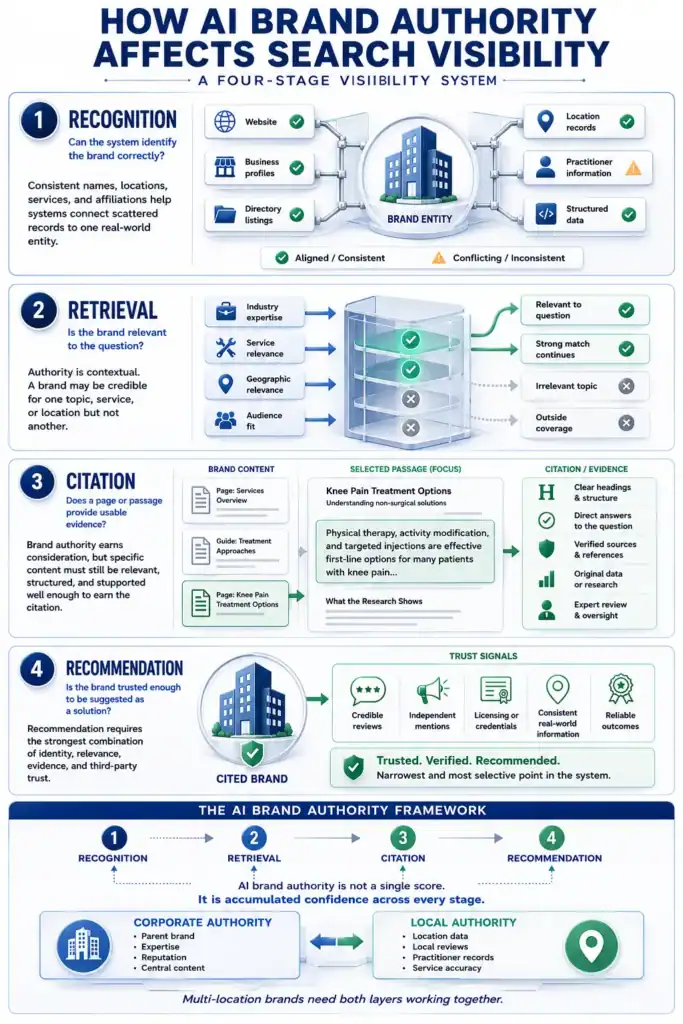
These four stages form the article’s core framework, and they build on each other rather than substituting for one another:
- Recognition: can the system identify the brand correctly
- Retrieval: is the brand or its content relevant to the query
- Citation: does a specific page or passage provide usable evidence
- Recommendation: is the brand trusted enough to be proposed as a solution
- Each stage depends on the one before it, not on brand reputation alone
Authority Still Requires Basic Search Eligibility
Authority cannot substitute for technical eligibility. Google is explicit that “to be eligible to be shown as a supporting link in AI Overviews or AI Mode, a page must be indexed and eligible to be shown in Google Search with a snippet, fulfilling the Search technical requirements. There are no additional technical requirements” — Google Search Central.
A highly authoritative brand with an unindexed or ineligible page still will not appear, which is why authority and technical readiness have to be managed together, not treated as separate workstreams.
How Do AI Systems Recognize and Verify a Brand?
AI systems recognize a brand by resolving whether multiple records — a business name, an address, a practitioner affiliation — refer to the same real-world entity. A brand must appear as a single coherent entity before any authority can coalesce around it.
Entity Resolution Explained
Entity resolution is a documented, well-studied problem in applied research: it is “the problem of determining when two entities refer to the same underlying entity” — Mayank Kejriwal, arXiv. For a marketing team, this means every system that touches the brand’s information — search engines, directories, AI assistants — independently tries to decide whether “the practice on Main Street” and “the clinic listed three blocks over” are the same business.
The Records That Establish Identity
Recognition draws on a wide, overlapping set of records, not one authoritative source:
- Business names across every listing
- Physical addresses and service areas
- Practitioner or staff affiliations
- Service descriptions and category tags
- Third-party profile and directory information
- Structured data on owned pages
- Historical naming or ownership changes
What Inconsistent Records Cost You
Conflicting records make entity recognition and verification harder for the systems trying to confirm who a brand is. This does not mean that one inconsistency automatically causes a ranking loss — the connection is not that direct or well-documented. It means unresolved conflicts slow down or block the recognition step that every later stage depends on, which is a governance problem before it is a ranking problem.
Which Signals Strengthen AI Brand Authority?
AI brand authority strengthens when independent, outside sources confirm what a brand says about itself. Demonstrated expertise, credible reviews, and accurate citations all function as corroboration that a brand cannot generate on its own.
Trust as the Controlling Concept
Google’s own quality guidance places trust above the other elements of E-E-A-T, noting that “experience, expertise, and authoritativeness are important concepts that can support your assessment of trust, with trust being the most important member of E-E-A-T” — Search Engine Land. Experience and expertise matter because they support trust, not as substitutes for it.
Third-Party Corroboration Matters
External validation carries weight precisely because it cannot be self-issued:
- Credible customer and client reviews
- Independent mentions in industry coverage
- Licensing or regulatory records where relevant
- Accurate citations from established sources
- Consistency between public claims and real-world outcomes
- Qualified authorship or editorial review on published content
Research on online reviews confirms this pattern outside of search specifically: “online product reviews provide vital information to help customers with their purchase decisions” — Zhao et al., Journal of Interactive Advertising.
Not Every Mention Is a Ranking Factor
Not every review, mention, or backlink functions as a confirmed AI ranking signal, and the exact comparative weighting between traditional link signals and newer trust signals is undisclosed. The safer framing is that backlinks remain one signal within a broader system of authority, not a factor being replaced outright.
If your operation needs to produce 20–50+ articles per month without sacrificing compliance or quality, Content Ops Lab builds the infrastructure to make that possible. Contact us today to discuss your content production requirements.
How Does Brand Authority Affect AI Citations and Search Visibility?
Brand authority affects AI citations by determining whether a source enters consideration — it does not determine whether a specific passage gets cited. A relevant, well-supported passage still has to earn that citation on its own merits.
From Consideration to Citation
Authority operates as a filter, not a guarantee. A source becomes discoverable, then relevant to the query, then extractable as a usable passage, and only then trustworthy enough to cite. Brand reputation can move a source through the earlier stages more quickly. Still, it does not waive the requirement that content-level evidence support the specific claim.
Passage-Level Retrieval
Modern retrieval systems increasingly select specific sections rather than entire sources. Perplexity’s documentation of its own product illustrates this mechanic directly: “Perplexity determines which internal files are relevant and uses the most pertinent sections within those files to form its responses” — Perplexity Help Center. That example describes an internal knowledge product, not public-web ranking mechanics, but it illustrates the same underlying principle: passage-level relevance, not brand reputation, determines what gets pulled into an answer.
Authority Alone Does Not Guarantee Citation
An authoritative brand is not automatically cited across every relevant query. Thin, generic, or poorly structured content from an authoritative brand can still lose out to a more specific, better-supported passage from a lesser-known source. Brand authority earns consideration; specific content earns the citation.
Related: How Can You Improve Brand Visibility in AI Search?
Why Do Multi-Location Brands Need Corporate and Local Authority?
Multi-location brands need two connected layers of authority: corporate authority that establishes the parent organization’s identity, and local authority that proves a specific branch is a credible answer for a local need. Corporate reputation does not automatically transfer evenly across every location.
Two Layers of Authority
Structured data standards already draw this distinction at a technical level. Schema.org defines a LocalBusiness as “a particular physical business or branch of an organization” — Schema.org, LocalBusiness. That separation matters for authority the same way it matters for data modeling: the parent brand and the individual branch are related but distinct entities, each requiring its own recognition and validation.
NAP Consistency and Local Signals
Location-level authority depends on a defined set of aligned records:
- Consistent name, address, and phone data
- Location-specific service descriptions
- Practitioner records are tied to the correct branch
- Local reviews are attached to the right location
- Alignment between corporate claims and local reality
- Accurate directory listings per location
Consistent NAP data supports the entity-resolution process described earlier. Still, it is not established as a direct cause of increased AI citations — the more accurate claim is that it removes friction from recognition, which every later stage depends on.
Why Authority Doesn’t Transfer Evenly
A single unresolved or conflicting location record can create real friction for that specific branch. However, this is not a universally documented rule that one weak location damages the entire brand. The practical risk is narrower and more manageable: a location with poor data hygiene struggles to be recognized as a credible local answer, regardless of how strong the corporate brand is elsewhere.
How Can Marketing Teams Build and Measure AI Brand Authority?
Marketing teams build entity and content authority through coordinated ownership across four areas: entity governance, content authority, external corroboration, and measurement. No single team or tactic accomplishes this alone.
Entity Governance
Maintain one trusted source of record for corporate, location, practitioner, and service data, and treat every directory, profile, and schema instance as a copy of that source rather than as an independent record to be managed separately.
Content Authority
Publish focused, evidence-rich content within clearly defined topic areas rather than broad, thin coverage across unrelated subjects. Depth within a defined scope builds content-level authority faster than volume across a scattered one.
External Corroboration
Build credible reviews, independent mentions, directory records, and expert validation deliberately rather than passively. This layer cannot be self-generated, which is exactly why it carries independent weight with AI systems evaluating trust.
Measurement
Track recognition accuracy, citation frequency, recommendation appearances, topic coverage, location-level differences, AI referral traffic, and downstream conversions — not publishing volume as a standalone metric of success.
Publishing more content does not automatically increase authority, and no proprietary scoring formula reliably captures all of these inputs. Coordinated ownership across content, data, reputation, and local operations is the actual operating model.
How Content Ops Lab Builds Authority Into Content Operations
Content Ops Lab’s underlying methodology has supported more than 1,000 citation-verified articles and pages in a regulated, multi-location healthcare environment, with zero documented compliance issues across that production run. That track record reflects research-first production, not volume publishing.
Every article moves through the same governed system:
- Research-first production before any drafting begins
- Institutional knowledge is documented and reused across articles
- Article-specific editorial strategy, not a generic template
- Independent citation verification against source documents
- Multi-location consistency is built into the production process
- More than 1,000 verified articles and pages produced
- Zero documented compliance issues across that production run
- A documented 21.4% AI referral conversion rate in a case study, roughly 6.4 times the site average — evidence that AI visibility can attract high-intent traffic when supported by mature content infrastructure, not proof that authority alone drove the difference
The Content Ops Lab Production System
Each stage exists to make the next one reliable, from initial research through final delivery:
- Research: build the evidence base before drafting starts
- Verification: confirm every claim against a source document
- Optimization: structure content for both readers and AI extraction
- Delivery: publish with consistency across every location
Authority becomes scalable when an organization can repeatedly produce accurate, verifiable content without having to rebuild the process each time.
Ready to build a content infrastructure that scales without the compliance risk? Get in touch — we’ll assess your current content operation and outline what a systematic approach would look like for your organization.
Frequently Asked Questions
Can a smaller brand build AI brand authority without competing directly with national companies?
Yes. Contextual authority does not require a national scale. A specialist brand can become a stronger source for a defined topic, service, audience, or geography, which is often a more achievable target than competing broadly. Focused depth within that scope outperforms thin coverage spread across unrelated topics.
How long does it take to build AI brand authority?
There is no fixed timeline, and teams should be skeptical of anyone who quotes one. Data corrections to entity records can improve recognition clarity relatively quickly. Reputation, topical depth, and third-party corroboration accumulate more gradually, since they depend on outside sources repeatedly confirming the same picture over time.
Can inconsistent business information reduce AI search visibility?
Conflicting records make entity recognition and verification more difficult for the systems trying to confirm who a brand is. That does not mean any single inconsistency automatically causes a ranking loss — the more accurate framing is that unresolved conflicts add friction to the recognition step, on which every later stage depends.
Is AI brand authority the same as domain authority?
No. Domain authority is typically a proprietary, link-based metric from a third-party SEO tool. Search authority in AI systems is broader: it includes entity identity, topical relevance, content-level evidence, outside reputation, and contextual trust across recognition, retrieval, citation, and recommendation.
Should a company build an authority system internally or use a managed partner?
The answer depends on operational capacity: available governance resources, access to subject matter, verification bandwidth, and the required publishing scale. Organizations with mature internal editorial governance may build it in-house; those needing regulated-industry verification at volume often need a managed partner with that infrastructure already in place.
Key Takeaways
- Brand authority is an accumulated system of confidence, not a single metric or platform-issued score
- Recognition, retrieval, citation, and recommendation are sequential stages — strength in one does not guarantee strength in another
- Content Ops Lab’s methodology has supported 1,000+ citation-verified articles with zero documented compliance issues
- AI-referred traffic converted at a documented 21.4% average in the case study, about 6.4 times the site average
- Multi-location brands need corporate and local authority to work together, since corporate reputation does not transfer evenly
- Entity governance, content authority, external corroboration, and measurement require coordinated ownership, not one team acting alone
- Marketing leaders should audit entity consistency first, since it is the fastest-moving input in an otherwise gradual system
Why AI Search Authority Is an Operating System, Not a Score
AI brand authority affects search visibility across four connected stages: whether a brand is recognized, whether it is retrieved as relevant, whether a specific passage earns citation, and whether the brand is trusted enough to be recommended. As Google’s own guidance confirms, foundational eligibility still governs what can appear at all, since “there are no additional technical requirements” beyond standard Search eligibility — Google Search Central.
Marketing teams that treat this as a publishing volume problem will keep missing the actual mechanism. The teams that treat it as a governance problem — one that centers on a trusted source of entity data, evidence-rich content within a defined scope, and deliberate, outside corroboration — put themselves ahead of competitors still chasing backlink counts.
Authority is not declared. It accumulates when owned content, structured data, third-party reputation, and real-world operations repeatedly confirm the same answer about who a brand is.
Related: Why Does AI Search Engine Optimization Compound Over Time?