

Why Does AI Search Engine Optimization Compound Over Time?
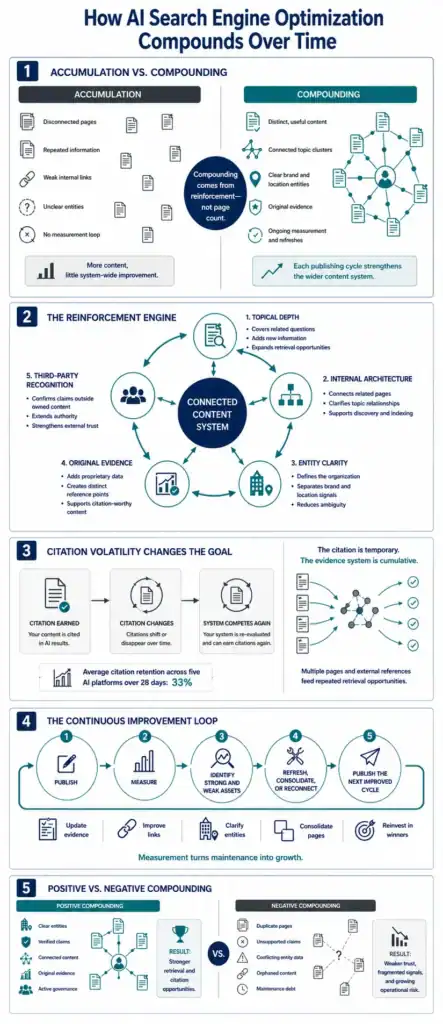
AI search engine optimization compounds when each new asset strengthens the connected system around it — not because a domain accumulates age or page count. That distinction matters because individual citations disappear fast: “The average Citation Retention Rate across all five AI platforms over 28 days was 33%. That means two-thirds of the URLs AI engines cited in week 1 were replaced by entirely different sources within four weeks” — Digital Authority Partners. Many marketing leaders still treat AI visibility as a volume problem, publishing more pages and waiting for authority to accumulate on its own.
Related: How Do AI Search Optimization Strategies Differ from Local SEO?
What Does It Mean for AI Search Engine Optimization to Compound?
AI search engine optimization compounds when a new or improved page increases the odds that the broader system around it gets selected for more queries and platforms, rather than when a single source holds a citation indefinitely. The durable asset is the connected corpus. Accumulation adds pages; compounding makes the whole system more useful.
Compounding Versus Passive Accumulation
Publishing volume alone doesn’t create authority. A page compounds value only when it adds distinct information, connects to related content, and clarifies what the organization already covers — otherwise it just adds mass.
- More disconnected pages add clutter, not authority
- Compounding requires each asset to reinforce existing coverage
- Accumulation measures output; compounding measures system-wide usefulness
- A useful page can raise retrieval odds for related pages, too
That distinction becomes clearer once you consider how quickly individual citations can change.
Why the Corpus Outlasts Any Single Citation
Individual AI citations turn over quickly, as the retention research above shows. Compounding doesn’t promise that any one source keeps its position — it increases the probability of being selected again across more queries.
- No single citation functions as a permanent asset
- The system’s overall selection probability is what compounds
- Losing one citation doesn’t erase broader system progress
- A wider opportunity set matters more than one placement
That broader opportunity set depends on how search systems evaluate topical expertise in the first place.
What Topic Authority Signals Reveal
Expertise is not established by a single page or keyword alone. Google has described evaluating a range of signals to determine how much expertise a publisher demonstrates within a given subject area over time.
- Multiple signals combine to establish topical expertise
- No single metric determines authority on its own
- “The topic authority system looks at a variety of signals to understand the degree of expertise a publication has in particular areas”— Google Search Central Blog
- Depth across a topic outweighs the strength of one asset
That same multi-signal logic is why architecture and entity clarity matter as much as topical depth.
How Do Topical Depth, Internal Architecture, and Entity Clarity Reinforce One Another?
These three elements reinforce AI search engine optimization together because none of them works in isolation: depth creates more retrievable passages, internal links connect those passages to what already exists, and clear entities tell systems what the organization, its services, and its locations actually represent.
Topical Depth Creates More Retrievable Passages
New content earns its place when it contributes something beyond what a brand has already published. Semrush describes this as a way to evaluate whether content adds unique value relative to what a reader has already seen elsewhere.
- Depth means covering a topic’s real sub-questions, not repeating angles
- Each genuinely new passage becomes a distinct retrieval opportunity
- Semrush frames this uniqueness test as an editorial lens, not a confirmed ranking signal — Semrush
- Treat it as a discipline for avoiding redundant publishing
Depth alone doesn’t connect anything — that’s where internal architecture comes in.
Internal Links Connect New Assets to Existing Ones
Google has long described internal link architecture as foundational to how a site gets discovered and indexed, and descriptive anchor text as a signal that helps both systems and readers understand what a linked page covers.
- Internal links help new pages get discovered faster
- “Link architecture…is a crucial step in site design if you want your site indexed by search engines” — Google Webmaster Central Blog
- Descriptive anchor text clarifies how pages relate to each other
- Links support discovery and understanding more than a direct authority transfer
Links connect pages to each other, but entities tell systems what those pages actually represent.
Entity Clarity Anchors Brand and Location Signals
Clear entities separate what the brand represents from what each location represents. Schema.org defines a local business as a distinct physical branch of an organization, which matters when a brand operates in multiple locations.
- Entity clarity distinguishes brand-level claims from location-level ones
- “LocalBusiness – A particular physical business or branch of an organization” – Schema.org
- Ambiguous entities create conflicting signals across locations
- Clear entities let new content reinforce the right layer of the system
Internal reinforcement only carries a system so far — external recognition is what extends it beyond owned content.
Why Do Original Evidence and Third-Party Recognition Increase Cumulative Value?
Original research and first-party data create citation-worthy assets, but independent, third-party mentions corroborate claims a brand cannot credibly prove by repeating them on its own site — and that outside corroboration is where owned content alone stops being sufficient for cumulative authority.
Original Research Creates Citation-Worthy Assets
Proprietary data, first-party findings, and original analysis can give search and AI systems a distinctive reference point that competing summaries lack. Restating existing information, by contrast, adds volume without adding a genuinely new reference point.
- Original data points give systems something specific to cite
- First-party findings are harder for competitors to replicate
- Original research increases citation odds; it doesn’t guarantee them
- Unique analysis outperforms repackaged summaries of existing coverage
Owned evidence still needs outside validation to carry full weight.
Third-Party Recognition Corroborates What Owned Content Cannot
Independent, third-party sources do most of the corroborating work behind AI recommendations. A recent original data study found that across recommendation and comparison queries, the large majority of supporting citations pointed away from the brand’s own domain.
- Independent sources validate claims a brand can’t self-certify
- “Across recommendation and comparison queries where brands were actively mentioned, 89% of supporting citations pointed to third-party editorial sources.”— Digital Authority Partners
- Only a small share of supporting citations came from brand-owned domains in that study
- This finding is specific to one study’s query set, not a universal rate
That reliance on external validation is exactly why owned-content production alone can’t carry the whole system.
Why External Validation Compounds Differently Than Publishing Volume
External recognition compounds differently than owned publishing does because it isn’t fully within a brand’s control — earning it requires original evidence worth referencing, not additional pages that restate known claims.
- External mentions extend reach beyond what owned pages alone can achieve
- Recognition can strengthen as more independent sources reference the same evidence
- Volume of owned pages doesn’t substitute for outside corroboration
- Distribution and outreach matter, but only when there’s something original to point to
That reliance on external validation is precisely why citation volatility is the strongest objection to the model as a whole — and it deserves a direct answer.
If your operation needs to produce 20-50+ articles per month without sacrificing compliance or quality, Content Ops Lab builds the infrastructure to make that possible. Contact us to discuss your content production requirements.
Why Does Citation Volatility Make Maintenance and Measurement More Important?
Citation churn means visibility has to be re-earned continuously rather than banked once and kept, which is exactly why refreshes, consolidation, and measurement function as part of compounding itself — not as separate maintenance tasks bolted onto a finished system afterward.
Citation Churn Changes What Compounding Means
The retention research referenced earlier shows how quickly individual citations move. That same research also found that a majority of AI-cited domains fall outside the sources that would appear in comparable organic search results.
- Citation turnover means no single source position is permanent
- “57% to 62% of AI-cited domains did not appear anywhere in those organic results,” as described by a citation layer standard rank trackers can’t see — Digital Authority Partners
- This citation layer sits partly outside traditional rank tracking
- Compounding means a broader opportunity set, not a fixed position
That broader opportunity set has to be actively maintained, not left to stand on its own.
Consolidation and Refreshes Keep the System Current
Google documents both canonicalization and reindexing as standard tools for keeping overlapping or updated content current, without guaranteeing that either action restores a page to its prior visibility.
- Canonicalization selects a representative URL for overlapping content
- “Canonicalization is the process of selecting the representative –canonical– URL of a piece of content”— Google Search Central
- Updated pages can be resubmitted for re-indexing after changes
- Neither step guarantees indexing or restored visibility; they only provide mechanisms for signaling updated or preferred content
Consolidation keeps the system tidy, but measurement is what tells you whether it’s working.
Measurement Closes the Loop
Without measurement, refreshes and consolidation are guesses. Tracking which pages get cited, which queries surface them, and which updates change that pattern is what turns maintenance into a genuine feedback loop.
- Measurement identifies which refreshes actually change citation patterns
- Tracking closes the loop between production and observed results
- Consolidation without measurement risks repeating the same mistakes
- Data from the measurement should inform the next publishing cycle directly
That feedback loop looks different depending on whether a brand operates one location or many.
Related: How Can You Improve Brand Visibility in AI Search?
How Does a Compounding AI Search System Work Across Multiple Locations?
Multi-location organizations operate two linked systems at once: brand-level authority and location-level relevance. Compounding AI search engine optimization across both requires that content, entities, architecture, authority, distribution, and learning and governance work together as one connected operation rather than as five separate, uncoordinated workstreams.
Content, Entities, and Architecture Operate as One Layer
Brand-level content establishes what the organization does broadly, while each location needs its own distinct signals. Schema’s LocalBusiness type exists precisely to separate a specific branch from the parent organization, and the internal architecture connects the two without collapsing them.
- Brand content and location content answer different questions
- Each location qualifies as its own distinct entity, not a brand clone
- Internal links connect brand and location pages without merging their identities
- Anchor text should clarify which layer — brand or location — a link supports
Content and architecture only work if the authority behind them reaches the right audience.
Authority and Distribution Connect Brand to Location
Brand-level authority provides useful context, but it doesn’t automatically transfer to every location’s specific queries. Distribution — internal linking, citations, and third-party recognition — has to deliberately connect brand credibility to location-specific relevance.
- Corporate authority alone doesn’t guarantee location-level visibility
- Distinct local signals still matter even under a strong brand umbrella
- Third-party recognition can reinforce either brand or location authority
- Distribution choices should route relevant credibility to the right locations
Whether that connection actually holds up depends on the learning system behind it.
Learning and Governance Close the Loop
A governed production and measurement system turns this five-layer model into an operating capability rather than a one-time project — it connects what gets published to what gets tracked, so the next cycle can improve on the last one instead of just repeating it.
As one observed example, a 12-location regulated healthcare organization scaled its content operation from roughly 10 articles per month to more than 50, producing over 1,000 citation-verified articles and pages across 23 months. Over an eight-month tracking window, its AI referral traffic averaged a 21.4% conversion rate compared with a 3.32% site average. This reflects the measured results of one engagement under its specific production system, not a guaranteed outcome of the cadence itself.
- Governed systems connect production volume to measured outcomes
- A 12-location healthcare organization scaled output roughly fivefold under this model
- Over 1,000 citation-verified articles were delivered across a 23-month engagement
- Tracked AI referral conversion averaged 21.4% against a 3.32% site average in that case
Compounding, in other words, is an organizational capability — and capability is exactly what breaks down under weak governance.
The Content Ops Lab Approach
Content Ops Lab applies this model through governed production systems that connect research, editorial strategy, content execution, verification, internal architecture, and performance measurement. In one 12-location regulated healthcare operation, the system scaled production from roughly 10 articles per month to more than 50. It supported the delivery of over 1,000 citation-verified articles and pages across 23 months.
During an eight-month tracking period, AI referral traffic averaged a 21.4% conversion rate compared with a 3.32% site-wide average. These results reflect a single operating environment rather than a universal outcome. Still, they show what compounding looks like when production and governance remain connected.
What Causes AI Search Engine Optimization to Compound in Reverse?
The same mechanisms that compound authority under strong governance compound weakness under weak governance: duplication, inconsistent entities, unsupported claims, and maintenance debt all scale the same way useful content does. Scale amplifies whatever quality already exists in the system — strength or risk, depending on how well it’s managed.
Duplication and Fragmentation Compound Confusion
Overlapping or duplicated content doesn’t automatically trigger a penalty. Still, it fragments signals across multiple URLs and complicates how systems decide which version represents the topic.
- Duplicate or overlapping pages split relevance across URLs
- Fragmentation makes canonical selection harder, not automatically punitive
- Unmanaged overlap compounds confusion with every new page added
- Consolidation becomes more urgent as the content library grows
Confusion at the page level tends to trace back to claims that were never verified.
Unsupported Claims Compound Risk
Once an unverified or overstated claim enters the system, subsequent content built on it inherits the same risk — especially in regulated industries where claim accuracy carries compliance consequences.
- Unverified claims compound risk with every page that repeats them
- Regulated industries face compliance exposure from unsupported statements
- Weak claims are harder to walk back the more they’re republished
- Verification at the source prevents the error from scaling further
Even accurate content eventually degrades if nothing maintains it.
Maintenance Debt Compounds Silently
Google’s own anti-spam efforts illustrate the cost of unmanaged content at scale. After a March 2024 update, the company reported a substantial reduction in low-quality, unoriginal content appearing in search results.
- Stale or unoriginal content accumulates risk the longer it goes unmanaged
- Google reported roughly 45% less low-quality, unoriginal content after a 2024 update — Google Blog
- Maintenance debt is invisible until measurement or a platform update exposes it
- Governance is what determines whether scale compounds strength or risk
Whichever direction a system moves in, that direction is a governance decision, not a byproduct of time.
Ready to build a content infrastructure that scales without the compliance risk? Get in touch today — we’ll assess your current content operation and outline what a systematic approach would look like for your organization.
Frequently Asked Questions
Does publishing more content automatically improve AI search visibility?
No. Publishing volume alone doesn’t compound visibility unless each new asset connects to existing content, adds genuinely new information, or clarifies an entity the system already recognizes. Disconnected pages add mass without strengthening retrieval odds elsewhere, and can even dilute topical clarity. Compounding depends on how content relates to the rest of the system, not on how many pages exist in total.
How long does AI search engine optimization take to compound?
There’s no fixed or universal timeline, and any claim promising one should be treated skeptically. Compounding depends on how quickly topical depth, internal architecture, entity clarity, original evidence, and governance come together into a working system — factors that vary by organization, industry, and existing content maturity rather than following a single predictable schedule across every business.
Can low-quality AI-generated content hurt an established content system?
Unoriginal or unverified content can dilute an otherwise strong system by fragmenting signals and introducing claims that later content inherits without further review. It isn’t a guaranteed penalty in every case. Still, it does compound risk and maintenance debt over time, particularly when publishing volume increases faster than editorial verification can keep pace.
Is compounding in AI search different from traditional SEO compounding?
The two overlap substantially, sharing crawling, indexing, authority, and content infrastructure rather than operating as separate universes. What differs is source selection: AI systems draw from a broader, more volatile citation layer that includes domains outside traditional organic rankings, which changes how compounding needs to be tracked and measured over time.
Do businesses need an internal team to maintain a compounding AI search program?
Not necessarily an internal team, but they do need a governed system — someone accountable for verification, internal architecture, entity consistency, and measurement over time. That capability can sit with an internal team or with a production partner. Still, compounding breaks down without it, regardless of who owns responsibility for the system.
Key Takeaways
- AI search engine optimization compounds through a connected system that reinforces itself, not from page count or domain age alone.
- Topical depth, internal architecture, and entity clarity work together — none of them compounds value in isolation.
- Original evidence can earn third-party recognition, extending credibility beyond owned content.
- Citation volatility means visibility must be continually re-earned, making refreshes, consolidation, and measurement part of growth itself.
- Multi-location brands need brand-level authority and distinct local signals operating together, not one substituting for the other.
- Weak governance compounds the same way strong governance does — just in the direction of duplication, unsupported claims, and maintenance debt.
The Governance Decision Behind Every Publishing Cycle
AI search engine optimization compounds when each publishing cycle makes the broader system more useful, connected, and credible. Individual citations may disappear within weeks, but a well-maintained content system creates more opportunities to be discovered, retrieved, and selected again across future queries.
That makes compounding a governance decision, not a volume decision. Publishing more pages will not strengthen visibility if those pages repeat existing coverage, introduce conflicting entity signals, rely on unsupported claims, or remain disconnected from the rest of the site. The cumulative advantage comes from adding distinct value, reinforcing clear relationships, earning recognition outside the organization, and using performance data to improve what already exists.
This is the operating principle behind Content Ops Lab’s approach: each publishing cycle should strengthen the system already in place, not simply add more content to maintain.
Related: How Does E-E-A-T Apply to AI Search?