

What Drives AI Brand Visibility?
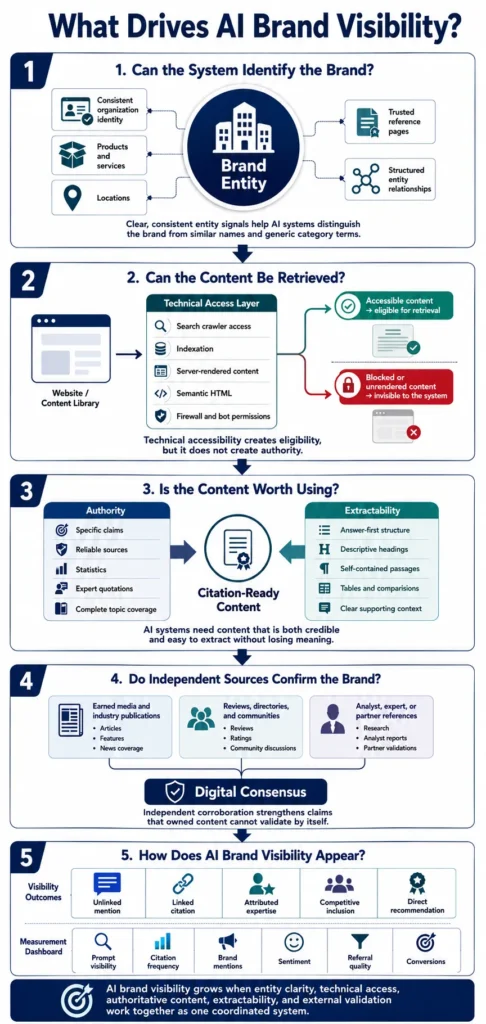
It comes from whether AI systems can recognize a brand as a distinct entity, retrieve its content, verify its claims, and connect it to the questions buyers actually ask. As one analysis of generative engines puts it, “Generative Engines, in contrast to traditional search engines, remove the need to navigate to websites by directly providing a precise and comprehensive response, potentially reducing organic traffic to websites and impacting their visibility” —Pranjal Aggarwal et al.
For marketing leaders, the operational question is how entity clarity, content authority, technical access, and third-party validation function together as one system. Content Ops Lab builds that system for regulated, multi-location brands where citation accuracy carries real compliance weight.
Related: How AI Search Engines Evaluate Source Trust and Credibility
What Does AI Brand Visibility Actually Mean?
It is a brand’s presence inside generated answers, measured across four outcomes: discovery, inclusion, attribution, and recommendation. Referral clicks capture only one outcome, often the smallest. An AI system can retrieve a brand’s content, cite its URL, mention its name, summarize its expertise, compare its product, or recommend it outright — several leave no measurable traffic behind.
How AI Systems Recognize a Brand as an Entity
Before an AI system can cite or recommend a brand, it has to resolve who that brand is across every place it appears online.
- Consistent organization name, address, and description across owned properties
- Machine-readable identity signals connecting the brand to authoritative reference pages
- Alignment between what a brand states about itself and what external sources confirm
Schema.org’s Organization type defines this mechanism directly: a sameAs property is “URL of a reference Web page that unambiguously indicates the item’s identity. E.g. the URL of the item’s Wikipedia page, Wikidata entry, or official website” — Schema.org. That property helps disambiguate the brand — it does not by itself place the brand in a knowledge graph or guarantee citation eligibility.
The Difference Between Mentions, Citations, and Recommendations
Not every appearance in an AI answer carries the same weight — treating a mention and a recommendation as equivalent hides where real influence sits.
| Visibility Type | What the User Sees | Link Present? | What the Brand Can Measure |
| Unlinked mention | Brand name in the answer text | No | Sentiment, prompt audits |
| Linked citation | Brand cited as a source with a URL | Yes | Referral sessions, citation frequency |
| Attributed expertise | Brand’s perspective summarized, unquoted | Rarely | Share-of-voice monitoring |
| Comparative inclusion | Brand appears beside competitors | Sometimes | Competitive prompt coverage |
| Direct recommendation | Brand named as the suggested choice | Sometimes | Conversion tracking |
Each level reflects a different degree of AI trust — chasing only linked citations undercounts a brand’s actual influence on the buyer’s research.
Why Visibility Exists Beyond Referral Traffic
A brand can shape a buyer’s decision without ever appearing in an analytics report, since several forms of AI-driven exposure leave no measurable trail behind.
- Zero-click exposure — the AI answers fully, and the user never clicks through
- Unattributed source use — content informs an answer without the brand being named
- Remembered brand association — a buyer recalls an AI conversation before visiting directly
- Delayed or untracked visits — the eventual visit carries no link back to the AI interaction
This is the core measurement problem marketing teams face with AI visibility — one this article builds out later.
How Do AI Systems Decide Which Brands to Surface?
Selection depends on relevance, authority, factual support, extractability, and external corroboration working together — not any single input. What a brand claims about itself matters far less than what independent sources associate with it. Content quality raises the probability of selection; it doesn’t guarantee it.
Topical Authority and Evidence Density
Authority, in an AI-retrieval context, means a source that answers category-level questions with enough specificity and evidence to be trustworthy on its own.
- Semantically complete coverage of the question, not a surface-level summary
- Specific claims supported by data rather than general assertions
- Explicit sourcing readers and models can trace back to origin
Research on generative engine optimization found that “including citations, quotations from relevant sources, and statistics can significantly boost source visibility, with an increase of over 40% across various queries” — Pranjal Aggarwal et al. That describes the study’s evaluated queries and methods — not a guaranteed lift for every brand or platform.
Third-Party Validation and Digital Consensus
Self-published claims carry limited weight with AI systems trained to weigh consensus across sources. External corroboration turns a brand’s own description of itself into something a model can trust.
- Owned sources: company website, product pages, and branded research
- Earned sources: industry publications, analyst coverage, and press citations
- User-generated sources: customer reviews, directories, and practitioner discussion
Consistent brand-capability associations across all three build the digital consensus AI systems use when deciding whether a brand belongs in an answer.
Content Extractability and Answer Readiness
Even authoritative content underperforms if a model can’t cleanly extract the claim it needs.
- Descriptive headings that state the question being answered
- Answer-first passages that don’t bury the point in setup
- Structured comparisons and tables for multi-attribute questions
Improving extractability raises the odds a model uses the content correctly — it doesn’t manipulate or guarantee which sources get selected.
Which Technical Factors Affect AI Brand Visibility?
Technical accessibility determines whether an AI system can retrieve a brand’s content at all — it says nothing about whether that content is authoritative once retrieved. Blocked crawlers, inaccessible rendering, weak semantic structure, and aggressive edge-security rules can quietly remove a brand from consideration before quality gets evaluated. Fixing those barriers restores eligibility; it does not create authority.
Search Crawlers and Training Crawlers Serve Different Purposes
Marketing leaders coordinating a technical audit need to know which crawler controls which outcome — these systems aren’t interchangeable.
| Crawler | Platform | Primary Purpose | Governance Implication |
| Googlebot | Google Search / AI features | Indexing, AI grounding | Standard robots.txt rules apply |
| OAI-SearchBot | ChatGPT Search | Search-result inclusion | Independent of training permissions |
| GPTBot | OpenAI foundation models | Training-data collection | Disallow without affecting search |
| ChatGPT-User | ChatGPT | User-triggered retrieval | Governed separately from above |
| PerplexityBot | Perplexity | Indexing, citation retrieval | Requires its own access review |
OpenAI documentation confirms these settings operate independently: “Each setting is independent of the others – for example, a webmaster can allow OAI-SearchBot in order to appear in search results while disallowing GPTBot to indicate that crawled content should not be used for training OpenAI’s generative AI foundation models” — OpenAI. Treating all crawlers as one setting is a costly misconfiguration.
Semantic HTML and Accessible Page Structure Support Extraction
A model can only extract what it can parse cleanly, which makes the underlying page structure as important as the words on it.
- Server-rendered content that doesn’t depend on client-side JavaScript to appear
- Descriptive HTML elements — proper headings, lists, and table markup
- Labeled tables and structured data readable without visual context
Not all cited AI systems disclose how they rely on ARIA markup — treat it as general accessibility practice, not a documented ranking lever.
Firewalls, Rendering, and Indexing Can Create Silent Barriers
These issues frequently sit outside content teams’ direct control, which is exactly why cross-functional ownership matters.
Technical Audit Checklist:
- Confirm WAF and bot-verification rules aren’t blocking legitimate AI crawlers
- Test whether critical content renders without JavaScript execution
- Review canonicalization for duplicate or conflicting page signals
- Check noindex directives aren’t accidentally applied to key pages
SEO and web development teams typically own this layer; content teams can flag symptoms but rarely have access to fix them.
If your operation needs to produce 20–50+ articles per month without sacrificing compliance or quality, Content Ops Lab builds the infrastructure to make that possible. Contact us to discuss your content production requirements.
How Should Content Be Built for AI Retrieval?
AI-ready content connects to how retrieval, grounding, and synthesis work: it answers a defined question, supplies evidence, and includes enough context that the claim can’t be misread once extracted. Traditional SEO remains part of this foundation — not obsolete, just insufficient alone.
Answer-First Content Creates Clear Retrieval Units
Direct section openings, precise definitions, and descriptive headings all help a model isolate a usable answer. But a concise passage still needs supporting context; a one-line definition without evidence behind it is easy to extract and easy to ignore.
Weaker Retrieval Unit vs. Stronger Retrieval Unit
| Weaker Retrieval Unit | Stronger Retrieval Unit |
| Vague claim, no source | Specific claim, named source and data |
| Buries the answer in setup | States the answer first |
| Generic heading (“Overview”) | Heading matching the actual question |
| Paragraph mixing multiple ideas | Self-contained passage, one idea |
Statistics, Quotations, and Sources Strengthen Grounding
Grounding means anchoring a claim to real evidence, not decorating a paragraph — the source has to actually support what the sentence says.
- Original data the brand can attribute to its own research or production history
- Reliable external research cited with exact attribution
- Citation verification before publication, not after
Google frames grounding as “Retrieval-augmented generation (RAG): A technique (also known as grounding) used to improve the quality, accuracy, and freshness of AI responses by relying on our core Search ranking systems to retrieve relevant, up-to-date web pages from our Search index” — Google Search Central. Decorative statistics that don’t support the claim add clutter, not grounding.
Topic Coverage Must Support Both Broad and Specific Questions
Pillar-and-cluster structures still matter, since AI systems draw on both category-level and highly specific questions when constructing an answer. Coverage needs to span implementation questions, comparisons, objections, and decision-stage concerns — not just the broad definitional question a brand ranks for today.
Content Review Checklist:
- Does this piece answer at least one specific, buyer-relevant question directly?
- Is the claim traceable to a named, verifiable source?
- Would this passage still make sense extracted with no surrounding text?
Breadth without depth produces generic coverage competing with dozens of similar pages. Depth without connective structure limits how easily a model finds the piece.
Related: Ranking vs Being Cited – What Actually Drives Visibility in AI Search?
How Does AI Brand Visibility Differ Across Platforms?
Retrieval mechanics vary by platform, and no single formula governs all of them identically. Google grounds responses in its Search index and query fan-out process. ChatGPT separates search crawling from training permissions and can perform user-triggered retrieval. Perplexity emphasizes live search with visible, linked sourcing. Claude and Gemini remain important surfaces to monitor, but aren’t documented with the same transparency.
Google AI Features Build on Search Retrieval
Google’s AI features build on the same infrastructure as standard Search, layering retrieval steps on top of it.
- Googlebot eligibility and indexation remain the entry point for consideration
- Existing Search ranking systems determine which pages are candidates for grounding
- Query fan-out expands one prompt into several related searches across subtopics
- A page may need to satisfy multiple subtopic questions, not just its keyword
Google’s own documentation confirms the mechanism: “Both AI Overviews and AI Mode may use a ‘query fan-out’ technique — issuing multiple related searches across subtopics and data sources — to develop a response” — Google Search Central.
ChatGPT Search Uses Separate Retrieval Controls
ChatGPT’s search inclusion runs on its own controls, distinct from Google’s indexing and OpenAI’s training permissions.
- OAI-SearchBot access governs eligibility for search inclusion
- User-triggered retrieval can pull a page directly during a live conversation
- This setting stays independent of the GPTBot training-crawler relationship covered earlier
- Source visibility appears inline, rewarding content that’s clearly attributable
Perplexity, Claude, and Gemini Require Platform-Specific Monitoring
Perplexity’s model centers on live search with explicit, linked citations — one of the more transparent platforms to monitor. Claude and Gemini don’t publish comparable documentation, so recommendations there stay limited to visibility testing and accessible content.
| Platform | Documented Retrieval Signal | Visibility Output | Primary Monitoring Concern |
| Google AI features | Search index + query fan-out | Cited snippets, AI Overviews | Subtopic coverage completeness |
| ChatGPT Search | OAI-SearchBot + user-triggered | Inline linked citations | Search vs. training settings |
| Perplexity | Live search, linked sourcing | Direct citations with URLs | Source freshness, authority |
| Claude / Gemini | Not publicly documented | Unlinked mentions, summaries | Prompt-level testing only |
Tactics validated for Google, OpenAI, or Perplexity should not be assumed to transfer automatically to Claude or Gemini.
How Should Marketing Teams Measure AI Brand Visibility?
Measuring AI visibility means combining exposure signals with business outcomes, since standard analytics undercount activity that’s zero-click, unlinked, or misattributed by design. A complete model covers prompt-level visibility, citations, mentions, sentiment, share of voice, referral sessions, and pipeline contribution together.
Track Visibility Before the Website Visit
Before any session reaches the website, visibility already exists in the form of mentions, citations, and recommendations across representative prompt sets.
| Metric | What It Reveals | Collection Method | Limitation |
| Prompt-level visibility | Whether the brand appears for target questions | Recurring prompt testing | Manual, not exhaustive |
| Brand mentions | Unlinked references to the brand | Prompt audits, monitoring tools | Misses paraphrased references |
| Source citations | Direct attribution with a link | Citation tracking | Varies by platform transparency |
| Sentiment | Tone of AI-generated brand references | Manual or sentiment tooling | Requires consistent methodology |
| Competitor inclusion | Relative share of voice | Comparative prompt testing | Time-intensive at scale |
“Superlines reports that 73% of AI presence instances are ‘ghost citations’ links without brand mentions across ChatGPT, Perplexity, and Google AI Overviews” — ZipTie / Superlines Report. That figure comes from one secondary report’s methodology — a directional signal, not a standardized industry measurement.
Separate Referral Volume From Visitor Quality
Session count alone tells an incomplete story about how AI-referred visitors behave once they arrive.
- Conversion rate — whether AI-referred sessions convert at a different rate than other channels
- Engagement depth — time on site, pages per session, and content interaction
- Lead quality — whether AI-referred contacts match a qualified buyer’s profile
Seer Interactive reported that “ChatGPT had a conversion rate of 16% compared to Google Organic’s 1.8%” — Seer Interactive. This was a single-site result, not a universal benchmark.
Build a Cross-Functional Improvement Loop
Measurement only drives improvement when findings route to the right owners across the organization.
Responsibility Table
| Function | Owns | Acts On |
| Content | Authority, extractability | Prompt gaps, weak retrieval units |
| Technical SEO | Crawler access, indexation | Silent technical barriers |
| Web Development | Rendering, page performance | Firewall, rendering conflicts |
| Digital PR | Third-party validation | Consensus gaps in monitoring |
| Marketing Operations | Attribution, tracking infrastructure | Misattributed, zero-click sessions |
| Analytics | Reporting, prioritization | Cross-team findings synthesis |
Do not combine prompt visibility scores, referral sessions, and conversions into one composite ROI number without a defined, defensible methodology.
How Does Content Ops Lab Build Sustainable AI Brand Visibility?
Content Ops Lab’s work with a 12-location regulated healthcare organization produced a 21.4% average AI search conversion rate against a 3.32% site average — 6.4x better. That gap indicates AI-originated traffic can be commercially meaningful even at modest session volume, which is why building visibility and attribution systems before the channel matures is worth the investment. Content Ops Lab treats this as an operating-system problem, coordinating research, production, verification, and measurement.
- 1,000+ articles and pages delivered with verified citations
- Zero compliance issues across a 23-month regulated healthcare engagement
- Content production scaled from 10 to 50+ articles per month
- 21.4% average AI search CVR vs. 3.32% site average (6.4x better)
- 95+ confirmed AI search conversions across the documented eight-month period
- 887% ChatGPT session growth in seven months
The Content Ops Lab Production System
Every article moves through the same four coordinated stages, regardless of client or industry:
- Research — Source identification and evidence gathering before drafting begins
- Verification — Fact-checking, citation confirmation, and compliance review
- Optimization — Structural and extractability formatting for AI and traditional search
- Delivery — Final QA against assignment, style, and completeness standards
These results reflect one production-tested application within a regulated healthcare deployment, not proof that the content system alone caused every outcome.
Ready to build content infrastructure that scales without the compliance risk? Get in touch today — we’ll assess your current content operation and outline what a systematic approach would look like for your organization.
FAQs About AI Brand Visibility
Is AI brand visibility just another name for SEO?
No. Traditional SEO optimizes for ranking positions; this depends on whether a generative system recognizes the brand as an entity, trusts its content, and can extract a clean answer. SEO is a foundation, not a guarantee of inclusion.
How long does it take to improve AI brand visibility?
Timelines vary, since entity clarity, technical accessibility, content authority, and third-party validation each improve on different schedules. Building topical authority and external validation is a longer, ongoing process measured in months, not a one-time project with a fixed end date.
Can brands control how AI platforms use and cite their content?
Only partially. Crawler directives let a brand permit or restrict search inclusion and separately control model-training access. Brands can’t control whether a platform cites, summarizes, or omits their content once eligible for retrieval.
Is ranking well in Google enough to appear in AI-generated answers?
No. Strong organic rankings support eligibility, but AI systems may also weigh factors such as extractability, factual density, and external corroboration when selecting sources — supporting conditions observed across this article’s evidence, not a confirmed universal formula. A page can rank well and still get passed over if it lacks the evidence a model needs to cite it confidently.
Should a company build an AI visibility system internally or use a managed content operation?
That depends on available cross-functional resources — content, technical SEO, web development, digital PR, and analytics all need coordination for this to work as one system. Organizations without that in place often move faster with a managed operation.
Key Takeaways
- Sustainable AI visibility depends on entity recognition, content authority, technical accessibility, and third-party validation working as one coordinated system.
- A 12-location regulated healthcare engagement produced a 21.4% average AI search conversion rate versus a 3.32% site average — 6.4x better.
- Technical eligibility, like crawler access, only creates the possibility of retrieval; it does not establish authority or guarantee citation.
- AI-originated traffic can carry commercial value even at low session volume, a pattern worth building visibility and attribution systems around before the channel matures.
- Measurement must combine prompt-level visibility, mentions, citations, referral quality, and conversions rather than relying on referral traffic alone.
- The immediate operator step is auditing where entity clarity, authority, technical access, or measurement is currently weakest.
What Drives AI Brand Visibility, and What Should Marketers Do Next?
This isn’t produced by any single ranking factor, and it isn’t a rebranded version of traditional SEO. It results from a brand being recognizable as a distinct entity, retrievable by the systems that matter, credible enough to earn external corroboration, and structured clearly enough to be extracted and cited accurately. Platforms differ in how they retrieve sources, so a shared foundation has to pair with platform-specific monitoring rather than one universal formula.
Building this system now is a strategic opportunity, ahead of AI search fully maturing and competitors treating it as solved. Content Ops Lab builds this coordinated system for regulated, multi-location organizations that need citation-verified content operating at production scale — without compliance risk along the way.
Related: Which AI Trust Signals Influence Brand Recommendations?





One Comment
Comments are closed.