

What Counts as Credible Proof in an AI Search Case Study?
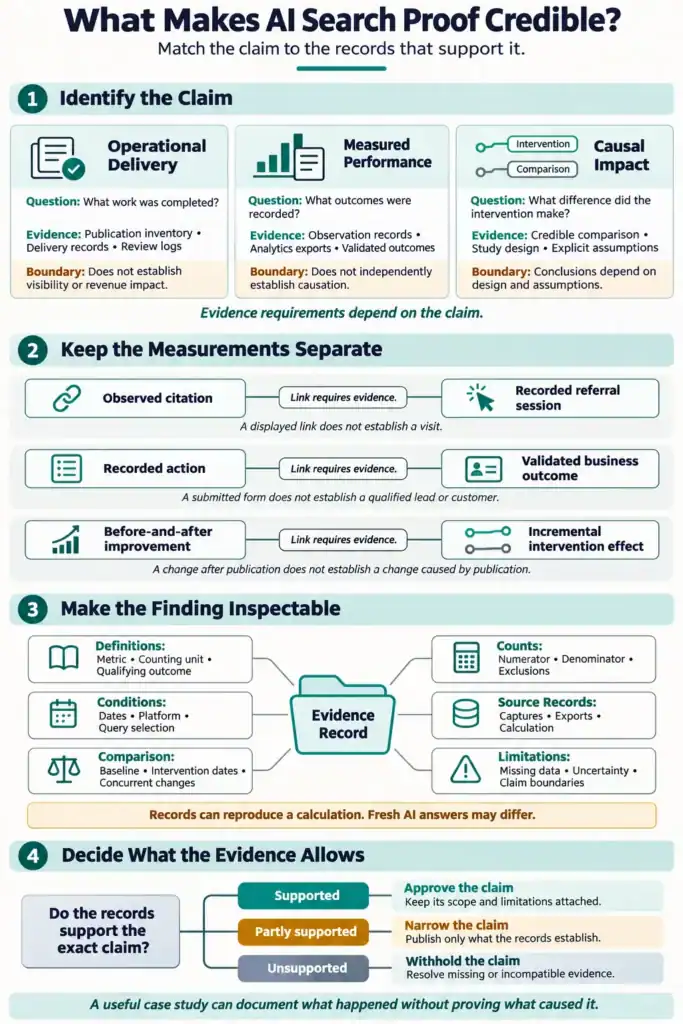
A credible AI search case study connects a specific claim to records that let readers inspect how the result was defined, measured, and interpreted. Proof of delivery, observed performance, and incremental impact require different evidence; a useful observational report can establish what happened without proving what caused it.
The STROBE statement calls for reporting so “readers can follow what was planned, what was done, what was found, and what conclusions were drawn”— PLOS Medicine.
That reporting principle applies here by analogy, without certifying study quality. Screenshots and percentages can otherwise carry budget decisions their evidence cannot support. Content Ops Lab approaches this through research-first content operations and verification against supporting records.
Related: How Do You Measure AI Search ROI?
What Does an AI Search Case Study Actually Prove?
An AI search case study can document completed work, describe measured outcomes, or estimate an intervention’s effects when its design supports that conclusion. The evidence requirement follows the claim’s wording. Executives should first identify what the author says happened, then inspect whether the records support that specific statement.
Operational Delivery, Measured Performance, and Causal Impact
A production inventory answers a different business question from an acquisition report. Both can inform investment, provided the conclusion stays within the boundaries of the records presented for review.
| Proof category | Supporting records | Unsupported conclusion |
| Operational delivery | Dated publication inventory, content versions, delivery records, review logs | Delivered content increased AI visibility or revenue |
| Measured performance | Defined observation set, analytics exports, calculation rules, validated outcome records where applicable | The content intervention caused the observed result |
| Causal impact | Intervention records, justified counterfactual, analysis, assumptions, uncertainty | One bundled technique independently caused all improvement |
These categories answer different questions. A bounded performance observation remains useful without isolating an intervention’s effect.
The distinction becomes more consequential when a report moves from publication counts to audience behavior.
Mentions, Citations, and Referral Sessions
A brand appearing in an answer, a linked source appearing beside it, and a recorded website visit are separate observations. Connecting them requires evidence beyond their appearance in one presentation.
“Session-scoped dimensions show you where both new and returning users are coming from when they start new sessions” — Google Analytics Help.
- Record brand mentions separately from linked citations.
- Define the source rules identifying referral sessions.
- Preserve unknown relationships between answers and visits.
Session acquisition cannot reconstruct the originating answer or measure incremental influence. A citation and referral total alone cannot establish a one-to-one connection.
Even a traceable visit leaves another question open: what did the visitor actually do?
Configured Actions and Validated Business Outcomes
An analytics action gains commercial meaning through its definition and validation. Calling every recorded interaction a conversion conceals differences that matter when leadership evaluates acquisition performance or expected returns.
“Any event you collect can become a key event” — Google Analytics Help.
- Identify the action triggering each recorded event.
- Validate unique leads against customer relationship records.
- Separate requested appointments from confirmed, completed bookings.
- Reconcile realized revenue with attributable customer records.
Disclose unmatched interactions and unknown outcomes rather than promoting them into customers.
Those definitions establish the outcome boundary; visibility claims need an equally clear boundary around observations.
When Does AI Citation Evidence Become More Than a Screenshot?
Citation evidence supports a broader claim when the record preserves how observations were selected, captured, and repeated. One authentic screenshot can document one appearance. Claims about persistence require an observation set, while claims about audience exposure require additional evidence connecting that set to the people or searches being described.
A Screenshot’s Observation Boundary
A screenshot is useful when another reviewer can understand exactly what it captured. Cropping away context can make a real appearance seem more comprehensive, relevant, or repeatable than the record establishes.
- Preserve the complete prompt and generated answer.
- Retain linked sources and their destination URLs.
- Record capture time, platform, and available version.
- Describe relevant account, mode, and environment conditions.
Retain the capture and metadata. “Appeared in this captured answer” can remain defensible when “consistently recommended to buyers” cannot.
A complete capture improves inspectability, but broader visibility claims still depend on how queries were selected.
Query Selection and Repeated Observations
Repeated testing estimates behavior within the selected query panel. It cannot repair a panel built around favorable phrases, convenient geographies, or prompts chosen after the brand already appeared successfully.
- Explain query intent, geography, and language coverage.
- Record personalization conditions and enabled search mode.
- Preserve panel versions and the repetition schedule.
- Retain unfavorable results and missing observation records.
Distinguish completed answers without citations from missing captures; disclose denominator treatment and panel changes. Repetition cannot repair systematic selection bias or establish actual audience exposure.
The resulting dataset can support calculation checks but cannot promise the same answers on future runs.
Recalculating Results and Repeating Answers
Reproducibility has two meanings here: checking a calculation from preserved observations and requesting fresh answers under similar conditions. A credible report distinguishes those tasks instead of promising identical outputs.
“This paper argues that citation visibility metrics should be treated as sample estimators of an underlying response distribution rather than fixed values” — arXiv.
The original preprint examines three platforms and three consumer-product topics; peer review is not established. It supplies no universal prompt threshold or local-services benchmark.
- Preserve observations used in each reported calculation.
- Document citation coding and denominator inclusion rules.
- Report uncertainty appropriate to the sampling design.
Reviewers can recalculate a preserved finding even when a new answer changes its cited sources.
What Makes an AI Referral Conversion Claim Credible?
A credible conversion claim provides a reconstructable rate, its absolute counts, and a comparable baseline when it claims a comparison. The report must identify eligible traffic and qualifying actions under consistent rules. A large percentage or multiplier carries little decision value when readers cannot determine what entered either side of the calculation.
Numerators, Denominators, and Reporting Periods
Rate definitions must precede interpretation. A session conversion rate, user conversion rate, and event count describe different quantities, even when a presentation places them beneath the same conversion heading.
Request these records before interpreting a conversion claim:
- Qualifying sessions and total eligible session counts.
- Action definitions, source rules, and reporting dates.
- User, session, or event scope explicitly identified.
- Comparison counts, exclusions, and consistent eligibility rules.
- Calculation method and underlying export for review.
A pooled rate divides total qualifying sessions by total eligible sessions. An unweighted monthly average gives each month equal weight: a different summary when volumes vary.
Once the rate is reconstructable, the remaining question is how much confidence the comparison deserves.
Small Samples and Uncertain Differences
Small cohorts can produce striking percentages with limited precision. Showing the underlying counts allows leadership to assess whether an apparent advantage warrants further observation, a bounded test, or stronger investment.
NIST cautions that “symmetical confidence limits that are approximated using the normal distribution may not be accurate enough for some applications” — NIST/SEMATECH.
The original discussion concerns binomial defect proportions. Conversion applications require suitable assumptions, including consideration of repeated users and clustering within locations or periods.
- Show absolute counts beside rates and multipliers.
- Report percentage-point differences alongside relative rate comparisons.
- Explain interval methods and relevant dependence assumptions.
Intervals cannot correct tracking errors, selected cohorts, or missing attribution. Direct traffic cannot become AI traffic by assumption.
Statistical uncertainty and measurement quality both matter before a conversion comparison becomes a commercial claim.
Recorded Conversion and Commercial Value
Commercial value requires another layer of validation beyond configured actions. A recorded inquiry may be duplicated, invalid, unqualified, or disconnected from any completed sale, booking, or collected payment later.
- Deduplicate inquiries using documented matching and exclusion rules.
- Validate qualification and bookings with accountable owners.
- Distinguish attributed revenue from modeled lead value.
- Reserve incremental return claims for supported effects.
Estimated lead value remains an estimate. Realized revenue requires business records; attributed revenue requires crediting rules. Neither establishes incremental revenue.
That final distinction determines whether the report describes observed performance or supports an intervention’s causal effect.
If your operation needs to produce 20–50+ articles per month without sacrificing compliance or quality, Content Ops Lab builds the infrastructure to make that possible. Contact us to discuss your content production requirements.
What Separates Improvement From Causal Proof?
Improvement describes a change between comparable observations; causal proof concerns the difference an intervention made relative to what would have happened otherwise. A before-and-after result can be useful without resolving that counterfactual. Stronger conclusions require a justified comparison, explicit assumptions, and attention to other changes that could explain the outcome.
Comparable Baselines and Intervention Records
A baseline must preserve the conditions against which you claim improvement. Choosing a convenient low point after seeing the results can distort the story even when the arithmetic is correct.
- Preserve dated exports and relevant prior trends.
- Record publication dates and subsequent content versions.
- Document measurement changes affecting either comparison period.
- Explain period selection before interpreting apparent improvement.
Document whether implementation was gradual. Reconcile changed definitions or disclose why direct comparison is unavailable. Original exports preserve the baseline despite later dashboard changes.
Comparable records support a change claim, but timing alone cannot rule out competing explanations.
Concurrent Changes and Alternative Explanations
Outcomes can change while content stays the same. The analysis should examine plausible alternatives in the organization and market, rather than treating publication as the only meaningful event.
- Record campaigns, demand shifts, and seasonal patterns.
- Assess technical changes and AI platform shifts.
- Track changes in location capacity and service availability.
- Consider regression after an unusually weak baseline.
Expanded capacity can affect bookings; tracking repairs can affect recorded actions. Bundled publication, design, and linking changes cannot isolate an individual technique’s effect without additional design.
An explanation of concurrent changes strengthens interpretation, but causal estimation still needs a justified counterfactual.
Counterfactuals and Stronger Study Designs
A counterfactual makes the no-intervention comparison explicit. Its credibility depends on the setting and assumptions, so a method’s name cannot substitute for examining how the study was actually conducted.
“Time series during the pre-intervention period are used to model a counterfactual situation without intervention during the post-intervention period” — Kyoung-Nam Kim.
This is general causal-methods guidance, applied here to marketing evaluation rather than evidence about an AI-search intervention.
| Approach | Comparison basis | Permissible conclusion | Material limitation |
| Descriptive pre/post | Defined observations before and after implementation | The measured outcome changed over the stated periods | Timing alone cannot establish intervention effects |
| Justified quasi-experimental analysis | Suitable control or modeled no-intervention trajectory | An estimated effect conditional on design and assumptions | Confounding, trends, seasonality, and autocorrelation can undermine interpretation |
| Randomized rollout | Outcomes compared across randomly assigned rollout groups | Estimated effects when assignment, implementation, and analysis support them | Spillovers, nonadherence, and limited precision can weaken conclusions |
- Justify comparison suitability for the specific intervention.
- Examine timing, trends, and correlated repeated measurements.
- State assumptions and unresolved alternative explanations explicitly.
When stronger analysis is unavailable, a bounded descriptive finding remains publishable and useful for decisions.
Related: Did Your ChatGPT Traffic Drop—or Did Attribution Break?
What Evidence Should Marketing Leaders Request Before Approval?
Marketing leaders should request a manageable record that connects the proposed claim to its definitions, data, calculations, comparisons, limitations, and accountable owners. Review depth should match the decision. Publishing a single observed appearance and expanding a multi-location investment require different support, even when both begin with the same agency presentation.
A Reviewable Claim and Its Source Records
Start with the exact sentence leadership would approve. Reviewing an undefined promise of success invites different stakeholders to approve different interpretations, leaving nobody responsible for the claim that eventually appears publicly.
Use this approval checklist for an AI search case study:
- Proposed wording and the decision it supports.
- Metric definitions, reporting dates, and selection rules.
- Source exports and calculations supporting reported findings.
- Comparison rationale, material limitations, and unresolved unknowns.
- Named data owner and documented review scope.
Distinguish planned analysis from exploratory findings. Preserve the analysis plan and changes; a pattern discovered across many examined segments warrants different interpretation from a prespecified test.
A complete claim record still needs consistent allocation rules when results cross brands and locations.
Consistent Measurement Across Locations
Multi-location reporting must preserve the difference between where content aimed to compete and where a business outcome occurred. Combining those fields can create apparent location performance that the underlying records cannot support.
- Use stable brand and location identifiers throughout.
- Retain pooled counts alongside individual location counts.
- Prevent duplicate credit across offices and brands.
- Publish allocation rules for shared business outcomes.
Separate targeted, observed, requested, booked, and revenue-owning location fields; mark unknowns explicitly. Explain intake routing and whether pooled changes reflect location performance or traffic mix.
Those distinctions make review possible; access rights and approval responsibilities determine who can complete it.
Approval, Access, and Reassessment
Approval should authorize only wording supported by the reviewed evidence. Confidentiality can change access arrangements, while preserved versions and reassessment triggers keep an earlier approval connected to its original scope.
“Validity and reliability for deployed AI systems are often assessed by ongoing testing or monitoring that confirms a system is performing as intended” — NIST AI RMF 1.0.
That general evaluation principle informs COL’s review recommendations; NIST does not prescribe this marketing approval process.
- Approve supported wording, narrow it, or withhold it.
- Arrange redacted records or controlled reviewer access.
- Preserve approval dates, evidence versions, and review scope.
- Reassess after material data or measurement corrections.
Client authorization differs from independent verification. Process documentation establishes process existence; reliability claims need review coverage, findings, and correction records.
The same distinction should govern a content partner’s own evidence, including its reported production results.
How Does Content Ops Lab Support Evidence-Based Content Operations?
Content Ops Lab reports a “5x increase in monthly output (10 → 50+ articles/month)” for a 12-location regulated healthcare client during an engagement reported as April 2024–March 2026. This is an operational throughput result, presented alongside documented production practices rather than as proof of channel growth or incremental revenue.
COL’s internal Comprehensive Knowledge Document records the following results and methods:
- 5x increase in monthly output (10 → 50+ articles/month)
- 1,000+ articles and pages delivered with verified citations across full 23-month engagement
- Line-by-line cross-checking against source research
- STAT vs CLAIM labeling for different evidence types
- Audit trail for every data point
- Knowledge base documentation from client SMEs
These are COL-reported figures and process descriptions. The internal record is the source; we have not independently examined the underlying publication inventories and verification logs for this account. Citation verification describes a reported process attribute. It does not establish error-free output, independent validation, increased citation frequency, or a causal effect on business performance.
The practical relevance is operational: research, review decisions, and delivery records give the client something concrete to inspect. Assessing channel performance or intervention effects requires appropriate data access, named measurement owners, and explicitly scoped responsibilities. Those services require agreement within an engagement.
The Content Ops Lab Production System
The production system organizes work around traceable inputs and human review. Its stages preserve the relationship between an approved statement, the supporting evidence, and the version delivered to the client.
- Research: Gather relevant sources and document their applicability to claims.
- Verification: Cross-check statements against source records and document human review.
- Optimization: Structure approved content for search visibility and clear extraction.
- Delivery: Hand over finalized content with supporting documentation and review context.
A reviewable production handoff gives leadership a firmer basis for defining its next measurement requirement.
Ready to build content infrastructure that scales without the compliance risk? Get in touch — we’ll assess your current content operation and outline what a systematic approach would look like for your organization.
FAQs About AI Search Case Study
Can an AI search case study be credible without proving causation?
Yes. An observational case study can credibly document delivery, captured visibility, or recorded performance when its definitions and supporting records are inspectable. Its conclusions must stay within that scope. A causal claim requires additional design and assumptions, but their absence does not erase a useful descriptive finding or make an operational delivery record inherently untrustworthy.
What should I request before using an AI search case study to justify budget?
Request the proposed claim, source records, metric definitions, dates, absolute counts, calculations, comparison rationale, and material limitations. Identify who owns the data and what reviewers actually checked. Match the evidence request to the investment decision: a bounded exploratory test and a major expansion need different support, especially when the proposal assumes incremental revenue or repeatable outcomes.
Can a confidential client case study still provide credible evidence?
Yes. Redacted records, anonymized identifiers, and controlled review can protect confidentiality while allowing an authorized reviewer to inspect the claim’s basis. State what was withheld and how that limits assessment. Client permission to publish establishes authorization; it does not independently validate the findings. Third-party certification is not required for every credible case study.
How can I compare AI search case studies that use different metrics?
Compare the business questions and definitions before comparing headline results. Citation frequency, referral sessions, qualified leads, and realized revenue describe different outcomes and cannot be ranked directly as equivalent performance measures. Where definitions can be reconciled, compare compatible counts and periods. Where they cannot, assess each study against its stated claim and intended decision separately.
Who should own case-study measurement when an agency produces the content?
Assign named owners for analytics configuration, business-outcome validation, analysis, and published wording. The agency can document content changes and production records; client teams often control analytics access, intake systems, and revenue validation. Agree responsibilities and review scope explicitly. Content production does not automatically include causal evaluation, and no stakeholder should approve results beyond the evidence they reviewed.
Key Takeaways
- Credible proof connects a bounded claim to inspectable records; delivery, observed performance, and incremental impact require different supporting evidence.
- Research-first production at COL combines source verification, human review, and documented handoffs; process documentation alone cannot establish output reliability.
- A reported “5x increase in monthly output (10 → 50+ articles/month)” documents COL’s operational scope without establishing that production caused channel growth.
- Across its reported engagement, COL delivered “1,000+ articles and pages delivered with verified citations across full 23-month engagement”; independent validation remains separate.
- Request the evidence package before expanding investment, then approve supported wording, narrow unsupported conclusions, or withhold claims that lack adequate records.
Make Your Next AI Search Case Study Support the Decision
A credible AI search case study makes the relationship between its claim and supporting records easy to inspect. Delivery evidence establishes completed work; measured outcomes describe a defined observation; causal conclusions require a justified account of what would otherwise have happened. A narrower conclusion can still guide a useful decision.
Before expanding investment or publishing a stronger statement, request the evidence package. Preserve the definitions, source exports, comparison, limitations, and approval record while the work is underway, when missing context is easier to recover.
Content Ops Lab’s contribution is research-first production with human verification and a documented handoff, giving stakeholders a concrete record to define further measurement and review.
Related: What Is AI Search Monitoring and What Should Brands Track?