

What Can AI Source Verification Tools Actually Verify?
AI source verification tools can match references to records, locate quoted wording, and assess whether selected evidence supports a claim. Each result establishes something different: identifying a paper does not validate its methods, and finding a sentence does not justify every assertion attached to it.
The December 2023 ALCE study reported that “on the ELI5 dataset, even the best models lack complete citation support 50% of the time” — Gao et al.
That historical benchmark doesn’t reflect current tool accuracy. A verification badge without scope leaves publishers guessing. Content Ops Lab connects verification labels to documented checks and accountable review.
Related: How to Verify AI Content Sources
What Does a Source Verification Result Actually Establish?
A source verification result establishes the outcome of a particular check against particular evidence. Its meaning depends on the object, procedure, and recorded limitations. A deterministic text match, a model’s support assessment, and an editor’s publication decision answer different questions, even when software presents them together.
Source Identity and Retrieval
An identifiable publication and an accessible document are different assets. A bibliographic record can identify a referenced work while leaving its contents unavailable for inspection, limiting what reviewers can establish.
Crossref describes its role precisely: “Our publicly available REST API exposes the scholarly metadata that members and trusted sources deposit with Crossref” — Crossref.
Distinguish these outcomes:
- Reference details agree with the identified publication record.
- Original text remains unavailable through checked access routes.
- Retrieved document differs from the version originally cited.
Absence from Crossref’s deposited records does not establish that a work is nonexistent.
Quotation Fidelity and Claim Support
Quotation matching asks whether wording appears in the checked representation. Claim assessment asks whether evidence warrants an assertion. Both matter, but success on the first cannot settle the second question.
Require verification outputs to distinguish:
- Literal wording located within the checked document.
- Context examined around the selected supporting passage.
- Support judgment attached to the final claim.
Require a match location and a separate explanation of support.
The harder decision begins when accurate wording sits beside an assertion broader than its evidence.
Evidence Quality and Publication Approval
Evidence appraisal examines whether research deserves the intended reliance. Publication approval assigns responsibility for using it. A source can be authentic and accurately summarized yet remain unsuitable for a particular audience.
Keep decisions visible:
- Methods fit the question the article addresses.
- Findings apply within the proposed audience boundaries.
- Designated publishing owner accepts the remaining uncertainty.
The boundaries below provide a practical reading guide for verification outputs, rather than a prescribed sequence.
| Check | A successful result establishes | Still unresolved |
| Reference matching | Metadata agrees with an identified record | Study quality and claim support |
| Document retrieval | A particular version was accessible | Completeness and correct interpretation |
| Quotation matching | Wording occurs in the checked representation | Context and evidentiary relevance |
| Claim assessment | A support judgment relative to selected evidence | Retrieval coverage and judgment reliability |
| Evidence appraisal | A review decision with stated criteria | Remaining uncertainty and applicability limits |
| Publication approval | A designated owner accepted the content | Error elimination and legal compliance |
Can Tools Detect Fabricated or Outdated References?
Tools can expose reference inconsistencies and locate reported publication updates within the sources they check. They cannot turn every failed lookup into proof of fabrication or every clean search into proof of currency. Identity, access, version, and update status need separate outcomes so unresolved cases remain visible to reviewers.
DOI Resolution and Bibliographic Agreement
A DOI can have valid syntax, resolve successfully, and still identify the wrong publication. Reference checking therefore needs bibliographic agreement alongside a working destination before the citation moves into evidence review.
Check the relationship between identifier and reference:
- DOI format passes the specified syntax check.
- Resolved identifier points to the intended work.
- Title, authors, venue, and dates agree appropriately.
If the identifier belongs to another paper, record an identifier–metadata mismatch. Online and issue dates can differ; investigate before alleging fabrication.
Once identity is established, access still determines how much of the claimed evidence reviewers can examine.
Unavailable Text and Ambiguous Matches
Unavailable text is an access limitation, while an ambiguous match is an identity problem. Combining them under one failure label makes follow-up research harder and can conceal what reviewers actually inspected.
Give each unresolved result a specific status:
- Broken destination; alternate publication record still under investigation.
- Access blocked; full text has not been examined.
- Abstract available; methods and results remain unreviewed.
- Near-match found; bibliographic identity still requires confirmation.
Assign an owner. Abstract-only access cannot stand in for unexamined material.
Even with full access, another question remains: whether the document is still the appropriate version to cite.
Corrections, Retractions, and Source Versions
Publication status checks should identify the channels consulted and the date checked. Finding no update notice describes that search; it does not certify that it captured every relevant change.
Crossref cautions that “the presence of Crossmark itself is not a guarantee” — Crossref.
Crossmark exposes reported updates through participating implementations. Your record should preserve:
- Checked document version and date of inspection.
- Update channels consulted and specific notices found.
- Decision about changes affecting the intended claim.
Assess whether the notice changes the intended use.
A current, correctly identified document can still be cited in ways its findings do not justify.
Can an Exact Quote Verify the Claim Beside It?
An exact quote verifies wording only within the representation checked; it does not establish the full claim beside it. Support requires attention to context, scope, and each material assertion. A sentence can reproduce a source faithfully while the surrounding copy changes association into causation or expands a limited finding.
Verbatim Wording and the Checked Document
Literal matching, normalized matching, fuzzy matching, and semantic comparison perform different jobs. A paraphrase with similar meaning may help locate evidence, but it cannot certify the wording of a direct quotation.
Ask for the matching method and location:
- Literal matching checks the specified character sequence.
- Normalization changes disclosed features such as whitespace.
- Fuzzy matching flags approximate wording for inspection.
- Semantic comparison assesses meaning rather than verbatim reproduction.
Inspect the visible document when extraction is uncertain. Record the passage locator and representation checked.
A confirmed match settles the reproduction question while leaving the meaning of the surrounding passage open.
Surrounding Context and Claim Scope
Context determines what a quoted finding permits you to say. Review the source’s boundaries before approving a broader sentence, particularly when concise marketing copy compresses qualifications readers need to understand.
The November 2020 SciFact paper defines a scientific-abstract task involving material “containing evidence that SUPPORTS or REFUTES a given scientific claim, and to identify rationales justifying each decision” — Wadden et al.
That task definition supplies no universal commercial accuracy estimate. For editorial review, preserve:
- Negation and qualifications surrounding the selected passage.
- Population and timeframe attached to reported findings.
- Causal language consistent with the research design.
Consider a hypothetical source reporting an association in a defined population. The draft promises that a service causes the outcome for all customers. An authentic reference and accurately copied sentence would not justify either expansion. Separate passages must also remain visibly separate, rather than becoming one continuous quotation.
Where one sentence contains several assertions, its strongest supported fragment cannot justify approving the whole sentence.
Individual Assertions and Partial Support
A sentence may combine a supported observation with an unsupported explanation or promise. AI source verification tools should make those separable assertions inspectable rather than hiding them beneath one overall verdict.
FActScore evaluates atomic facts by “breaks a generation into a series of atomic facts and computes the percentage of atomic facts supported by a reliable knowledge source” — Min et al.
The December 2023 measure remains tied to its knowledge source. For publishing, consider these editorial dispositions:
- Supported: evidence warrants the specific assertion reviewed.
- Partially supported: only identified components have support.
- Topic relevance: shared subject without adequate substantiation.
- Contradicted: examined evidence conflicts with the assertion.
- Insufficient evidence: available material cannot settle support.
Each decision remains bounded by retrieval coverage and the assessment’s reliability.
If your operation needs to produce 20–50+ articles per month without sacrificing compliance or quality, Content Ops Lab builds the infrastructure to make that possible. Contact us to discuss your content production requirements.
How Should Leaders Compare Source Verification Tools?
Compare source verification tools by the objects they examine and the evidence their results expose. Deposited metadata, classified citation statements, and research summaries solve different problems. Product documentation states behavior and limitations; it does not independently compare effectiveness or certify suitability for your publishing decisions.
The Object Each Tool Evaluates
Begin with the unit being checked. Similar interface language can obscure whether a result concerns a publication record, another paper’s citation, or a generated summary of the underlying research findings.
scite defines its object directly: “A Smart Citation is a citation statement classified by how it uses the target publication”— Scite API.
| Tool/infrastructure | Documented object | Boundary |
| Crossref | Deposited scholarly metadata, as described above | Record matching does not appraise claim support. |
| scite | Classification of citation statements about target publications | Does not validate an arbitrary attached marketing sentence. |
| Elicit | Research extraction and summaries, with imperfect quality heuristics | Does not assure that a study is trustworthy. |
Keep distinctions visible:
- Supporting classifications concern citing statements and target findings.
- Statement tallies do not count independent replications.
- Metadata agreement leaves substantive evidence appraisal unresolved.
Knowing the object prevents category errors, but leaders must still judge whether the research warrants reliance.
Credibility Indicators and Research Quality
Credibility indicators can guide attention without settling study quality. Journal, publication date, citation count, study type, and available disclosures help frame review; none independently establishes that a finding supports your intended use.
Elicit states: “Elicit summarizes the findings of a bad study just like it summarizes the findings of a good study” — Elicit Help Center.
Elicit discloses imperfect quality heuristics. Review should address:
- Methods appropriate to the question being asked.
- Limitations affecting interpretation of the reported finding.
- Applicability to the audience and proposed use.
An accurate summary can preserve weak research, so useful extraction still needs an independent appraisal decision.
Acceptance Tests for Your Content
Evaluate AI source verification tools against a disclosed set of examples from your publishing work. Include straightforward and difficult cases, and record reviewer expectations before interpreting the software’s results.
Build cases that expose meaningful failure modes:
- Real identifiers paired with mismatched bibliographic details.
- Accurate quotations beside unsupported causal or universal qualifiers.
- Unavailable documents with clearly documented access limitations.
- Conflicting findings requiring an explicit editorial decision.
Track false-support judgments across reviewed cases, unresolved results, and reviewer decisions. Retain the test set, configuration, and adjudication notes. Distinguish appropriate uncertainty from false approval. Set criteria around consequence and review capacity, without universal pass thresholds.
The test is only useful if someone owns what happens when a result remains unresolved.
Related: What Makes an AI Content Workflow Reliable Enough to Scale?
How Should Verification Work Across a Publishing Operation?
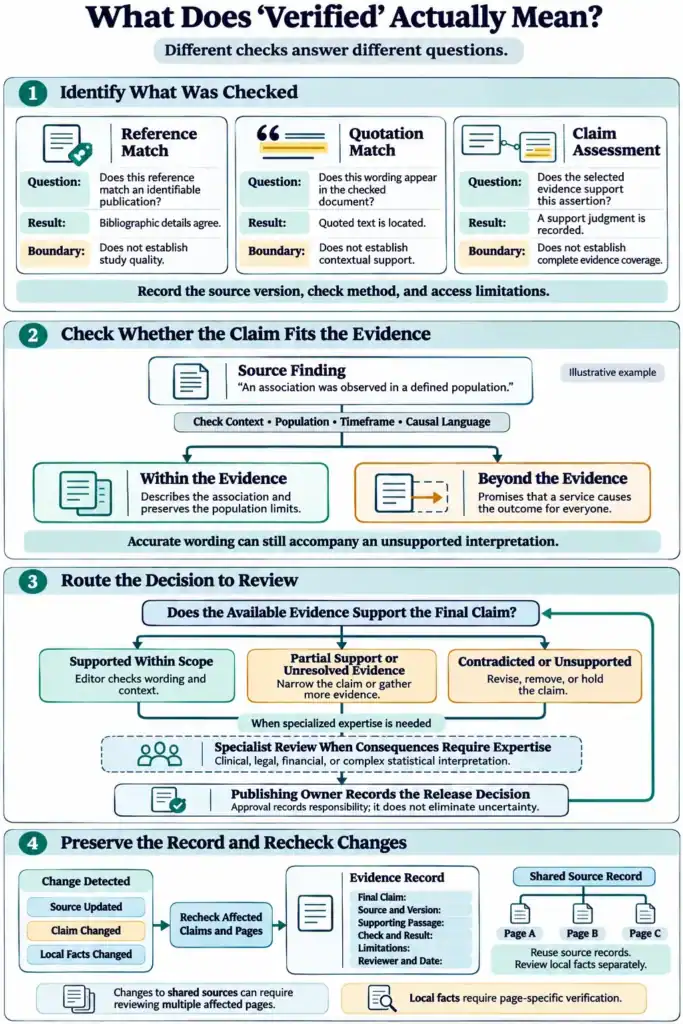
Verification should produce a reusable evidence record, a claim-specific decision, and an accountable publishing owner. Scale depends on retaining those relationships as wording, sources, and local facts change. The following operating recommendations make review inspectable; they do not turn tool outputs or human signatures into accuracy guarantees.
Claim Records and Reviewer Ownership
A claim record should let another reviewer reconstruct the publication decision without repeating every search. Store the final wording alongside the evidence and decision, rather than keeping only a successful checkmark.
Capture these fields together in the record:
- Final claim, source identity, and checked version.
- Passage locator, check method, and recorded result.
- Access limitations, unresolved conflicts, and remaining uncertainty.
- Named reviewer, final disposition, and verification timestamp.
For example: full-text access, literal quotation match, causal claim narrowed by editor. Research staff should own source identity and capture; editors should own wording and support; publishing owners should own release. Recheck a claim when its wording changes materially.
Clear ownership makes a decision traceable, but difficult interpretations still require the right expertise and attention.
Specialist Review and Unresolved Evidence
Human approval adds value when reviewers inspect evidence within their competence. A person who accepts the software’s verdict without examining the claim and its limitations offers little protection against misplaced confidence.
NIST’s July 2024 Generative AI Profile warns: “Automation bias can exacerbate other risks of GAI, such as risks of confabulation or risks of bias or homogenization” — NIST AI 600-1, Section 2.7.
For consequential clinical, legal, financial, or statistical interpretations:
- Route decisions to reviewers with appropriate expertise.
- Provide claims, passages, limitations, and conflicting findings.
- Record reasons for overrides and unresolved dispositions.
NIST provides voluntary risk guidance; these publishing assignments are operating recommendations. Hold unsupported consequential assertions for resolution, revision, or removal.
Even a well-supported approval can become stale when its source changes or local operating facts move.
Shared Sources and Change-Triggered Review
A shared research record can support several location pages, but local accuracy requires separate review. A general finding does not establish which service, practitioner, or appointment option a particular clinic provides.
Maintain dependencies between evidence, claims, and pages:
- Source corrections trigger review of dependent assertions.
- New contradictions reopen affected evidence support decisions.
- Local service changes reopen relevant location copy.
- Material wording changes require renewed claim assessment.
Measure audited false support, unresolved access, reviewer effort, overrides, and correction propagation time. Keep findings attached to the audited sample. Assign correction propagation to an owner and confirm completion.
Reusable research reduces duplicated work, while accountable maintenance keeps that efficiency from spreading outdated claims further.
How Does Content Ops Lab Make Verification Inspectable?
Content Ops Lab’s internal case record reports a 5x increase in monthly output during an anonymized multi-location healthcare engagement, April 2024–March 2026. That production experience connects verification to sustained publishing work, where research handling and editorial interpretation must remain visible as volume grows.
The case record documents these results and controls:
- 5x increase in monthly output (10 → 50+ articles/month)
- 1,000+ articles and pages delivered with verified citations across full 23-month engagement
- Every statistic cross-checked against the underlying source research.
- Line numbers documented to preserve an audit trail.
- STAT versus CLAIM labeling distinguishes different evidence types.
- Knowledge base documentation incorporates input from client SMEs.
These are internally reported results and practices. They are not an independent accuracy audit, a measured error rate, a causal evaluation, or a compliance certification. The phrase “verified citations” describes the internal production record; it should not be read as evidence that every published interpretation was independently validated.
The practical value lies in connecting source records to the work being reviewed. Source locators make passages easier to inspect. Distinguishing statistics from other claims clarifies the evidence being used, while documentation from subject matter experts informs client-specific content.
The Content Ops Lab Production System
The Content Ops Lab Production System organizes that work through four stages. Its structure keeps evidence handling connected to editorial production, rather than leaving verification as a detached final badge.
- Research: Gather relevant evidence and client knowledge for the assignment.
- Verification: Cross-check statistics and document source locations for editorial inspection.
- Optimization: Shape supported content for search relevance and clear extraction.
- Delivery: Prepare finished content with its citations and supporting documentation.
The four stages provide production structure; responsible reviewers still make the decisions that the evidence requires.
Ready to build content infrastructure that scales without the compliance risk? Get in touch — we’ll assess your current content operation and outline what a systematic approach would look like for your organization.
FAQs About AI Source Verification Tools
Can AI Source Verification Tools Replace Human Fact-Checkers?
AI source verification tools can assist with specific checks, but they cannot replace responsibility for interpreting evidence and approving publication. Matching a reference or quotation leaves questions about scope, methods, and applicability. Assign research staff to source capture, editors to wording and support, specialists to consequential interpretations, and a publishing owner to the release decision.
How Should a Marketing Team Measure the Value of Source Verification?
Measure review effort, audited support errors, unresolved cases, and correction handling against a documented baseline. Include time spent investigating ambiguous results and revising unsupported copy, rather than counting only completed automated checks. Keep audit findings tied to the sample examined. The useful management question is whether decisions become more defensible at an acceptable operating cost.
Does a Verified Citation Make Healthcare or Legal Content Compliant?
A verified citation establishes only the check actually performed. Healthcare and legal content can still require sector-specific review of its interpretation, audience, promotional wording, and applicability. An authentic source does not settle those questions. Give qualified reviewers the claim and supporting passages, record their decision, and retain an internal owner responsible for publication and later corrections.
How Do Source Verification Tools Differ from AI Search Visibility Tools?
Source verification examines evidence behind published statements, while AI search visibility monitoring observes how brands or sources appear in generated answers. A visibility observation does not establish that an answer is supported, and a successful evidence check does not guarantee future citations. Evaluate the two functions against their respective questions and keep their reporting outcomes separate.
Can a Content Partner Manage Verification Without Replacing Our Internal Reviewers?
A content partner can manage research capture, citation documentation, and evidence preparation for review while your organization retains publishing ownership. Define which decisions the partner makes, which require internal approval, and when specialist review applies. Agree on unresolved-case handling and correction responsibilities before production expands, so higher output does not obscure accountability for final claims.
Key Takeaways
- AI source verification tools establish specific check outcomes; reference matches and accurate quotations do not automatically substantiate the surrounding claims.
- Content Ops Lab connects source research, documented passage locations, evidence labeling, and client SME knowledge within its four-stage Production System.
- COL’s internal healthcare case record reports a 5x monthly output increase, from 10 to 50+ articles, within sustained content production.
- The same internal record reports 1,000+ articles and pages delivered with verified citations; that production figure is no independent accuracy audit.
- Require inspectable claim records, named reviewers, visible unresolved outcomes, and change-triggered review before expanding verification across a multi-location publishing operation.
Make AI Source Verification Tools Accountable to the Claim
AI source verification tools become useful when their outputs answer a bounded question and leave an inspectable record. A matched reference, located quotation, support judgment, and study appraisal each contribute something different. None removes the need to decide whether the final wording belongs in publication.
Before expanding production, require your team to show what was checked, which evidence was available, what remains unresolved, and who accepted the claim. Connect that decision to the pages that depend on it so changes can reach the right owners. Content Ops Lab’s production experience positions verification within research, optimization, and delivery, with documented evidence handling supporting accountable editorial decisions.
One Comment
Comments are closed.