

What Makes an AI Content Workflow Reliable Enough to Scale?
An AI content workflow becomes reliable enough to scale when its people, inputs, evidence, and checks consistently produce acceptable content across the intended workload, with manageable review effort and accountable exception handling. Readiness requires records of that performance over time, including the work that gets rejected, deferred, or corrected.
“Reliability is a goal for overall correctness of AI system operation under the conditions of expected use and over a given period of time” — NIST.
A polished sample leaves those operating conditions untested. Content Ops Lab applies this broader reliability principle through research-first production, source verification, and documented editorial requirements.
Related: How Do You Build a Scalable Content Production Workflow?
Why Doesn’t a Strong AI Draft Prove a Workflow Can Scale?
A strong draft demonstrates an acceptable result for one assignment. It leaves unanswered whether the production process can repeat that result across harder topics, ordinary operators, and competing deadlines. Expansion requires evidence about the whole workload, including the human intervention needed to reach approval.
Output Quality and Workflow Reliability
Quality belongs to the finished asset; reliability concerns repeated production under defined conditions. Two articles can meet the same requirements while needing very different amounts of editorial repair.
- Correct claims within the approved audience and subject scope.
- Consistent acceptance requirements despite differences in wording and style.
- Visible editorial interventions before the final asset earns approval.
- Repeatable outcomes across the work the team actually receives.
- Recorded failures alongside examples selected for their strong performance.
The finished article therefore needs an operating record before it can support expansion decisions.
Representative Work and Ordinary Operators
VeriScore’s long-form factuality research emphasizes variation across tasks, “highlighting the need for expanding factuality evaluation across tasks with varying fact density” — ACL Anthology.
- Include routine assignments alongside topics requiring more factual support.
- Test locations with different services and available business information.
- Include evidence gaps that require a documented editorial decision.
- Involve ordinary operators rather than only the process designer.
- Compare acceptance across content types using their applicable requirements.
This research supplies neither a commercial publishing benchmark nor a universally sufficient pilot size.
Visible Interventions and Complete Pilot Records
A pilot record should preserve what happened between assignment and disposition. Otherwise, a skilled editor’s unrecorded rescue can make an unstable drafting process appear ready for routine production.
- Initial submission, assignment identifier, and applicable source record versions.
- Human interventions, responsible roles, and time spent reviewing work.
- Revision rounds, unresolved questions, and escalations requiring specialist judgment.
- Final disposition, including approval, rejection, deferral, or abandoned work.
- Later corrections, affected claims, and reasons for reopening approval.
Complete records show whether accepted output depends on effort the expanded operation cannot sustain.
What Must Be Controlled Before Content Enters Production?
Production needs a traceable assignment with approved intent, usable evidence, and current business facts. Those inputs serve different purposes and need identifiable owners. An AI content workflow cannot resolve uncertainty simply by repeating a shared record, especially when that record supplies facts to many assets.
Approved Briefs and Current Requirements
A brief establishes what the article must accomplish and where its claims must stop. Approval should attach to a specific version that writers and reviewers can both access.
- Identify the reader and decision the article should support.
- Define required structure and the intended scope of coverage.
- State prohibited claims and qualifications that must survive editing.
- Assign approval responsibility for changes to the article’s requirements.
- Record the version used for drafting and subsequent review.
Clear editorial intent still depends on evidence and business information that support its execution.
Source Evidence and Location Facts
Published research and business records answer different questions. A study can support a general explanation without establishing whether a particular location currently provides the service described in copy.
- Separate research findings from approved descriptions of business operations.
- Confirm source identity before interpreting what its findings support.
- Match evidence to the claim and intended audience context.
- Assign uncertain service facts to a named business owner.
- Record confirmation dates and the scope of approved availability.
A current record also needs dependency tracking when multiple assets inherit its factual statements.
Shared Dependencies and Batch Errors
In its discussion of foundation-model bias and homogenization, NIST identifies downstream effects “with the foundation models acting as ‘bottlenecks,’ or single points of failure” — NIST.
- Identify shared records feeding multiple briefs and generated drafts.
- Trace affected assets to the record version they used.
- Hold dependent unpublished content while disputed facts remain unresolved.
- Correct the shared input with its accountable business owner.
- Review affected published assets before treating containment as complete.
Consider a hypothetical outdated location record listing an unavailable service. Writers reuse it in location pages, service articles, and FAQs. Containment means correcting that record, identifying every dependent asset, holding affected drafts, and reviewing published statements. Fixing the first reported page leaves the shared cause intact.
This example applies the shared-failure idea operationally; NIST did not document this content incident.
How Do You Know the Verification Process Actually Works?
Verification works when it can detect relevant defects under realistic review conditions, using evidence beyond the draft’s own assertions. Agreement between reviewers is useful information, but it does not establish correctness. Test the checking process separately from generation, including its missed defects, false alarms, and authority to stop publication.
Source Checks and Claim Support
A functioning link establishes access to a page. It does not establish that the right source supports the article’s wording or that its findings apply to the intended reader.
- Existence: does the cited material actually resolve and exist?
- Identity: is this the intended publisher, author, and document?
- Relevance: does the source address this specific subject matter?
- Support: does the evidence justify the exact claim made?
- Applicability: do population, timeframe, and conditions fit this audience?
Automated checks can flag broken links or missing sections; evidence-dependent judgments require further examination.
Known Defects and Reviewer Calibration
“Results show that human and LLM judges are vulnerable to perturbations to various degrees” — ACL Anthology. These evaluation experiments establish vulnerabilities, not marketing-editor failure rates.
- Use acceptable examples, and defects adjudicated independently before testing.
- Include valid citations attached to claims they cannot support.
- Test incorrect service statements against confirmed current business records.
- Record missed material defects and false alarms on acceptable work.
- Resolve severity disagreements using publication context and potential consequences.
Keep these examples unpublished; agreement alone cannot show whether reviewers caught the known defects.
Human Review With Evidence and Authority
A cross-domain review concludes “although explanations may increase perceived system acceptability, they are often insufficient to improve decision accuracy or mitigate AB” — Springer Nature. AB means automation bias.
- Give reviewers original evidence rather than only model explanations.
- Match review responsibilities to relevant subject and editorial competence.
- Allocate time for checking claims against their supporting material.
- Authorize reviewers to reject work or hold uncertain content.
- Evaluate assistance separately from its apparent confidence and persuasiveness.
The review does not establish editorial-specific error rates; local checking performance still needs measurement.
If your operation needs to produce 20–50+ articles per month without sacrificing compliance or quality, Content Ops Lab builds the infrastructure to make that possible. Contact us to discuss your content production requirements.
Which Metrics Reveal Whether More Volume Is Sustainable?
Sustainable volume requires acceptable output and enough qualified capacity to produce it. Measure quality, effort, cost, and delay separately within each workload segment. An AI content workflow can look efficient in aggregate while difficult assignments pile up in a specialist queue or rejected drafts disappear from the operating record.
Acceptance and Escaped Defects
First-pass acceptance measures initial submissions against a stable rubric. Later audits examine what passed through that rubric. Neither measure should conceal consequential errors behind an otherwise favorable overall result.
- Keep acceptance requirements stable across the period being compared.
- Count all submitted initial drafts in the acceptance denominator.
- Separate initial acceptance from approval earned after substantial revision.
- Define audit scope and report material defects by severity.
- Record later corrections against the affected accepted asset cohort.
Acceptance and audit findings describe quality; they leave the operating burden of achieving it unresolved.
Review Effort and Cost per Approved Asset
The cost of approved content includes the work that failed to earn approval. A production budget becomes misleading when it excludes rejected drafts and extensive editorial repair.
- Include research, generation, review, rework, and attributable operating costs.
- Record human minutes separately for each participating professional role.
- Include effort spent on rejected, deferred, and abandoned assignments.
- Match cost periods to clearly defined approved asset counts.
- Document allocation choices when shared costs span multiple workloads.
| Metric | Operational Definition | Interpretation Limit |
| First-pass acceptance | Accepted initial submissions / all submitted initial drafts. | Stable rubric required; excludes approval achieved through revision. |
| Escaped material defects | Material defects found in a defined accepted-asset audit sample. | Report sample size and severity; not a population estimate automatically. |
| Review minutes | All review/rework minutes, segmented by role. | Include unsuccessful work; averages can hide specialist burden. |
| Cost per approved asset | Attributable workflow cost / approved assets. | Define period and allocations; zero approvals leaves the ratio undefined. |
| Cycle time | Intake to approval; deferred/rejected work recorded separately. | Report median and upper-percentile times; completed assets omit open queues. |
These definitions support comparison only when the team preserves workload context and consistent accounting boundaries.
Cycle Time and Review Capacity
NIST includes assessing the “resources needed (e.g., staffing, funding) to achieve AI risk management goals in a cost-effective, prioritized manner” — NIST. This guidance supports assessing review resources; it does not establish an AI editorial staffing benchmark.
- Track intake to approval rather than only generation time.
- Report median and upper-percentile durations within comparable workload segments.
- Monitor queue age alongside the number of pending assignments.
- Count available qualified review hours after existing responsibilities consume capacity.
- Identify specialist bottlenecks before approving additional intake work.
Fast drafting cannot establish sustainable throughput when review capacity remains constrained or poorly measured.
Related: How to Verify AI Content Sources
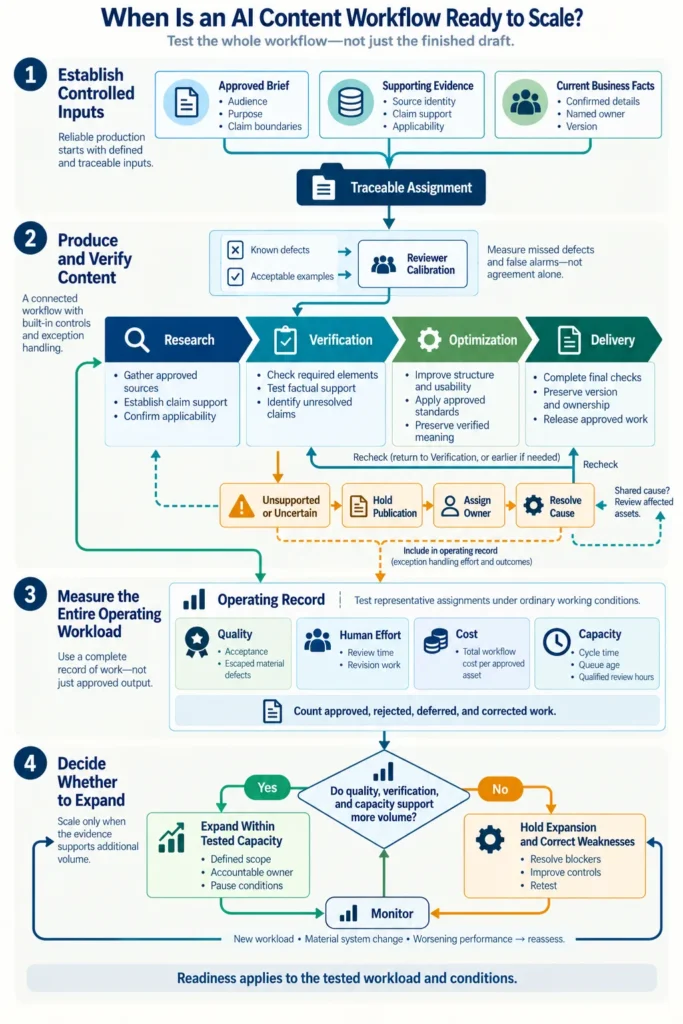
What Should Happen When the Workflow Encounters an Exception?
Exceptions need explicit handling before production volume increases. An unsupported claim, disputed business fact, or repeated material defect should reach someone authorized to hold publication and determine release conditions. The appropriate response depends on potential consequences and affected scope, with a record connecting the issue to its resolution.
Publication Holds and Escalation Owners
NIST’s Playbook states, “Incidents that result in a bypass/deactivate decision require documentation and review to understand root causes, impacts” — NIST. Publication holds are an editorial application.
- Unsupported consequential claim: hold pending evidence or approved removal.
- Unresolved business fact: escalate to its accountable information owner.
- Repeated material defect: pause affected production pending cause review.
- Ineffective verification: hold scope if its checking controls cannot support.
Record the decision-maker, resolution, supporting evidence, and release conditions; a deadline cannot resolve uncertainty.
Root Causes and Affected Assets
Repair scope should follow the defect’s root cause. An isolated wording error may need one correction; a contaminated shared source can require reviewing an entire dependent content batch.
- Preserve the original defect and relevant production record versions.
- Distinguish isolated drafting mistakes from errors in shared inputs.
- Identify unpublished and published assets using the affected dependency.
- Assign correction ownership for both inputs and resulting content.
- Confirm affected-scope review before closing the recorded production incident.
Correcting the source prevents neither historical exposure nor future recurrence without checking dependent work.
Controlled Changes and Targeted Retesting
A material change can invalidate earlier production evidence. The team should record what changed and test any affected requirements before applying the change across routine publishing.
- Version prompt, template, model, and source-library changes before deployment.
- Record the change owner and its intended operating purpose.
- Identify content requirements that could behave differently after modification.
- Retest affected cases, including previously detected material defect examples.
- Retain a documented fallback when performance remains unacceptable after changes.
Retesting should follow affected requirements; successful earlier work cannot automatically validate a changed process.
When Is an AI Content Workflow Ready for More Volume?
An AI content workflow is ready for more volume when representative work meets defined requirements, checking controls detect relevant defects, and qualified reviewers can handle the proposed load. Authorize a specified publishing scope with an accountable owner and pause conditions. Keep unresolved blockers separate from concerns that monitoring can reasonably address.
Evidence Needed Before Expansion
Leadership needs a decision record that connects observed performance to the proposed workload. Attractive samples and fast generation provide incomplete evidence when review effort or exception ownership remains uncertain.
- Representative accepted work across the proposed expansion scope.
- Tested detection of material defects relevant to that work.
- Documented intervention effort within the available qualified review capacity.
- Resolved ownership for disputed facts and consequential publication decisions.
- Operating records covering rejected work and post-approval corrections.
These are proposed operating criteria, not an independently validated industry threshold for publishing readiness.
Bounded Expansion and Pause Conditions
Authorize only the increase the local evidence and capacity can support. The decision should identify both immediate blockers and the conditions that would require stopping additional intake or publication.
- Evidence: does tested performance cover the proposed publishing scope?
- Blockers: are critical unresolved cases closed before additional publication?
- Capacity: can qualified reviewers absorb the proposed additional workload?
- Owner: who can authorize expansion and stop affected publishing?
- Pause conditions: material escapes, unresolved critical cases, or excessive queues.
Set queue limits and release conditions locally; no universal expansion percentage follows from this evidence.
New Workloads and Reassessment
Expansion changes more than the number of drafts. A new location, content category, operator, or source environment can introduce requirements the previous evaluation never tested adequately under ordinary conditions.
- Evaluate new locations against confirmed local service and business facts.
- Test new categories for their different evidence and review demands.
- Assess operator handoffs under routine production conditions.
- Reassess material system changes against the requirements they affect.
- Preserve earlier baselines to distinguish change effects from workload differences.
Reassessment keeps approval tied to the demonstrated operating scope rather than a permanent readiness claim.
How Does Content Ops Lab Support Reliable Content Production?
Content Ops Lab documented expansion from 10 to 50+ articles per month in an anonymized regulated healthcare engagement. That work combined AI-assisted production with a research-first foundation and documented editorial infrastructure; the historical output describes delivered scope rather than establishing readiness for every future workload.
The engagement ran from April 2024 through March 2026. Its production figures are proprietary, self-reported observations, not independent measurements of defect rates, review capacity, savings, or causation. COL’s relevant production capabilities and approved historical proof are:
- Research-first foundation: Assemble supporting material before drafting, giving editorial decisions an evidence base rather than asking reviewers to reconstruct one afterward.
- Line-by-line source cross-checking: Compare factual wording with original supporting material, including qualifications that can change what an article may reasonably claim.
- Documented client knowledge and SME input: Capture business facts and subject expertise so writers can distinguish published research from organization-specific information.
- Unified versioned source of truth: Maintain identifiable approved records that support consistent production and make shared dependencies easier to trace when facts change.
- Historical production expansion: 5x increase in monthly output (10 → 50+ articles/month).
- Historical delivered scope: 1,000+ articles and pages delivered with verified citations across full 23-month engagement.
The Content Ops Lab Production System
The production system makes editorial decisions traceable through delivery. Its documentation supports repeatable work and provides a basis for evaluating performance within the publishing scope a team intends to operate.
- Research: Establish assignment evidence, document the business context, and define editorial requirements.
- Verification: Cross-check claims against sources and resolve unsupported factual wording.
- Optimization: Refine structure, search relevance, and answer clarity within approved boundaries.
- Delivery: Transfer approved content with documentation supporting publication and subsequent updates.
Next, review current production requirements before defining the infrastructure your team needs.
Ready to build content infrastructure that scales without the compliance risk? Get in touch — we’ll assess your current content operation and outline what a systematic approach would look like for your organization.
FAQs About AI Content Workflow
Does every AI-generated article need human review?
Review should reflect the content’s consequences, factual demands, and demonstrated checking performance. There is no universal staffing formula for every article. Define which work requires editorial or specialist approval, test those controls, and document exceptions. Reducing review requires evidence that the remaining controls support the intended publishing scope under ordinary operating conditions.
How do you measure the cost of an AI content workflow?
Divide attributable workflow cost by approved assets within a defined accounting period. Include research, generation, review, rework, and effort spent on rejected or deferred assignments. Document shared-cost allocations and segment materially different workloads. Also report human minutes by role, because a favorable average cost can conceal a specialist bottleneck that limits further production.
What should happen when an AI content workflow produces an unsupported claim?
Hold publication when the unsupported claim could materially affect the reader or business. Assign an owner to obtain support, revise the wording, or remove it. Record the resolution and release conditions. If the defect came from a shared input, correct that dependency and review affected assets before treating the issue as contained.
Can a second AI model replace independent fact-checking?
A second model can assist review, but agreement between models does not independently establish factual truth. Verification still requires examining source identity, relevance, claim support, and audience applicability. Test the assisting model against known defects and acceptable examples. Give the accountable reviewer access to original evidence and authority to hold or reject unresolved content.
Can Content Ops Lab build a workflow for an internal content team?
Yes. Content Ops Lab’s System Build model creates documented production infrastructure that can be transferred to an internal team, with onboarding to operate it. The work supports defined editorial requirements, source verification, and documented business knowledge. The receiving team still needs assigned owners, qualified review capacity, and evidence that it can operate within those controls.
Key Takeaways
- Reliable production requires representative quality, tested defect detection, manageable human effort, and accountable exception handling across the intended workload.
- Research-first preparation and line-by-line source cross-checking connect editorial requirements to evidence before an asset receives approval for publication.
- COL reports a historical 5x increase in monthly output (10 → 50+ articles/month), documenting expansion within an anonymized healthcare engagement.
- COL reports 1,000+ articles and pages delivered with verified citations across full 23-month engagement; this does not establish independent defect rates.
- Measure rejected work, revision effort, escaped defects, and qualified review capacity alongside approved output before authorizing additional publishing volume.
- Review your current workload, resolve expansion blockers, assign stop authority, and reassess when content scope or material system inputs change.
Scale AI Content Production Within Demonstrated Capacity
A reliable AI content workflow earns expansion through observed operating performance. Acceptable drafts matter, but so do the controls that detect defects, the effort required to secure approval, and the decisions made when evidence runs out. Rejected work and later corrections belong in that assessment.
Before authorizing more publishing, review the workload already moving through production. Confirm its requirements, test its checking controls, and establish what qualified reviewers can sustain. Define who can pause affected work and what must change before it resumes.
Content Ops Lab builds documented production infrastructure around research, source verification, and accountable editorial requirements, giving teams a concrete basis for evaluating their next expansion decision.
Related: Why Do Internal Content Teams Hit a Production Ceiling?