
How Are AI Search Queries Different From Google Search Queries?
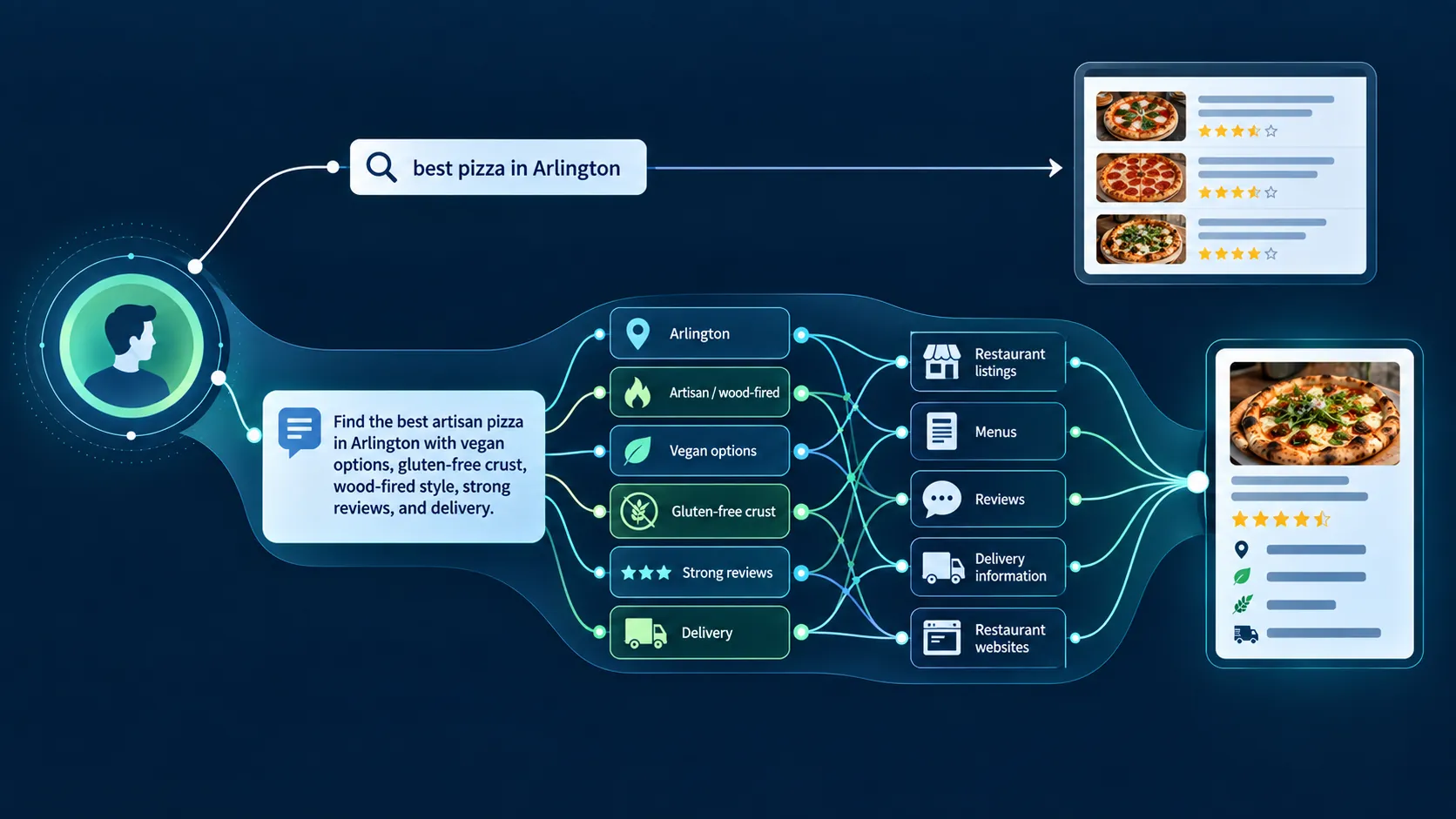
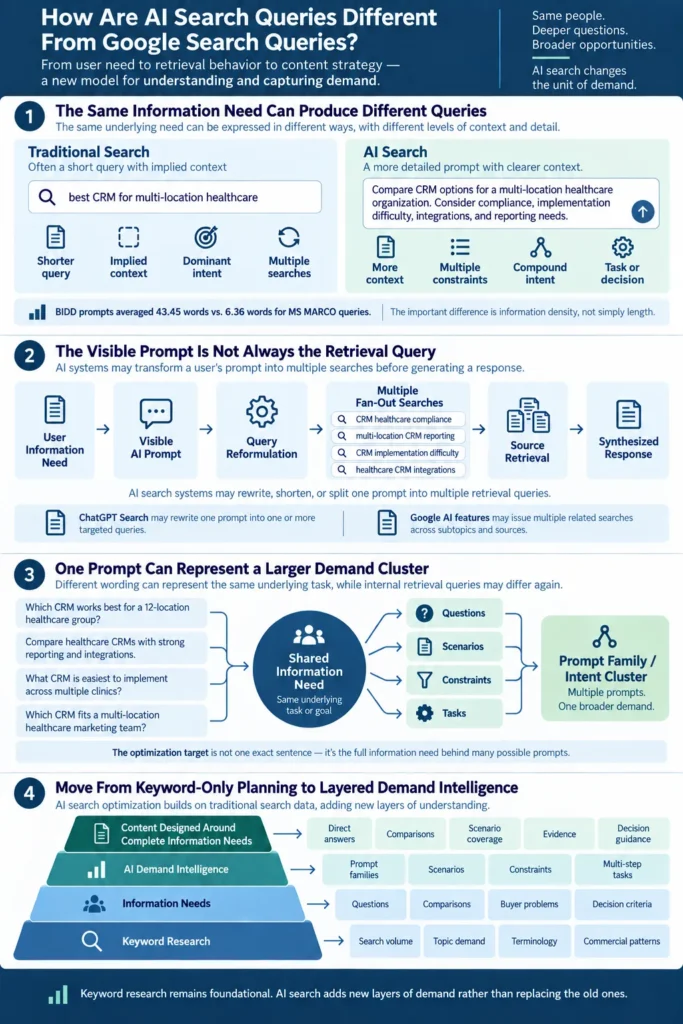
AI search queries differ from Google search queries primarily because they can express more context, constraints, intent, and task direction in a single interaction—not because every AI prompt is unusually long. Research comparing Bard interaction data with conventional search queries found: “We found a contrasting difference in average lengths—43.45 words for BIDD versus 6.36 words for MS MARCO—demonstrating that BIDD prompts by nature are more information-dense” — ACM.
For marketing leaders, that changes what useful demand intelligence looks like. Content Ops Lab starts with verified evidence about information needs and search behavior before AI generation, rather than assumptions about what users might type.
Related: AI Search vs Google Search – What Multi-Location Operators Need to Know
How Different Are AI Search Queries From Google Queries?
The difference is meaningful, but it is not a clean break between keyword search and conversational search. Google has interpreted semantic intent and incomplete queries for years. AI interfaces make richer questions easier to express, while generative search features increasingly bring similar conversational behavior into Google itself.
Google Queries Already Express More Than Keywords
Traditional search queries may look compressed, but the information need behind them can be much larger. Modern retrieval systems interpret meaning, context, relationships, and likely intent rather than matching isolated words literally.
- Short queries can represent complex information needs.
- Search systems infer meaning beyond literal wording.
- Semantic matching predates generative AI interfaces.
- Query reformulation resolves incomplete user language.
“A Survey of Conversational Search” describes this as an established information-retrieval practice: “Query reformulation is a widely used technique in the context of information retrieval… This is because the input queries are usually vague, ambiguous, or incomplete, which requires the system to reveal the user search intent to address the information needs better”— arXiv.
That behavior predates AI-generated answers, even if newer interfaces make it more visible.
AI Search Makes Richer Questions Easier to Use
AI interfaces reduce the need to compress an information need into a compact phrase. Users can state circumstances, preferences, desired outputs, exclusions, and follow-up questions within the same interaction.
- Context can travel with the initial request.
- Constraints can narrow acceptable answers immediately.
- Follow-ups can refine the original information need.
- Descriptive questions require less query compression.
Google describes this shift directly: “With generative AI in Search, people are able to: – Ask new kinds of questions that are more complex and more descriptive – Get the gist of a topic faster, with links to relevant results to explore further… – Make progress easily, by asking conversational follow-ups or trying suggested next steps” — Google.
Conversational behavior is expanding without replacing the semantic foundations of traditional search.
The Difference Is Evolutionary, Not Absolute
The better model is convergence. AI platforms are adopting search infrastructure, while Google is incorporating generative answers, conversational follow-ups, and increasingly complex requests into an established search system.
- Google already interprets natural-language information needs.
- AI systems increasingly depend on web retrieval.
- Both environments can reformulate user requests.
- Conversational interfaces blur historical category boundaries.
For marketers, the dividing line is less “keywords versus prompts” than how users express information needs and how systems process them.
That distinction becomes clearer when you separate prompt length from prompt density.
Are AI Search Queries Really Longer Than Google Queries?
AI prompts can be substantially longer on average, but averages conceal wide behavioral variation. The more useful distinction is information density: a single request can carry background, constraints, comparisons, instructions, and desired outcomes that a conventional searcher might distribute across several queries.
AI Prompts Can Carry Far More Context
The BIDD research demonstrates a strong distributional difference between observed Bard prompts and MS MARCO search queries. That does not establish a universal benchmark, but it shows how much information an LLM interaction can accommodate.
- Users can explain circumstances before asking questions.
- Requests can include several decision criteria.
- Prompts can specify format or desired outcomes.
- Context reduces repeated clarification across searches.
A compressed search might be:
Google-style query: best CRM for multi-location healthcare
An information-dense AI request might ask for CRM options for a 12-location healthcare organization, require HIPAA-related considerations, compare implementation difficulty, exclude enterprise-only products, and request a shortlist for marketing and operations.
Both address the same broad need. The second carries more decision context upfront.
Longer Does Not Mean Every Prompt Is Long
The Bard dataset also shows why averages should not become stereotypes. A substantial share of users still relied on relatively short prompts, meaning short-query behavior remained inside the same dataset.
- Some users still submit compact requests.
- Simple lookups do not require long prompts.
- Prompt behavior varies substantially across users.
- Platform averages hide very different use cases.
The research also notes the opposite extreme: “The longest prompts—some longer than 4,000 terms—often contain text or data pasted from other sources” — ACM.
Those extremes demonstrate variability rather than defining normal AI search behavior.
Task Density Matters More Than Word Count
Prompt length matters less strategically than what additional context lets users accomplish. One interaction can combine explanation, analysis, comparison, recommendation, transformation, and execution instructions.
- Questions can contain explicit operating constraints.
- Prompts may request comparison and recommendation together.
- Users can assign actions rather than request facts.
- One interaction may contain several subproblems.
“Our findings indicate that users mainly engage in short sessions; however, they also (i) go beyond keyword search with non-trivial action-oriented prompts (i.e., complex commands), (ii) engage in interactive dialogue and exploration rather than simply consuming information; (iii) expect information personalisation; (iv) use LLMs for monotonous or repetitive tasks like data extraction or arithmetic; and (v) employ LLMs for higher-order tasks like code generation, data analysis, or creative writing” — ACM.
That behavioral expansion matters even more once the system transforms the request behind the interface.
Why Does One AI Prompt Become Multiple Search Queries?
One AI prompt can become multiple searches because the visible request and the retrieval process are separate layers. AI search systems may rewrite, shorten, reformulate, or fan out a request before retrieving information. This hidden transformation is one of the most important differences for marketers trying to interpret query behavior.
AI Systems Can Rewrite the Original Prompt
A user may submit a detailed natural-language request, but an AI search platform does not necessarily send that exact wording to its search providers. Retrieval can begin with a transformed version.
- Visible wording may differ from retrieval wording.
- One prompt can produce several targeted searches.
- Reformulation can isolate different information requirements.
- Retrieval behavior remains partly hidden from marketers.
OpenAI documents this directly: “To provide relevant responses to your questions, ChatGPT search sometimes partners with other search providers. When it does, ChatGPT search typically rewrites your query into one or more targeted queries that it sends to those providers” — OpenAI.
That separation weakens the assumption that exact prompt wording represents the actual retrieval target.
Query Fan-Out Splits One Need Into Multiple Searches
Rewriting can also become decomposition. A complex request may contain several subtopics, each of which can trigger separate retrieval activity before the system synthesizes a response.
- Compound questions can create retrieval subproblems.
- Different subtopics may require different sources.
- Retrieval can expand beyond the user’s visible wording.
- Final answers synthesize across retrieved evidence.
Google describes the same architecture: “Both AI Overviews and AI Mode may use a ‘query fan-out’ technique — issuing multiple related searches across subtopics and data sources — to develop a response.” — Google Search Central.
Conceptually, the sequence looks like this:
User information need → visible prompt → reformulated or fan-out queries → retrieval → synthesized response
The sequence helps explain the system, not predict every internal search it runs.
Exact Prompt Wording Is Therefore a Weak Optimization Target
If platforms can transform one visible request into several unseen retrieval queries, building pages around supposedly canonical prompt strings becomes a fragile strategy. The wording users type is only one part of the process.
- Prompt phrasing can vary without changing intent.
- Internal reformulation may change retrieval targets.
- Fan-out introduces multiple possible source-selection paths.
- Exact-match prompt optimization misses underlying needs.
Marketers generally cannot see the complete fan-out process, reproduce it deterministically, or know every query generated internally.
The practical shift is from optimizing for sentences people might type toward understanding the tasks those sentences are trying to complete.
If your operation needs to produce 20–50+ articles per month without sacrificing compliance or quality, Content Ops Lab builds the infrastructure to make that possible. Contact us to discuss your content production requirements.
How Does AI Search Change the Meaning of Search Intent?
AI search does not require marketers to discard informational, commercial, transactional, navigational, or local intent. It makes those categories less complete when used individually because one conversational request can combine several familiar intents, constraints, and actions within a single task.
Traditional Queries Often Compress One Dominant Intent
Traditional keyword analysis commonly assigns a dominant intent because short queries provide limited explicit context. That remains useful for understanding likely search behavior, especially at aggregate scale.
- Informational searches seek understanding or explanation.
- Commercial searches compare possible choices.
- Transactional searches signal intended action.
- Local searches add geographic decision criteria.
Those categories remain useful abstractions, but they simplify the broader information need behind the query.
AI interfaces expose that need more directly, making mixed intent easier to observe.
AI Prompts Can Combine Several Intents at Once
A user can ask for an explanation, compare alternatives, specify a location, impose reputation criteria, and request a recommendation without starting five separate searches.
- Explanation and evaluation can occur together.
- Location can combine with commercial criteria.
- Recommendations may include explicit exclusions.
- Action requests can follow informational questions immediately.
Microsoft illustrates the separation between detailed prompting and retrieval itself: “Copilot generates a Bing search query using a few words from your prompt or any file you’ve uploaded. The full prompt or file is not used as the query unless it’s already very short (for example, ‘New York City weather’)” — Microsoft.
The full information need can therefore remain richer than any individual query used during retrieval.
Intent Increasingly Belongs to the Task or Conversation
Conversational interfaces allow intent to develop across turns. What begins as education can become evaluation, recommendation, troubleshooting, or action after the user receives new information.
- Follow-ups add context unavailable initially.
- New constraints can change acceptable answers.
- Recommendations can trigger comparison questions.
- Conversations can move across intent categories.
This does not require a new intent taxonomy. It requires marketers to recognize that familiar intent types can combine and evolve within one information-seeking task.
Keyword-level intent remains useful, but it becomes less complete on its own.
Related: How AI Search Engines Decide Which Sources to Cite
Does AI Search Make Keyword Research Obsolete?
No. Keyword research still provides evidence about aggregate demand, terminology, seasonality, commercial interest, and topic relationships. What changes is its coverage: conventional keyword data cannot fully describe variable AI prompts, compound scenarios, conversational context, or internal retrieval queries generated after a request is submitted.
Keyword Data Still Measures Real Demand
Keywords remain one of the strongest scalable signals marketers have for understanding what audiences care about. Search volume and related-query data provide repeatable market evidence that sampled AI prompts cannot currently replace.
- Keywords reveal recurring language at scale.
- Volume indicates relative aggregate interest.
- Trends expose seasonality and changing demand.
- Commercial modifiers help identify buying behavior.
Discarding that evidence would replace a measurable demand signal with a far less mature one.
The better approach is to preserve keyword intelligence while expanding the units used for planning.
Keyword Tools Cannot See the Whole AI Conversation
Traditional tools cannot capture every conversational variation, user-specific constraint, follow-up question, or hidden query transformation generated inside an AI search system.
- Prompt distributions lack equivalent public volume data.
- Scenarios create enormous wording variation.
- Follow-ups depend on preceding conversational context.
- Internal fan-out queries remain largely unobservable.
This creates a measurement asymmetry. Keyword tools provide structured aggregate data; AI visibility tools typically test selected prompts and observe sampled outputs.
Neither provides a complete map of user demand.
Prompt Families Extend Keyword Research
A prompt family groups requests around a shared information need, task, scenario, or constraint set rather than treating one exact sentence as the target phrase.
- Start with established keyword and topic demand.
- Identify recurring questions surrounding that demand.
- Add buyer scenarios and decision constraints.
- Group equivalent requests into prompt families.
| Keyword Research | AI Demand Intelligence | |
| Demand signal | Aggregate search interest | Information needs and task patterns |
| Typical unit | Keyword or keyword cluster | Prompt family, scenario, or task |
| Available volume data | Established directional volume estimates | Limited platform-level volume visibility |
| Context/constraints | Often inferred from modifiers | Can be expressed explicitly |
| Measurement precision | Structured but still estimated | Sampled and directional |
| Best use | Market sizing and topic prioritization | Scenario, question, and task expansion |
Used together, the two approaches provide a stronger planning model than either alone.
How Should Content Strategy Change for AI Search Queries?
Content strategy should expand from keyword coverage toward complete information needs while preserving its SEO foundation. Marketing teams need content that addresses questions, comparisons, scenarios, constraints, and specific decision tasks—not thousands of speculative pages built around individual prompt strings.
Plan Around Information Needs, Not Individual Prompt Strings
Start with proven topic and keyword demand, then widen coverage around what users are trying to understand, compare, decide, or accomplish within that subject area.
- Map keywords to larger information needs.
- Group related questions into prompt families.
- Identify scenarios that change recommended answers.
- Include meaningful buyer and operating constraints.
A CRM topic, for example, may contain demand around pricing, compliance, integrations, migration difficulty, multi-location reporting, and implementation resources.
Those needs matter more than guessing the exact sentence a future user will type.
Build Passages That Can Answer Specific Retrieval Tasks
Pages should contain clear, self-contained sections capable of resolving meaningful subquestions without forcing a reader—or retrieval system—to reconstruct answers from scattered prose.
- Answer important questions directly and specifically.
- Separate distinct comparisons into clear sections.
- Support factual claims with verifiable evidence.
- Give decision criteria enough surrounding context.
This is not a formatting guarantee. Headings, bullets, tables, or concise passages cannot force an AI platform to retrieve or cite a page.
Their value is editorial: distinct information needs become easier to answer and verify.
Measure Visibility Across Prompt Families
Because comprehensive AI prompt-volume reporting does not exist, teams should treat prompt testing as sampled intelligence rather than a complete demand census.
- Test multiple phrasings of important needs.
- Include scenarios and constraint variations.
- Compare visibility across relevant AI platforms.
- Track directional movement across repeated samples.
A ten-prompt test does not mean a market contains ten prompts. Visibility across a selected prompt set also does not establish total AI demand.
Measurement should reveal patterns worth investigating, not manufacture precision the data cannot support.
How Does Content Ops Lab Build Content for Changing Search Behavior?
Content Ops Lab uses a research-first content operations approach that combines established search intelligence with emerging AI-search behavior without rebuilding strategy around speculative prompt lists. Planning begins with evidence about demand, information needs, platform behavior, and the questions buyers need answered.
The system keeps traditional search signals and sampled AI-search signals in their proper roles.
- Keyword research remains a foundational demand layer.
- Research identifies questions surrounding core search topics.
- Prompt families extend planning into realistic scenarios.
- Research-first methodology: Verified sources before AI generation
- Question-based architecture supports direct information retrieval.
- SEO and AI-search requirements operate together.
- Prompt testing remains sampled rather than comprehensive.
- Production follows a repeatable quality-control process.
The goal is systematic coverage of meaningful demand, not chasing individual prompt strings that may never repeat.
The Content Ops Lab Production System
The production system moves through four coordinated stages while maintaining source integrity, editorial quality, and consistency at scale.
- Research: Map verified demand, questions, scenarios, and information needs.
- Verification: Confirm sources and claims before AI generation begins.
- Optimization: Align SEO, answer quality, and AI-search requirements.
- Delivery: Complete editorial QA before publication-ready handoff.
That structure allows search strategy to change without treating every new interface behavior as a reason to rebuild the content operation.
Ready to build content infrastructure that scales without the compliance risk? Get in touch — we’ll assess your current content operation and outline what a systematic approach would look like for your organization.
FAQs About AI Search Queries
Are AI search queries always longer than Google search queries?
No. Research shows substantially longer average prompts in some LLM datasets, but that does not mean every AI interaction is long. Users still submit short questions and simple lookups. A more useful distinction is information density: AI interfaces let users include more context, constraints, instructions, comparisons, and desired outcomes when the task requires them.
Should marketers change their keyword research process for AI search?
Yes, but they should extend it rather than replace it. Continue using keyword research to understand aggregate demand, terminology, seasonality, and commercial patterns. Then add question research, scenarios, decision criteria, tasks, and sampled prompt families. This creates broader demand intelligence without discarding the structured market signals traditional search data still provides.
What are the risks of optimizing content around exact AI prompts?
Exact-prompt optimization creates false precision. Users can express the same information need in many ways, while AI search systems may rewrite or fan out those requests into different retrieval queries. A page designed around one canonical prompt can therefore miss the larger topic, scenario, or task that determines whether its information is relevant.
Is Google Search becoming more like ChatGPT and other AI search platforms?
Yes, in important respects. Google now supports generative answers, descriptive questions, conversational follow-ups, and query fan-out within its AI features. At the same time, AI assistants increasingly use traditional search infrastructure for retrieval. The systems remain different, but the historical boundary between conventional web search and conversational AI search is becoming less useful.
How can Content Ops Lab help teams plan content for AI search queries?
Content Ops Lab combines traditional search-demand research with evidence about questions, scenarios, tasks, and emerging AI-search behavior. Its research-first process verifies sources before AI generation, organizes related needs into useful content structures, and treats prompt-family testing as directional evidence. It does not claim to expose hidden fan-out queries or comprehensive prompt-volume data.
Key Takeaways
- AI search differs more through information density, compound intent, and task direction than through raw prompt length alone.
- BIDD prompts averaged 43.45 words versus 6.36 words for MS MARCO, while prompt behavior still varied substantially.
- Documentation from OpenAI and Google confirms one visible request can generate multiple reformulated or fan-out retrieval queries.
- Keyword research remains foundational for aggregate demand; prompt families extend it into questions, scenarios, constraints, and tasks.
- Prompt-family tracking is sampled and directional, not an equivalent replacement for established keyword-volume reporting.
- Content Ops Lab begins with verified research before AI generation rather than speculative assumptions about what audiences might prompt.
- Marketing teams should organize coverage around information needs and decision tasks instead of optimizing for isolated prompt strings.
What Should Marketing Leaders Do About Changing Search Queries?
AI search expands the useful unit of demand from individual keywords toward information needs, scenarios, intent combinations, tasks, and prompt families. It does not erase traditional search intelligence. Google already interprets complex meaning, while AI platforms increasingly depend on search-style retrieval and query reformulation behind conversational interfaces.
The practical move is additive. Keep keyword research for market-level demand, then build a broader view of what audiences are trying to understand and accomplish.
Teams that chase exact prompts will optimize for wording they cannot reliably predict. Content Ops Lab methodology instead starts with verified search behavior and evidence, then builds content around durable information needs that remain relevant as interfaces and retrieval systems change.
Related: How AI Content Strategy Differs From Traditional SEO



2 Comments
Comments are closed.