

What Does Google Search Console’s AI Search Report Actually Measure?
Google Search Console’s AI Search Report measures visibility: how often links to your pages appear within Google’s generative AI experiences. It does not independently measure AI-generated traffic, conversions, or revenue. “Today, we’re excited to announce the launch of new Search Generative AI performance reports in Search Console, including dedicated reports for Search and Discover, to help you understand your site’s visibility within generative AI features on Search” — Google Search Central.
That distinction matters. Marketing teams can now isolate part of their Google AI visibility, but visibility is only one layer of performance measurement. Content Ops Lab treats that layer as one input in a broader system that connects AI visibility, analytics, prompt monitoring, and first-party business outcomes.
Related: How Do You Measure Success in AI Search Beyond Rankings and Traffic?
What Does Google Search Console’s AI Search Report Measure?
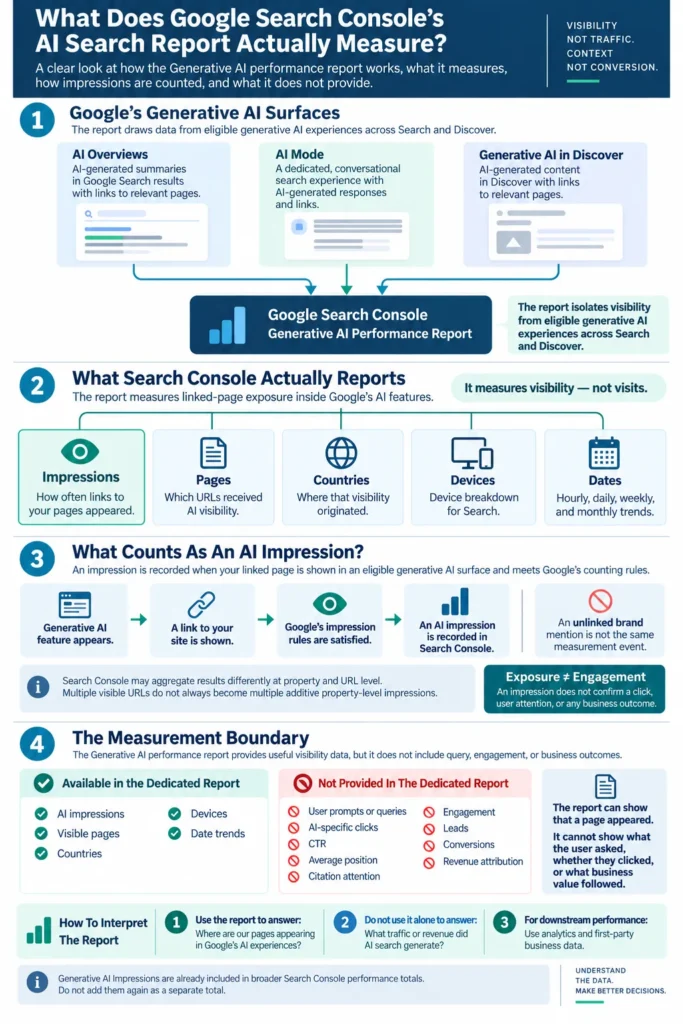
Google Search Console’s AI Search Report measures when URLs from your site appear within eligible generative AI experiences across Search and Discover. Google calls it the Generative AI performance report, but “performance” should not be interpreted as complete acquisition or business-performance reporting. Its core metric is impressions.
Which Google AI Surfaces Are Included?
The reporting covers Google’s generative Search experiences and generative AI features in Discover. That gives marketers a first-party view of where linked pages are appearing inside Google’s own AI interfaces.
- AI Overviews within Google Search results
- AI Mode within Google Search
- Generative AI features appearing in Discover
- Search and Discover reported in separate views
Google’s AI reporting is therefore broader than AI Overviews alone, but the measurement rules are tied to each eligible surface.
Which Metrics And Dimensions Are Available?
Google exposes a relatively focused set of visibility dimensions. “To help you understand how pages from your site are shown, our new reports show the following information: – Impressions: How often URLs from your site appeared in generative AI features in Search and Discover. – Pages: Check which URLs appeared within AI features. – Countries: Understand your visibility on a country basis. – Devices: Identify the devices people are using when seeing your website (available for Search results). – Dates: Monitor your performance over time with hourly, daily, weekly, and monthly granularity” — Google Search Central.
- Impressions for qualifying linked-page appearances
- Pages receiving generative AI visibility
- Country-level visibility patterns
- Device data within Search reporting
- Hourly through monthly date granularity
That is enough to establish where visibility exists and how it changes, but not what happened after the exposure.
What Questions Can The Report Answer?
The report is useful when the question concerns measurable exposure rather than acquisition or commercial results. Teams can identify visible pages, geographic differences, device patterns, and directional changes across time.
- Which URLs receive Google AI visibility?
- Which countries generate the most impressions?
- Which devices show Search visibility?
- Is AI visibility rising or falling?
- Which pages gain visibility over time?
| Shows | Does Not Show |
| Generative AI impressions | AI-specific visits |
| Visible pages | User prompts |
| Countries | Leads |
| Search devices | Revenue |
| Visibility trends | Conversion attribution |
The report becomes misleading only when those visibility answers are treated as answers to questions it was never designed to resolve.
What Counts As An AI Search Impression?
An AI search impression represents a qualifying exposure in which a link to your site is shown within an eligible Google generative feature. It does not necessarily mean a person read the source, noticed the brand, clicked the link, or engaged with the page. Google’s reporting logic defines the event.
When Does A Link Generate An Impression?
“The generative AI performance report includes impressions for the following generative AI capabilities on Google Search: – AI Overviews – AI Mode … Impressions are how many times links to your site were shown to a user in a generative AI feature on Google Search”— Google Search Console Help.
- A qualifying Google AI feature appears
- A link points to your site
- Google’s impression conditions are satisfied
- The event enters AI visibility reporting
That definition is more precise than saying Google “cited your brand,” because a mention without a qualifying link is a different measurement event.
How Are Multiple Links From The Same Site Counted?
Google’s broader Search Console aggregation rules distinguish property-level and URL-level counting, which matters when interpreting AI impression totals. “All results for the same query that point to the same Search Console property are counted once in total. – Impressions: If a property appears twice on a Search results page, it counts as a single impression. … Each unique URL in a Search result is counted separately, even if they point to the same site. – Impressions: Each unique page is counted separately” — Google Search Console Help.
- Property views aggregate qualifying site appearances
- Page views distinguish unique visible URLs
- Multiple URLs can appear from one property
- Aggregation depends on reporting context
That difference matters when comparing property totals with page-level visibility because the two views are answering different counting questions.
Does An Impression Mean The User Saw Your Citation?
No. An impression indicates qualifying exposure under Google’s reporting rules, not verified human attention. A linked source may technically satisfy impression criteria without proving the user consciously noticed, read, trusted, or interacted with it.
- Exposure does not prove visual attention
- Visibility does not prove source recognition
- An impression does not require a click
- Engagement remains outside this metric
This is the first major boundary in interpretation: Google can document exposure without documenting what the person actually did with it.
Is AI Search Data Separate From Your Regular Search Console Data?
The dedicated AI report segments generative visibility that already contributes to broader Search Console performance reporting. It does not create a completely separate pool of impressions that should be added back to standard Search totals. Doing so would overstate total visibility through double-counting.
Where Did AI Data Appear Before The Dedicated Report?
“This data is included in the overall performance report, where it will continue to be tracked to give site owners an overview of the overall visibility of their site in Google Search. Today, we are launching a separate view dedicated to visibility from generative AI features” — Google Search Central.
- AI visibility existed inside broader totals
- Standard reporting already contained the data
- Generative impressions were not separately visible
- Overall Search visibility remained the aggregate layer
The underlying visibility therefore predates the dedicated view even though marketers previously had less ability to isolate it.
What Changed When Google Added The AI Report?
The change is segmentation. Google created a dedicated view so site owners can examine generative AI visibility separately instead of seeing it only inside aggregated Search Console performance data.
- Generative visibility became independently inspectable
- AI pages can be analyzed separately
- Geographic patterns become easier to isolate
- AI visibility trends gain dedicated reporting
That is a substantial measurement improvement, but it should not be mistaken for creation of a new acquisition channel.
How Should Marketing Teams Report The Numbers?
Teams should report AI impressions as a segmented visibility metric while keeping overall Search Console totals intact. The dedicated view explains part of the broader number rather than adding another number to stack on top.
- Report total Google visibility normally
- Break out generative AI visibility separately
- Avoid adding AI impressions twice
- Label segmented metrics clearly
For example, suppose the broader Performance report shows 1,000,000 impressions and the Generative AI report shows 100,000 impressions. Reporting 1,100,000 total impressions would double-count the 100,000 already represented inside the broader figure.
That discipline matters most when AI visibility appears in executive dashboards alongside established organic metrics.
If your operation needs to produce 20–50+ articles per month without sacrificing compliance or quality, Content Ops Lab builds the infrastructure to make that possible. Contact us to discuss your content production requirements.
What Does The AI Search Report Not Measure?
Google Search Console’s AI Search Report does not fully measure user behavior, attribution, or business results. It isolates generative AI visibility, but marketers still need other systems to understand visits, engagement, conversions, and revenue associated with AI-influenced acquisition journeys.
Can You See AI Search Clicks Or CTR?
“Impressions here means a link to your site was shown to someone inside a generative AI feature. It is a visibility signal, nothing more. … It does not show queries, clicks, click-through rate or average position, so it answers ‘am I visible’, not ‘is it earning me anything’” — Sinton Agency.
- AI-specific clicks are not isolated
- CTR is not provided
- Average position is not available
- Impression growth remains visibility growth
Google may measure other user behavior elsewhere, but marketers cannot isolate generative-AI-specific performance in this dedicated report.
Can You Measure Leads, Revenue, Or Conversions?
No. Search Console impressions cannot establish whether AI visibility produced a lead, booking, opportunity, transaction, or revenue event. Those outcomes occur farther downstream and require analytics plus first-party business systems.
- Impressions establish measurable exposure
- Analytics measures on-site behavior
- CRM systems capture commercial progression
- Revenue systems establish realized business value
Even when AI impressions and conversions rise together, correlation alone does not prove that increased visibility caused the commercial result.
Can You See Citation Position Or User Engagement?
The report also lacks meaningful context about how prominently a source appeared inside an AI answer or whether users noticed and interacted with it. That prevents teams from treating every impression as equivalent attention.
- No reliable intra-answer position metric
- No source-attention measurement
- No interaction-depth reporting
- No verified citation engagement signal
| Measurement Layer | AI Report Status |
| Visibility | Available |
| Traffic | Not isolated |
| Engagement | Not available |
| Conversion | Not available |
| Revenue | Not available |
That boundary is why visibility reporting must remain separate from performance reporting even when both eventually feed the same executive dashboard.
Related: How Are AI Search Queries Different From Google Search Queries?
Why Is The Missing Query Dimension Such A Big Limitation?
The missing query or prompt dimension prevents marketers from seeing the information need that triggered an AI impression. Google can show which page appeared, but not the exact question, prompt family, follow-up sequence, or AI Mode reformulation responsible for that visibility.
What Can You Learn From Page-Level AI Visibility?
Page data still provides useful strategic signals. A cluster of pages gaining impressions can reveal where Google increasingly surfaces a site across generative experiences, especially when teams compare those pages over time and across markets.
- Identify high-visibility URLs
- Compare related topic clusters
- Track regional visibility differences
- Monitor gains and losses
- Spot recurring page-level patterns
Those patterns support diagnosis at the content level, but they stop short of revealing the demand expression that produced the exposure.
What Can’t You Learn Without Prompt Data?
“There is no query or prompt dimension, so you can see that a page appeared in AI features but not what the user asked. That is the single largest gap for anyone trying to act on the data, since content decisions start from the question, not the URL” — Elmohq.
- Exact user questions remain unknown
- Prompt families cannot be reconstructed
- Follow-up sequences remain hidden
- AI reformulations are not exposed
- Information needs require outside evidence
Standard GSC query data should not be treated as a clean reconstruction of generative-AI-specific prompting because it measures a different reporting layer.
How Should Teams Handle The Prompt Blind Spot?
The practical answer is triangulation. Teams should combine page-level Google visibility with broader demand research, customer language, AI monitoring, and information-need modeling rather than pretending the page impression contains prompt data it does not provide.
- Analyze conventional query demand
- Collect customer questions
- Monitor AI prompt families
- Map topics to information needs
- Compare cross-platform source visibility
The goal is not to reverse-engineer an unreported prompt; it is to build enough surrounding evidence to understand the demand pattern responsibly.
How Should Marketing Teams Measure AI Search Performance?
Marketing teams should treat Google Search Console as the first-party Google visibility layer inside a multi-system measurement model. Analytics explains downstream behavior, AI monitoring supplies broader prompt and source context, and CRM or first-party systems establish whether those interactions produce commercial value.
Layer 1: Google AI Visibility
GSC answers the narrow but important question of where a site appears across Google’s generative surfaces. That makes it Google’s first-party source for the generative AI visibility layer.
- Track generative AI impressions
- Identify visible pages
- Compare country-level exposure
- Analyze Search device patterns
- Monitor changes across time
That visibility layer establishes presence, but presence alone cannot establish the quality or business value of the resulting audience.
Layer 2: Traffic And AI Visibility Context
Analytics and AI visibility monitoring answer different questions around the GSC data. Analytics shows landing-page behavior, while monitoring systems add prompt, citation, mention, recommendation, competitor, and cross-platform context.
- Measure landing-page sessions
- Compare engagement patterns
- Monitor prompt families
- Track mentions and recommendations
- Compare source visibility across engines
“The new report gives us that separation, but not a complete picture of AI search performance. At the moment, this is primarily an impression report. It tells us that links to our content appeared somewhere within Google’s generative features” — Search Engine Journal.
Layer 3: Business Outcomes
The final layer connects acquisition activity to outcomes the business actually values. Depending on the organization, those may include leads, appointments, qualified opportunities, purchases, contract value, or recurring revenue.
- Connect traffic to lead capture
- Track bookings and qualified opportunities
- Match journeys with CRM records
- Measure revenue where attribution permits
- Compare value across acquisition sources
| Layer | Primary Question | Example Systems |
| Visibility | Where are we appearing? | GSC |
| Behavior / AI Context | What happened around that visibility? | Analytics + AI monitoring |
| Business Outcomes | Did it produce value? | CRM / first-party systems |
You can analyze the layers together, but rising numbers across them should not be interpreted as proof that one metric directly caused another.
How Does Content Ops Lab Approach AI Search Measurement?
Content Ops Lab treats AI search measurement as a connected operating system, not a single dashboard. Visibility metrics matter, but their job is to document exposure. Traffic, engagement, conversion, and revenue remain separate measurement layers because each answers a different business question.
That distinction is visible in our own production data: 21.4% average AI search CVR vs. 3.32% site average (6.4x better). The performance gap shows why downstream measurement matters, but it does not mean Google AI impressions produced those conversions.
The operating model combines content production with measurement discipline:
- Research begins with demand and information needs
- Citations are verified before production
- Optimization spans Google and major AI platforms
- 1,000+ articles and pages delivered
- 23 months of production-system iteration
- Analytics connects visibility with behavioral signals
- First-party data measures commercial outcomes
The goal is to prevent one metric from carrying more meaning than it can support. A Google AI impression belongs in the visibility layer. A session belongs in the traffic layer. A qualified lead or purchase belongs in the business layer.
The Content Ops Lab Production System
The production system follows the same principle of defined responsibilities: each stage has a specific job, while performance measurement remains a separate feedback layer.
- Research: Map demand, questions, and information requirements
- Verification: Confirm evidence, claims, sources, and boundaries
- Optimization: Structure content for search and AI retrieval
- Delivery: Publish systematically and connect performance measurement
Measurement becomes more defensible when each system answers the question it is actually equipped to answer.
Ready to build content infrastructure that scales without the compliance risk? Get in touch — we’ll assess your current content operation and outline what a systematic approach would look like for your organization.
FAQs About Google Search Console’s AI Search Report
Is Google Search Console’s AI Search Report Enough To Measure AI Search Performance?
No. It measures a defined portion of Google AI visibility, but not complete AI search performance. Teams still need analytics for user behavior, AI visibility monitoring for prompt and cross-platform context, and first-party systems for leads, opportunities, conversions, and revenue. Each measurement layer answers a different question.
How Should Marketing Teams Connect GSC AI Impressions To Traffic And Conversions?
Treat GSC impressions as the visibility layer, then compare page-level trends with analytics and first-party business data. Look for directional relationships between visible pages, landing-page behavior, and downstream outcomes without assuming causation. Where attribution is available, CRM and revenue systems should remain the source of record for commercial performance.
What Reporting Mistakes Can Make Google AI Visibility Data Misleading?
The biggest errors are treating impressions as visits, adding generative AI impressions to totals that already contain them, equating linked exposure with verified attention, and presenting correlation as attribution. Teams should also avoid implying that page-level visibility reveals the exact user prompt because the dedicated report does not expose that dimension.
How Is Google Search Console’s AI Reporting Different From Third-Party AI Visibility Tools?
Search Console provides first-party reporting for eligible Google generative surfaces. Third-party tools can supply different context, including monitored prompts, source citations, mentions, recommendations, competitors, and visibility across multiple AI platforms. Those systems can complement Google’s data, but they do not replace Search Console’s first-party Google visibility measurement.
What Should An AI Search Measurement System Include Beyond Search Console?
A complete system should connect four capabilities: first-party Google AI visibility, web analytics, AI visibility monitoring, and first-party commercial data. Together, those layers can answer where the brand appears, what users do afterward, how visibility behaves across AI platforms, and whether resulting acquisition journeys generate measurable business value.
Key Takeaways
- Google Search Console’s AI Search Report measures linked-page visibility within Google generative experiences, not complete traffic, attribution, or business performance.
- Generative AI impressions already contribute to broader Search Console totals, so adding them again creates double-counted visibility.
- The missing query dimension prevents teams from directly connecting visible pages with exact prompts, questions, or information needs.
- Content Ops Lab separates visibility, behavioral context, and commercial outcomes instead of forcing one dashboard to answer every measurement question.
- COL’s AI-originated traffic averaged 21.4% CVR against a 3.32% site baseline, reinforcing the value of downstream measurement.
- Use GSC with analytics, AI monitoring, and first-party business systems to build a defensible AI search measurement model.
What Should You Actually Do With Google Search Console’s AI Search Report?
Google Search Console’s AI Search Report gives marketing teams something they previously lacked: a first-party view of linked-page visibility inside Google’s generative experiences. That makes AI visibility more measurable, but it does not make attribution simple.
Use the report to understand where Google is surfacing your pages, how that visibility changes, and which parts of the site appear most often. Then stop asking the metric to prove what happened next.
Traffic belongs in analytics. Prompt and cross-platform context require additional monitoring. Leads and revenue belong in first-party business systems. Content Ops Lab’s measurement model keeps those layers connected without pretending they are interchangeable.
Related: Google Rankings vs AI Citations – What Is the Difference?