
Google Rankings vs AI Citations: What Is the Difference?
The difference between Google rankings and AI citations comes down to two visibility outcomes: a page’s position in an ordered results list, and a reference used to support part of a generated answer. Google’s automated ranking systems evaluate many factors and signals across hundreds of billions of pages to produce that ordered list. (Google Search Central) An AI citation works differently — it identifies the specific passage an AI system pulled from to ground one statement, not a ranked list of destinations.
Marketing teams that treat the two as interchangeable end up optimizing for visibility they can measure while missing visibility they can’t. Content Ops Lab builds content infrastructure that competes for both outcomes at once, using a documented 6.4× conversion difference in AI-referred traffic as one proof point of what that infrastructure produces.
Related: How Do You Get Cited by ChatGPT?
What Is the Difference Between a Google Ranking and an AI Citation?
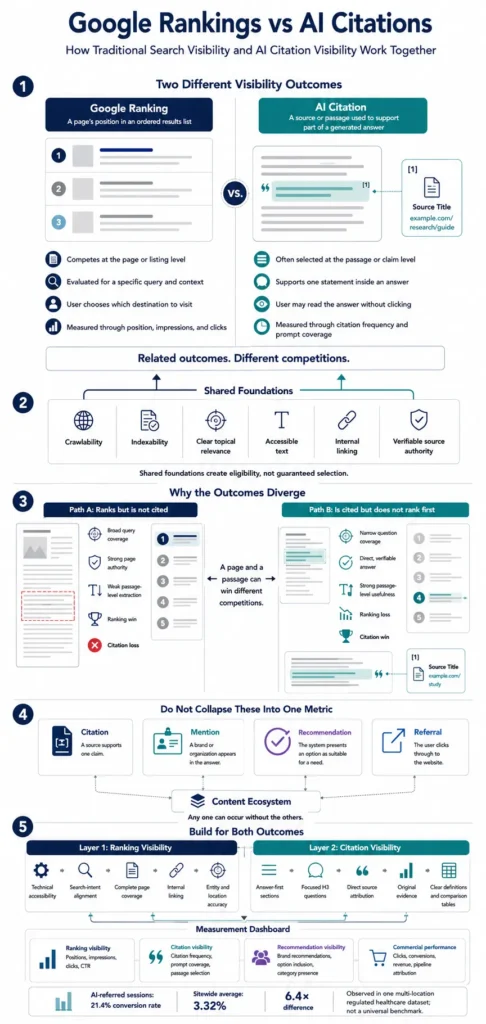
A Google ranking is the position a page occupies for a specific query; an AI citation is a source reference attached to part of a generated answer. Set against each other, Google rankings vs AI citations are related outcomes, produced by different systems, and won through different competition.
What Does a Google Ranking Represent?
A Google ranking represents a page’s position within an ordered set of results for a specific query and user context. It is the output of crawling, indexing, and ranking — three sequential stages a page must clear before it appears at all. (Google Search Central)
- Position within a single ordered list
- Google primarily ranks pages or listings, though its systems can also evaluate individual passages for relevance
- Produced by automated ranking systems, not manual selection
- Users choose among ranked destinations themselves
- Standardized measurement through position, impressions, and CTR
A ranking tells a user which destinations to consider next — it doesn’t tell them what any of those pages actually say.
What Does an AI Citation Represent?
An AI citation identifies a specific source or passage that an AI system used to support a claim inside a generated answer. Citations return the exact passages behind each claim, which lets a user verify the answer rather than search further. (Anthropic)
- A reference tied to one claim, not a whole page
- Citation selection often occurs at the passage, claim, or source level
- Selected by generative retrieval, not ranked by position
- Users read the synthesized answer; citation optional to click
- Measurement is directional, not standardized across platforms
Neither outcome is an unconditional endorsement — a ranking reflects algorithmic visibility, and a citation reflects evidence selection for one statement.
| Dimension | Google Ranking | AI Citation |
| Primary outcome | Ordered position in results | Supporting reference in a generated answer |
| Unit of competition | Full page or listing | Passage, claim, or statistic |
| User experience | User selects from ranked options | User reads a synthesized answer |
| Source role | Destination to visit | Evidence to verify a claim |
| Measurement | Position, impressions, CTR | Citation frequency, prompt coverage |
| Commercial meaning | Implied relevance to query | Implied evidentiary support, not endorsement |
How Do Google Rankings and AI Citations Overlap?
Rankings and AI citations share technical and editorial foundations — crawlability, topical relevance, and source authority — but shared foundations do not make the two systems interchangeable.
Which Foundations Support Both Outcomes?
Both systems depend on content that is discoverable, accessible, relevant, and trustworthy before either ranking or citation can occur. A page that fails basic technical requirements is invisible to both systems simultaneously.
- Crawlability and indexability across the domain
- Textual accessibility without rendering barriers
- Internal linking that signals topical relationships
- Clear topical relevance to the query or prompt
- Source authority built through consistent, verifiable publishing
- Original, helpful information beyond generic summary
- Structured data that matches visible on-page content
- Sections that directly answer identifiable questions
To be eligible for a supporting link in AI Overviews or AI Mode, a page must already be indexed and eligible to appear in standard Google Search results. (Google Search Central)
Does Ranking Well Increase Citation Potential?
Ranking strength can improve citation potential in systems tied closely to live search retrieval, but this relationship is conditional, not universal, and varies by platform.
- Google AI Overviews and AI Mode: May issue several related searches across subtopics to construct one response, drawing directly from search-connected retrieval (Google Search Central)
- Perplexity: Retrieval appears to draw partly on live search results, alongside its own source-selection process
- ChatGPT, Claude, Gemini: Publicly available detail on retrieval behavior is limited, and the degree of connection to any single search index is not something businesses can verify directly
Strong rankings and shared authority signals may improve citation potential, particularly in search-connected systems, but citation selection still varies by platform and prompt.
Shared foundations explain why rankings and citations correlate at all — they don’t explain the cases where one appears without the other, which is where operational planning gets harder.
Why Can a Page Rank Without Being Cited?
A page can satisfy the broad intent behind a Google query without containing the narrow passage an AI system needs to support one specific generated statement.
Why Does Query Specificity Matter?
Ranking systems evaluate whether a page is a useful candidate for a query in general. Generative retrieval evaluates whether one section of that page answers a much narrower conversational question.
- Page targets a broad keyword, not the exact phrasing of a prompt
- The page mixes several intents without one concise answer unit
- A primary source addresses the specific question more directly than a broad page can
- Broad ranking intent and a narrow conversational question are simply different targets
A study of the ranking-citation relationship found that Perplexity’s citation set showed only partial overlap with Google’s own rankings for the same queries. (Search Engine Journal)
What Makes a Ranking Page Difficult to Cite?
A page built for broad search intent often lacks the concise, attributable passage that generative retrieval selects for.
- The answer exists but sits buried inside long, diffuse copy
- Claims read as generic, promotional, or weakly sourced
- Relevant information is hard to extract or independently verify
- Page authority carries it, but it offers no distinctive data point
Consider two pages targeting the same topic: one is a 3,000-word pillar page that ranks first for a broad head term but buries its key statistic in paragraph fourteen. The other is a narrower page that opens with a direct, sourced definition in the first sentence. The first may be better positioned to earn the click, while the second may be easier for an AI system to cite. These operational patterns reflect observed behavior rather than a formula every AI platform applies identically.
If broad ranking pages routinely lose citation competition to narrower passages, the reverse question follows naturally: can a page earn a citation without ranking well at all?
If your operation needs to produce 20–50+ articles per month without sacrificing compliance or quality, Content Ops Lab builds the infrastructure to make that possible. Contact us today to discuss your content production requirements.
Why Can a Page Be Cited Without Ranking First?
Citation selection can reward a single passage’s usefulness even when the page holding that passage does not occupy a top organic position for the same query.
What Makes a Passage Citation-Ready?
A citation-ready passage answers a precise prompt directly, without requiring the reader to infer the point from surrounding context.
- Provides a direct answer to a specific, narrow prompt
- Contains original research or first-party data
- Cites primary-source documentation rather than secondhand summary
- Attributes a statistic clearly to its origin
- States a concise, unambiguous definition
- Offers current information for a freshness-sensitive question
- Demonstrates specialized expertise over broad commercial framing
- Sits on a domain the platform’s retrieval system actually covers
One dataset found that only 12% of AI-cited URLs ranked in Google’s top ten for the matching query. (Ahrefs)
Why Do Platforms Select Different Sources?
A lower-ranking page may hold the strongest support for one sentence inside a generated answer. In contrast, a top-ranking page remains the stronger destination for the broader task the user is actually trying to complete.
Page-level competition vs. passage-level competition:
- Google evaluates and ranks the page as a whole result; it doesn’t require every page to cover a topic comprehensively to rank well
- An AI system, by contrast, may select a single narrow passage as supporting evidence regardless of how the rest of the page performs
- A page can lose the ranking competition and still win the citation
This 12% figure reflects one study’s dataset and methodology rather than a universal citation rate that holds across every platform or query type.
Passage-level competition explains why citation and rank diverge — but citation, mention, recommendation, and referral are frequently treated as one outcome when they are, in fact, four separate ones.
Is an AI Citation the Same as a Recommendation?
Citations, mentions, recommendations, and referrals are four distinct outcomes, and a business can receive any one of them without the other three following automatically.
What Are Citations, Mentions, Recommendations, and Referrals?
- Citation: A source supports one claim inside a generated answer
- Mention: A brand, person, product, or organization appears in the answer text
- Recommendation: The system presents an option as suitable for the user’s stated need
- Referral: The user clicks from the AI platform through to the source website
A citation returns the exact passage behind a claim so a user can verify it — that verification function is distinct from endorsement. (Anthropic) Citations, mentions, recommendations, and referrals are four independent visibility outcomes: a business may receive any one of them without the others — a business can be cited without ever being recommended, and recommended without its own page ever being cited.
What Additional Signals Affect Local Recommendations?
For local and multi-location businesses, recommendation prompts depend on factors well beyond content quality alone.
- Geographic relevance to the user’s stated location
- Accurate, current business information across listings
- Confirmed service availability at the specific location
- Review volume, recency, and sentiment
- Provider credentials and licensing status
- Published hours and location-level reputation
- Third-party corroboration across independent sources
A healthcare practice could be cited for an educational explanation without being recommended as a provider. A business could just as easily be recommended through listings, reviews, and proximity data without its own educational page ever being cited — being cited means the source was used to support part of an answer, not that the platform recommends or endorses the business.
Separating these four outcomes only matters operationally if a business also knows what to measure — and what to keep doing — for each one.
Related: How Does AI Brand Authority Affect Search Visibility?
How Should Businesses Optimize and Measure Both Outcomes?
Optimizing for Google rankings vs. AI citations means running two connected efforts side by side—one that sustains the systems businesses already rely on, and one that adds what generative retrieval specifically rewards.
What Should Businesses Continue Doing for Google Rankings?
- Maintain technical accessibility across the full site
- Confirm indexation status on every priority page
- Align page content tightly with search intent
- Build useful, non-duplicative page-level coverage
- Strengthen internal linking between related topics
- Establish source credibility through consistent publishing
- Clarify author and entity signals sitewide
- Keep local page information accurate and current
- Maintain structured data that matches visible content
- Track organic conversion by page, not just by session
What Should Businesses Add for AI Citation Visibility?
- Write answer-first explanations at the top of sections
- Build focused, passage-level sections around single claims
- Use descriptive H3s that state the question being answered
- Attribute claims directly to a named, verifiable source
- Include original data or proprietary observations
- Cite primary sources instead of secondhand aggregation
- Add clear definitions and comparison tables
- Keep factual information current and dated
- Maintain consistent brand, provider, service, and location entities
- Answer the follow-up and long-tail questions readers actually ask
Which Metrics Belong in Each Measurement Layer?
- Ranking visibility — position, impressions, CTR, organic sessions, local pack presence
- Citation visibility — citation frequency, citation share, prompt coverage, cited passages, cross-platform visibility
- Recommendation visibility — recommendation presence, brand and location inclusion, comparison-set frequency, sentiment language
- Commercial performance — AI referral sessions, engagement, leads, conversion rate, revenue or appointment value
Google’s AI Overviews now appear in a growing share of queries. One industry dataset found impressions rising sharply on affected content. At the same time, click-through rates declined over the same period. (BrightEdge) Google ranking metrics remain comparatively standardized, while AI citation and recommendation tracking stay directional — results vary by platform, prompt, location, time, and repeated execution. Search Console folds AI Overview traffic into overall Web search reporting, but it does not provide a complete cross-platform citation reporting system.
What no longer works:
- Reporting rank position alone as the full visibility picture
- Publishing broad, unsourced content and hoping it gets cited
- Applying generic “AI optimization” checklists across every platform
How Content Ops Lab Builds for Rankings and Citations
Content Ops Lab treats ranking visibility and citation visibility as related requirements inside one production system, not two separate initiatives run by two separate teams. Where the previous section outlined what businesses should do, this section covers how Content Ops Lab operationalizes Google rankings vs AI citations inside a single production workflow.
- Verified source documentation required before drafting begins
- A defined editorial assignment sequence rather than freeform writing
- Multi-stage review checking both structure and factual accuracy
- Cross-platform measurement built into delivery, not added afterward
The Content Ops Lab Production System
- Research: Source verified evidence before any drafting begins
- Verification: Confirm every claim traces to a documented source
- Optimization: Structure passages for both ranking and citation retrieval
- Delivery: Publish with citation formatting ready for extraction
For a 12-location regulated healthcare client, AI-referred sessions converted at a 21.4% average rate over an eight-month measurement period, compared with a 3.32% sitewide average — a 6.4× difference. This is the practical stakes behind Google rankings vs AI citations: AI-referred visitors can carry meaningful commercial value once they reach the site, but that doesn’t mean citation visibility alone caused the higher rate. Not every visitor arrived through a visible citation, and the conversion difference will not automatically apply to every brand.
That production model raises the questions most marketing teams ask next about combining rank and citation strategy.
Ready to build content infrastructure that scales without the compliance risk? Get in touch today — we’ll assess your current content operation and outline what a systematic approach would look like for your organization.
Frequently Asked Questions
If my pages already rank well in Google, do I need to optimize for AI citations?
Yes. High Google rankings do not automatically produce AI citations — the two systems select at different levels. Strong rankings and shared authority signals may improve citation potential in search-connected systems. However, citation selection still depends on passage-level clarity, direct attribution, and platform-specific retrieval behavior that ranking alone does not guarantee.
Should businesses track AI citations separately from Google rankings?
Yes. Ranking metrics like position and CTR are standardized and comparable across time. AI citation and recommendation metrics remain directional because results vary by platform, prompt, location, and repeated execution. Search Console reports AI Overview traffic within Web search totals but does not provide complete cross-platform citation reporting.
Can an AI citation still misrepresent or inaccurately support a claim?
Yes. A citation indicates that a source was used to support part of a generated answer — it does not guarantee the claim is accurate or that the platform verified it independently. Recommendation and endorsement are separate outcomes from citation, and a cited source can still be misapplied to a broader claim than it actually supports.
Is it more valuable to rank first in Google or be cited by an AI platform?
Neither consistently outranks the other in value — they serve different functions. A top Google ranking wins clicks and destination traffic. An AI citation wins evidentiary support inside a synthesized answer, sometimes without a click at all. Businesses need both, measured separately, rather than treating one as a proxy for the other.
Can Content Ops Lab build a system that targets both rankings and AI citations?
Yes. Content Ops Lab’s production system treats page-level SEO and passage-level citation readiness as one integrated workflow — research, verification, optimization, and delivery — rather than two separate content tracks, with cross-platform measurement built into every article’s reporting layer.
Key Takeaways
- Google rankings and AI citations are related but distinct visibility outcomes, produced by different systems
- A ranking competes at the page level; a citation competes at the passage or claim level
- Shared technical foundations improve citation potential but do not guarantee it, even for top-ranked pages
- Citations, mentions, recommendations, and referrals are four separate outcomes worth measuring separately
- A 12-location regulated healthcare client saw AI-referred traffic convert at 21.4% versus a 3.32% sitewide average, a 6.4× difference
- Businesses need one content system built to compete for both rankings and citations, since rank-only reporting no longer captures the full visibility picture
The Bottom Line on Google Rankings vs AI Citations
Google rankings vs AI citations isn’t a choice between two competing systems — it’s two forms of visibility that share foundations but don’t substitute for each other. Businesses that measure only rank position are already missing half the picture generative search now produces. (Anthropic) Content Ops Lab’s production system is built to compete for both at once.
Related: Which AI Trust Signals Influence Brand Recommendations?