

How Do You Scale Content Across Multiple Locations Without Losing Quality?
You scale content across multiple locations without losing quality by standardizing the production system, not the substance of every page. Google evaluates scaled content based on whether pages help users, not on whether templates, automation, or AI were involved in producing them — Google Search Central.
Most multi-location brands lose quality because ownership, data freshness, and review capacity never scale alongside publishing volume—not because more pages inherently mean worse pages.
Related: What Are Multi-Location Content Systems?
Why Does Multi-Location Content Quality Decline as Volume Increases?
Quality declines when the number of pages, markets, and contributors outpaces the systems governing them, not because publishing volume itself is the problem. Brands that try to scale content across multiple locations without addressing that gap first are the ones that see drift. The real failure is publishing without value, accuracy, or governance behind it.
How Does Content Drift Begin?
Content drift starts small and compounds silently across dozens of location pages before anyone notices the pattern.
- Ownership of location data becomes unclear across teams
- Outdated hours, pricing, or service details persist unnoticed
- Conflicting documents give writers different “facts”
- Duplication creeps in as deadlines compress
- Review capacity stays flat while page count climbs
- Local teams operate from different, unversioned standards
Each of these gaps widens further once the next location launch adds new pages to an already ungoverned system.
When Does Standardization Become Scaled Content Abuse?
Standardization becomes risky when pages are produced primarily to manipulate rankings rather than help users. Google’s own spam policy draws that line directly: “Scaled content abuse is when many pages are generated for the primary purpose of manipulating search rankings and not helping users” — Google Search Central.
“Scale” vs. “scaled content abuse”:
- Scale: consistent structure, verified facts, genuine local usefulness
- Abuse: identical substance, decorative city swaps, no real user value
- The dividing line is user value, not page count or automation
Consistent structure protects quality; it’s duplicated substance that puts a multi-location program at risk.
What Should Be Centralized and What Must Stay Local?
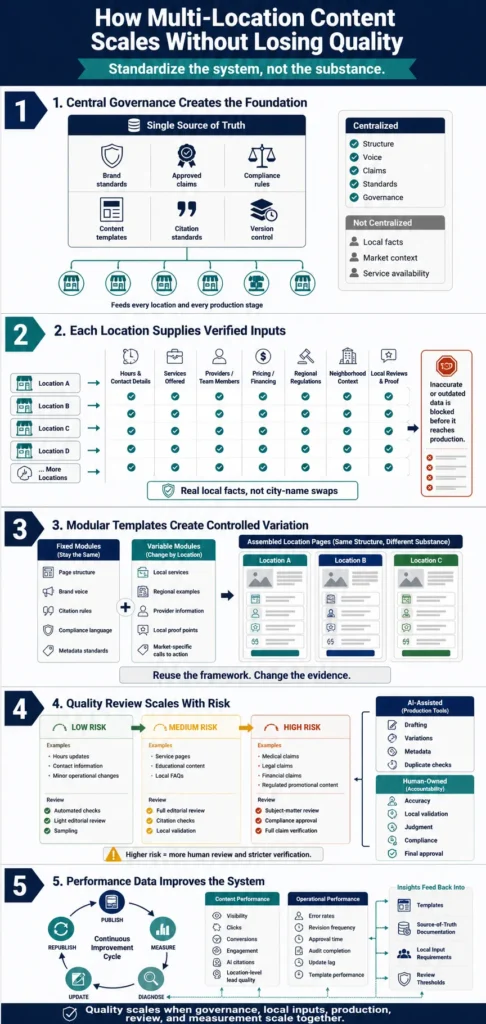
A multi-location content system works when central teams govern standards and reusable structure while local owners verify the facts that genuinely differ by market. Getting this division right is the foundation for any brand trying to scale content across multiple locations without generic pages or brand drift.
Which Content Elements Belong in the Central System?
Central governance protects brand consistency and legal exposure across every location a company operates.
| Centralized | Localized |
| Brand positioning and voice | Hours, address, phone (NAP) |
| Approved claims library | Services actually offered |
| Compliance and regulatory rules | Pricing and financing terms |
| Content templates and modules | Providers or team members |
| Citation and sourcing standards | Regional regulations |
| Metadata and structured data rules | Neighborhoods and trade-area context |
| Content inventory and version control | Reviews and local proof points |
A single governed repository is what makes this division workable. “A single source of truth is a central repository where all team members can find the most accurate and up-to-date information about a project or process” — Atlassian.
Which Inputs Require Location-Level Verification?
Local relevance depends on facts that affect a reader’s decision, not on inserting a city name into otherwise identical copy.
- Assign a named owner for hours, NAP, and services per location
- Trigger updates when staffing, pricing, or regulations change
- Verify provider credentials and local proof before publishing
- Confirm service availability against current operational status
- Refresh regional rules whenever compliance guidance updates
Owners without update triggers still let stale data sit unnoticed for months at a time.
How Do Modular Templates Create Consistency Without Duplication?
Controlled variation keeps architecture, evidence standards, and voice consistent while facts, examples, and services change wherever local conditions justify it. Templates function as quality controls, not paragraph generators.
What Should Every Template Control?
A template’s job is to guarantee completeness and evidence quality, not to dictate identical sentences across every location.
- Required fields for services, credentials, and local proof
- Evidence and citation standards for every claim made
- Voice, structure, and metadata requirements
- Compliance checkpoints tied to content category
Where Should the Template Permit Variation?
Variation belongs wherever facts genuinely differ, and nowhere else.
- Local examples, proof points, and testimonials
- Service emphasis based on market demand
- Calls to action tied to regional offers
- Supporting statistics relevant to that trade area
Bad vs. good local variation: Swapping only the city name across identical paragraphs is decorative and adds no value. A verified local module — real provider names, current service availability, a location-specific proof point — is what modular templates are built to deliver. Structured content supports exactly this kind of controlled reuse: “Structured content treats information as a ‘source of truth’ that exists independently of its final format” — NetEffect.
Reuse done well doesn’t just protect consistency; reported localization work has also shown measurable efficiency gains, as one company-reported case study noted: “we’ve reduced our linguist translation efforts by 31% and improved the quality of our machine translation by over 100%” — Adobe. Treat that figure as a single company’s reported outcome, not a universal benchmark for multi-location content.
Complete uniqueness was never the objective — usefulness, accuracy, and appropriate local context are.
Content Ops Lab builds the infrastructure to scale content across multiple locations without sacrificing compliance or quality. Contact us to discuss your content production requirements.
How Does Content Ops Lab Build Multi-Location Quality Into the System?
Content Ops Lab runs this framework as a production-tested operating model, not a theoretical one. The system separates institutional knowledge, editorial strategy, production execution, and final QA within a single governed source-of-truth architecture, with each layer accountable for a distinct part of the production cycle.
- Increased production for a 12-location regulated healthcare client from roughly 10 to 50+ articles monthly
- Delivered more than 1,000 citation-verified articles and pages across 23 months
- Maintained zero reported compliance issues throughout that production run
- Ran research, editorial strategy, writing, verification, and QA as coordinated layers, not one undifferentiated step
- Applied risk-tiered review rather than identical scrutiny across every asset
- Kept a single governed repository for standards, claims, and location data throughout
How Do Coordinated Production Layers Prevent Drift?
Separating knowledge, assignment, production, and QA into distinct layers keeps errors from compounding silently across a growing library of location pages. In this model, research and editorial strategy define the assignment before a single word is drafted; production executes against approved evidence and templates; and QA verifies compliance, accuracy, and structure before anything publishes. No single layer absorbs decisions that belong to another, which is what kept a 12-location regulated healthcare client’s compliance record intact through a five-fold increase in volume.
When Should a Business Build the System or Use a Managed Service?
Building in-house makes sense when a company already has dedicated editorial, compliance, and production staff with time to maintain governance discipline. A managed content operations partner makes sense when volume is scaling faster than internal capacity to build and maintain that same governance layer.
Results from this case reflect that specific regulated environment; they establish what a governed system supported there, not a guaranteed outcome for every organization.
Ready to scale content across multiple locations without the compliance risk? Get in touch — we’ll assess your current content operation and outline what a systematic approach would look like for your organization.
How Should AI Be Used in a Multi-Location Content System?
AI functions as an acceleration layer that operates from approved templates, citation inputs, and explicit local data — never as an independent source of judgment. Used this way, AI helps teams scale content across multiple locations faster without shifting accountability away from humans, who remain responsible for factual accuracy, local validation, and final approval.
Which Tasks Can AI Accelerate Safely?
| AI-Assisted | Human-Owned |
| Research assistance and first drafts | Factual accuracy verification |
| Structured content variants | Local data validation |
| Metadata suggestions | Editorial judgment and thesis |
| Duplicate comparison checks | Compliance and risk assessment |
| Internal-link recommendations | Final publication approval |
| Localization checks | Claim risk sign-off |
Which Decisions Still Require Human Ownership?
The risk in AI-assisted production comes from ungoverned output and missing value, not from AI’s presence in the workflow.
- Confirming every claim against approved evidence
- Validating location-specific facts before publication
- Judging whether local differentiation is genuine
- Approving anything touching regulated claims
Unedited, uncurated automation is exactly what search quality guidelines flag as the failure mode: “Pages and websites made up of auto-generated content with no editing or manual curation, and no original content or value added for users, should be rated Lowest.” — Google Search Quality Evaluator Guidelines.
The same guidance applies directly to multi-location production: “Using generative AI tools or other similar tools to generate many pages without adding value for users may violate Google’s spam policy on scaled content abuse.” — Google Search Central.
Manual content can be just as thin, duplicated, or inaccurate as poorly governed AI output — the governance layer is what determines quality either way.
Related: How to Build a Scalable Content Production Workflow
Which Quality Gates Keep the System Accurate as It Grows?
Quality assurance has to run across the full production lifecycle, not just as a final check before publishing. Review depth should scale with risk, not with reviewer headcount alone.
Which Checks Belong Before Publication?
- Confirm topic eligibility, service availability, and risk level
- Verify location inputs and source documentation are current
- Check template compliance and citation support during drafting
- Validate claims, NAP, links, metadata, and structured data before it goes live
How Should Review Depth Change by Risk?
| Risk Tier | Example Content | Review Depth |
| Low | Hours updates, minor NAP edits | Sampled, light-touch review |
| Medium | Service pages, general FAQs | Standard editorial review |
| High | Medical, legal, financial claims | Full compliance review |
What Must Be Audited After Publication?
Publishing is not the end of the quality process — drift accumulates quietly without recurring audits.
- Factual drift against the current source of truth
- Content decay in rankings or engagement
- Operational changes affecting accuracy
- Indexation problems and broken components
Governance is a habit, not a document: “Content drift is not a document you write once. It is a system you run. The plan is only as good as the habit behind it” — Storywebs.
More reviewers alone never fixes a quality problem — review depth has to match the risk, novelty, and stability of what’s being reviewed.
How Does Performance Data Improve the Content System?
A well-governed system stays adaptive after publication by tracking both content performance and operational performance, then feeding both back into templates and workflows.
Which Metrics Reveal Content Quality Problems?
Content performance metrics:
- Impressions, clicks, and conversions by location
- Engagement and local search visibility
- AI citation visibility across engines
- Lead quality by market and page type
Operational performance metrics:
- Revision rates and factual error frequency
- Approval time and audit completion rates
- Source-of-truth update lag
- Template-level performance across locations
How Should Feedback Change Templates and Workflows?
The feedback loop runs continuously: Publish → Measure → Diagnose → Update → Republish. Findings from that loop should revise templates, add missing local fields, adjust review thresholds, and improve source documentation over time.
Governed multi-location systems that pair central standards with localized execution and shared reporting have shown measurable gains in industry-reported cases: “Lead volume lift +41%… Cost per lead reduction -38%… Average unit revenue lift +34%… Time to full brand compliance rollout 90 days” — RogoLook. These results belong to that specific franchise case study; correlation between a workflow change and performance doesn’t prove the workflow alone caused the result.
Deeper review or heavier automation should go wherever the data shows the greatest risk or the greatest opportunity, not evenly across every market by default.
Frequently Asked Questions
Do Location Pages Need Completely Unique Content to Avoid Duplication?
No. Brands can scale content across multiple locations without every page being fully unique — location pages need sufficient factual differentiation and genuine local usefulness, not completely unique structure or wording. Google’s scaled content policy targets pages built to manipulate rankings without helping users, not the reuse of approved templates. Consistent architecture, approved claims, and recurring modules can remain the same across locations as long as the facts and local proof are accurate and verified.
What Should a Multi-Location Company Standardize First?
Standardize the central source of truth before anything else: brand standards, approved claims, compliance rules, and templates. Without one governed repository, teams work from conflicting documents and content drift begins immediately. Once that foundation exists, modular templates and risk-tiered review can scale safely alongside rising publication volume.
How Should Regulated Businesses Review Content Across Multiple Locations?
Apply risk-tiered review rather than identical scrutiny for every asset. Low-risk operational updates can move through sampled, lighter review, while medical, legal, or financial claims require full compliance sign-off before publication. This keeps review capacity proportional to actual risk instead of bottlenecking the entire system.
Is Centralized Content Production Better Than Letting Each Location Write Its Own Content?
Neither model alone is inherently better. Central teams should govern strategy, standards, systems, and reusable content, while reliable local owners validate facts and supply market-specific inputs. Fully decentralized production tends to fragment brand voice; fully centralized production without local verification tends to produce generic pages.
Should a Company Build Its Own Content System or Use a Managed Content Operations Partner?
Building in-house works when dedicated editorial, compliance, and production staff already have capacity to maintain governance discipline. A managed partner works when publishing volume is outgrowing internal capacity to build and sustain that same system. Both paths can maintain quality if the governance layer — not just the writing — scales with volume.
Key Takeaways
- Standardize the production system, not the substance of every location page
- A single source of truth with named owners prevents content drift before it starts
- Modular templates encode evidence and fields, not identical paragraphs
- Risk-tiered review scales quality assurance alongside publishing volume
- A 12-location regulated healthcare client scaled to 50+ articles monthly with zero reported compliance issues
- Performance and operational metrics should continuously reshape templates and review gates
- Brands ready to scale content across multiple locations should audit governance capacity before adding volume
The Real Cost of Scaling Content Across Multiple Locations Without Governance
Multi-location brands don’t lose quality because they publish more pages — they lose it when ownership, verified local data, and review capacity fail to scale alongside volume. The governance layer, not the page count, determines whether growth stays safe. A 12-location regulated healthcare client proved this at scale, growing from roughly 10 to more than 50 articles per month across 23 months with zero reported compliance issues.
Waiting for a quality problem to force the issue costs more than building the system now: assign information owners, verify local inputs, and tier review by risk before the next location launch adds pressure to an already strained process.
Content Ops Lab builds and manages the governed production systems that let multi-location brands increase output without giving up accuracy, consistency, or compliance.