
What Does NAP Consistency for AI Visibility Actually Do?
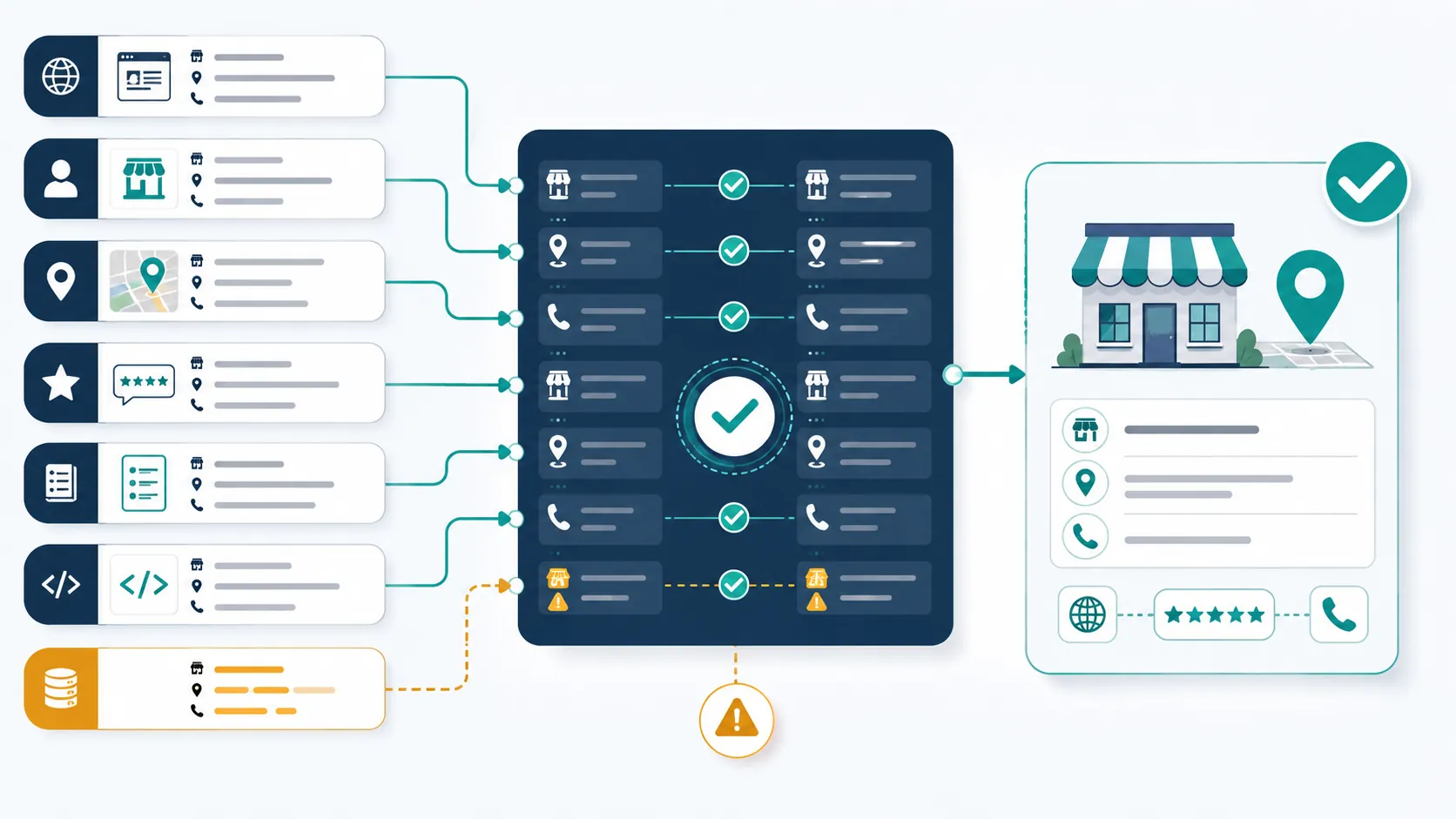
NAP consistency for AI visibility helps search engines, maps, directories, and AI systems confirm that separate records describe the same real-world business location. “NAP” — name, address, and primary phone number — is not currently a confirmed standalone ranking factor for Google AI Overviews, AI Mode, ChatGPT, Perplexity, Claude, or Gemini. According to Google’s own guidance, businesses should “represent your business as it’s consistently represented and recognized in the real world across signage, stationery, and other branding” — Google.
Most marketing teams treat NAP work as a one-time directory cleanup, then move on — while the underlying records drift out of alignment as locations open, close, rebrand, or change phone systems. Content Ops Lab builds governed, multi-location content infrastructure where NAP verification runs as a standing checkpoint rather than a project with an end date.
Related: Which AI Trust Signals Influence Brand Recommendations?
What Does NAP Consistency Mean?
NAP consistency means the underlying facts about a business location agree across every platform that references it — not that the formatting is identical everywhere it appears. A business name, address, and phone number can look slightly different from one directory to the next and still describe the same verified location without confusion.
The distinction that matters is factual alignment versus visual uniformity. “Street” versus “St.,” dash-formatted versus parenthetical phone numbers, and platform-default capitalization are stylistic variations, not identity problems, as long as the underlying facts stay the same across every source.
Which Business Records Should Agree?
The records that matter most for NAP consistency include:
- The website’s homepage and footer
- Location and contact pages
- Structured data (schema markup)
- Google Business Profile listings
- Major map services and navigation apps
- Review platforms like Yelp and industry-specific sites
- Industry directories and licensing boards
- Authoritative organizational or association records
Does NAP Have to Match Character for Character?
No — NAP does not need to match character for character to support strong location identity. What matters is whether a user or a system can reliably identify the same physical location from the available information, regardless of minor formatting differences between sources.
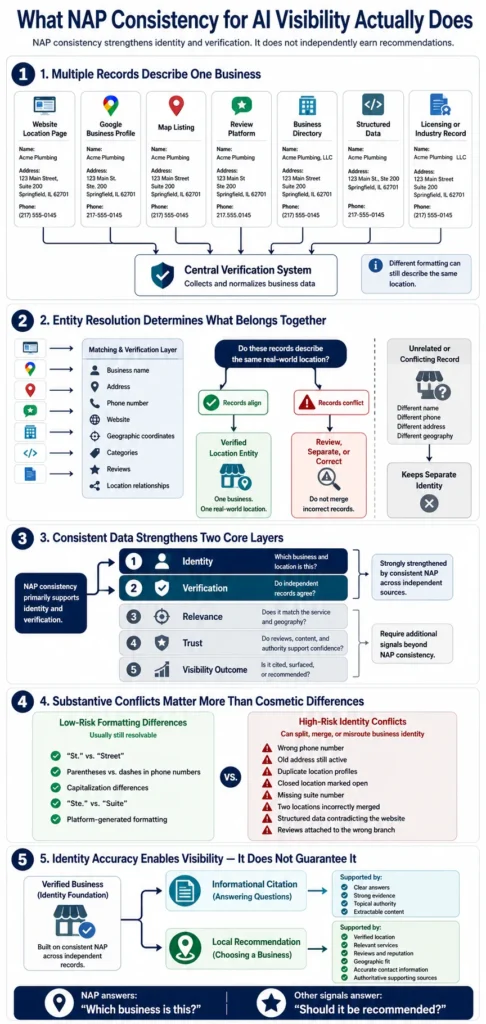
| Usually Harmless Formatting Differences | Substantive Identity Conflicts |
| “St.” vs. “Street” | Old address still listed as active |
| Parentheses vs. dashes in phone numbers | Wrong phone number assigned to a location |
| Minor capitalization differences | Two active profiles for one location |
| Suite abbreviated as “Ste.” vs. “Suite” | Missing suite number in a shared building |
| Platform-generated formatting defaults | Structured data contradicting visible content |
Substantive contradictions create confusion; cosmetic formatting differences generally do not. That distinction anchors every layer of NAP consistency for AI visibility discussed below.
How Does NAP Consistency Help AI Systems Identify a Business?
NAP consistency for AI visibility helps AI systems perform entity resolution — the process of confirming that records from different sources describe the same real-world business rather than a competitor, a different branch, or an unrelated entity. Search engines, maps, directories, and AI assistants each encounter overlapping records and must decide which ones belong together before they can act on any of them.
Entity resolution is a well-established concept outside of local search. As Senzing explains, “entity resolution (ER) is the process of determining when different data records refer to the same real-world entity — such as a person, organization, or product — and when they don’t” — Senzing. Applied to local business, that means matching a website, a review profile, a phone number, and an address to one confirmed location before any downstream signal — reviews, relevance, or authority — can attach to it correctly. Modern entity-resolution systems can also reconcile some incomplete or inconsistent records when the underlying identity signals remain strong.
A five-layer framework clarifies where NAP consistency fits into the larger visibility picture:
- Identity: Which business, and which specific location, is being referenced
- Verification: Whether independent records corroborate that same identity
- Relevance: Whether the location matches the query’s service and geography
- Trust: Whether reviews, content, and authority support confidence in the result
- Visibility outcome: Whether the business is ultimately cited, surfaced, or recommended
NAP consistency operates primarily in the first two layers — identity and verification — not the later layers that determine whether a business gets recommended.
How Does Consistent Data Reduce Entity Confusion?
- Prevents duplicate profiles from splitting reviews across two listings
- Reduces the chance of merging two distinct locations into one record
- Helps systems attach the correct phone number to a recommendation
- Keeps practitioner and department records properly separated
NAP is one input among several that entity resolution systems weigh — never the only one a system relies on.
Which NAP Inconsistencies Actually Create Problems?
Not every inconsistency carries the same risk. The inconsistencies worth prioritizing are the ones capable of misleading a system or a user about which business is active, where it operates, or how to reach it — not the ones that only affect visual formatting.
Google’s own location guidance sets a clear factual bar: “use a precise, accurate address and/or service area to describe your business location. P.O. boxes or mailboxes located at remote locations aren’t acceptable” — Google.
Google applies a similar standard to phone and website accuracy: “provide a phone number that connects to your individual business location, or provide a website that represents your individual business location” — Google.
Which Errors Create Identity Conflicts?
- Old and new addresses listed as active simultaneously
- Wrong phone number attached to a location
- One phone number reused ambiguously across locations
- Duplicate active profiles for a single location
- Separate locations incorrectly merged into one record
- Missing suite numbers inside multi-tenant buildings
- Closed locations still marked open
- Location pages linked to the wrong Business Profile
- Practitioner, department, and parent-brand records blended
- Structured data that contradicts visible website content
Which Formatting Differences Are Usually Harmless?
- Standard abbreviations for street types
- Platform-generated punctuation in phone numbers
- Parentheses or dashes around area codes
- Capitalization differences with no factual impact
| High-Severity Conflicts | Low-Severity Differences |
| Duplicate active location profiles | Abbreviation variations (“St.” vs. “Street”) |
| Closed location marked as open | Platform-default phone punctuation |
| Wrong phone routed to a location | Minor capitalization differences |
| Structured data contradicting page content | Suite formatted as “Ste.” vs. “Suite” |
Modern entity-resolution systems handle natural variation well; the real risk emerges when several fields — address, phone, and profile status — contradict one another at once. Even robust systems can only reconcile so much before conflicting records erode confidence in the underlying identity.
If your operation needs to produce 20–50+ articles per month without sacrificing compliance or quality, Content Ops Lab builds the infrastructure to make that possible. Contact us to discuss your content production requirements.
Does NAP Consistency Directly Improve AI Rankings or Recommendations?
No confirmed documentation from Google, OpenAI, Perplexity, Anthropic, or other major platforms names NAP consistency for AI visibility as a standalone AI ranking factor. Google instead directs site owners toward general SEO discipline: “you can apply the same foundational SEO best practices for AI features as you do for Google Search overall… making sure your structured data matches the visible text on the page… [and] checking that your Merchant Center and Business Profile information is up-to-date” — Google Search Central.
Four distinct concepts get collapsed together when marketers talk about NAP and AI visibility, and separating them matters:
- Eligibility and accuracy: Whether a business record is valid and current
- Entity confidence: Whether records can be reliably connected to one location
- Relevance: Whether the business matches the query’s service and geography
- Recommendation strength: Whether reviews, reputation, authority, and content support selection
A location can be perfectly consistent and still go unrecommended if it lacks relevant content, strong reviews, or supporting authority. A well-reviewed, well-known business can still surface despite minor formatting inconsistencies, because its identity signals remain strong enough for systems to resolve confidently.
Emerging industry analysis from Menra offers a useful — though non-official — data point on how this plays out on one AI platform: “a local business appears in Perplexity recommendations when three conditions hold: it is well-reviewed on platforms Perplexity retrieves (Yelp, TripAdvisor, industry directories), its name-address-phone data is consistent everywhere it appears, and its own website answers local intent questions in plain extractable text” — Menra. That analysis reflects the publisher’s own research, not disclosed platform documentation, but it illustrates how NAP consistency tends to function alongside — not in place of — other recommendation signals.
What Does NAP Consistency Contribute?
- Clarifies which business and location a query is referencing
- Supports verification across independent third-party sources
- Reduces ambiguity when multiple similar entities exist nearby
- Strengthens accurate association between reviews and the correct location
What Other Signals Influence Recommendations?
- Review volume, recency, and sentiment
- Local relevance and service-area fit
- Website content that directly answers local intent questions
- Geographic proximity to the query
- Source authority and third-party corroboration
- Overall reputation across the categories a business competes in
| NAP Can Help Systems Determine | NAP Cannot Prove |
| Which specific business a record describes | That the business deserves a recommendation |
| Whether records match a single location | That reviews or reputation support selection |
| Whether contact information is current | That content answers the user’s actual query |
Identity accuracy is necessary for this system to function, but it is not sufficient on its own to earn a recommendation.
Related: How Is AI Search Optimization Different From Local SEO?
When Does NAP Consistency Matter Most for AI Visibility?
NAP consistency for AI visibility carries different weight depending on the query type. Informational citation visibility and local recommendation visibility are not the same problem, and treating them identically leads teams to over-invest in NAP work where it matters least.
How Is Citation Visibility Different From Recommendation Visibility?
For informational queries — “what is entity resolution” or “how does structured data work” — an AI system may cite an article because its explanation, evidence, and topical authority answer the question directly. The publisher’s address and phone number are generally less relevant to that citation decision than the page’s clarity, evidence, and topical authority.
For local recommendation queries — “urgent care near me” or “best HVAC company in [city]” — the system must identify a specific business, confirm its geography, and supply accurate contact information. Here, NAP consistency for AI visibility becomes far more consequential, because an identity error produces a misleading or unusable answer rather than just a slightly imperfect one.
| Informational Citation Query | Local Recommendation Query |
| Prioritizes topical authority and clarity | Prioritizes verified location and contact accuracy |
| NAP has limited direct influence | NAP directly affects usability of the answer |
| Errors reduce credibility | Errors can send users to the wrong place |
Why Are Multi-Location Businesses More Vulnerable?
- Multiple nearby locations increase the chance of record confusion
- Shared office space means several practitioners list one address
- Departments often maintain separate, competing profiles
- Franchises sharing one domain across branches blur location boundaries
- Centralized call routing disconnects phone numbers from physical locations
Businesses also face heightened NAP risk during transitions: moves, closures, acquisitions, rebrands, and markets where similarly named competitors operate nearby. According to the supplied Menra analysis, “NAP consistency across the web” functions as a factor of medium weight in local recommendation contexts, with inconsistency contributing to entity confusion — Menra. That weighting reflects one publisher’s independent analysis, not disclosed Perplexity scoring — but it reinforces why local-intent queries carry more NAP sensitivity than informational ones.
How Should Multi-Location Businesses Govern NAP Data?
Multi-location NAP consistency works best as ongoing data governance, not a one-time directory cleanup project. A governed approach establishes one approved record per location and a controlled process for distributing updates whenever anything changes.
A functional governance model includes:
- One canonical business name per approved entity
- One validated address, including suite and floor detail
- One primary public-facing phone number per location
- Defined ownership for profile and directory updates
- A location-level website URL
- Approved categories, hours, services, and operating status
- Documented relationships between parent brand, branches, and practitioners
- Version control with effective dates for every change
- Change workflows for launches, moves, closures, acquisitions, and rebrands
- Scheduled audits of first-party and high-authority third-party records
- Checks confirming website text and structured data agree
- Periodic AI recommendation testing for location and contact accuracy
What Belongs in a Canonical Location Record?
- Approved name, address, and phone number
- Suite, floor, and building detail where applicable
- Website URL specific to that location
- Category, hours, and service list
- Ownership and update responsibility
Which Changes Need a Coordinated Update Process?
- New location launches
- Physical moves or address changes
- Closures and consolidations
- Rebrands and name changes
- Tracking-number swaps
- Acquisitions and practitioner transitions
- Department restructuring
How Should Businesses Prioritize NAP Corrections?
- Fix wrong or outdated information first
- Resolve duplicate or incorrectly merged profiles next
- Correct closed-location and contact failures
- Reconcile conflicting first-party records
- Address cosmetic variations on low-authority directories last
Prioritizing this way — by identity risk rather than by the raw volume of directories showing a stylistic difference — keeps limited resources focused on the conflicts most likely to cause entity confusion.
How Does Content Ops Lab Support Location-Data Consistency?
Content Ops Lab treats NAP consistency for AI visibility as one operational checkpoint inside a broader governed content and quality-control system for multi-location businesses — not a standalone service or a guaranteed visibility lever.
- NAP verification runs alongside canonical knowledge documentation for every location
- Location-specific content assignments draw from the same approved source-of-truth records
- Structured data and visible website text are checked against each other before publication
- Citation and location review happen as part of standing quality assurance, not a one-time audit
This approach comes from operating content infrastructure across a 12-location regulated healthcare network, where location-data accuracy had to hold steady across dozens of location pages, provider profiles, and directory listings simultaneously. Coordinated version control made it possible to synchronize changes across affected location records and content as they occurred, rather than reconciling drift after the fact.
The Content Ops Lab Production System
Four production stages keep location data and content quality aligned across every article and location page in the system:
- Research: Verified sourcing pulled from approved evidence libraries
- Verification: Fact-checking against canonical location and claim records
- Optimization: Structuring content for both reader clarity and AI extraction
- Delivery: Coordinated publication across affected location pages
Governed data accuracy supports a stronger content foundation, though it does not control or guarantee how any AI platform ranks, cites, or recommends a business.
Ready to build content infrastructure that scales without the compliance risk? Get in touch with us today — we’ll assess your current content operation and outline what a systematic approach would look like for your organization.
Frequently Asked Questions
Do Small NAP Formatting Differences Hurt AI Visibility?
Usually not. Formatting differences like “St.” versus “Street” or punctuation variations in phone numbers rarely damage AI visibility on their own. Substantive conflicts—wrong numbers, duplicate profiles, outdated addresses—carry far more risk, especially when several fields disagree simultaneously.
Which NAP Errors Should a Multi-Location Business Fix First?
Prioritize wrong or outdated information, duplicate profiles, incorrectly merged locations, and closed locations still marked active. These create genuine entity confusion. Cosmetic formatting variations on low-authority directories can wait until higher-severity conflicts are resolved.
Can Incorrect Business Data Cause AI Systems to Recommend the Wrong Location?
Yes. When phone numbers, addresses, or profile links are wrong, a system can associate reviews, contact information, or directions with the wrong physical location. That risk grows with multi-location businesses, shared offices, and centralized phone systems.
Is NAP Consistency More Important Than Reviews for AI Recommendations?
No — they serve different functions. NAP consistency supports identity and verification, while reviews, relevance, and content quality drive recommendation strength. A well-reviewed business with minor data inconsistencies can still be recommended; a perfectly consistent business with weak reviews often will not be.
Can Content Ops Lab Manage NAP Consistency as Part of a Content System?
Yes. Content Ops Lab treats NAP verification as one checkpoint inside governed, multi-location content infrastructure — connected to canonical records, structured-data checks, and coordinated updates — rather than a standalone service or guarantee of ranking impact.
Key Takeaways
- NAP consistency for AI visibility supports entity identification and location verification, not a confirmed standalone ranking signal
- Substantive identity conflicts — wrong numbers, duplicates, outdated addresses — matter more than cosmetic formatting differences
- Local recommendation queries carry more NAP sensitivity than informational citation queries
- Multi-location businesses need canonical records, defined ownership, and coordinated change management, not a one-time cleanup
- Content Ops Lab treats NAP verification as one checkpoint within a 12-location regulated healthcare content system
- Reviews, relevance, content quality, and authority determine recommendation strength — NAP alone cannot produce it
What Should Multi-Location Businesses Do Next?
NAP consistency for AI visibility gives search engines, maps, directories, and AI systems the identity and verification foundation they need to confirm which real-world business a record describes. As Senzing’s entity-resolution research confirms, systems reconcile records across sources — even imperfect ones — before any recommendation decision happens — Senzing. That verification layer is necessary, but it is not what earns a recommendation.
Multi-location operators gain the most by treating location-data governance as an ongoing responsibility rather than a project with an end date — auditing high-authority records on a schedule, prioritizing substantive conflicts over cosmetic ones, and keeping structured data aligned with visible content as locations change.
NAP verification functions as one quality-control checkpoint within Content Ops Lab’s multi-location content production system, built to support that governance rather than to maintain or synchronize every external location record independently.
Related: How Do You Scale Content Across Multiple Locations Without Losing Quality?