
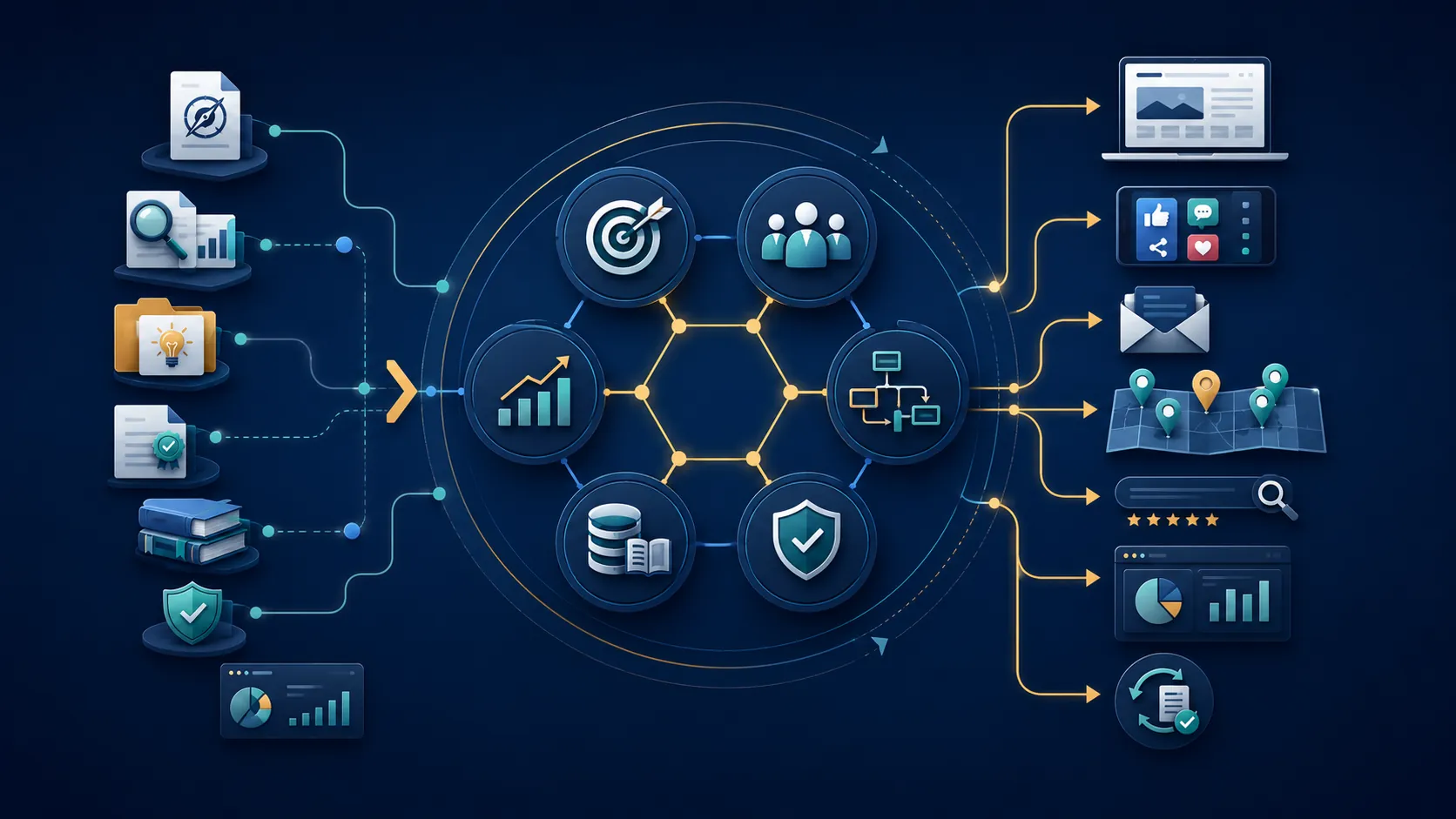
What Is Content Operations and Why Does It Matter at Scale?
Content operations is the system that connects strategy to consistent execution — the people, workflows, technology, and governance that turn a plan into accurate, on-brand content. Acquia describes it as the execution side of content strategy, covering the lifecycle from planning through the revitalization of high-performing assets — Acquia.
Most organizations don’t have a writing-capacity problem. They have a coordination problem. Adding writers, subscribing to AI tools, or buying publishing software does not create scale — it just adds more inputs to a workflow that was never designed to absorb them. Content operations matters because documented systems let output grow while reducing the risk of quality, consistency, compliance, or accountability breaking down.
Related: What Is Content Infrastructure for Multi-Location Brands?
What Is Content Operations?
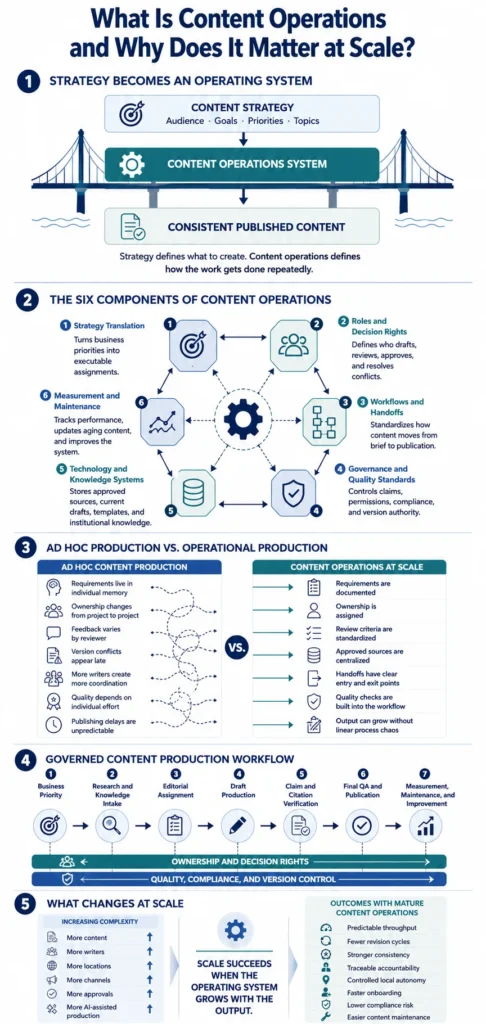
Content operations is the coordinated system organizations use to plan, create, review, approve, publish, distribute, measure, update, and retire content. It is not a department name, a tool category, or an editorial calendar — it is the operating layer that makes strategy repeatable.
Content Operations Connects Strategy to Execution
Content strategy sets direction. Content operations makes that direction executable, repeatedly, across teams and channels.
- Assigns clear ownership for every stage of production
- Standardizes how work moves from brief to publication
- Applies consistent quality and compliance checks
- Feeds performance data back into planning decisions
- Reduces dependence on any single person’s memory
The system falls apart when ownership and workflow stay undocumented, no matter how strong the strategy is.
Content Operations Covers the Full Content Lifecycle
The lifecycle runs from planning through retirement, not just drafting through publishing.
- Planning and assignment creation
- Research, sourcing, and verification
- Drafting and structural execution
- Review, approval, and compliance sign-off
- Publishing and distribution
- Performance measurement
- Maintenance, updates, and retirement
Content operations coordinates the people, processes, and technologies responsible for executing content strategy throughout this lifecycle, and it treats content management — storage, organization, and publishing controls — as one component inside that larger system, not a synonym for it.
How Is Content Operations Different From Content Strategy and Content Marketing?
These four disciplines often get used interchangeably in marketing conversations. They answer different operational questions, and confusing them is where scaling programs quietly break.
Content Strategy Defines What the Organization Should Create
Content strategy determines audiences, objectives, positioning, topics, and priorities. It answers “what should we create and why,” not “how does it get made.”
Content Operations Defines How the Work Gets Done
Content operations determines ownership, workflow, standards, tools, approvals, and measurement. Screendragon describes the discipline as the orchestration of the people and processes involved in planning, creating, managing, distributing, and measuring content, transforming isolated projects into a sustainable, scalable system — Screendragon.
Content Management Supports Part of the System
Content management stores, organizes, controls, and publishes content assets. It is essential infrastructure, but it manages storage and access — not decision rights, review standards, or accountability.
| Discipline | Primary Question | Responsibilities | Typical Failure When Absent |
| Content Strategy | What should we create? | Audience, objectives, positioning, priorities | Content without direction or focus |
| Content Operations | How does the work get done? | Ownership, workflow, standards, measurement | Bottlenecks, rework, inconsistent output |
| Content Marketing | How does content drive engagement? | Attraction, education, conversion | Content that publishes but doesn’t perform |
| Content Management | Where does content live and how is it controlled? | Storage, organization, publishing controls | Version conflicts, lost or duplicated assets |
An organization can have sharp strategy and talented creators and still fail to scale, because no operating system connects those decisions to consistent production.
Why Do Informal Content Processes Break at Scale?
Scale is not simply more articles. It’s more stakeholders, more locations, more formats, more compliance requirements, and more approval dependencies — all interacting at once.
More Content Creates More Dependencies
Every additional piece of content adds handoffs: writer to reviewer, reviewer to compliance, compliance to publisher. Each handoff is a place where ownership can blur.
- Unclear ownership over who approves what
- Duplicate assignments across teams
- Inconsistent briefs producing inconsistent drafts
- Version conflicts between draft copies
- Approval bottlenecks stalling publication
- Repeated revision cycles for the same asset
Handoffs Become the Hidden Bottleneck
Most teams assume delays come from writing or reviewing time. The data points elsewhere. Content workflows with five or more handoff points spend 70 to 85% of total cycle time waiting between stages rather than being actively reviewed — EasySunday.
That gap between active work and idle waiting is where scaling programs lose the most time — not in the writing itself.
Adding People Does Not Repair a Broken Workflow
More writers or more AI-assisted drafts do not resolve unclear ownership, duplicated work, or inconsistent standards. They add volume to the same undocumented process, which increases unfinished work rather than reducing it.
An astonishing 84 percent of marketers do not have a formal content strategy or distribution process to feed their growing marketing channels, and lack any kind of formally managed content supply chain — McKinsey & Company.
That finding reflects a longstanding operational gap rather than a current 2026 estimate — the underlying pattern of informal processes breaking under growth has held for a decade. Approval latency is one common source of delay, not the sole cause of every missed deadline; version conflicts, unclear briefs, and duplicated work contribute as well.
If your operation needs to produce 20–50+ articles per month without sacrificing compliance or quality, Content Ops Lab builds the infrastructure to make that possible. Contact us to discuss your content production requirements.
What Are the Core Components of a Content Operations System?
A scalable system rests on six connected components. No single tool or platform constitutes the system on its own — each component resolves a distinct operational question.
Roles and Decision Rights
Every asset needs a clear answer to “who owns this decision.” Without defined roles, the same question gets re-litigated on every article.
- Assign a single owner for drafting
- Assign a single owner for final approval
- Define who resolves conflicting feedback
- Document escalation paths for disputed claims
Workflows and Handoffs
Standardized workflows answer “what must happen before publishing” the same way every time, regardless of who is running the project.
- Map every required stage from brief to publish
- Define entry and exit criteria for each stage
- Set expected turnaround time per handoff
- Flag stages that can run in parallel
Governance and Quality Standards
Governance answers “which claims require review” and “which version is authoritative.” CMS governance defines how content gets created, approved, published, and maintained — encompassing roles and permissions, editorial workflows, content ownership, publishing rights, and compliance and auditability — Brightspot.
Governance should define decision rights and quality thresholds without requiring every stakeholder to sign off on every asset — that’s a formula for the same bottlenecks it’s meant to prevent.
Technology and Knowledge Systems
Technology answers “where are source materials stored” and “which system holds the current version.” The Content Supply Chain covers the entire content life cycle, from ideation to delivery, encompassing stages such as ideation, production, enhancements, distribution, and analytics — Everest Group.
- Centralized repository for approved sources
- Single system of record for current drafts
- Shared taxonomy across teams and locations
- Integration between planning, drafting, and publishing tools
Measurement and Maintenance
Measurement answers “how does performance feed back into planning” and “who updates or retires aging content.” Without this component, content accumulates without anyone responsible for keeping it accurate.
- Track cycle time and revision counts
- Audit published content on a defined schedule
- Route outdated claims back through review
- Retire or consolidate low-performing assets
How Does Content Operations Protect Quality While Increasing Output?
Scale and quality are often treated as opposing forces. They aren’t — when standards live in the system instead of in individual memory, quality becomes repeatable rather than personality-dependent.
Quality Standards Must Be Built Into the Workflow
Research requirements, approved sources, templates, brand guidance, and claim verification only protect quality consistently if they’re encoded into every assignment, not left to individual judgment.
- Standardized editorial assignments per article
- Pre-approved source libraries for citations
- Templates enforcing structural consistency
- Built-in compliance and claim-verification steps
Governance Should Reduce Rework, Not Add Bureaucracy
The goal of governance is fewer errors reaching publication, not more approval layers. Too many review layers slow production without improving accuracy. Risk-based review — deeper scrutiny for high-risk claims, lighter review for routine content — keeps quality high without stalling the pipeline.
Controlled Autonomy Supports Distributed Teams
Distributed and multi-location teams need standards they can apply independently, not centralized approval for every asset. Documented requirements, reusable templates, and parallel review paths let teams move quickly inside a consistent framework.
| Ad Hoc Quality Control | Operational Quality Control |
| Requirements live in memory | Requirements are documented |
| Feedback varies by reviewer | Review criteria are standardized |
| Errors found near publication | Risks are addressed earlier |
| Every asset is rebuilt | Templates and approved components are reused |
| Quality depends on one person | Quality is supported by the system |
Why Is Content Operations Especially Important for Multi-Location and Regulated Organizations?
Multi-location and regulated organizations carry a structural tension: central control over standards, distributed execution across locations. A documented operating system resolves that tension deliberately instead of leaving it to chance.
Central Standards Create Consistency
Central teams control brand standards, approved claims, templates, taxonomies, reusable assets, and compliance rules that every location must follow.
- Approved messaging and claim libraries
- Shared templates across all locations
- Consistent taxonomy for content classification
- Centralized compliance requirements
Local Execution Preserves Relevance
Local or specialized teams contribute location details, market context, subject-matter expertise, and timely updates that central teams can’t produce alone.
- Location-specific service and market details
- Subject-matter review from local experts
- Timely updates reflecting local conditions
- Feedback loops from location-level performance
Compliance Requires Traceable Decisions
Defined permissions determine who can draft, review, approve, publish, update, and retire content, while version history and audit trails preserve accountability across every location. Shared systems prevent locations or departments from publishing conflicting information about the same claim.
Each new location multiplies pages, profiles, services, claims, stakeholders, and maintenance obligations — the degree of local autonomy should depend on risk, expertise, and content type, not a blanket preference for centralization or decentralization.
Related: How to Build a Scalable Content Production Workflow
How Does AI Change Content Operations?
Generative AI expands production capacity. It does not replace the operating system responsible for verification, accountability, and quality — if anything, it raises the stakes on all three.
AI Increases Capacity and Risk at the Same Time
Faster research synthesis, draft acceleration, reusable prompt systems, content variation, and workflow automation all increase what a team can produce. Generative AI can also produce inaccurate, unsupported, or fabricated material, creating a need for verification, review, and documented accountability. That risk profile covers fabricated facts or citations, inconsistent outputs, unsupported claims, bias, brand drift, privacy exposure, unclear accountability, and overproduction of low-value content.
Verification Must Be an Assigned Workflow Stage
Verification cannot be optional or informal once AI is part of production. It needs to be a defined stage with an assigned owner, the same as drafting or approval.
- Define the task and approved inputs
- Ground production in trusted research and institutional knowledge
- Assign responsibility for factual and editorial decisions
- Verify claims and citations
- Review compliance, tone, and brand alignment
- Record approved versions and reusable learning
- Measure results and refine the workflow
Human Accountability Cannot Be Automated Away
Part 2 of the framework describes four functions to help organizations address the risks of AI systems in practice — GOVERN, MAP, MEASURE, and MANAGE — broken down further into categories and subcategories — National Institute of Standards and Technology.
That framework was built as a broader risk-governance model for organizational AI use generally, not written specifically for marketing content operations — but the underlying principle applies directly: AI should increase system capacity without removing human accountability for what gets published.
What Business Results Can Strong Content Operations Improve?
Operational maturity changes the conditions under which content is produced. It doesn’t guarantee marketing results on its own — the two categories of metrics measure different things.
Operational Metrics Show Whether the System Works
Operational metrics measure the production system itself, independent of how content performs once published.
- Brief-to-publication cycle time
- Time waiting between stages
- Number of revisions per asset
- On-time publication rate
- Cost per completed asset
- Content reuse rate
- Error or correction rate
- Percentage of outdated content reviewed
Marketing Metrics Show Whether the Content Creates Value
Marketing metrics measure audience response and business impact — a separate question from whether the production process ran efficiently.
| Operational Metrics | Marketing Outcome Metrics |
| Brief-to-publication cycle time | Search visibility |
| Time waiting between stages | Engagement |
| Number of revisions | Conversions |
| On-time publication rate | Lead quality |
| Cost per completed asset | Content-assisted revenue |
| Content reuse rate | AI referral traffic |
| Error or correction rate | Citation or mention visibility |
McKinsey has reported 15–25% improvements in marketing effectiveness from well-run marketing operations, measured by return on investment and customer-engagement metrics. Marketing operations is a broader discipline than content operations specifically, so content operations should be understood as one contributor to that kind of improvement — through better coordination, execution, and measurement — not as a standalone guarantee of it — McKinsey & Company.
Scale Should Be Measured by Completed, Effective Content
Volume alone is a misleading scale metric. An operation that publishes more articles without tracking cycle time, error rates, or reuse is trading one operational problem for another. Content operations improves the conditions under which content performs — it does not, on its own, guarantee rankings, AI citations, leads, or revenue.
How Does Content Ops Lab Build Content Operations for Scale?
Content Ops Lab builds and operates structured content production systems for multi-location organizations. The production system supported a fivefold increase in monthly content output for a 12-location regulated healthcare client — from approximately 10 articles per month to more than 50 — contributing to more than 1,000 citation-verified articles and pages across a 23-month production period, while maintaining citation-verification and compliance controls throughout.
That scale came from a coordinated research, assignment, writing, verification, and QA system — not from asking individual writers or AI tools to work faster.
A Unified Source of Truth
Every article draws from a single institutional knowledge layer and a verified research and source library, so claims trace back to approved evidence rather than individual memory.
- One approved source library across all writers
- Institutional knowledge layer shared across the team
- Standardized editorial assignments per article
- Consistent brand and compliance standards applied uniformly
- Factual claims and statistics traced to approved sources
- Version-controlled assignment and draft history
- Centralized tracking across the full production pipeline
- Reusable frameworks across recurring article types
Defined Production Roles and Handoffs
Research, assignment creation, writing, revision, and QA each have a defined owner, so responsibility for every editorial decision is traceable rather than assumed.
Verification Before Publication
Every claim and citation is checked against source material before an article is approved for publication — the differentiator is not access to AI tools, but the documented production and verification infrastructure surrounding them.
Content moves from institutional knowledge and research through article-specific assignment, AI-assisted writer execution, human revision and citation verification, and final QA before publishing handoff — with measurement feeding back into system refinement for the next cycle.
Ready to build content infrastructure that scales without the compliance risk? Get in touch today — we’ll assess your current content operation and outline what a systematic approach would look like for your organization.
Frequently Asked Questions
Does a small content team need content operations?
Small teams benefit from lightweight content operations — clear ownership, a simple workflow, and a basic source library — before they scale, not after problems appear. Waiting until a team grows to formalize ownership and standards means retrofitting a system under pressure. Even a two-person team gains from documenting who approves what and where sources live.
How do you know when content operations is worth the investment?
The signal is usually operational, not financial: repeated revision cycles, missed deadlines, duplicated assignments, or inconsistent quality across writers. If a team is producing more content but spending more time coordinating it than creating it, informal processes have already become the bottleneck. Formalizing ownership and workflow may reduce coordination costs, revision cycles, and delays.
How does content operations reduce compliance and accuracy risks?
Content operations builds verification and approval into the workflow itself rather than relying on a reviewer catching problems late. Defined roles, approved source libraries, and documented sign-off create traceable accountability for every claim, which is what regulated and multi-location organizations need for audit trails.
What is the difference between content operations and hiring a content agency?
An agency typically produces content; content operations is the underlying system — people, workflow, governance, and technology — that makes production repeatable at scale. Some agencies build and operate that system for clients directly, which combines execution with the operational infrastructure behind it.
Should a business build content operations internally or use a managed service?
The right choice depends on internal capacity, content volume, and compliance complexity. Organizations with steady, predictable volume and in-house expertise can build internally; those scaling quickly or operating in regulated, multi-location environments often move faster by using a managed system that already has verification and governance built in.
Key Takeaways
- Content operations is the operating system connecting content strategy to repeatable execution, not a department, tool, or calendar.
- Scaling content output is primarily a coordination problem — people, workflows, governance, and technology — not a writing-capacity problem.
- Content workflows with five or more handoffs spend 70–85% of cycle time waiting between stages, not being actively reviewed.
- Governance should reduce rework and uncertainty, not add unnecessary approval bureaucracy to every asset.
- AI increases production capacity while increasing the need for verification and clear human accountability.
- Operators building toward scale should document ownership and workflow before adding more writers or tools.
The Real Constraint on Scaling Content Is Operational, Not Creative
Organizations that treat scale as a hiring or tooling problem keep adding capacity to a workflow that was never built to absorb it. Organizations that treat scale as an operational problem document ownership, standardize handoffs, and build verification into the system before adding volume.
Content Ops Lab’s production experience shows that gains like these come from the operating system itself, not from writer or AI speed alone. The organizations that build that system now will scale without the rework, compliance exposure, and quality drift the ones without it are already absorbing.
Related: How Do You Scale Content Across Multiple Locations Without Losing Quality?