
How Can Multi-Location Businesses Appear in Google AI Overviews?
Multi-location businesses become eligible to appear in Google AI Overviews through the same indexing, ranking, and quality systems that support traditional Search. “The best practices for SEO continue to be relevant because our generative AI features on Google Search are rooted in our core Search ranking and quality systems” — Google Search Central. Location-level clarity and consistency are operational requirements for that eligibility, not documented AI Overview ranking factors — and for brands operating five, twenty, or two hundred locations, the barrier to visibility usually isn’t a missing AI tactic. It’s a fragmented location information system.
Content Ops Lab’s work across a 12-location regulated healthcare organization demonstrates the operational challenge behind that visibility: location information, citations, templates, and claims must remain accurate across every branch as production scales. The question this article answers is not whether multi-location businesses appear in Google AI Overviews at all, but what has to be true across every branch for that to happen.
Related: How AI Search Engines Decide Which Sources to Cite
How Does Google Choose Sources for AI Overviews?
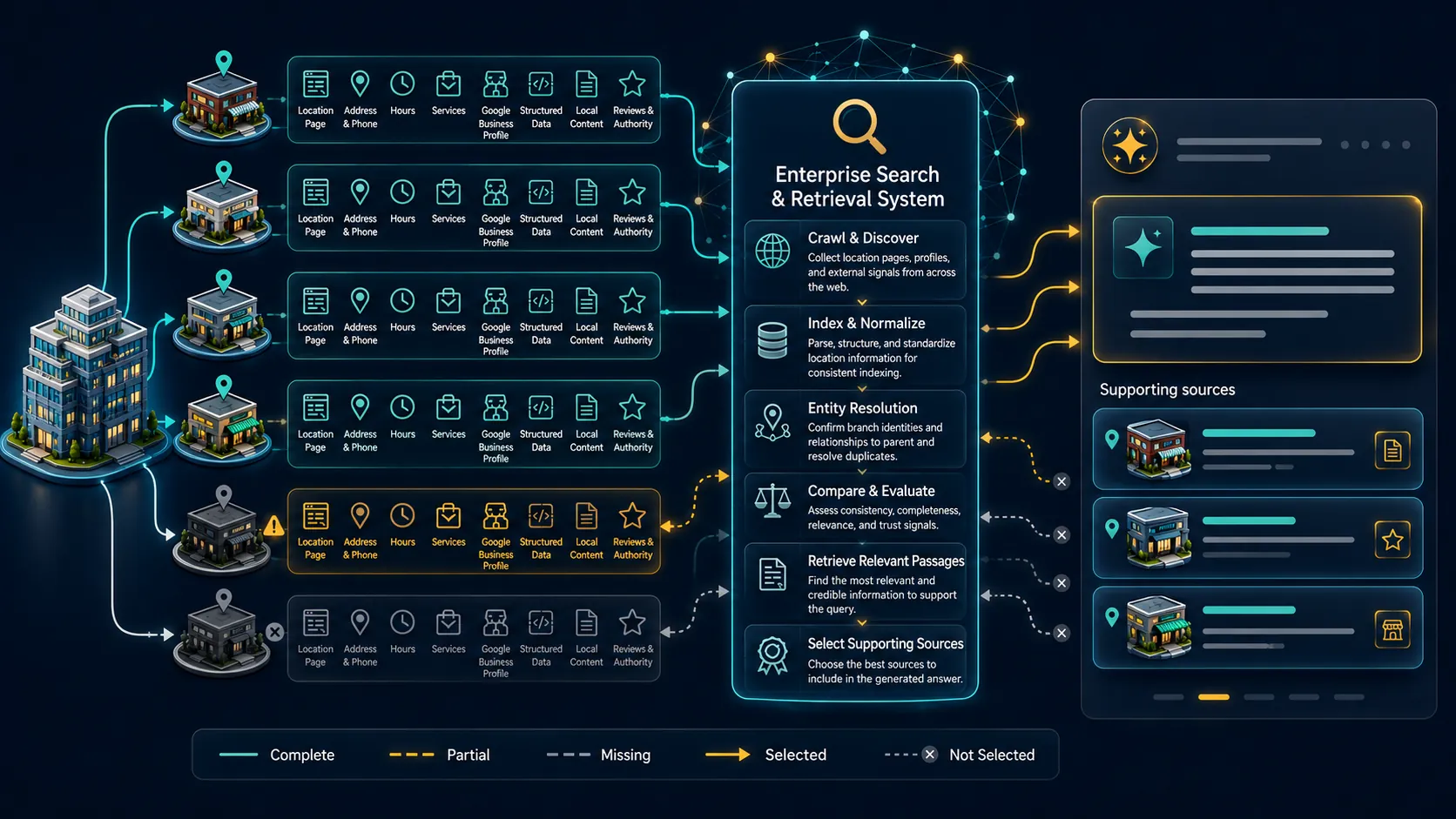
Google generates AI Overviews from its existing Search index, ranking systems, and Knowledge Graph — not from a separate AI-only content pool. For multi-location businesses to appear in Google AI Overviews consistently, Google must be able to distinguish each branch, connect it to the parent brand, and retrieve reliable information about it. For location-based questions, Google’s systems often use query fan-out, breaking one question into several related searches to retrieve supporting passages from different pages.
What Does Query Fan-Out Change for Local Searches?
A question like “which location offers Saturday appointments” isn’t answered from a single query. Google’s systems may decompose it into related lookups:
- Service availability at a specific branch
- Location eligibility and service area
- Hours, cost, or scheduling details
- Comparative quality or review signals
- Related nearby locations offering the same service
Each sub-query creates an additional opportunity to supply relevant information — or a gap if a location’s information doesn’t answer it.
What Makes a Location Page Eligible for an AI Overview?
Before rankings or entity signals matter, a page has to clear a baseline eligibility bar:
- Indexed in Google Search
- Eligible to appear with a snippet
- Publicly crawlable, with no access blocks
- No special AI markup required
- Eligibility does not guarantee selection
Everything else in this article — entity clarity, local content quality, structure — operates on top of that baseline, not as a substitute for it.
Do Organic Rankings Determine AI Overview Citations?
Industry data shows meaningful overlap between top organic results and AI Overview sources, but overlap is not a guarantee. In one third-party dataset, 99.5% of AI Overviews included at least one source that also appeared in the top 10 organic results — WarpDriven. Treat that figure as a correlation from one dataset, not proof that ranking position causes citation. High organic visibility can improve discoverability and retrieval opportunities, but Google does not document a fixed organic position required for AI Overview inclusion.
- Confirmed by Google: generative features are rooted in core Search ranking and quality systems
- Observed in industry data: strong overlap between organic rankings and AI Overview sources
- Not confirmed by Google: any specific ranking position guarantees citation
What Search and Technical Foundations Must Every Location Have?
Before an AI Overview can cite a location, that location’s page must clear a basic bar: it must be indexed and eligible to appear in Search with a snippet. “To be eligible to be shown as a supporting link in AI Overviews or AI Mode, a page must be indexed and eligible to be shown in Google Search with a snippet” — Google Search Central. At multi-location scale, small technical defects compound quickly across dozens or hundreds of branch pages.
Can Google Crawl and Index Every Location Page?
Each location page needs stable crawl access, a clear canonical signal, working internal links, and inclusion in an accurate XML sitemap. Common failure points include:
- Accidental noindex directives on branch templates
- Canonical tags pointing to a generic corporate page
- Address or hours rendered only through unreliable JavaScript
- Orphaned URLs with no internal links pointing to them
- Duplicate URLs representing the same physical branch
A single template defect can silently remove dozens of locations from consideration at once.
Does Each Location Have a Stable Search Destination?
Every legitimate physical branch needs one primary, canonical page — not a URL that shifts, duplicates, or competes with a store-locator entry. A clear site hierarchy signals to Google which page represents which branch.
- Template flaw introduced at the platform level
- Location loses indexing or snippet eligibility
- Page becomes unavailable for retrieval
- Branch has no path to citation in Search or AI Overviews
Strong technical SEO creates eligibility. It does not guarantee AI Overview inclusion.
How Should a Business Help Google Understand Each Location?
Google needs to interpret each physical branch as a distinct real-world entity while still connecting it to the parent brand. That relationship depends on consistent facts, not special AI markup. “Define each local business location as a LocalBusiness type” — Google Search Central. There is no separate AI Overview schema — the entity clarity that supports rich results also supports the broader information ecosystem from which Google retrieves sources.
What Information Should Match Across Every Platform?
Location details need to agree everywhere Google can find them:
| Data Point | Location Page | GBP | Schema | Store Locator | Directories |
| Name, address, phone | Required | Required | Required | Required | Required |
| Hours | Required | Required | Optional | Required | Recommended |
| Services offered | Required | Required | Recommended | Optional | Optional |
| Location status (open/closed) | Required | Required | Required | Required | Required |
Mismatched hours or a closed branch still listed as active create exactly the kind of contradictions that reduce Google’s ability to interpret a location confidently at scale.
How Does LocalBusiness Schema Support Entity Clarity?
Structured data helps Google parse relationships without functioning as a ranking shortcut. “There are no additional technical requirements, nor is special schema.org markup or other machine-readable files needed to appear in AI Overviews or AI Mode” — Google Search Central. Useful relationships and identifiers include:
- parentOrganization linking a branch to the brand
- subOrganization for brand-to-branch mapping
- branchCode for internal identification
- The most specific valid LocalBusiness subtype available
Google Business Profile accuracy and structured data may strengthen Google’s understanding of a location, but neither is documented as a direct AI Overview trigger. For multi-location businesses, the goal is not one isolated optimization but a consistent branch identity across the location page, Google Business Profile, structured data, store locator, and major directories.
If your operation needs to produce 20–50+ articles per month without sacrificing compliance or quality, Content Ops Lab builds the infrastructure to make that possible. Contact us to discuss your content production requirements.
What Makes Location Content Useful Enough to Be Reused?
A location page built by swapping a city name into a shared template rarely holds up. The page needs enough verified local substance to answer questions specific to that branch — not just a restated version of brand-level content.
What Information Can Be Standardized Across Locations?
Some content is safe to share across every branch:
- Brand-level compliance language
- Core service definitions
- Standard process descriptions
- General company background
What Must Be Verified at the Location Level?
Other information must be governed and confirmed branch by branch:
- Services actually available at that location
- Equipment, facilities, or operational limits
- Staff or practitioner credentials
- State or local regulatory requirements
- Neighborhoods and service areas genuinely served
When Do Local Pages Become Doorway or Scaled Content?
Google’s spam policies flag two related patterns: generating many pages without adding user value, and building near-identical pages that funnel visitors to one destination. “Using generative AI tools or other similar tools to generate many pages without adding value for users” — Google Search Central. Regional page fleets built only to capture geographic keyword variants carry the same risk, regardless of whether AI produced them.
| Governed Reuse | Low-Value Duplication |
| Shared compliance language, unique local facts | Same content with only the city name changed |
| Verified staff and service data per branch | Assumed or copied service lists |
| Distinct local evidence (reviews, photos) | No original local proof |
Using AI in production isn’t itself a violation. The risk comes from publishing volume without substantive local review. Branches with verified local substance provide Google with stronger, more relevant information than pages assembled through city-name replacement alone.
Related: What Does NAP Consistency for AI Visibility Actually Do?
How Can Multi-Location Content Be Structured for Retrieval?
Clear structure helps both readers and Google’s systems locate the right passage without reducing a page to disconnected fragments. “People appreciate content that is organized in paragraphs and sections with headings that provide a clear structure” — Google Search Central. Extractability supports comprehension; it doesn’t replace it.
Which Page Elements Make Answers Easier to Find?
- Descriptive, question-based headings
- Direct-answer opening sentences per section
- Lists for criteria, steps, and comparisons
- Tables for location or service differences
- Clearly attributed factual claims
Does Every Search Question Need Its Own Page?
No. One substantial page can address several related questions when the topics genuinely belong together — a services page can cover eligibility, cost factors, and process without splitting into a page per phrasing variation. Formatting cannot compensate for weak facts, unoriginal content, inaccurate location details, or thin authority.
What Operating System Supports AI Overview Visibility at Scale?
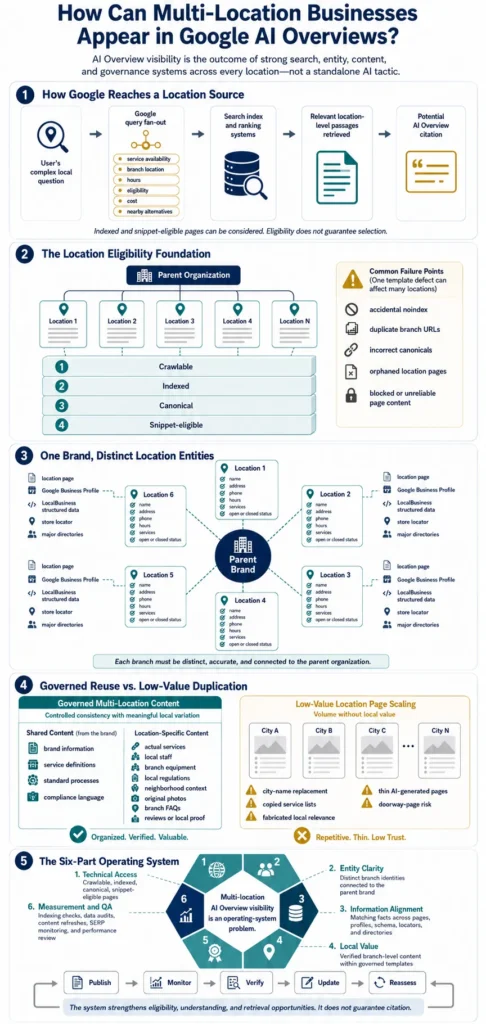
Multi-location businesses appear in Google AI Overviews through coordinated technical, entity, content, and governance systems — summarized here as a six-part operating framework, not a page-by-page tactic:
- Technical access: Every important branch page stays crawlable, indexable, canonical, and snippet-eligible.
- Entity clarity: Each legitimate location holds a distinct identity tied cleanly to the parent brand.
- Information alignment: Location pages, GBP profiles, schema, store locators, and directories agree on core facts.
- Local value: Shared templates include governed fields for real branch-level evidence.
- Authority maintenance: Content uses credible sources, clear authorship, and outside corroboration where relevant.
- Measurement and QA: Teams monitor indexing, visibility, and content decay on an ongoing basis.
Who Owns Each Part of the Location Information System?
- SEO: technical access, indexing, canonicalization
- Content: page quality, local substance, template governance
- Local operations: hours, services, staff accuracy
- Development: template stability, structured data implementation
- Compliance: regulated claims and disclosures
- Analytics: performance monitoring and decay detection
Inconsistent ownership causes location drift — closed branches stay live, hours diverge, and pages grow generic over time.
How Can Teams Prevent Location Information From Drifting?
Ownership only holds up with routine maintenance behind it:
- Scheduled GBP and NAP audits
- Defined workflows for location openings and closures
- Review cycles for service and staff changes
- Template QA as shared page structures evolve
- Clear ownership for content refreshes
- An escalation path when data sources contradict each other
How Should AI Overview Visibility Be Measured?
Measurement here is directional, not exact. Search Console reports the broader Web performance of these pages. At the same time, manual checks and third-party tools can provide directional evidence of AI Overview appearances. None provides a complete explanation of why a page was selected. Useful signals include:
- Search Console Web performance
- Page-level impressions and clicks
- Indexing and enhancement reports
- Manual review of priority queries
- Third-party SERP-feature tracking
- Location-by-location coverage comparisons
Google’s available reporting doesn’t provide a complete causal view of why a page was selected or which query fan-out path retrieved it. AI Overview visibility should be read alongside organic traffic, leads, and revenue — never as a standalone KPI.
How Does Content Ops Lab Build Multi-Location Search Visibility Into the Production System?
Content Ops Lab’s production system scaled from approximately 10 articles per month to more than 50, producing more than 1,000 citation-verified articles and pages across a 12-location regulated healthcare organization with zero reported compliance issues. That scale only holds up when location facts, editorial strategy, and citation verification are governed as separate, disciplined stages.
- One institutional source of truth for every branch’s facts
- Location-specific data assigned before drafting begins, not discovered mid-draft
- Editorial strategy separated from production execution
- Every citation and local claim verified before publication
- Shared templates that preserve required local variation
- QA applied consistently across dozens of monthly articles
- Systems updated as locations, services, and regulations change
This production discipline doesn’t cause AI Overview appearances. It demonstrates that location-level content governance and citation verification can run at scale — the same governance this article argues AI Overview visibility depends on.
Ready to build content infrastructure that scales without the compliance risk? Get in touch today — we’ll assess your current content operation and outline what a systematic approach would look like for your organization.
Frequently Asked Questions
Can a Business Pay Google or Use Special Markup to Appear in AI Overviews?
No. Google has not documented a paid or markup-based path into AI Overviews. Eligibility depends on standard Search indexing and snippet requirements — the same foundation that governs organic visibility, not a purchasable placement or a separate technical standard.
How Long Does It Take to Improve AI Overview Visibility Across Multiple Locations?
Timelines vary by how fragmented the current location system is. Fixing technical access and entity consistency across dozens of branches can take weeks to months, and results depend on Google’s ongoing crawling and reassessment rather than a fixed rollout schedule.
Can AI-Generated Location Pages Hurt a Multi-Location Business in Google Search?
Using AI in production isn’t itself a violation, but publishing large volumes of unoriginal or low-value pages can trigger Google’s scaled-content and doorway-page spam policies, particularly when pages differ only by city name with no real local substance.
Is Ranking in Local Search the Same as Appearing in a Google AI Overview?
No. Local rankings commonly reflect relevance, distance, and prominence, while AI Overview citations are selected through a separate retrieval and generation process rooted in Google’s broader Search systems.
Should a Multi-Location Business Manage AI Search Optimization Internally or Use a Managed Content System?
The right model depends on location count and internal bandwidth. Businesses with dozens of locations typically need a governed system for facts, templates, and verification — internal teams can execute it, but few have the bandwidth to sustain it at monthly-article scale.
Building a Governed Path to AI Overview Visibility
Multi-location businesses don’t earn AI Overview visibility through a standalone AI tactic — they earn it by building the same governed information system that traditional Search visibility has always required: crawlable pages, consistent entity data, and genuine local substance at every branch. “The best practices for SEO continue to be relevant because our generative AI features on Google Search are rooted in our core Search ranking and quality systems” — Google Search Central.
Brands that treat this as infrastructure—not a page-by-page trick—give every legitimate location a stronger foundation for discovery, retrieval, and potential citation as Google’s generative Search features develop. Content Ops Lab helps multi-location organizations build and operate that infrastructure through governed research, location-specific content systems, citation verification, and repeatable quality control.
Related: How Do You Scale Content Across Multiple Locations Without Losing Quality?