
Why Is Most AI-Generated Content Terrible?
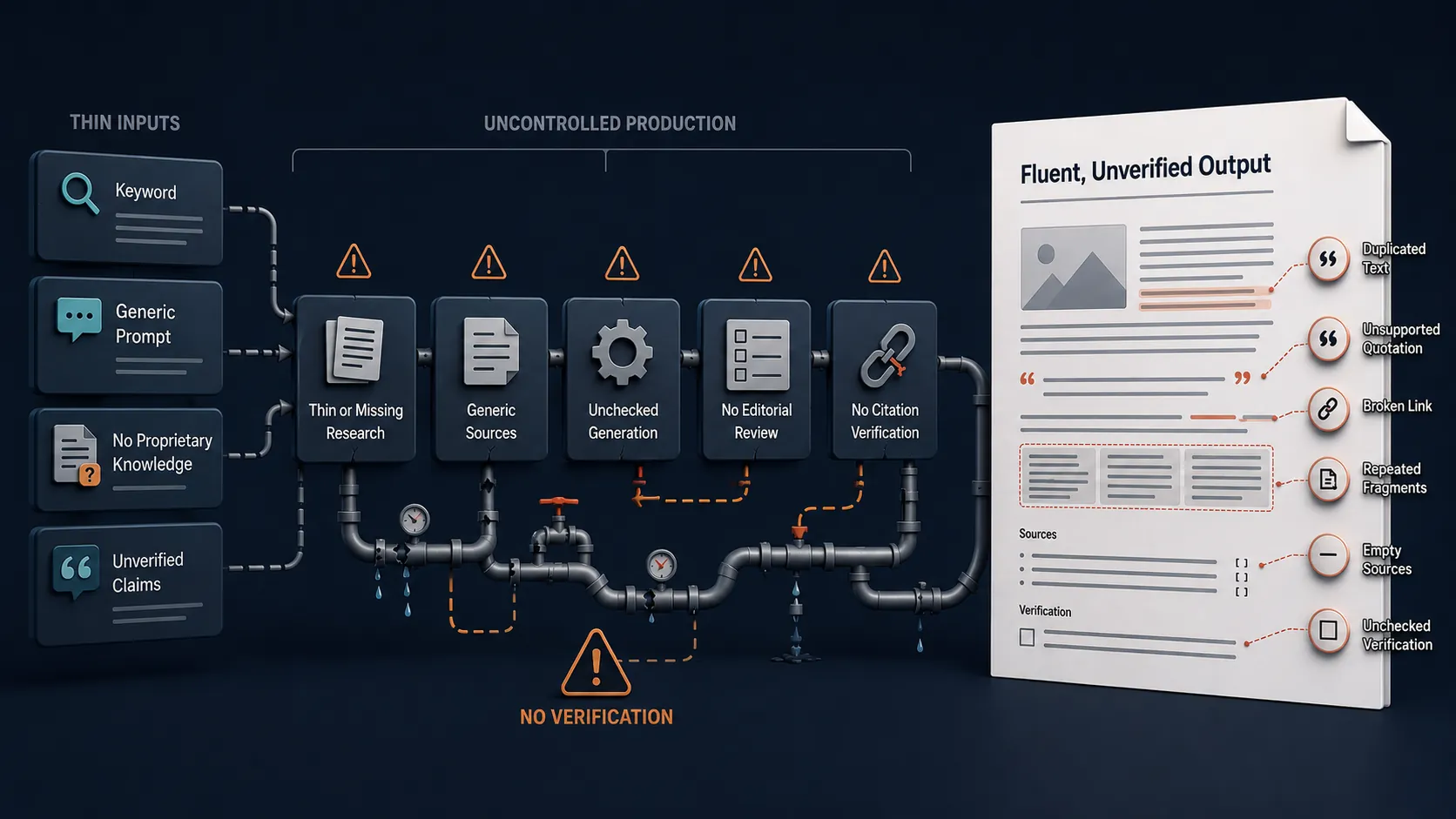
Most AI-generated content is terrible not because language models lack the capacity for strong writing, but because organizations often use them as unsupervised writers instead of as one stage in a controlled production system. NIST’s Artificial Intelligence Risk Management Framework describes what these systems actually do: they “generate outputs that approximate the statistical distribution of their training data” — NIST.
That process produces fluent sentences, not verified ones, and the resulting pages read as generic and carry unverified claims. Content Ops Lab has tracked this exact failure pattern across 23 months of production work. Better prompting can improve a draft, but it cannot replace the production system surrounding it.
Related: Why Does AI-Generated Content Fail Without Verification?
Is AI the Problem, or Is the Production Process Broken?
Generative AI can produce usable language. A language-generation capability is not a complete content operation, and treating the two as identical is where most publishing programs go wrong.
What Counts as Terrible AI-Generated Content?
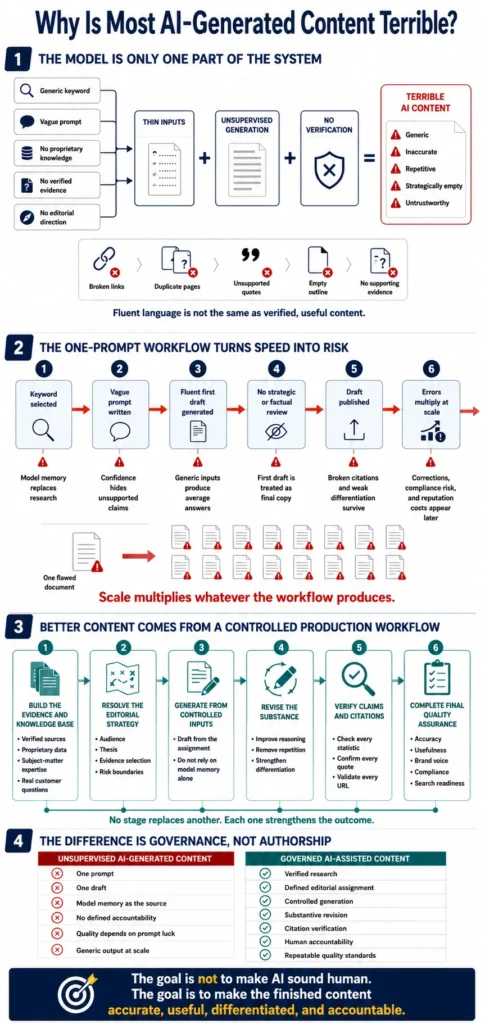
“Terrible” content shares five traits, regardless of which model produced it:
- Generic — could apply to any competitor in the category
- Inaccurate — contains unverified or fabricated claims
- Repetitive — recycles structure and phrasing across articles
- Strategically empty — answers no real business question
- Untrustworthy — cannot survive a fact-check
A one-prompt workflow commonly produces several of these defects, not because the model is broken, but because nothing upstream or downstream corrects for its limits.
What Is the Difference Between AI-Generated and AI-Assisted Content?
The distinction is production method, not authorship label. Poor human-written content exists. Strong AI-assisted content exists. What separates them is whether a governed system surrounds the generation step.
| AI-Generated Content (unsupervised) | AI-Assisted Content (governed workflow) |
| One prompt, one draft, one publish | Research, assignment, draft, revision, verification, QA |
| Model memory as the knowledge source | Verified source material as the knowledge source |
| No editorial accountability | Human sign-off at defined checkpoints |
| Quality varies by prompt luck | Quality is a system output, not a gamble |
Why Can Bad AI Content Sound So Convincing?
Language models are optimized to generate coherent continuations, not to independently confirm that every statement is true. Fluent syntax and a confident tone can make an article feel finished well before it has earned that status.
Fluency Can Hide Weak Reasoning
OpenAI’s research on model behavior names the exact risk: “Hallucinations are plausible but false statements generated by language models” — OpenAI. A hallucinated statistic and a verified one can share identical sentence structure, so surface-level reading cannot tell them apart.
Common factual failure modes include:
- Unsupported statistics with no traceable source
- Invented studies or reports that do not exist
- False quotations attributed to real people or brands
- Broken or fabricated URLs
- Plausible-sounding explanations that are simply wrong
Confidence Is Not Source Verification
Models generate the statistically likely continuation of a prompt, not a fact-checked answer. That does not mean every generated sentence is false—current models produce accurate content regularly. It means unverified generation carries an unresolved risk until someone checks the underlying claims.
| Surface Quality | Substantive Quality |
| Reads smoothly | Traces claims to verifiable sources |
| Uses correct grammar | Reflects real subject-matter expertise |
| Sounds authoritative | Survives factual review |
Copyediting improves surface quality. Fact verification establishes substantive quality. The two are not interchangeable.
Why Does AI Content So Often Sound Generic?
Generic output is usually a systems failure, not a model failure. A model given only a topic, a keyword, a word count, and a vague tone instruction has little material to reason from — so it defaults to the most statistically average answer available.
Generic Inputs Produce Average Answers
The pattern compounds predictably:
| Missing Input | Model Default | Published Defect |
| No proprietary data or point of view | Falls back on common training patterns | Advice fits every competitor |
| No real customer questions | Generates generic FAQ framing | Answers no meaningful objection |
| Only a vague tone instruction | Uses familiar phrasing patterns | Prose reads like a template |
Shared Models Encourage Similar Patterns
Independent research backs the mechanism. A study of AI-assisted writing found that suggestions “homogenize writing toward Western norms, diminishing nuances that differentiate cultural expression” — Agarwal, Naaman & Vashistha. A separate ideation study found that “different users tended to produce less semantically distinct ideas with ChatGPT” — Anderson, Shah & Kreminski.
Neither finding proves all model-assisted writing converges into one voice. Both confirm a real homogenization risk when many organizations issue the model the same thin instructions.
If your operation needs to produce 20–50+ articles per month without sacrificing compliance or quality, Content Ops Lab builds the infrastructure to make that possible. Contact us today to discuss your content production requirements.
What Is Missing When AI Writes Without Expertise?
A model cannot infer undocumented customer knowledge, hands-on operational experience, case-specific judgment, internal data, brand positions, or subject-matter boundaries. It can only work with what the assignment supplies.
Brand Voice Is More Than Tone
Google’s guidance on helpful content points at the underlying signal set: “Our systems aim to prioritize those that seem most helpful” — Google Search Central. Tone instructions control word choice. They do not supply first-hand experience, subject-matter knowledge, credible sourcing, or the other signals that make content genuinely useful.
Proprietary Knowledge Creates Differentiation
Recent research on heavy LLM reliance found that “heavy LLM users reported that the writing was less creative and not in their voice” — Abdulhai et al. This is a 2026 preprint, and the finding is emerging rather than settled — but it aligns with a pattern any content operator has likely already seen first-hand.
Without proprietary knowledge in the assignment, the model has no differentiation to draw on:
- Case-specific data unique to the organization
- Subject-matter positions the brand actually holds
- Real customer language and objections
- Operational detail competitors cannot access
- Explicit exclusions the brand will not claim
Expertise Must Shape the Assignment Before Drafting
Tone prompts cannot replace institutional knowledge, and SME review conducted only after the draft exists usually arrives too late to shape the argument. By that point, the article’s structure and claims are already set. Expertise has to enter the workflow at the assignment stage, before generation begins.
Why Is a Good Prompt Not Enough?
Clear prompts, relevant context, and concrete examples measurably improve output. Anthropic’s own prompt engineering guidance confirms the mechanism directly: “being specific about your desired output can help enhance results” — Anthropic. None of that makes prompting a substitute for the production system surrounding it.
Better Instructions Improve Execution
A well-built prompt genuinely helps. It shapes tone, format, length, and the immediate quality of a single generation pass.
Prompts Cannot Replace Missing Inputs or Governance
| A prompt can help control | A production system must control |
| Tone and voice within one draft | Consistent brand voice across hundreds of articles |
| Output length and format | Research sourcing and citation accuracy |
| Immediate clarity of instructions | Compliance boundaries and claim review |
| Style within a single generation | Multi-stage revision and final QA |
Related: How to Build a Scalable Content Production Workflow
How Does One-Shot Generation Turn Speed Into Risk?
The common workflow runs keyword to prompt to first draft to publication, with no stage in between to catch what goes wrong.
The First Draft Is an Input, Not a Deliverable
Walking that path in order:
- A keyword and a vague brief go into the prompt
- The model returns a fluent first draft
- Strategic errors, duplicated ideas, and weak evidence pass through unchallenged, since nothing in the workflow is built to catch a false but confident-sounding statement
- The draft publishes with fabricated citations or broken internal links intact
- Google’s published guidance warns that using generative tools to create many pages without adding value may violate its spam policies — Google Search Central
- The cost that generation skipped resurfaces downstream as corrections, reputation risk, and compliance exposure
Scale Multiplies Whatever the Workflow Produces
A first draft is useful for testing structure and generating raw material. It is not a publication-ready deliverable. Skipping upstream planning and downstream QA does not eliminate the work required for accurate, differentiated content — it relocates that work to after publication, at a volume the workflow itself just multiplied. The required depth of review depends on topic risk, source quality, and business requirements; there is no universal number of revision rounds that applies everywhere.
What System Produces Better AI-Assisted Content?
A six-stage operating framework replaces the one-prompt workflow, and no single stage duplicates or replaces another:
- Build the Evidence and Knowledge Base — Gather verified sources, proprietary data, and SME input before any drafting begins
- Resolve the Editorial Strategy — Set the thesis, audience, evidence selection, and risk flags in a defined assignment
- Generate From Controlled Inputs — Draft from the assignment and evidence library, not from model memory alone
- Revise the Substance — Improve reasoning, evidence use, and differentiation, not just grammar
- Verify Claims and Citations — Confirm every quote, statistic, and URL against its source
- Complete Final Quality Assurance — Check accuracy, usefulness, distinctiveness, voice, compliance, and search readiness before publication
A quick pre-publication checklist follows the same six categories: does the article verify as accurate, useful, distinctive, on-voice, compliant, and search-ready? Human involvement in this model does not mean writing every sentence manually. It means holding accountable decisions and verification at the stages a model cannot safely own on its own.
The goal was never to make AI sound human. It is to make the finished content accurate, useful, differentiated, and accountable — at whatever volume the business actually needs.
How Content Ops Lab Builds Content Infrastructure
Content Ops Lab’s production system was developed through 23 months of live production and more than 1,000 articles and pages in a multi-location regulated healthcare organization. It separates research, editorial strategy, writer execution, and final QA into accountable stages, so no single stage is asked to substitute for another.
The Content Ops Lab Production System
- Research and Knowledge Intake — Verified sources and proprietary knowledge assembled before any assignment is written
- Editorial Assignment Creation — Thesis, evidence selection, and risk flags resolved before a model drafts
- Writer Execution and Self-Revision — Drafting and substantive revision against the assignment, not against an open prompt
- Final QA — Accuracy, voice, compliance, and search readiness confirmed before publication
This structure lets a regulated, multi-location organization scale publishing volume without treating a first draft as the finished product and without accepting generic output, fabricated support, or inconsistent voice along the way.
Ready to build content infrastructure that scales without the compliance risk? Get in touch — we’ll assess your current content operation and outline what a systematic approach would look like for your organization.
Frequently Asked Questions
Can a Better Prompt Fix Bad AI-Generated Content?
A better prompt improves one generation pass, but it cannot supply research, select the business argument, verify citations, or run final QA. Clear instructions and context measurably improve output, yet they remain one input into a larger system rather than a replacement for it.
Is Building an AI Content Workflow Worth the Added Time and Cost?
The added time goes into research, editorial assignments, and verification — the stages that determine whether published content is accurate and differentiated. Skipping them does not remove that work; it relocates the cost downstream into corrections, compliance exposure, and weak search performance.
Who Is Responsible When AI-Generated Content Includes a False Claim or Fabricated Citation?
The organization publishing the content remains accountable for verifying the claims it publishes. A verification stage exists precisely to catch unsupported statistics, invented sources, and broken citations before publication, which is why skipping it is primarily an editorial failure rather than a technical one.
Is AI-Assisted Content Better Than Hiring Traditional Freelance Writers or an Agency?
Both human and AI-assisted workflows can produce strong or weak content; production method matters more than authorship label. A governed AI-assisted system can support higher publishing volume while maintaining consistent standards, provided the research, verification, and QA stages remain intact.
Should a Company Build Its Own AI Content System or Use a Managed Content Production Service?
The right choice depends on whether the organization has the research, editorial, writing, verification, and QA infrastructure to run the workflow consistently. Building in-house requires sustained investment in each stage; a managed service supplies that infrastructure already tested at scale.
Key Takeaways
- Most AI-generated content fails because organizations skip the production system, not because models lack capability
- Fluency and factual accuracy are separate qualities; copyediting cannot substitute for source verification
- Generic output traces to generic inputs — proprietary knowledge and real customer questions create differentiation
- A good prompt improves one draft; it cannot supply research, governance, or final QA on its own
- Content Ops Lab’s methodology comes from 23 months of production and 1,000+ articles in a regulated healthcare environment
- One-shot publishing relocates hidden cost downstream into corrections, compliance exposure, and weak performance
- Operators evaluating AI content quality should ask where research, verification, and QA sit in the workflow — not just which model wrote the draft
What Separates Publishable AI-Assisted Content From Generic AI Output?
Most AI-generated content is terrible because it skips the system that generation was always meant to sit inside—verified research, a defined editorial assignment, substantive revision, citation verification, and accountable QA. Organizations that treat generation as the entire workflow will continue publishing generic, weakly differentiated content that carries avoidable accuracy and credibility risks.
Content Ops Lab builds the production infrastructure that prevents those failures. Its research-first, multi-stage system separates strategy, writing, verification, and final review so businesses can scale content without treating a fluent first draft as a finished product.
The dividing line is not whether AI touched the draft. It is whether a governed content operation surrounded the generation step.
Related: What Is Content Operations and Why Does It Matter at Scale?