

How Should Content Teams Use Bing Topics Portfolio to Find Editorial Opportunities?
Content teams should use Bing Topics Portfolio to identify candidates for investigation, then verify audience relevance, business fit, and existing coverage before approving work. A reported citation gap can justify a closer look, but decisions to refresh, consolidate, publish, investigate, or decline require evidence beyond the report itself.
“Everything in this view is personalized to your site” — Microsoft Bing.
The budget risk begins when a personalized observation becomes an automatic publishing commitment. Teams can spend scarce review capacity answering questions they already cover—or serving audiences they cannot help. Content Ops Lab’s research-first approach validates those signals before turning them into production assignments.
Related: What Is the AI Search Content Gap for Multi-Location Businesses?
What Does Bing Topics Portfolio Add to Editorial Planning?
The beta adds a site-specific thematic view, ecosystem context, and opportunity queries inside Bing Webmaster Tools’ AI Performance report. The October 2026 beta expands earlier topic reporting. Its planning value is orientation: understanding observed presence and identifying questions worth examining within the report’s supported Microsoft and partner experiences.
The Site-Specific Portfolio View
The portfolio starts from observed activity associated with your site. That makes it relevant to your reporting property, while limiting what it can establish about the wider market.
- Treat displayed themes as observations requiring interpretation.
- Compare reported presence with independently maintained audience priorities.
- Keep reporting properties distinct when reviewing organizational coverage.
A personalized view still needs context before its observations can support a production commitment.
The Expansion Beyond June’s Topics Feature
The October release did not introduce thematic analysis from scratch. June’s feature already grouped grounding queries, giving publishers a broader lens than individual retrieval phrases could provide alone.
“We are also introducing Topics, which group related grounding queries into broader thematic clusters”— Microsoft Bing.
- Recognize June’s grouping capability in the product history.
- Associate October’s expansion with portfolio and opportunity context.
- Preserve individual query wording within each thematic cluster.
The expanded context helps organize questions, but the beta still has limits that require judgment.
The Limits of a Beta Planning Input
Availability depends on sufficient site presence and ecosystem activity. AI-generated classification can also misplace queries, while low-activity topics may be omitted from the view your team receives.
- Check classification against the query’s actual meaning.
- Treat shorter lists as potentially incomplete reporting views.
- Avoid diagnosing eligibility from an absent feature alone.
Even an appropriate topic classification leaves the underlying measurement units open to misinterpretation by planners.
What Do the Portfolio Metrics Actually Measure?
Portfolio metrics describe citation activity, cited-site participation, and grounding-query breadth over a selected period. They do not directly measure customer demand, content quality, or expected revenue. Keep the ecosystem’s activity separate from your site’s reported presence, and preserve approximate values rather than converting them into precise investment assumptions.
Topic Size and Sites Cited
Topic Size describes approximate citations across sites, while Sites Cited describes approximate participation. A busy topic can attract attention without establishing whether it deserves your organization’s production budget.
| Metric | Reported Unit | Planning Use | Unsupported Conclusion |
| Topic Size | Approximate citations across sites | Context for observed activity | Customer demand or revenue |
| Sites Cited | Approximate cited-site count | Context for participation | Validated SEO difficulty |
| Queries | Approximate distinct grounding queries | Breadth of retrieval questions | User-prompt volume |
| Your Citations | Reporting-site citations within a topic | Observed site presence | Verified expertise or accuracy |
| Opportunity citation ranges | Reported citation-volume bands | Directional comparison | Exact volume or attainable gains |
- Interpret ecosystem activity alongside verified business relevance.
- Avoid inventing competitive difficulty thresholds from participation.
- Require audience evidence before inferring commercial demand.
Activity and participation provide context; they do not explain the meaning of every underlying query.
Queries and Your Citations
Grounding queries are phrases used during retrieval, rather than a count of original user prompts. Your Citations describe observed inclusion, which cannot independently verify the cited material’s accuracy.
- Read retrieval phrases before assigning audience needs.
- Allow related queries to share one useful answer.
- Validate cited claims independently of their observed inclusion.
Those distinctions become harder to maintain when approximate reporting values acquire false precision in presentations.
Opportunity Ranges and Reporting Windows
Preserve the period and displayed ranges together. October’s announcement documents one-, two-, or three-month windows, so a planning comparison needs its selected timeframe attached to every observation retained.
“Topic Size, Sites Cited and Queries are approximate, and opportunity citation volumes are deliberately shown as ranges” — Microsoft Bing.
- Retain opportunity bands exactly as originally displayed.
- Record the window alongside the capture date.
- Avoid replacing ranges with invented midpoint estimates.
Correct measurement language protects the budget discussion, but you still need to diagnose an apparent gap first.
How Can Teams Diagnose an Opportunity Before Commissioning Content?
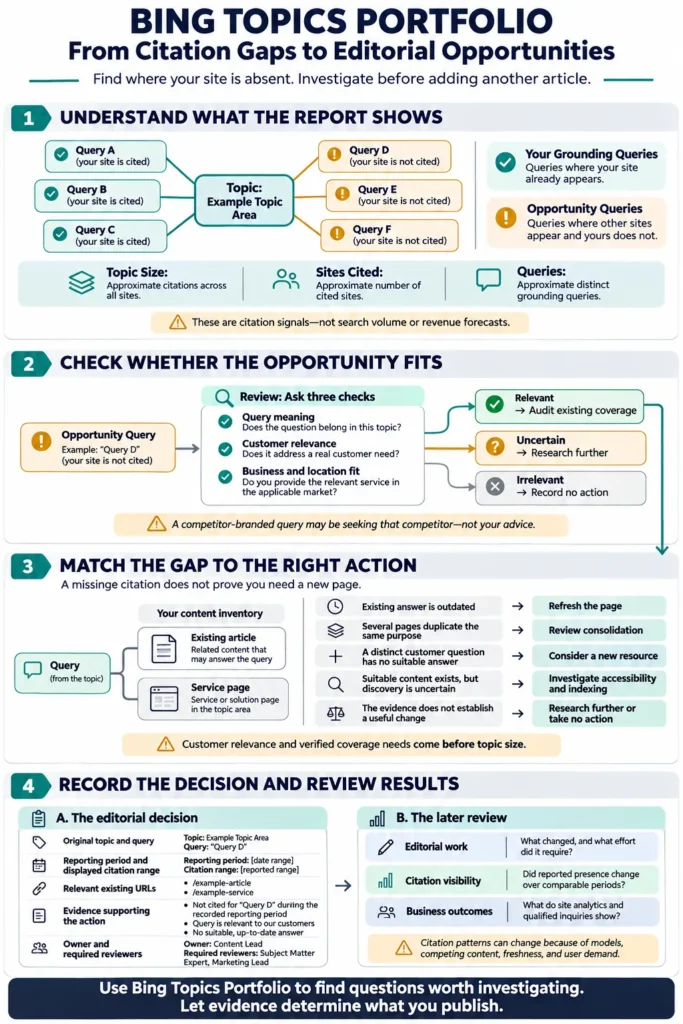
Teams should diagnose a reported opportunity by checking intent, business relevance, and existing URLs before commissioning content. Top Opportunity Queries span the portfolio; topic-specific Opportunity Queries stay within a theme. Both identify reported absence, leaving the reason for that absence—and the appropriate response—to further investigation.
“Below the topic table you will find Top Opportunity Queries: the strongest queries across your whole portfolio where other sites appear, and yours does not”— Microsoft Bing.
Classification, Intent, and Brand Fit
Review the wording before accepting the opportunity label. A competitor-branded query could express a legitimate comparison need, or simply seek another organization’s website, location, or customer support channel.
- Separate useful comparisons from competitor-navigational requests carefully.
- Confirm your audience benefits from the proposed response.
- Record irrelevant requests as rejections, not backlog.
Microsoft’s undisclosed ranking method for “strongest” opportunities cannot replace this review of audience fit.
Existing URLs and Coverage Quality
Map the question to relevant pages before treating it as uncovered. Several queries may share a useful answer, and several existing URLs may contribute distinct parts of one response.
- Review existing answers for currency, completeness, and clarity.
- Compare page purposes before deciding coverage is duplicated.
- Distinguish weak answers from uncertainty about discovery.
A missing citation establishes neither a missing page nor a specific reason for its absence.
The Appropriate Editorial or Technical Response
Choose the response that fits the verified problem. New content is one possible outcome; technical investigation, additional research, and declining irrelevant work can all represent responsible allocation decisions.
| Diagnosis | Proposed Action |
| Relevant answer is outdated | Refresh existing content |
| Multiple pages serve a duplicate purpose | Review consolidation and dependencies |
| Distinct customer task lacks coverage | Commission a new resource |
| Suitable page has discovery uncertainty | Investigate technical accessibility and indexing |
| Evidence does not establish the problem | Research before committing production |
| Request is irrelevant to the organization | Take no action; retain the rationale |
- Match each response to the supported diagnosis.
- Review consolidation dependencies before removing useful pages.
- Keep uncertain requests outside committed production temporarily.
An appropriate response still competes with other worthwhile work for limited production and review capacity.
If your operation needs to produce 20–50+ articles per month without sacrificing compliance or quality, Content Ops Lab builds the infrastructure to make that possible. Contact us to discuss your content production requirements.
Which Editorial Opportunities Deserve Limited Resources?
Prioritize verified audience need and business relevance before citation magnitude. Then weigh coverage quality, evidence confidence, delivery effort, and review requirements together. This qualitative judgment can favor a small, well-supported refresh over a large general-interest topic without inventing a weighting formula or promising a particular return.
Audience Need and Business Relevance
A subject earns consideration when the organization can credibly help the intended audience. Citation activity becomes useful context only after that connection survives scrutiny against real services and priorities.
- Identify the customer task the answer serves.
- Confirm the organization provides the relevant service.
- Compare audience priorities before considering topic size.
A relevant task deserves consideration, although relevance alone does not establish the work’s readiness.
Evidence Confidence and Delivery Effort
A narrow update with a clear factual basis may be easier to approve than speculative expansion. Compare the uncertainty of the diagnosis alongside the resources required to resolve it.
- Favor coverage problems supported by current evidence.
- Include specialist review time in delivery estimates.
- Delay commitment while decision-changing evidence remains unavailable.
Keep delivery estimates incomplete until the team confirms where the proposed information applies.
Local Applicability and Review Requirements
Consider a hypothetical healthcare network reviewing three candidates. Its central editor must distinguish shared education from local services, then obtain qualified review wherever clinical statements or market applicability require it.
| Candidate | Relevance and Evidence | Proposed Action |
| Larger general-interest cosmetic-surgery topic | Procedure outside the network’s services | Decline despite greater reported activity |
| Smaller rehabilitation question | Existing answer needs updating; service confirmed in eligible markets | Refresh after clinical and market review |
| Ambiguous recovery query | Audience task and treatment context unresolved | Research before assigning production |
- Confirm service availability in each included market.
- Check jurisdictional requirements for local treatment-related language.
- Assign qualified review to actual clinical statements.
This relevance-led choice is an editorial recommendation, not a validated return model. Microsoft Bing supplies the metric definitions; organizational evidence supplies the decision.
The hypothetical choice remains provisional until its evidence, ownership, and scope enter an assignment record.
Related: What Makes an AI Content Workflow Reliable Enough to Scale?
What Must an Approved Assignment Record Contain?
An approved assignment needs the original observation, a supported diagnosis, a bounded action, and accountable ownership. Record enough context for another editor to review the decision without reconstructing it from a dashboard. These are internal documentation practices; they do not depend on native exports, an API, or automated assignment creation.
The Original Observation and Its Context
Preserve what the report actually displayed before adding interpretation. Incomplete reporting makes that distinction especially valuable when someone later asks why a query became an assignment rather than further research.
“The data shown represents a sample of overall citation activity” — Microsoft Bing.
This statement concerns grounding-query data; it supplies no sampling rate for Portfolio ecosystem totals.
- Record property, capture date, and reporting period.
- Preserve original wording, labels, counts, and ranges.
- Store classification corrections separately from reported observations.
An intact observation supports review, but the assignment still needs an explicit diagnosis and scope.
The Diagnosis and Approved Scope
Continue the hypothetical rehabilitation refresh with a record that separates the reporting input from the team’s findings. The example describes decision fields without inventing dashboard observations or values.
| Field | Hypothetical Decision Record |
| Observation | Attach the actual captured query, property, period, and displayed range before approval |
| Evidence | Existing rehabilitation URL; current clinical sources; confirmed service and market records |
| Diagnosis | Existing answer needs updating for the verified rehabilitation task |
| Action | Refresh that URL for eligible markets after required review |
| Alternatives | No new page: existing URL serves the task; no expansion into unverified markets |
| Owner | Central editor; clinical reviewer and market contacts approve applicable facts |
| Review conditions | Reopen if service eligibility changes; assess later observations over comparable periods |
- Link the relevant URL and supporting evidence.
- Specify the answer gap and included markets.
- Preserve rejected alternatives and their decision rationale.
Even a clear scope can stall when ownership and review dependencies remain implicit rather than assigned.
The Owner and Review Conditions
Assign responsibility for the decision through publication and later review. A handoff should clarify who resolves outstanding questions and what new information would prompt the team to reconsider.
- Name the editor accountable for final approval.
- Identify specialist approvals and dependencies before scheduling.
- Record approval, publication dates, and reopening conditions.
Accountability makes the decision inspectable, while evaluating its consequences requires several distinct kinds of evidence.
How Should Teams Evaluate the Results of Their Decisions?
Evaluate decision quality, citation observations, site activity, and business outcomes separately. A useful review can show that the team avoided irrelevant production or repaired an outdated answer even when citation movement remains uncertain. Later visibility or conversion changes require their own evidence before anyone attributes them to the intervention.
Decision Quality and Production Allocation
Start with whether the review improved resource allocation. Refreshes, rejections, and research holds should remain visible alongside new assignments, rather than disappearing from reporting that rewards only published output volume.
- Track effort across accepted and rejected candidates.
- Distinguish refresh decisions from newly commissioned content.
- Check whether finished changes address verified needs.
These measures describe operational choices; they cannot independently establish that the changes improved external visibility.
Citation Observations Over Comparable Periods
Compare observations with consistent scope and periods, keeping the intervention date visible. Changes in topic classification can also complicate comparison, so investigate whether apparently matching themes still contain comparable queries.
“Citation activity can be influenced by many factors including evolving AI models, competing content, freshness signals, and shifts in user demand” — Microsoft Bing.
- Keep properties and periods comparable across reviews.
- Annotate interventions and plausible external citation influences.
- Check classification stability before comparing topic-level totals.
Citation observations remain off-site visibility evidence, leaving actual visits and commercial outcomes to separate records.
Site Activity and Business Outcomes
Use configured analytics for site activity and business records for qualified inquiries or revenue. Neither a citation count nor citation share demonstrates that someone visited, converted, or became a customer.
- Review referral activity through appropriately configured analytics.
- Connect qualified inquiries where business records permit.
- Report uncertainty when records cannot establish attribution.
Evaluation can support continued investigation without establishing a proven commercial return from the beta.
How Can Content Ops Lab Support Opportunity-Led Editorial Work?
Content Ops Lab reports a “5x increase in monthly output (10 → 50+ articles/month)” for an anonymized 12-location regulated healthcare client. Across its April 2024–March 2026 engagement, COL also reports “1,000+ articles and pages delivered with verified citations across full 23-month engagement.” These self-reported historical results describe production scope and citation-verification experience.
These production results come from an engagement completed before the October beta announcement and do not demonstrate results from Topics Portfolio. For a team evaluating the report today, COL’s relevant experience is carrying approved editorial decisions through research, source verification, organizational review, and delivery.
- Research-first methodology evaluates signals before turning them into assignments.
- Citation verification checks source support for the claims used.
- Custom knowledge integration brings organizational facts into production decisions.
- Multi-stage quality control reviews drafts before their final delivery.
- “5x increase in monthly output (10 → 50+ articles/month)”
- “1,000+ articles and pages delivered with verified citations across full 23-month engagement”
Validated Portfolio findings can enter that methodology. An approved refresh should include its URL, audience task, market boundaries, evidence, and reviewer requirements. Writers can then address the verified gap within its approved scope.
The Content Ops Lab Production System
An approved editorial input still needs disciplined execution. The production system carries its evidence and boundaries through drafting so the delivered work remains aligned with the decision that authorized it.
- Research: Establish the audience need, organizational context, and supporting evidence.
- Verification: Check source support, factual applicability, and required review decisions.
- Optimization: Refine structure, clarity, and extraction around the approved purpose.
- Delivery: Prepare reviewed content with its citations and scope intact.
Bring the captured observation, relevant URLs, and proposed action to that conversation so the discussion starts with a concrete editorial need.
Ready to build content infrastructure that scales without the compliance risk? Get in touch — we’ll assess your current content operation and outline what a systematic approach would look like for your organization.
FAQs About Bing Topics Portfolio
Why is Bing Topics Portfolio missing from my account?
The beta depends on sufficient site presence and ecosystem activity, so some sites may not see it. Its absence alone does not identify an account problem or prove that your content lacks value. No numerical eligibility threshold is established here. Check the available AI Performance reporting and avoid promising access through a particular publishing target.
How can we evaluate whether Bing Topics Portfolio is worth our team’s time?
Evaluate the time spent reviewing candidates against the useful decisions produced, including refreshes and justified rejections. Track accepted work, unresolved questions, review effort, and subsequent observations separately. That record can show whether the process helps allocate capacity. It does not establish a standard return, and later citation changes alone cannot prove incremental business impact.
How should regulated businesses review Bing Topics Portfolio opportunities?
Regulated businesses should apply qualified factual review, service eligibility checks, jurisdictional requirements, and claims-evidence standards before approving content. A query’s appearance does not authorize a clinical claim or confirm local availability. Central editorial oversight should retain responsibility for scope, while appropriate specialists and market owners verify facts within their responsibilities.
How does Bing Topics Portfolio differ from keyword research tools?
It adds observed grounding-query and citation context around the reporting site, while keyword research investigates search terms and demand through its own data and methods. Those inputs answer different planning questions. Use them together where relevant, preserving each tool’s definitions. Neither a citation observation nor a demand estimate removes the need to check audience fit.
Can Content Ops Lab help turn Bing Topics Portfolio findings into editorial assignments?
Content Ops Lab’s System Build and Done-For-You models can support validation and assignment processes around findings your team supplies. The work should begin with the observation, business context, existing coverage, and approval requirements. That describes support through an established methodology; it does not claim existing Portfolio integration, prior deployment, or performance results from the beta.
Key Takeaways
- The portfolio supplies investigation candidates; audience relevance, service fit, existing coverage, and accountable approval determine whether work deserves resources.
- Preserve approximate citation units, opportunity ranges, and reporting periods; none independently establishes search demand, content accuracy, or expected commercial return.
- Content Ops Lab’s research-first methodology connects validated inputs to production; its self-reported historical engagement scaled monthly output from 10 to 50+ articles.
- COL reports 1,000+ articles and pages with verified citations across that 23-month engagement; these results predate the beta and establish no Portfolio impact.
- Select one relevant candidate, inspect existing URLs, document the supported action, and keep later citation observations separate from business outcomes.
How Should You Put Bing Topics Portfolio Into Practice?
Use the portfolio to choose a relevant question for bounded investigation. Verify the audience task, inspect existing coverage, confirm service and market applicability, and approve only the response supported by those findings. The right outcome may be a refresh, further research, or no action.
Begin with one candidate your team can review without displacing committed priorities. Preserve the original observation, name the owner, and define what would reopen the decision. That creates a useful basis for learning even when later visibility remains difficult to interpret. Content Ops Lab connects approved findings to production through research, verification, optimization, and delivery—the operational discipline that keeps the finished work aligned with its purpose.
Related: What Is AI Search Monitoring and What Should Brands Track?
