
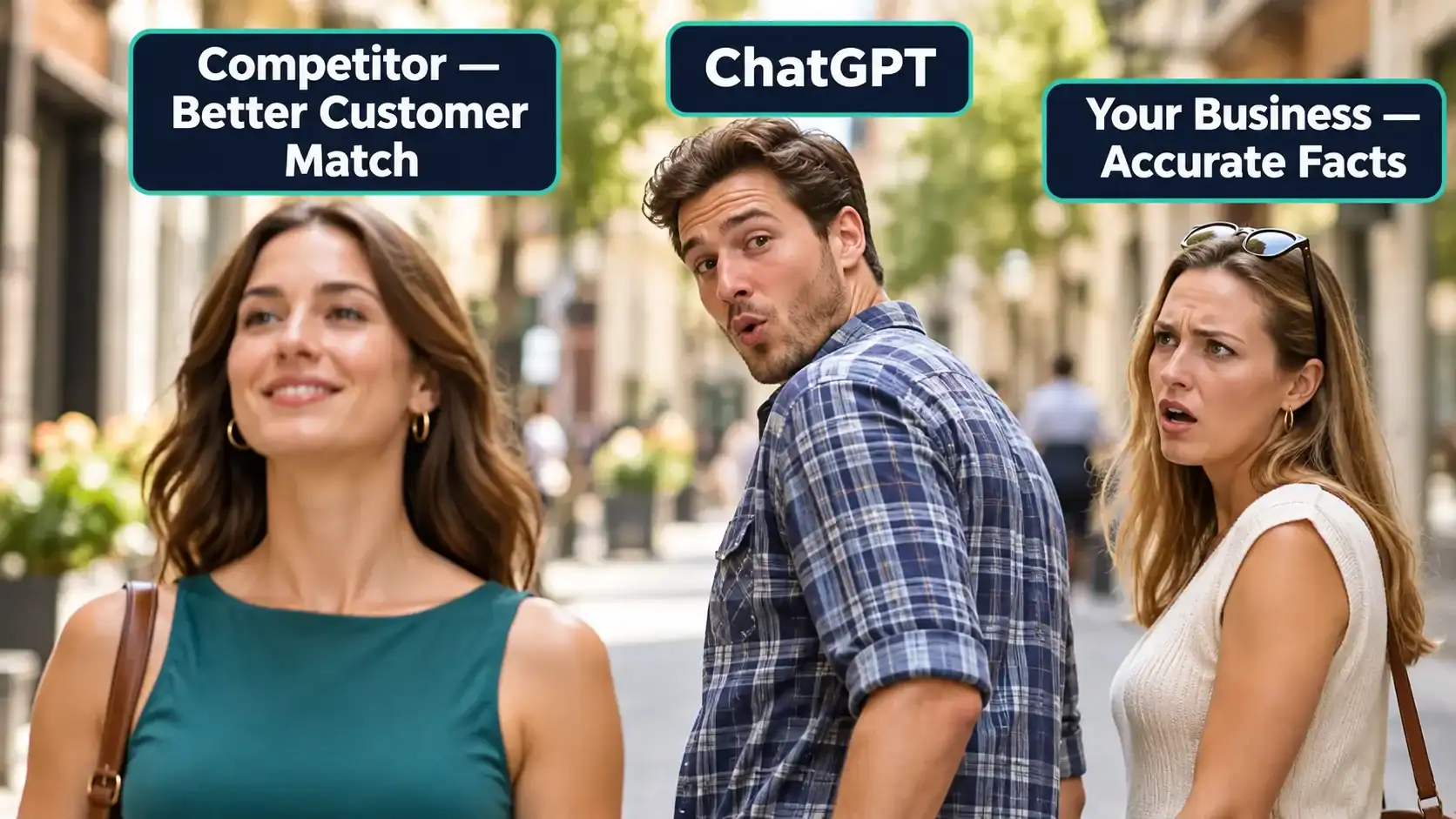
Why Can ChatGPT Find Your Business Facts but Still Recommend a Competitor?
ChatGPT can find your business facts without recommending your business because describing a company named in a question and suggesting candidates for a customer’s needs are different tasks. Correct facts demonstrate accuracy; they do not establish suitability for a particular request or independent inclusion among alternatives.
OpenAI’s shopping documentation illustrates the distinction: “A product appears in the carousel when ChatGPT perceives it to be relevant to your intent” — OpenAI. That concerns shopping, not a local-provider formula. A competitor’s appearance warrants investigation before production. Content Ops Lab approaches that question through research-first verification of information needs.
Related: What Is AI Search Monitoring and What Should Brands Track?
What Does It Mean When ChatGPT Can Find Your Business Facts?
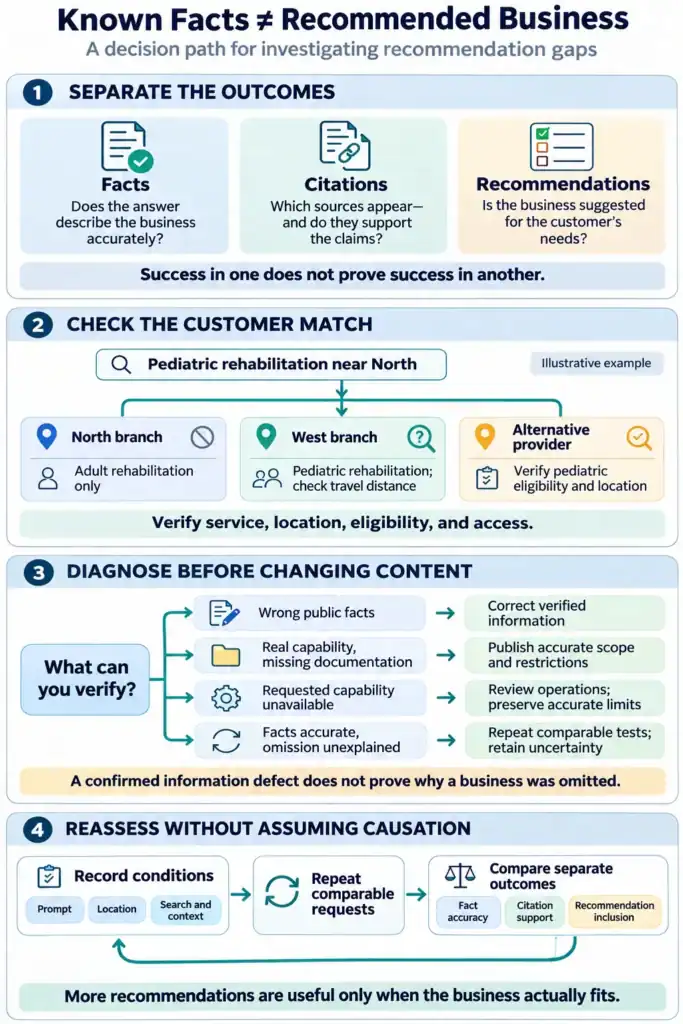
An accurate named-business answer establishes correctness on the checked facts. It does not show that the business would appear without its name in the question. Treat factual accuracy, citation visibility, and recommendation inclusion as separate observations, rather than disclosed stages of an internal selection process.
Named-Business Facts and Unbranded Discovery
“What is Company A’s North branch address?” supplies the entity. “Which rehabilitation providers serve this postal code?” asks for candidates. The task changes despite identical geography.
- Check named facts against current branch records.
- Test unbranded requests within the same geography.
- Preserve each question’s actual wording for review.
When ChatGPT finds your business in the first test, it leaves the second question unanswered.
Source Citations and Actual Recommendations
A link to your website can support an address without suggesting anyone book an appointment. Conversely, a recommendation can cite an external record rather than the recommended company’s own page.
- Code factual correctness separately from source appearance.
- Identify the business actually suggested for consideration.
- Record which source supports each relevant statement.
| Outcome | Observable Success | What It Cannot Establish |
| Factual accuracy | Checked business facts match verified records. | Independent discovery or suitability for another request. |
| Citation visibility | The specified source appears in the answer. | Claim support, endorsement, or recommendation inclusion. |
| Recommendation inclusion | The answer suggests the business for consideration. | Objective superiority or verified customer fit. |
These distinctions tell you what appeared; they leave the quality of its supporting evidence unresolved.
Supplied Comparisons and Independent Selection
An A/B comparison gives the system a candidate set. A preference within that set does not demonstrate that either company would appear in an unbranded search across the wider market.
- Separate supplied comparisons from open discovery requests.
- Counterbalance company order across comparable comparison tests.
- Distinguish explicit preference from simple display order.
Once the task is clear, the next question is whether the business fits the customer.
How Can Customer Fit Change Which Business Appears?
Customer fit depends on whether a specific branch can serve the stated need under the customer’s constraints. Verify that suitability independently before interpreting an omission. Geography, eligibility, specialization, and access are useful investigation categories; their usefulness does not establish how ChatGPT weights them in any particular recommendation.
Geography and the Requested Service
Location context deserves its own record. OpenAI states: “ChatGPT may use an approximate location based on your IP address to provide relevant local results”— OpenAI.
- Specify the requested city or postal code.
- Independently verify the branch’s actual service territory.
- Record location context alongside the original answer.
This documents a relevant condition without proving that proximity caused the observed recommendation or omission.
Eligibility, Specialization, and Access
A branch can offer rehabilitation while lacking the requested specialty appointment. General opening hours also don’t show when a particular clinician or service is available to the customer.
- Confirm eligibility for the requested customer group.
- Check credentials against the relevant issuing authority.
- Verify service-specific hours and the appointment process.
Before interpreting whether ChatGPT can find your business, establish whether the requested access actually exists.
Network Claims and Branch Availability
Network-level descriptions can conceal meaningful branch differences. A service in one part of the organization does not establish availability at a nearby location, even when both branches share the same brand.
- Keep each service attached to its branch.
- State population restrictions where customers evaluate suitability.
- Verify alternatives against the same customer constraints.
Hypothetical example: Company A’s North branch provides adult postoperative knee rehabilitation. Pediatric rehabilitation is available only at West. For a pediatric request near North, North’s adult service does not establish eligibility. Verify whether West is geographically suitable and whether the recommended Company B actually accepts the relevant pediatric patients. Excluding North can be appropriate; including B still requires scrutiny.
Correctly excluding one branch does not verify the alternative, so the supporting claims still need inspection.
What Evidence Supports the Recommendation and Its Claims?
Audit the attributes that make a recommendation relevant, using sources suited to each claim. A visible citation is a starting point for inspection. It does not establish source independence, current branch availability, or verified suitability, and a competitor’s claims deserve the same scrutiny as your own.
Business-Owned Statements and External Records
Business records can establish current appointment policies, while credential authorities can confirm credentials within their remit. A directory listing may help locate information but still require a currency check.
- Match service statements to accountable operational records.
- Use credential authorities for claims they govern.
- Check external listings for dates and duplication.
Having ChatGPT find your business website therefore establishes source appearance, while support requires closer review.
Claim Support and Source Limitations
A citation must support the actual claim beside it. Check whether the source addresses the same branch, service, patient population, and effective period rather than merely mentioning the company.
- Inspect the cited passage against the sentence.
- Treat reviews as accounts of reported experiences.
- Identify copied coverage before counting independent corroboration.
In a 2023 human evaluation of Bing Chat, NeevaAI, perplexity.ai, and YouChat, researchers reported that “only 74.5% of citations support their associated sentence” — Association for Computational Linguistics. This historical finding is not a current ChatGPT error rate or a local-recommendation benchmark.
Citation inspection can reveal unsupported claims, but it cannot by itself explain why another business appeared.
Competitor Claims and Missing Information
Company B’s inclusion in the hypothetical pediatric request does not verify its pediatric capability. Apply the same evidentiary standard to both businesses, including when one has more visible documentation.
- Verify the competitor’s relevant branch and eligibility.
- Keep absent documentation separate from absent capability.
- Treat generated selection explanations as unverified hypotheses.
An answer’s explanation is not an internal audit trail; resource decisions need a confirmed finding.
If your operation needs to produce 20–50+ articles per month without sacrificing compliance or quality, Content Ops Lab builds the infrastructure to make that possible. Contact us to discuss your content production requirements.
Which Recommendation Gaps Justify a Content Change?
Verified errors and undocumented capabilities can justify corrections. Genuine service limitations may require operational decisions. Conflicting records warrant investigation; unexplained omissions may need observation without content changes. Finding an information defect and establishing the cause of an omission remain different conclusions.
Confirmed Errors and Undocumented Capabilities
If a page incorrectly assigns pediatric rehabilitation to North, correct it against verified records. If West’s verified pediatric service is missing publicly, publish its actual scope and restrictions accurately.
- Document the confirmed defect before assigning production.
- Require an accountable owner to verify capability.
- Preserve restrictions in the corrected public information.
Helping ChatGPT find your business facts accurately is worthwhile even when recommendation effects remain unknown.
Genuine Limits and Appropriate Exclusion
In the hypothetical example, North cannot become a pediatric provider through broader wording. Accurate information may make its exclusion clearer while helping families assess whether West meets their needs.
- Retain North’s adult-only scope in relevant descriptions.
- Assess West against the customer’s geographic constraints.
- Escalate actual service gaps to operational leadership.
A proposed expansion needs a business decision; promotional language cannot supply a capability that does not exist.
Uncertainty and the Appropriate Response
When current records already describe the relevant capability accurately, an omission alone does not establish a publishing defect. Preserve uncertainty instead of converting every competitor appearance into another content assignment.
- Resolve conflicting evidence before recommending public changes.
- Repeat comparable observations when recommendation outputs vary.
- Permit no content change when facts hold.
| Confirmed Finding | Appropriate Action | Omission-Cause Status |
| Wrong branch-service claim | Correct verified records and affected pages. | Causal role remains unproven. |
| Verified capability absent publicly | Publish accurate scope and restrictions. | Missing information is an observed defect. |
| Actual capability absent | Escalate for operational review; preserve accurate limits. | Exclusion may reflect real mismatch. |
| Conflicting evidence | Resolve sources with accountable owners. | Interpretation remains uncertain. |
| Comparable runs vary | Repeat observations and report variation; content may need no change. | Variation alone identifies no cause. |
The next decision needs consistent observation records, especially when repeated tests produce different answers.
Related: How Should You Evaluate Citation Quality in AI Search Results?
How Should Teams Measure Facts, Citations, and Recommendations Separately?
Use a bounded panel of commercially relevant questions with declared counting rules and recorded conditions. Separate the outcomes before comparing results. A panel can describe observed performance within its scope; it cannot expose hidden selection mechanics or establish a universal inclusion rate across all business requests.
Prompt Classes and Testing Conditions
Identical prompts can involve different retrieval. When partnering with search providers: “When it does, ChatGPT search typically rewrites your query into one or more targeted queries that it sends those providers” — OpenAI.
- Separate named, unbranded, need-specific, and comparison questions.
- Record timestamp, time zone, surface, displayed model, geography.
- Preserve memory/context, requested search, and observed search.
- Save raw answers, source URLs, and branch identifiers.
Counterbalance A/B candidate order. Record unavailable context as unknown rather than assuming that conditions matched.
Comparable conditions improve interpretation, but each outcome still needs its own explicit denominator and coding rule.
Separate Metrics and Explicit Denominators
Define the checks before reviewing results so favorable answers do not determine the scoring system. Each rate should answer one question about one declared prompt class or audited set.
- Report wrong, missing, and unverifiable facts separately.
- Separate first-party citations from relevant third-party citations.
- Exclude negative mentions from positive recommendation counts.
| Metric | Counting Rule | Reporting Boundary |
| Factual accuracy | Correct predefined checks / all predefined checks. | Report wrong, missing, and unverifiable checks separately. |
| Citation visibility | Completed tests containing the specified source class / all completed tests in that prompt class. | Report first-party and relevant third-party visibility separately; a test can contain both. |
| Citation support | Supported audited claim–citation pairs / all audited pairs. | Declare the audited set; unresolved support remains separately visible. |
| Recommendation inclusion | Completed recommendation tests suggesting the business / all completed recommendation tests in the declared class. | Negative mentions do not qualify; distinguish relevant branches. |
Zero-denominator rates are unavailable, not zero. Predefine how partial support is coded and report it separately from full support.
These measures describe different observations; combining them into one score can conceal the actual problem.
Repeated Observations and Uncertainty
Repeat the panel under recorded conditions and retain the counts behind each frequency. Repetition shows whether an observation recurs within the panel, without establishing a universal minimum sample size.
- Preserve per-prompt counts and separate branch breakdowns.
- Report refusals, failures, and incomplete outputs separately.
- Rank explicit preferences; keep omissions recorded separately.
Letting ChatGPT find your business repeatedly in named tests still does not measure unbranded inclusion.
What Should Leaders Improve Before Testing Again?
Improve verified information defects through assigned ownership, publication review, and comparable reassessment. Track customer usefulness and qualification accuracy alongside recommendation inclusion during each subsequent review. Clearer restrictions can appropriately reduce unsuitable recommendations; unchanged inclusion does not erase a correction’s customer value.
Verified Service and Location Information
Maintain a current branch-service record before expanding public descriptions. Accessible text should explain the verified distinction clearly enough for customers to understand it without relying on implied network-wide availability.
- Record service status, restrictions, credentials, and provenance.
- Assign an owner and dated review responsibility.
- Keep markup consistent with visible page content.
Google’s AI Overviews and AI Mode guidance states: “There’s also no special schema.org structured data that you need to add” — Google. That is Google guidance, not a ChatGPT requirement or evidence that markup changes improve recommendations.
Accurate records make corrections reviewable, but publication still requires clear responsibility across the people involved.
Accountable Corrections and Publication Review
Operations should verify what the branch can provide before editorial turns that information into copy. Publication review then checks whether the page communicates the verified scope without adding unsupported implications.
- Operations verifies capability; editorial checks claims and citations.
- SEO checks access and relevant location relationships.
- Analytics preserves panel definitions and observation rules.
An external listing correction request is not a completed correction. A changed external answer is another distinct outcome.
Once publication is confirmed, reassessment must preserve enough context to distinguish observed changes from assumed effects.
Comparable Reassessment and Business Decisions
Reuse the fixed panel and annotate both content and operational changes. Later inclusion gains can coincide with those changes without demonstrating causation, especially when other conditions also changed concurrently.
- Preserve the original questions and coding definitions.
- Annotate corrections, operational changes, and test conditions.
- Measure customer inquiries and business outcomes separately.
Seeing ChatGPT appear in more recommendations is an observation, not attributable revenue by itself.
How Can Content Ops Lab Support More Reliable Business Information?
Content Ops Lab reports a 5x increase in monthly output, from 10 to 50+ articles per month, for a 12-location regulated healthcare client. Its own reporting also records 1,000+ articles and pages delivered with verified citations across the full 23-month engagement, April 2024–March 2026. These historical figures describe reported production experience, not recommendation performance.
A verified branch-service defect needs an accurate brief, supporting records, and reviewable delivery. An unexplained omission may need further observation before writing begins. Intake discipline keeps those assignments separate.
- Research-first intake defines the question before production begins.
- Citation verification checks source support for specific claims.
- Custom knowledge integration grounds drafts in approved records.
- Multi-stage review examines accuracy, structure, and publication readiness.
- 5x increase in monthly output (10 → 50+ articles/month).
- 1,000+ articles and pages delivered with verified citations across full 23-month engagement.
These figures are self-reported, not independently verified evidence of factual accuracy, recommendation uplift, competitor displacement, or causal business impact. Applying these production practices to a recommendation investigation does not establish that the client engagement tested that use case. The proposed work begins with the information need the investigation can substantiate.
The Content Ops Lab Production System
The production system carries verified requirements into publishable material with a reviewable basis for each decision. Its role is governed content delivery; recommendation selection remains an external outcome to observe.
- Research: Establish customer questions and collect relevant business records.
- Verification: Check claims, citations, and branch scope against supporting evidence.
- Optimization: Clarify structure and extractable answers while preserving verified restrictions.
- Delivery: Provide reviewed content with documented ownership and publication requirements.
A useful engagement starts with a reviewable information problem and an agreed production scope.
Ready to build content infrastructure that scales without the compliance risk? Get in touch — we’ll assess your current content operation and outline what a systematic approach would look like for your organization.
FAQs About ChatGPT Find Your Business
If ChatGPT already knows our business, why should we investigate an omission?
Correct named-business facts do not establish inclusion in an unbranded recommendation. Investigate commercially relevant requests the business plausibly fits. Compare verified customer needs, branch capability, and the answer’s claims before commissioning changes. The investigation may identify a correction, an operational limitation, a need for more observation, or no content work.
How can we tell whether improving business information is worth the effort?
Judge the work by the confirmed defect, correction effort, and usefulness to customers, alongside later comparable observations. A wrong service restriction can deserve correction even if recommendations remain unchanged. Define the intended improvement and owner before production. Track inquiries and business outcomes separately; an increase in inclusion does not provide a universal ROI calculation.
Can clearer information cause ChatGPT to recommend our business less often?
Clearer restrictions could reduce recommendations for customers the business cannot appropriately serve, although an observed change alone would not establish causation. In the hypothetical example, North’s adult-only scope should remain accurate for pediatric requests. Evaluate qualification accuracy alongside inclusion. More appearances are not automatically better if they imply a service the branch lacks.
Does a competitor’s recommendation mean ChatGPT considers it a better business?
A generated recommendation does not establish objective superiority or independently verified qualifications. Check whether the competitor fits the same geography, requested service, customer group, and access constraints. Inspect the cited claims under the same standards applied to your business. A supplied A/B preference also cannot establish market-wide rank or explain an unbranded omission.
Can Content Ops Lab help when ChatGPT recommends a competitor?
Content Ops Lab can apply research-first intake, approved business knowledge, citation verification, and reviewed production to substantiated information needs. Start with the request, verified branch records, saved answers, and source evidence. That scope may involve correcting content. It does not include platform correction access or a guarantee of recommendation placement.
Key Takeaways
- Factual accuracy, citation visibility, and recommendation inclusion answer different questions; measure each separately before interpreting a competitor’s appearance as a production problem.
- Verify customer fit at the branch level; accurate restrictions can appropriately exclude locations that cannot provide the requested service.
- Content Ops Lab’s research-first intake connects production assignments to verified information needs, preserving uncertainty when the cause of omission remains unexplained.
- COL reports 5x monthly output growth and 1,000+ delivered articles and pages during one historical engagement; neither figure establishes recommendation gains.
- Review one commercially important request against verified records, audit competitor claims equally, and repeat comparable observations before committing resources to changes.
What Should You Do After Seeing ChatGPT Find Your Business Facts?
Start with one commercially important service and location request. Verify which branch can serve it, inspect the answer’s supporting claims, and repeat the observation under recorded conditions. That gives a decision owner something concrete to assess: a factual correction, an undocumented capability, a real service limitation, or uncertainty that warrants further observation.
Having ChatGPT find your business should support useful, accurate qualification, with testing limits clearly stated. Publishing more material should follow a verified need. Content Ops Lab applies governed research and production to those information requirements, while recommendation outcomes are measured separately. Bring the request, branch records, saved responses, and cited sources to the first review.
Related: How Are AI Search Queries Different From Google Search Queries?