

Which AI Trust Signals Influence Brand Recommendations?
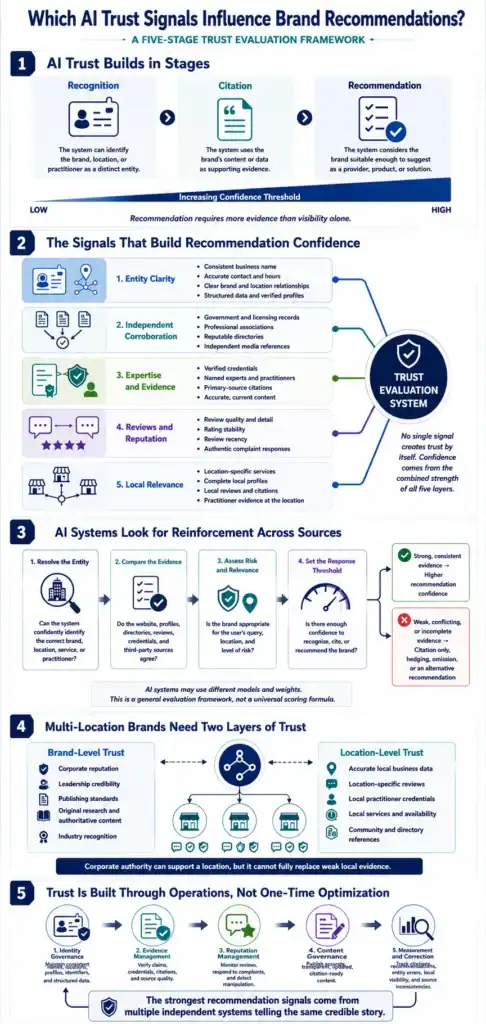
AI trust signals are the observable evidence — entity consistency, independent corroboration, reputation, expertise, and location accuracy — that answer engines use to decide whether a brand is worth recommending, not just citing. Search systems have said they “largely understand the quality of content through what are commonly called ‘signals'” rather than through a single trust metric — Google.
Most marketing teams still chase one lever — more citations, a higher authority score — as if it were the trust switch. No single signal appears to work alone; recommendation confidence is more likely to grow when multiple signal families reinforce one another. Content Ops Lab has spent nearly two years building citation-verified systems for a 12-location regulated healthcare client. That work demonstrates how identity, evidence, and governance can be managed operationally at scale.
Related: How Does AI Brand Authority Affect Search Visibility?
What Are AI Trust Signals?
AI trust signals are the observable evidence — entity data, independent mentions, reviews, credentials, and content quality — that answer engines use to infer whether a brand is reliable and suitable to recommend. No platform publishes a single trust score; a layered set of clues collectively raises or lowers confidence.
A Working Definition, Not a Ranking Formula
“AI trust signals” is a practical shorthand, not a documented taxonomy any platform has published in full.
- Entity data confirms who the brand is
- Independent sources corroborate its stated claims
- Reviews and credentials support its reputation
- Content quality demonstrates real subject-matter competence
- Location data confirms a specific branch is legitimate
Treat these as evidence categories to strengthen, not as a checklist to finish once and continuously.
Why Search Documentation Only Goes So Far
Google has published guidance describing quality signals for organic search — useful background, not a disclosure of generative recommendation logic.
- Google’s public guidance covers organic search ranking
- Generative answer engines publish no equivalent recommendation criteria
- Borrowing search concepts requires treating them as an analogy
- Platform-specific behavior still needs platform-specific caution
Applying search-era thinking directly to generative recommendation logic risks treating inference as fact.
Expertise and Trust Signals Intensify for High-Stakes Topics
High-stakes topics — health, finance, civic information — draw closer scrutiny across search and recommendation systems alike, and the dedicated section on expertise later in this article covers why.
- Health, finance, and safety topics draw more scrutiny
- Regulated categories should expect a higher evidence bar
- The exact recommendation threshold remains undisclosed by any platform
This sets up the higher bar that the rest of the article examines: recommendation rather than citation.
Why Is Being Recommended Different From Being Recognized or Cited?
Recognition means a system can identify a brand as an entity. A citation means it used the brand’s content as a source. Recommendation means the system concluded, with enough confidence, that the brand suits this specific query — a materially higher bar than the first two.
Recognition Means the System Knows Who You Are
Recognition is entity-level identification: the system matches a name, location, or organization to a known record, nothing more.
- Recognition confirms identity, not quality
- A brand can be recognized and never get recommended
- Entity recognition is a prerequisite, not a proof point
- Confusing recognition with endorsement misleads strategy
- Recognition alone tells a system nothing about suitability
Recognition is table stakes; it doesn’t carry a brand any further on its own.
Citation Means the System Used Your Content as Evidence
Perplexity describes itself as an answer engine that “searches the internet in real time to deliver fast, clear answers… with sources and citations included” — Perplexity.
- Citation shows sourcing, not approval
- A cited page can still be outdated or incomplete
- Platforms cite for user verification, not brand endorsement
- Treating citation as trust confuses two separate outcomes
- Being cited once says nothing about future recommendations
That gap between “used as a source” and “trusted enough to recommend” is where GEO advice often goes wrong.
Recommendation Means the System Trusts You Enough to Suggest You
Research on conversational recommender systems found that “an accurate confidence signal generates the greatest increase in trust-related metrics” — ACM FAccT 2023. Recommendation implies a confidence judgment, not just retrieval
- Confidence research supports, but doesn’t prove, platform mechanics
- Higher-stakes recommendations plausibly require stronger evidence
- No platform has disclosed an internal confidence threshold
Whatever confidence threshold a system applies, reliable entity identification is a necessary starting point.
Which Entity and Consistency Signals Help AI Systems Trust a Brand?
Systems cannot confidently recommend an entity they cannot consistently identify. Matching names, addresses, phone numbers, categories, and hours across a website, business profiles, and directories reduces the ambiguity that undermines confident identification.
Consistent Identity Across Every Channel
Google states that “businesses with complete and accurate info are more likely to show up in local search results” — Google.
- Match name, address, and phone across every listing
- Keep categories, hours, and services aligned everywhere
- Reconcile legal entity names with public-facing brand names
- Treat every authoritative directory and business profile as part of the same identity record
- Correct discrepancies at the source, not listing by listing
Consistency alone doesn’t prove quality — but inconsistency creates doubt about which brand is being evaluated.
Every Location Is Its Own Entity
Schema.org defines LocalBusiness as “a particular physical business or branch of an organization,” explicitly including branches of a chain — Schema.org.
- Each branch is a separate entity, not a headquarters clone
- Location-level data needs its own accuracy and completeness
- A trusted flagship doesn’t automatically cover a new branch
- Entity structure should mirror real operational boundaries
- New locations cannot rely on parent-brand authority alone
Structuring locations correctly is groundwork — describing them well with schema is a separate step.
Structured Data Describes, It Doesn’t Certify
Schema.org reports that “over 45 million web domains markup their web pages with over 450 billion Schema.org objects” — Schema.org.
- Structured data helps machines parse entity attributes
- Adoption scale doesn’t equal ranking or trust impact
- Schema supports clarity, not quality certification
- Markup without accurate underlying data adds no real trust
- Schema is a description of infrastructure, not a credibility shortcut
Clear identity reduces ambiguity; independent corroboration gives systems more evidence to evaluate.
If your operation needs to produce 20–50+ articles per month without sacrificing compliance or quality, Content Ops Lab builds the infrastructure to make that possible. Contact us to discuss your content production requirements.
How Do Reviews, Reputation, and Independent Corroboration Influence Recommendations?
Systems need evidence beyond what a brand publishes about itself. Reviews, third-party mentions, licensing records, and independent press function as corroboration — confirmation from someone other than the brand.
Reputation Is Composite, Not a Star Rating
A systematic review of e-commerce trust research found that “review quality, volume, consistency, and reviewer credibility significantly influence consumer trust” — Trust in E-Commerce.
- Volume and consistency matter as much as average rating
- Reviewer credibility affects how much weight the evidence carries
- Recency and specificity strengthen a review’s evidentiary value
- A high average rating alone doesn’t establish a reputation
- Composite reputation only holds if the reviews are genuine
Independent Corroboration Beats Self-Promotion
A brand’s own website claims carry less evidentiary weight than the same facts confirmed by unrelated sources— such as licensing boards, trade groups, or independent press.
- Third-party confirmation strengthens a brand’s own claims
- Not every mention carries equal weight — source quality matters
- Syndicated or copied content isn’t independent corroboration
- Credible, unrelated sources repeating a fact raise confidence
- Corroboration only helps when the sources are genuinely independent
Independent corroboration only helps if it’s genuine — manipulated evidence works against a brand instead.
Manipulated Reviews Undermine the Whole System
The FTC has warned that “some businesses abuse that trust by writing or procuring fake reviews or by paying supposedly independent websites for good rankings” — FTC. Fake reviews directly violate documented FTC guidance.
- Manipulated reputation evidence can trigger regulatory exposure
- Deceptive endorsements undercut the corroboration model entirely
- Authentic reputation management protects both compliance and trust
- A pattern of manipulation is riskier than any single incident
Reputation carries more weight as stakes rise — exactly where expertise enters the picture.
Why Do Expertise, Credentials, and Evidence-Backed Content Matter More in High-Stakes Industries?
An incorrect recommendation in healthcare, legal, or financial categories carries more real-world consequences than one for a restaurant. That asymmetry is why verifiable credentials and transparent authorship matter more as stakes rise.
Higher Stakes Raise the Evidence Bar
Google places “an even greater emphasis on factors related to expertise and trustworthiness,” specifically for health, finance, and crisis-related topics — Google.
- Regulated categories draw more evidentiary scrutiny
- Health, finance, and safety topics carry more real-world risk
- Higher risk plausibly demands stronger, more verifiable evidence
- Weak sourcing is costlier in high-stakes categories
- Generic content underperforms fastest in regulated niches
Meeting that bar starts with proving the expertise itself is real, not just claimed.
Expertise Must Be Verifiable, Not Just Claimed
Source-credibility research describes expertise and trustworthiness as “the most enduring” dimensions of credibility across decades of study — Metzger & Flanagin.
- Verifiable credentials outweigh decorative titles
- Licensing and registry checks matter more than bio copy
- Author transparency supports, but doesn’t replace, real qualifications
- Unverifiable expertise claims add risk, not credibility
- A credential that can’t be checked functions as an unsupported claim
Verified expertise only matters if the content built on top of it holds up.
Content Quality Signals Compound with Credentials
Google’s ranking systems documentation notes that its reviews system aims to reward “content that provides insightful analysis and original research… written by experts or enthusiasts who know the topic well” — Google.
- Original analysis outperforms shallow, templated content
- Primary-source citations strengthen credibility claims
- Transparent authorship supports the expertise a page claims
- Citations alone don’t make content accurate or safe
- Defensible claims matter more than confident-sounding phrasing
Credibility built at the corporate level still has to hold up at the level of one location.
Related: How Does E-E-A-T Apply to AI Search?
Why Must Multi-Location Brands Build Trust at Both the Corporate and Local Levels?
Corporate reputation and national content can establish brand-level authority. Local recommendation still depends on that specific location’s relevance, accuracy, and reviews — corporate strength helps, but can’t fully substitute for it.
Corporate Authority Sets a Baseline, Not a Guarantee
A strong parent brand creates a favorable starting point for any location, but doesn’t automatically confer full trust on a branch that a local system hasn’t independently evaluated.
- National reputation can support a location’s baseline credibility
- It cannot replace location-specific evidence and accuracy
- Corporate authority helps eligibility; it doesn’t guarantee it
- Each location still needs its own case made
That baseline still has to hold up against how relevant and close a location is.
Local Relevance and Distance Still Decide the Match
Google states that “local results are mainly based on relevance, distance, and popularity,” which together help match customers to the best nearby option — Google. Relevance to the query matters as much as brand strength.
- Distance affects whether a location is even a viable match
- A smaller, closer specialist can outrank a bigger, distant brand
- Trust and proximity are related but separate factors
- Being the best-known option doesn’t guarantee being the closest fit
Relevance and distance only tell half the story — each location still needs its own proof.
Every Branch Must Earn Its Own Evidence
Schema.org’s LocalBusiness definition treats “a particular branch of a restaurant chain” the same as any standalone business, as its own entity — Schema.org: LocalBusiness.
- Each branch needs complete, accurate business information
- Local reviews and credentials matter at the branch level
- Staff credentials should be verifiable, location by location
- Corporate content supports but doesn’t replace local proof
- Location-level gaps undercut an otherwise strong national profile
Trust-building is not only additive — conflicting, manipulated, or outdated evidence can weaken confidence in recommendations.
Which Negative Signals Can Weaken AI Recommendation Confidence?
Trust isn’t built only by accumulating positive evidence. Conflicting business data, fake reviews, deceptive claims, and outdated information introduce uncertainty that can suppress recommendation confidence even when other signals look strong.
Conflicting Information Creates Ambiguity
When a brand’s name, address, category, or hours differ across sources, systems face genuine ambiguity about which version is correct.
- Conflicting NAP data confuses entity resolution
- Outdated directory listings create false conflicts
- Ambiguity about identity weakens every other signal
- Reconciling conflicting sources is foundational identity hygiene
- Unresolved conflicts persist until someone corrects the source
Ambiguity is a data problem; manipulated evidence is a deliberate one, and more damaging.
Fake Reviews and Deceptive Claims Erode Confidence
The FTC’s guidance on fake and purchased reviews treats manipulated reputation evidence as a recognized compliance risk, not just a trust problem — FTC. Fake reviews violate documented FTC guidance.
- Deceptive endorsements undermine independent corroboration
- Unsupported claims create risk without evidence behind them
- One manipulated data point doesn’t ruin trust — a pattern does
- Compliance exposure compounds the reputational damage
Manipulation deliberately corrupts trust; stale or unsafe information erodes it just as effectively.
Outdated or Unsafe Information Can Weaken Recommendation Confidence
Stale hours, discontinued services, or unresolved safety issues signal that a brand’s public information no longer reflects reality — a risk any recommendation system has reason to avoid.
- Outdated information misrepresents current operations
- Unresolved safety or regulatory issues raise a real risk
- Stale profiles suggest a brand isn’t actively maintained
- Recommendation risk rises when information can’t be trusted, as the current
- A profile frozen in time reads as an abandoned one
Understanding what weakens trust matters less than knowing how to build it deliberately.
How Can Brands Build AI Trust Signals as an Operating System?
Trust isn’t manufactured with a single campaign. It’s built through repeatable systems that keep identity, evidence, reputation, and content accurate over time — organized around governance, verification, and measurement.
Identity Governance Comes First
Every location and channel needs a single source of truth for name, address, phone, category, and hours, with a process to propagate corrections across all locations and channels.
- Assign ownership for every business profile and directory listing
- Audit NAP consistency on a recurring schedule, not once
- Correct discrepancies at the source, then propagate the fix
- Treat schema and structured data as description, not decoration
- Document the identity record so it survives staff turnover
Clean identity data means little without evidence and a reputation to back it up.
Evidence Verification and Reputation Management
Content Ops Lab’s own production model reflects this discipline: a research-first, citation-verified system run for 23 months across a 12-location regulated healthcare organization, producing more than 1,000 articles and pages with zero reported compliance issues.
- Verify credentials against real licenses and registries
- Verify third-party evidence before using it to support brand claims
- Require primary-source citations for high-stakes claims
- Audit content for accuracy on a defined schedule
- Track proxy indicators over time instead of chasing a score
None of this holds if it’s a one-time project instead of an ongoing system.
Turning Principles Into a Repeatable System
Brands that treat trust as an operating system, not a one-time project, are the ones whose evidence still holds up after the next platform update.
- Document identity, evidence, and reputation standards centrally
- Repeat verification at every new location, not just headquarters
- Measure proxy indicators over time, not a synthetic trust score
- Build governance that survives staff turnover and platform changes
Building this kind of infrastructure is exactly what Content Ops Lab was built to operationalize.
How Content Ops Lab Builds Content Infrastructure
Content Ops Lab operates a research-first, citation-verified production system, run for 23 months across a 12-location regulated healthcare organization. That deployment produced more than 1,000 articles and pages with zero reported compliance issues — proof that trust principles can be operationalized at scale.
- 23-month production run across a 12-location regulated healthcare client
- 1,000+ citation-verified articles and pages delivered
- Zero reported compliance issues across the full deployment
- Every claim is traced to a verified source before publication
- Entity and location data are governed centrally across all 12 locations
- Entity, location, and source-verification controls are built into the standard workflow
- Structured data is applied for entity clarity, not as a ranking shortcut
- Content standards enforced through a defined editorial review process
The Content Ops Lab Production System
The system runs on four repeatable stages that keep identity, evidence, and content accurate as brands scale across locations.
- Research: source verified facts before any draft begins
- Verification: trace every claim to its original document
- Optimization: structure content for readers and answer engines alike
- Delivery: publish with governance that catches drift over time
Ready to build a content infrastructure that scales without the compliance risk? Get in touch today — we’ll assess your current content operation and outline what a systematic approach would look like for your organization.
Frequently Asked Questions
Can AI recommend a brand without strong backlinks or major press coverage?
Yes. No single signal is known to determine whether a brand will be recommended. A smaller specialist can build a strong case through clear entity data, verifiable expertise, credible reviews, and authoritative content, even without major press. Independent mentions still strengthen the case, but they aren’t the only path to recommendation.
Which AI trust signals should a multi-location brand fix first?
Start with entity and location data accuracy, credential verification, and review governance — these are foundational and can be fixed quickly. High-risk content accuracy and independent corroboration come next. Prioritize documented, verifiable fixes over speculative GEO tactics without a clear evidentiary basis.
Can fake reviews or unsupported claims reduce AI trust signals?
Platforms document spam, deceptive reviews, and reliable information systems that treat manipulated evidence as a risk factor. The FTC separately treats fake and paid reviews as a compliance issue. The exact effect of any single AI recommendation isn’t publicly disclosed, but the manipulation of evidence undermines a brand’s credibility.
Why might AI recommend a smaller specialist instead of a better-known brand?
Popularity and credibility aren’t the same thing. A smaller specialist may be more relevant to the query, more clearly expert in a narrow area, better corroborated by independent sources, or stronger at the local level — any of which can outweigh general brand recognition.
Can an agency build AI trust signals for a brand?
An agency can build the systems that publish, verify, structure, and monitor evidence — governance, content standards, and consistency across locations. It cannot manufacture genuine expertise, licenses, authentic customer experience, or third-party reputation. Those have to be real first.
Visibility Is Not Trust: What Multi-Location Brands Must Build Next
AI trust signals aren’t a single lever — they’re identity, corroboration, reputation, expertise, and location evidence working together, and a recommendation follows only when enough of them agree. Google’s own description of quality signals as clues rather than a single metric reinforces this — Google.
Brands waiting for a published ranking formula will keep optimizing the wrong thing. The ones that start now — auditing entity consistency, verifying credentials, governing reviews — are the ones whose evidence compounds rather than decays.
Visibility measures where a brand appears; trust reflects whether the available evidence supports recommending it. Brands cannot control the final judgment, but they can control the accuracy, consistency, and credibility of the evidence systems that are evaluated.