
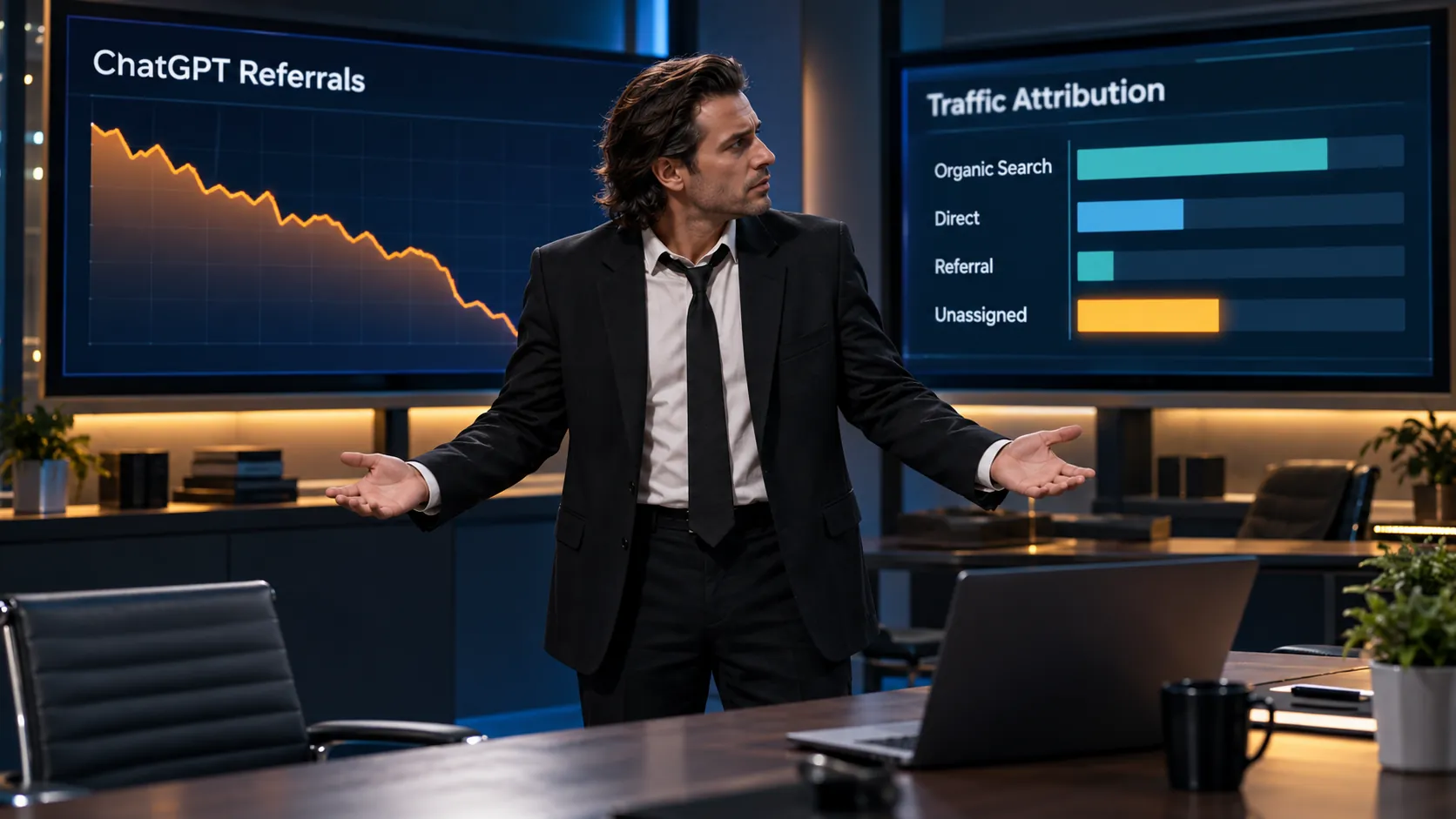
Did Your ChatGPT Traffic Drop—or Did Attribution Break?
A ChatGPT traffic drop can reflect fewer visits, lost source information, failed analytics collection, or changed reporting. The line alone cannot distinguish them. Before changing content investment, compare the affected landing pages, test referral paths, and check independent arrivals alongside business outcomes. Measurement failure and visit loss can coexist.
Webflow reported that “there was an average 47% decline in ChatGPT-attributed traffic.” Its Analyze/Optimize customer dataset had undisclosed size and controls. Webflow dates missing tags to October 8–15, 2026, reporting restoration October 15; unchanged visits remain unproven for individual sites.
The wrong diagnosis can misdirect budget. Content Ops Lab puts evidence verification before content-strategy changes.
Related: How Do You Track AI Referral Traffic?
What Does a ChatGPT Traffic Drop Actually Measure?
A source report measures sessions your analytics system identified and classified. It does not independently count everyone arriving from ChatGPT. A decline becomes actionable when you establish which part changed: discovery, arrival, collection, classification, or the commercial value of those visits.
Attributed Sessions and Actual Arrivals
URL campaign markers are labels attached to links, such as utm_source=chatgpt.com. Browser referrers are separate information about the referring page. Either can help identify where an arrival originated.
- Campaign markers label the destination through URL query parameters.
- Browser referrers supply separate evidence about the referring page.
- Compare recorded source information against the final report label.
Neither source input guarantees that the analytics system collected the visit or classified it correctly.
Reclassification and Missing Collection
Collection means sending measurement events to analytics; classification means assigning recorded activity to reporting categories. A missing source label and a missing event therefore require different investigations and repairs.
Google states: “A session is processed as direct traffic when no information about the referral source is available”. Its documentation also covers exclusions and source precedence.
- Direct can include visits with unavailable referral source information.
- Missing markers do not guarantee matching increases in Direct.
- Unassigned can indicate source details failed channel classification rules.
- If no analytics events are collected, there is no recorded session to reclassify.
- Existing source precedence can affect the resulting session attribution.
A larger Direct total is a clue to investigate, not a recovered ChatGPT audience.
Genuine Visit Loss and Mixed Outcomes
An attribution defect does not protect a site from declining demand or weaker discovery. Both problems can occur together, while unrelated traffic growth makes the overall website appear stable.
- Discovery losses can affect previously successful educational landing pages.
- Homepage traffic can change differently from deeper referral destinations.
- Check whether other channels conceal losses within affected pages.
- Keep genuine visit loss open while testing measurement defects.
The next question is where evidence disappears between the outbound link and final report.
How Can Link and Reporting Changes Hide ChatGPT Visits?
Link behavior, redirects, processing, and dashboard definitions can change what appears in a ChatGPT report. Missing URL tags do not necessarily erase attribution if another usable source signal survives. A collected visit can disappear from a dashboard whose filter excludes its current classification.
Missing URL Markers and Browser Referrers
A redirect can remove campaign parameters before analytics reads them. Browser behavior or link attributes can also suppress referral information, leaving the destination with less evidence about the visit’s origin.
W3C defines noreferrer: “Requires that the user agent not send an HTTP Referer (sic) header if the user follows the hyperlink.”
- Missing UTMs can coexist with a usable browser referrer.
- Both inputs can disappear along the same referral path.
- Distinguish referrer suppression from noopener, which controls opener access.
- Attribute tested behavior only to the specific environment observed.
That standards definition explains a possible mechanism; it does not establish universal ChatGPT behavior.
Default Channels and Dashboard Definitions
A report restricted to Referral can miss traffic assigned elsewhere. Google’s May 13, 2026 update introduced AI Assistant classification, so an unchanged dashboard can produce a changed interpretation of arrivals.
Google documents: “A new “ai-assistant” value is automatically assigned when the referrer matches a recognized AI Assistant”.
- Inspect session source and medium alongside aggregate channel totals.
- Check default and custom channels against legacy dashboard filters.
- Compare manually tagged visits with automatically recognized assistant referrals.
Hypothetically, a collected visit retains utm_source=chatgpt.com, but the property’s processing and channel rules place it outside Referral. A dashboard filtered to Referral would omit that visit even though its session source still identifies ChatGPT. Check the property’s actual rules before assigning an expected channel.
A classification update cannot identify a visit whose usable source information never reached analytics.
Report Scope and Processing Conditions
Use session-scoped acquisition to investigate the incident period. First-user acquisition describes how users were initially acquired, answering a different question from which sources brought sessions during the affected dates.
- Allow the affected reports to complete their processing windows.
- Inspect visible data-quality notices before attributing differences to artifacts.
- Confirm the selected acquisition dimensions answer the incident question.
A successful click today establishes current behavior; it cannot reconstruct an undocumented historical referral path.
How Do You Check Whether Visits Still Reached Your Site?
Investigate a ChatGPT traffic drop by preserving the original report, selecting comparable landing pages, and requesting independent arrival evidence plus controlled tests. Give analytics and web owners a clearly bounded request that locates demonstrated breaks and keeps remaining uncertainty visible.
Comparable Landing Pages and Independent Arrivals
Build a cohort from pages with identified ChatGPT visits before the disruption, including relevant homepage traffic. Compare equivalent weekdays, hours, devices, and markets rather than unmatched site-wide totals.
Apache describes its configured log referrer field: “This gives the site that the client reports having been referred from.”
| Symptom | Primary Check | Remaining Uncertainty |
| ChatGPT down; Direct up | Compare source fields and timing within a matched landing cohort. | Direct includes other origins; matching movements cannot identify individual visits. |
| GA4 down; independent arrivals stable | Compare collection against filtered server/CDN requests, checking cache coverage. | Requests differ from sessions; bots can distort the comparison. |
| Both arrival measures down | Validate coverage and comparability, then inspect demand and discovery. | Several origins may decline; measurement defects can coexist. |
| Source present; expected channel absent | Compare collected source with processed dimensions, rules, and filters. | Current defects may explain only part of historical losses. |
- Confirm logging configuration retained the fields needed for comparison.
- Document consistent bot filtering, deduplication, and request inclusion rules.
- Check cache coverage before treating origin logs as comprehensive.
- Match report dates, time zones, filters, and comparison windows.
Logs corroborate requests under stated assumptions; absent origin evidence still prevents reliable ChatGPT assignment.
Controlled Clicks Across Representative Environments
Commission repeatable clicks using clean test profiles across representative desktop and mobile paths. The record must link what the tester clicked to what the website received and what analytics eventually reported.
- Capture timestamp, client, browser, device, account, model, where available.
- Save prompt, link surface, and exact copied outbound URL.
- Record redirects, final destination, and received browser referrer information.
- Confirm landing request and collected event under recorded consent.
- Reconcile processed session source, medium, and channel after processing.
Repeat representative paths; one successful browser test cannot establish reliable attribution across all environments.
Tag, Consent, and Deployment Evidence
Compare the incident onset against implementation records. A received landing request without a corresponding analytics event points toward collection; intact source details outside the expected channel point toward classification.
On blocking tags, Google says it “prevents them from firing so they can’t send any information at all.” Consent-mode operation differs; denial does not universally eliminate every signal.
Google Tag Manager states: “Tag Manager maintains a publish history, so you can see when versions were live and who published them.”
- Align container versions and website releases against incident onset.
- Review redirect and CDN changes affecting source information retention.
- Compare consent settings and diagnostics without changing visitor choices.
- Identify the earliest demonstrated divergence within each tested path.
Timing helps prioritize an investigation, but a coincident deployment alone does not establish causation.
If your operation needs to produce 20–50+ articles per month without sacrificing compliance or quality, Content Ops Lab builds the infrastructure to make that possible. Contact us to discuss your content production requirements.
What Can AI Visibility and Conversions Actually Confirm?
Visibility and conversion evidence help assess discovery and commercial exposure. Neither independently proves visits stayed constant. Use each signal for the question it measures, then compare it with landing requests and collection tests. Stable business results can coexist with lost visits, changed traffic quality, or delayed effects.
Sampled Mentions, Citations, and Link Opportunities
A brand mention, retrieved page, visible citation, and clickable link each represent a different opportunity. Visibility monitoring samples answer behavior under selected conditions; it does not observe every potential buyer’s interaction or click.
Peec AI defines visibility as: “Percentage of AI responses where your brand appears.”
- Match prompt sets, models, locations, and available environment settings.
- Separate brand appearance from page retrieval and visible citations.
- Inspect whether cited pages provide actual clickable visitor destinations.
- Treat sampled changes as investigation leads requiring arrival corroboration.
Stable monitored visibility cannot rule out falling clicks from questions or audiences outside that sample.
Engagement, Leads, and Revenue
Commercial outcomes help establish the urgency of a ChatGPT traffic drop. Evaluate the affected landing cohort, recognizing that outcomes can reflect other origins and may emerge after the initial visit.
- Track engagement using consistent definitions across affected landing pages.
- Separate inquiry volume from qualified leads and eventual revenue.
- Allow for conversion lag within the relevant sales cycle.
- Examine whether changing visitor quality explains stable conversion totals.
- Check other acquisition sources supporting the same business outcomes.
A stable pipeline limits some immediate concerns without proving that referral volume stayed unchanged.
Corroboration Without False Reattribution
Branded search, customer discovery answers, and CRM notes can strengthen interpretation. They describe related behavior, but they don’t provide the missing source fields needed to identify anonymous sessions retrospectively and reliably.
- Retain customer-reported discovery as a separately labeled evidence source.
- Compare branded demand changes without treating searches as visits.
- Connect known CRM context only where evidence supports linkage.
- Preserve unidentified sessions instead of assigning a preferred origin.
Corroboration can justify another test or a narrower decision without recovering historical session identities.
Related: What Is AI Search Monitoring and What Should Brands Track?
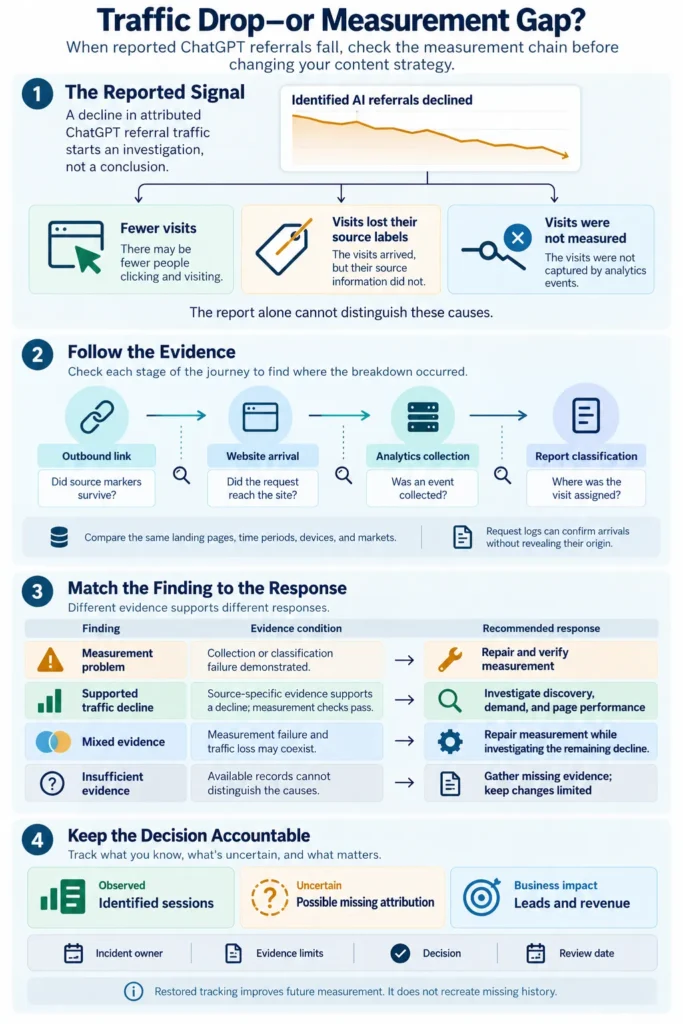
When Should You Repair Measurement or Change Content Priorities?
Repair demonstrated measurement defects first, then evaluate any remaining decline under comparable conditions. Change content priorities only when evidence identifies a specific discovery, citation, landing-page, or demand problem that content can address.
Confirmed Measurement Problems and Uncertain Evidence
The strength of the evidence should determine the size and reversibility of the response. Treat unresolved attribution as an owned incident, with explicit missing tests and a scheduled review date.
| Finding | Evidence Condition | Authorized Response |
| Measurement issue | Repeated tests demonstrate a measurement defect; independent arrivals show no comparable decline under stated assumptions. | Repair the defect, verify future reporting, and retain uncertainty about whether historical visits were preserved. |
| Actual decline | Stable tested measurement and comparable independent arrivals support reduced volume; source evidence supports the claimed ChatGPT scope. | Investigate discovery and demand, then authorize content changes only for an identified problem they can address. |
| Mixed evidence | Tests demonstrate measurement failure while comparable arrivals also decline, with incomplete evidence about each contribution. | Repair measurement and investigate residual loss concurrently; keep the effects separate and limit commitments to supported findings. |
| Insufficient evidence | Historical coverage, traffic volume, or representative testing cannot distinguish plausible explanations with useful confidence. | Assign missing tests, retain observed reporting, and restrict investment changes to bounded, reversible actions pending review. |
- Specify which defect each proposed measurement repair actually addresses.
- Verify repaired paths before declaring future source identification reliable.
- Avoid automatic historical backfills after restoring tags or rules.
Restored tagging improves future identification; it cannot recreate source data that was never retained.
Corroborated Visit Loss and Content Decisions
Even a well-supported decline doesn’t identify content as the cause. Look for a specific gap between what prospective buyers ask, what answers cite, and what landing pages help them do.
- Establish residual visit loss after completing the diagnostic checks.
- Inspect relevant questions for lost citations or weaker discovery.
- Review landing pages for inaccurate information or decision friction.
- Define the problem each proposed content change should address.
Use a ChatGPT traffic drop to reprioritize content only when the diagnosis identifies a problem content can address.
Leadership Reporting and Incident Ownership
Keep observed values, estimated uncertainty, commercial outcomes, and authorized operational actions separate. Leadership needs what changed, what remains unknown, and which decision the evidence supports.
- Record owner, affected dates, metrics, and the known-good baseline.
- Preserve implementation changes, test evidence, decisions, and unresolved questions.
- Report identified sessions separately from any modeled uncertainty range.
- State estimation assumptions, confidence limits, and non-additivity warnings explicitly.
- Include cohort business outcomes, authorized response, and review date.
Do not add estimated missing visits to observed totals where populations overlap. Report unsupported ranges as unquantified. Schedule review around traffic volume, processing completion, and conversion lag.
An accountable record lets leadership revisit the decision without pretending the uncertainty has disappeared.
How Does Content Ops Lab Keep Content Decisions Grounded in Evidence?
21.4% average AI search CVR vs. 3.32% site average (6.4x better) was observed for a 12-location regulated healthcare client during July 2025–February 2026. That historical comparison explains why identified AI referrals deserve commercial attention and why measurement uncertainty matters to publishing decisions.
The data span AI platforms, not just ChatGPT. They do not establish attribution completeness, causation, the effects of the October incident, or expected client results.
Content Ops Lab applies evidence discipline to research and governed content production. Analytics and web owners establish the measurement findings; COL uses their documented conclusions and limits to inform defensible editorial priorities.
- Research-first methodology grounds assignments in relevant, documented audience problems.
- Citation cross-checking tests whether sources support the published claims.
- Custom institutional-knowledge integration brings confirmed organizational facts into production.
- Multi-platform optimization considers how content serves different discovery environments.
- Multi-stage quality control checks evidence, wording, structure, and consistency.
- Consistent delivery uses a unified system for governed production.
The Content Ops Lab Production System
When performance evidence changes an editorial decision, the reasoning must survive the handoff into published copy. The production system preserves that connection while keeping evidence limits visible through review and delivery.
- Research: Establish audience questions, relevant evidence, and confirmed institutional context.
- Verification: Cross-check citations, factual boundaries, and the proposed editorial interpretation.
- Optimization: Shape accurate content for search relevance and clear extraction.
- Delivery: Complete quality controls and deliver consistent, publication-ready editorial work.
A targeted revision becomes reviewable: the assignment identifies the problem, the draft addresses it, and quality control checks the evidence boundaries. Measurement uncertainty remains attached to the decision instead of disappearing during production.
The next step is content infrastructure that carries those evidence boundaries into consistent publishing.
Ready to build content infrastructure that scales without the compliance risk? Get in touch — we’ll assess your current content operation and outline what a systematic approach would look like for your organization.
FAQs About ChatGPT Traffic Drop
Does a ChatGPT traffic drop mean our AI search strategy is failing?
No. Lower identified sessions can reflect visit loss, missing source information, failed collection, or changed classification. Several can happen together. Compare affected landing pages, controlled referral tests, and independent arrival evidence before judging strategy. Stable visibility or conversions can inform that investigation, but neither proves visits stayed constant or identifies the cause of a decline.
What evidence should we gather before changing our content budget?
Preserve the original report and its definitions, a known-good baseline, affected landing pages, implementation history, and representative click-test records. Add consistently filtered independent arrival evidence and cohort leads or revenue, allowing for conversion lag. Change content investment when the remaining evidence identifies a problem content can address, with an owner and evaluation date attached.
Can we recover missing attribution without bypassing consent settings?
Sometimes retained campaign markers, referrers, or authorized records clarify what happened, but recovery depends on evidence that actually exists. Respect applicable consent choices throughout testing. Distinguish blocked collection from consent-mode operation, and repair demonstrated implementation defects appropriately. Restoring future identification does not recreate absent historical source fields; any estimates need separate labels, assumptions, and limits.
Can an AI visibility tool replace GA4 when ChatGPT attribution breaks?
No. Visibility tools measure sampled answer behavior, such as brand appearances or citations, while GA4 records collected website activity and its processed attribution. Independent request evidence addresses another part of the investigation. Use these sources together. Stable mentions cannot certify unchanged visits, and a citation opportunity does not establish that someone clicked or converted.
How does Content Ops Lab use performance evidence to guide content decisions?
Content Ops Lab uses documented findings to inform research, editorial priorities, and governed production. Its capabilities include citation cross-checking, integrating institutional knowledge, multi-platform optimization, and multi-stage quality control. The Research → Verification → Optimization → Delivery system carries those decisions into consistent publishing. Analytics and web owners remain responsible for establishing measurement findings and repairing collection or classification defects.
Key Takeaways
- A ChatGPT traffic drop requires arrival and measurement checks before it can justify a change in content investment.
- Missing source information, failed collection, and real visit loss can overlap; investigate each without assuming the others disappear.
- Content Ops Lab connects research, citation verification, institutional knowledge, and quality control through its Research → Verification → Optimization → Delivery production system.
- Historical cross-platform client data: 21.4% average AI search CVR vs. 3.32% site average (6.4x better); this does not establish causation.
- Assign an incident owner, preserve observed results, document uncertainty, and set a review date before authorizing targeted changes.
Diagnose a ChatGPT Traffic Drop Before Changing Content Investment
A falling source line starts an investigation. It does not finish one. Compare the affected landing cohort, follow representative clicks through collection and processing, and assess independent arrivals under consistent assumptions. Then evaluate leads and revenue, giving outcomes time to emerge.
Repair what the evidence demonstrates. Keep investigating any residual visit loss, and change content only when a specific problem supports that response. Where history cannot be reconstructed, preserve the gap with an owner and review date.
Content Ops Lab methodology brings research, citation verification, and governed production to the publishing decisions that follow, keeping the connection between evidence and editorial action intact.
Related: How Do You Measure AI Search ROI?