

What Happens When AI Search Guidance Changes After You Publish?
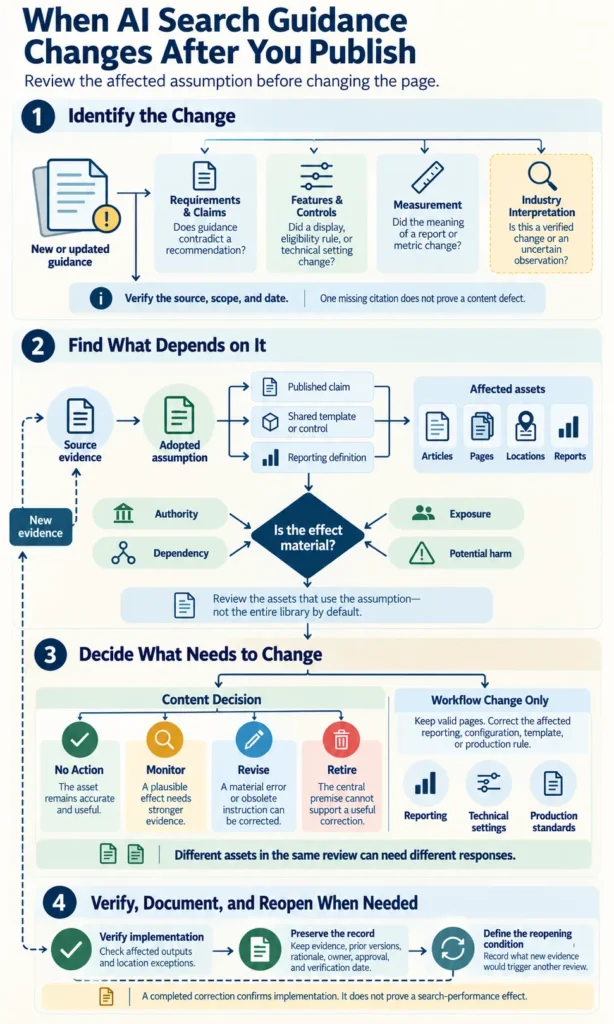
When AI search guidance changes after you publish, review the assumptions your content, implementation, and reporting depend on. Revise an asset when the change materially affects its accuracy or usefulness. Some announcements require technical or measurement corrections; others leave published pages valid. A review trigger does not automatically authorize a rewrite.
Google advises: “Avoid doing “quick fix” changes (like removing some page element because you heard it was bad for SEO)” — Google Search Central.
That advice concerns core updates; applying it to content governance is an editorial interpretation. Reactive refreshes consume capacity and introduce errors. Content Ops Lab’s research-first production and verification provide a foundation for examining what actually needs correction.
Related: What Is AI Search Monitoring and What Should Brands Track?
What Actually Changes When AI Search Guidance Changes?
Changed AI search guidance can affect requirements, displays, controls, or industry interpretations. Identify what changed before deciding whether pages need attention. The underlying information, its optimization rationale, and the feature displaying it can remain valid on their own; review each on its own terms.
Official Requirements and Industry Assumptions
Start with what the platform actually documents. A popular practitioner prescription can become an internal publishing rule without ever having been an official eligibility requirement for that platform.
“There are no additional requirements to appear in AI Overviews or AI Mode, nor other special optimizations necessary” — Google Search Central.
- Separate required eligibility conditions from suggested practitioner tactics.
- Check whether your internal standard cites primary documentation.
- Preserve useful improvements whose original rationale was unsupported.
- Correct claims that present optional tactics as mandatory.
Google’s statement does not guarantee inclusion or establish requirements for another platform’s search features.
Search Features and Underlying Content
A retired display can undermine implementation advice while leaving educational value intact. Review what the asset promises before deciding which information still serves its intended readers.
In its June 2025 announcement retiring selected structured-data displays, Google stated: “This update won’t affect how pages are ranked” — Google Search Central Blog.
- Review instructions promising access to that retired display.
- Assess the underlying page information on its merits.
- Check whether other consumers still use the markup.
- Separate lost presentation support from unsupported ranking conclusions.
That assurance covers this retirement; other product changes require their own specific assessment.
Reporting, Controls, and Terminology
Some changes affect operations surrounding a page. Others expose ambiguous language that concealed different settings or measurement definitions, requiring teams to examine what their published instructions mean.
- Reporting changes alter definitions behind recorded performance totals.
- Control changes affect access, permissions, or technical behavior.
- Interpretation changes challenge assumptions without changing platform requirements.
- Review published instructions when their operational meaning changes.
Classification starts the review; exposure depends on where your operation uses the assumption.
How Do You Identify Which Published Assets Are Affected?
Trace the changed assumption to the claim, component, or configuration using it. Articles discuss controls; shared settings implement them. Review scope follows that dependency, including inherited templates, central rules, and location-specific exceptions.
The Claim or Assumption Behind the Asset
Write the assumption as a testable sentence. “Blocking training also blocks search discovery” creates a different investigation from a general concern about a brand’s visibility in generated answers.
“OAI-SearchBot is used to surface websites in search results in ChatGPT’s search features” — OpenAI.
OpenAI documents independent settings for OAI-SearchBot and GPTBot, permitting separate search and training decisions. This distinction is current documentation, not evidence of a newly announced reversal.
- Inspect tutorials that conflate search discovery with training.
- Check whether technical configurations inherited that same assumption.
- Assign published explanations and implemented settings separate owners.
- Avoid treating permitted access as guaranteed brand recommendation.
A corrected explanation does not mean every destination page needs a corresponding rewrite.
Shared Templates and Location Exposure
Consider a hypothetical CMS component across location pages. An embedded mistaken rule can create widespread exposure even when editors never entered that instruction on individual pages.
- Identify location pages inheriting the same shared rule.
- Separate central defaults from locally maintained implementation exceptions.
- Sample representative pages before assuming deployment is uniform.
- Expand review where different location implementations create uncertainty.
The page count determines review scope; it does not make the underlying evidence more authoritative.
A Reviewable Source and Dependency Record
A compact record makes reasoning inspectable without an elaborate registry. Connect the source to a specific dependency and someone responsible for reviewing whether it still holds.
- Preserve excerpts supporting the exact assumption under review.
- Distinguish shared implementation records from individual page records.
- Assign an accountable person to investigate unresolved dependencies.
- Keep records usable by editorial and technical reviewers.
| Field | Purpose |
| Asset URL | Locate the affected published asset. |
| Assumption statement | Specify the organization’s adopted assumption. |
| Source and access date | Identify the reviewed source version. |
| Preserved excerpt | Preserve the supporting source wording. |
| Implementation or template | Locate the implementing component. |
| Owner | Assign review responsibility. |
| Risk | Describe harm, exposure, and uncertainty. |
| Last substantive review | Date the substantive dependency check. |
A small log can serve one brand; shared deployments also need component-level records.
When Does a New Signal Justify a Content Review?
Review when credible evidence intersects with an assumption your organization uses and creates a potentially material effect. Authority, dependency, exposure, and harm determine urgency. Treat verified contradictions differently from tentative experiments or isolated visibility fluctuations, even when many pages could be affected.
Authoritative Contradictions and Material Risk
Prioritize findings that could mislead readers or encourage obsolete instructions. First decide whether investigation is warranted; the appropriate page treatment follows from what that investigation establishes.
- Escalate contradictions affecting the article’s central actionable claim.
- Prioritize obsolete instructions with meaningful implementation or user consequences.
- Compare leaving the error against introducing unnecessary revisions.
- Define review scope before authorizing changes across assets.
An authoritative announcement needs a material dependency before it justifies changing published content.
Repeated Observations and Ordinary Variability
Visibility movement needs interpretation before it becomes a diagnosis. A source disappearing from one generated answer does not establish a platform change, a content defect, or an optimization failure.
“Source sets overlap by only 34–42% on average” — Schulte, Bleeker and Kaufmann.
The April 2026 preprint examined four Swiss-German commercial verticals in a Swiss-server context, using 4,044 consecutive-day comparisons. The percentage measures source-set Jaccard overlap, not brand disappearance. Exclude zero-citation runs from the overlap analysis; this is not a general benchmark.
- Compare equivalent prompts under recorded and comparable conditions.
- Preserve baseline answers alongside the subsequent observed results.
- Look for repeated patterns before diagnosing content defects.
- Seek corroborating evidence outside the individual generated answer.
Repeated observations can justify investigation, but they cannot explain exactly why an answer selected sources.
Event Triggers and Scheduled Backstops
Pair event-driven review with scheduled verification to catch dependencies announcements might miss. These are recommended governance practices, not platform requirements or universal rules for publishing cadence.
- Maintain a watchlist of sources your standards depend on.
- Schedule verification according to exposure and potential harm.
- Revisit unresolved observations within a defined monitoring window.
- Close calendar reviews without rewriting content that remains valid.
Scheduled verification checks assumptions; the evidence determines whether a publishing intervention is warranted.
If your operation needs to produce 20–50+ articles per month without sacrificing compliance or quality, Content Ops Lab builds the infrastructure to make that possible. Contact us to discuss your content production requirements.
Should You Leave, Monitor, Revise, or Retire the Content?
Choose a content disposition according to the asset’s continued accuracy, usefulness, and exposure to the changed assumption. No Action, Monitor, Revise, and Retire describe page decisions. Workflow Change Only describes operational remediation when content remains valid; it can also accompany a page revision elsewhere in the same dependency chain.
No Action and Monitor
Leaving a page unchanged can be a defensible decision when the reviewed change does not materially affect it. Monitoring fits a plausible effect whose supporting evidence remains incomplete or uncertain.
- Document why the reviewed asset remains accurate and useful.
- Assign an owner and observation window for monitoring.
- Define evidence needed to reopen the decision.
- Escalate when that evidence changes the materiality assessment.
Without rationale and reopening conditions, it becomes hard to distinguish leaving content unchanged from neglect.
Revise and Retire
Revise when you can correct a material error without abandoning the asset’s purpose. Consider retirement when its central premise is indefensible and a useful replacement cannot preserve that purpose.
- Target the claim or instruction that actually failed.
- Review retained value before deciding an asset’s future.
- Consider reader needs and existing links when retiring.
- Choose replacement, consolidation, redirection, or removal deliberately after review.
Retirement needs an asset-specific plan; announcements alone cannot justify deletion across the library.
Workflow Changes Without a Page Rewrite
Valid pages can coexist with obsolete operational rules. Correct those rules for future execution, while reviewing whether published tutorials explaining the old approach also need revision.
- Record content disposition independently from required operational remediation.
- Correct reporting definitions when the educational page remains accurate.
- Update shared configurations where unchanged pages inherit exposure.
- Review tutorials that recommend the superseded operational approach.
| Decision | Condition | Page treatment | Operational action |
| No Action | No material asset effect. | Leave unchanged. | Record rationale and reopening condition. |
| Monitor | Plausible effect; evidence remains uncertain. | Retain pending further evidence. | Assign owner, window, and escalation condition. |
| Revise | Correctable material error or obsolete instruction. | Amend the affected content. | Correct the upstream source of the error. |
| Retire | Central premise cannot be corrected. | Choose replacement, consolidation, redirection, or removal. | Review dependencies and existing links. |
| Workflow Change Only | Valid content; outdated operations. | Leave valid pages unchanged. | Update configuration, reporting, or production rules. |
Decisions apply asset by asset; different dependencies can produce different actions within one review.
Related: What Causes AI Visibility Volatility?
What Must Change Upstream After the Review?
Correct the rule, component, or measurement definition that created the exposure so future production does not reproduce it. Page edits alone leave that dependency active. A coordinating owner should connect editorial, SEO, technical, and analytics responsibilities, while each specialist remains accountable for the part they can actually verify.
Editorial Rules and Technical Components
An outdated assumption can persist in briefs after article correction. Follow the dependency back into production and change the specific instruction that carried it into published content.
- Amend briefs that require unsupported claims or tactics.
- Update prompt libraries carrying the same disputed assumption.
- Correct QA criteria that would reject accurate replacements.
- Version shared CMS components before broader implementation changes.
Correcting instructions addresses recurrence; technical deployment still needs verification against actual production outputs.
Measurement Definitions and Historical Comparisons
Reporting changes can alter what a performance series represents. Review that definition before treating movement in aggregate totals as evidence that published pages improved or failed after an update.
Google’s June 16, 2025 documentation entry states: “Data from AI Mode is now counting towards the totals in the Search Console Performance report” — Google Search Central.
Aggregate inclusion does not isolate AI Mode performance or prove a growth effect. The documentation date is not a universal, precisely timed account-level implementation boundary.
- Annotate comparisons with the reporting definition under review.
- Revisit published instructions describing measurement scope or attribution.
- Separate measurement changes from evidence of page failure.
- Keep uncertain historical boundaries explicit in stakeholder explanations.
Accurate reports can mislead when interpretations assume measurement definitions that no longer hold.
Owners, Approvers, and Propagation
Cross-functional reviews need an owner to follow corrections through handoffs. Assign approval according to the decision’s subject; editorial cannot validate every technical, measurement, or regulated-claim change.
- Editorial owns published claims, recommendations, and wording corrections.
- SEO owns interpretation of relevant platform eligibility guidance.
- Technical teams own configuration, components, and implementation checks.
- Analytics owns reporting definitions and qualified historical comparisons.
- Qualified reviewers assess regulated claims and high-risk changes.
High-risk changes warrant another reviewer; verify that approved corrections propagated before closing review.
How Do You Verify the Change Without Losing the Evidence?
Verify that the intended correction reached the affected assets, then preserve enough evidence to explain and reverse the decision if necessary. Implementation checks establish that a change occurred. They do not establish that subsequent search visibility or conversions changed as a result; performance assessment remains a separate inquiry.
“Security impact analysis is incorporated into the documented configuration change control process” — NIST.
NIST’s guidance concerns security-focused information systems. Applying its change-control principle to content operations is an analogy, not an AI-search mandate, certification, or NIST-approved editorial model.
Implementation Checks Across Affected Assets
Verify what readers and operational teams receive. Correcting a source template does not ensure generated pages, reports, or locally maintained versions reflect the intended change.
- Inspect representative live pages generated by shared components.
- Check report definitions and visible stakeholder-facing measurement explanations.
- Include location exceptions that use different implementation paths.
- Expand checks when representative samples reveal inconsistent propagation.
Sampling supports shared implementations; differing location paths require checks tailored to those actual differences.
Preserved Baselines and Decision History
Keep the reviewed evidence and pre-change implementation before overwriting them. The record should let a future reviewer understand what changed, what stayed untouched, and which uncertainties remained unresolved.
- Preserve source excerpts and the prior implementation version.
- Record reviewed scope, decisions, uncertainty, and deliberately deferred actions.
- Retain approval and the date implementation was verified.
- Document rationale for assets deliberately left unchanged after review.
- Specify evidence that would reopen the recorded decision.
Preserved baselines support reversibility and accountability without implying that earlier decisions were certain.
Review Completion and Performance Follow-Up
Close the correction review when agreed implementation checks pass. Assess subsequent outcomes over a defined observation window, using the preserved baseline to distinguish what was verified from what remains interpretive.
- Assign responsibility for the separate performance observation window.
- Record simultaneous changes that complicate interpreting subsequent results.
- Consider seasonality, platform updates, and ordinary answer variability.
- Avoid claiming causation from recovery following the correction.
Search performance can reopen an investigation, but it cannot retroactively replace implementation verification.
How Does Content Ops Lab Support Evidence-Led Content Operations?
“21.4% average AI search CVR vs. 3.32% site average (6.4x better)” describes historical proprietary data from a regulated, multi-location healthcare engagement, measured July 2025–February 2026. Content Ops Lab’s production methodology provides a disciplined foundation for protecting useful content while correcting material errors.
The comparison is descriptive. It establishes neither a current benchmark nor expected results, and it does not show that verification, maintenance, or any particular optimization drove conversion performance.
COL’s established capabilities support that discipline:
- Research-first methodology grounds production decisions in evidence before drafting begins.
- Line-by-line citation cross-checking tests whether sources support the published wording.
- Evidence audit trails preserve the basis for claims and editorial decisions.
- Documented, reversible iterations retain enough context to assess and undo changes.
- Validation against live production checks execution before adopting changes more widely.
- Client subject-matter expertise informs knowledge integration and the resulting editorial standards.
The Content Ops Lab Production System
Consistent production requires evidence to remain connected to the finished asset. The four stages give teams an ordered way to carry source understanding into reviewed, usable content at delivery.
- Research: Establish source authority, relevant context, and the reader’s information needs.
- Verification: Cross-check claims line by line against their supporting evidence.
- Optimization: Structure verified information for clear reading, search, and extraction.
- Delivery: Provide reviewed content that follows documented standards and production requirements.
That foundation supports accountable revisions without treating every new announcement as permission to restart production.
Ready to build content infrastructure that scales without the compliance risk? Get in touch — we’ll assess your current content operation and outline what a systematic approach would look like for your organization.
FAQs About AI Search Guidance
Do I Need to Rewrite Every Article When AI Search Guidance Changes?
No. Rewrite or revise an article when verified guidance materially affects its accuracy, usefulness, or actionable recommendations. First, identify the assumption it depends on. A display retirement, reporting change, or uncertain visibility observation may require another response. Record why unchanged assets remain valid and what evidence would prompt another review.
How Should We Prioritize Reviews Across a Large Content Library?
Prioritize reviews by source authority, actual dependency, exposure, and potential harm. Start with material contradictions and shared components that can reproduce errors across many assets. Group pages by the assumption they inherit, then examine location exceptions separately. Inventory size determines review scope; it does not strengthen weak evidence or justify blanket revisions.
What Should We Do When New Guidance Contradicts a Published Claim?
Verify the contradiction against the relevant primary source, preserve the earlier evidence, and assess how central the claim is to the article. Correct material errors with an appropriate reviewer, then update the brief, template, or rule that produced them. Consider retirement when the central premise cannot support a useful correction.
Should We Copy a Competitor’s AI Search Changes Before Testing Them?
No. A competitor’s change can identify a question worth investigating, but it doesn’t establish a requirement or show that the change caused their results. Check the source, your own dependency, and the likely cost of adopting it. Where uncertainty remains, define a bounded investigation and reopening condition. Preserve useful content while evaluating whether the intervention fits.
What Should a Content Partner Document When Updating Published Content?
A content partner should document the source, affected assumption, reviewed assets, change rationale, and responsible owners. Retain the prior wording or implementation, approval, verification date, unresolved uncertainty, and reopening condition. Distinguish confirmed corrections from subsequent performance observations. The handoff should also identify upstream production rules that need amendment, so the same problem does not return in the next publishing cycle.
Key Takeaways
- Changed AI search guidance warrants action when it materially affects an assumption your content, implementation, or reporting uses.
- Page disposition and operational remediation are separate decisions; valid content can remain unchanged while operational rules need correction.
- Source authority, dependency, exposure, and potential harm determine review urgency; isolated visibility movement does not establish a content defect.
- COL’s research-first methodology and line-by-line citation cross-checking connect claims to evidence, supporting documented corrections and consistent production standards.
- Historical healthcare engagement data: 21.4% average AI search CVR vs. 3.32% site average (6.4x better); descriptive, without causal attribution.
- Identify dependencies, preserve baselines, assign owners, and record reopening conditions for assets deliberately left unchanged.
How Should You Respond to Changing AI Search Guidance?
Treat AI search guidance changes as a reason to examine dependencies before committing publishing capacity. Identify what changed, where your operation relies on it, and whether the effect is material. Then choose the page treatment and any independent operational correction. Let accuracy and continued usefulness drive the decision.
Trace one exposed assumption through published claims, shared components, and reporting definitions. Preserve what you reviewed, verify the correction, and document a rationale for unchanged assets. Later decisions become easier to inspect and reopen.
Content Ops Lab’s scalable, research-backed production connects documented verification with consistent standards, providing a foundation for responsible iteration as guidance changes.
Related: What Does Google Search Console’s AI Search Report Actually Measure?