

Why Should You Monitor Brand Mentions in AI Search Results?
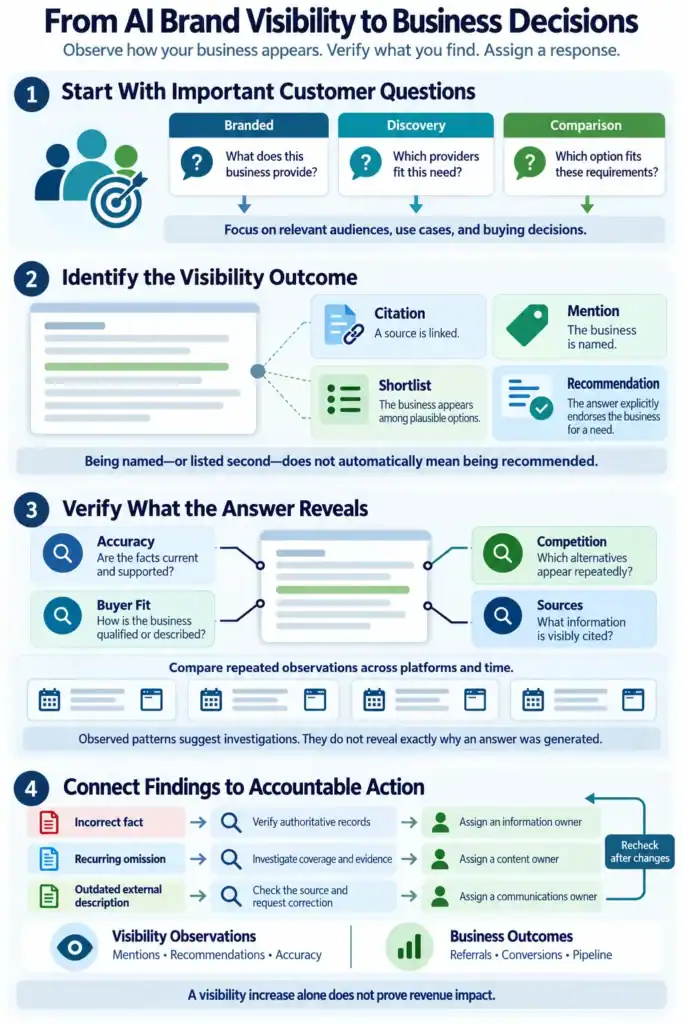
You should monitor brand mentions in AI search because answers can introduce your business, frame its suitability, or misstate its capabilities before a buyer visits your website. Monitoring reveals whether important customer questions produce accurate, relevant consideration and gives your team specific information to investigate, correct, and measure.
Gartner surveyed 645 B2B buyers in August–September 2025: “45% said they used GenAI, primarily to gather information on vendors and products” — Gartner.
That describes reported research use, not AI deciding purchases. Counting appearances alone leaves buyer context and factual risk unresolved. Content Ops Lab connects observed customer questions to verified, consistent information through research-first content operations.
Related: How Do You Monitor Brand Mentions in AI Search?
Why Does AI Brand Visibility Matter Before a Website Visit?
AI brand visibility matters because a response can shape the options a buyer investigates before your analytics records a visit. When you monitor brand mentions in AI search, you observe that representation directly. Its business relevance depends on the question, the audience, and what the answer actually says about your company.
Discovery Can Happen Inside the Answer
A buyer researching a problem may encounter possible suppliers within the response itself. Your business can enter consideration there, even when the buyer has not searched for your name.
- Suppliers introduced alongside explanations of the business problem.
- Alternatives described against the buyer’s stated operating constraints.
- Qualifications that encourage further research into particular vendors.
An appearance becomes useful intelligence when its context matches a customer you can serve.
Website Analytics Capture a Later Event
An answer appearance and a website visit are separate observations. Referral reporting captures activity reaching your site; it cannot reconstruct every response encountered before that visit.
“Users who encountered an AI summary clicked on a traditional search result link in 8% of all visits” — Pew Research Center.
Pew analyzed March 2025 browsing from 900 U.S. adults and reconstructed results in April. The comparison was 15% without summaries; this does not establish brand persuasion or aggregate traffic effects.
- Answer visibility recorded separately from measured referral sessions.
- Website conversions associated with visitors who actually arrive.
- Unobserved exposure excluded from claimed revenue attribution totals.
The measurement gap justifies observing answers, but it does not assign financial value to exposure.
Commercial Relevance Depends on the Question
A mention deserves attention when the question reflects a commercially important need. Broad appearance counts can obscure whether your company is visible to the audience that makes buying decisions.
- Category questions associated with your priority customer segments.
- Use-case questions reflecting problems your business can address.
- Evaluation questions tied to meaningful purchasing requirements today.
Question relevance establishes business importance; interpreting answers requires a more precise definition of visibility.
What Does an AI Brand Mention Actually Tell You?
An AI brand mention establishes that your company was named in a sampled response. It does not automatically establish source attribution, suitability, endorsement, or influence on a purchase. You need the surrounding language and customer intent to distinguish a passing reference from inclusion among credible options or an explicit recommendation.
Citations, Mentions, Shortlists, and Recommendations
Four visibility outcomes answer different questions about a response. They can overlap within one answer, and none requires the others to occur beforehand or follow a fixed sequence.
“Being mentioned in an AI-generated answer does not necessarily mean a brand’s own website is cited as the supporting source”— Semrush.
| Outcome | What It Establishes | What It Does Not Establish |
| Citation | Visible attribution or link. | Endorsement of that business. |
| Mention | The brand is named. | Website citation or suitability. |
| Shortlist | Inclusion among plausible options. | Preferred choice for this buyer. |
| Recommendation | Explicit endorsement for a need. | Accuracy or a purchase. |
- Exact endorsement language retained with its buyer context.
- List order recorded separately from stated recommendation strength.
- Source attribution distinguished from naming a particular business.
A company listed second can remain an option while another company receives the explicit endorsement.
Branded and Non-Branded Questions Reveal Different Gaps
Known-brand questions test representation of a company already under consideration. Non-branded questions test discovery among possible suppliers, while comparisons reveal how respondents describe differences relevant to selection.
A hypothetical B2B comparison prompt: “How do Vendor A and Vendor B compare for a midsize manufacturer needing inventory software with ERP integration?”
- Branded questions checking current capabilities and service limitations.
- Non-branded questions identifying suppliers for a defined need.
- Use-case questions testing fit for specific operating requirements.
These question types reveal different gaps, so combining them can hide strategically important findings.
Competitive Context Changes the Meaning
Competitive intelligence comes from recurring alternatives and the reasons attached to them. A flattering description can still position your company outside its priority buyer segment.
- Competitors repeatedly included for your priority customer needs.
- Cost qualifications that narrow the suggested buyer audience.
- Implementation limits affecting suitability for complex purchasing requirements.
Preserve these distinctions alongside the appearance count so competitive reporting retains the buyer’s decision context.
How Can Monitoring Protect Brand Accuracy and Positioning?
Monitoring exposes statements your team can check against authoritative information and shows how answers frame your business for different buyers. Factual integrity and favorable tone require separate assessments: accurate criticism deserves attention, while an unsupported compliment can create expectations your organization cannot meet.
Facts Need Checking Even When the Answer Sounds Positive
A confident answer can present an incorrect capability as a selling point. Verify whether each consequential statement matches what your organization currently provides, permits, or supports publicly.
“AI Overviews can and will make mistakes” — Google.
That acknowledges a platform limitation; it supplies no error rate.
- Product capabilities checked against current approved technical documentation.
- Checked service availability and locations against operating records.
- Policies verified against the organization’s authoritative published records.
- Favorable claims reviewed for unsupported promises or guarantees.
Positive wording does not reduce the need to verify facts that may affect customer expectations.
Brand Framing Can Help One Buyer and Deter Another
Positioning needs buyer context. Describing a vendor as suited to smaller teams can attract one segment while discouraging an enterprise buyer with different requirements, even when accurate.
- Attributed strengths compared with your intended market positioning.
- Suitability language assessed against the buyer’s stated requirements.
- Limitations distinguished from unsupported negative characterizations of capabilities.
- Accurate criticism considered for product or service improvement.
The useful question is whether the description accurately represents suitability for the intended buyer.
Source Conflicts Require an Accountable Response
A discrepancy needs an owner and an authoritative reference. Before treating an answer as wrong, verify whether your published information is current and consistent across relevant records.
- Inaccurate facts: document discrepancies and assign correction ownership.
- Accurate criticism: investigate limitations with responsible operational teams.
- Conflicting records: reconcile information against current authoritative sources.
- Unsupported praise: clarify capabilities before expectations become commitments.
Recheck outputs after corrections; fixing a published record does not guarantee a changed AI answer.
If your operation needs to produce 20–50+ articles per month without sacrificing compliance or quality, Content Ops Lab builds the infrastructure to make that possible. Contact us to discuss your content production requirements.
What Can AI Citations Reveal About Your Information Gaps?
AI citations identify visible sources worth investigating around important customer questions. Repeated omissions and competitor source patterns suggest questions about coverage, evidence, identity, or external reputation. Use these observations as starting points for investigation before deciding which information changes deserve resources; they do not explain the model’s internal reasoning.
Owned Content Is Part of a Wider Source Ecosystem
Your website contributes to a broader public record. An answer may describe your business through an external source, making third-party accuracy as important as the quality of owned content.
Bain reports that 89% of unbranded prompts in its cited ScrunchAI analysis “are fulfilled by third-party sources” — Bain & Company. The proprietary dataset spanned about 500 million citations.
The denominator is unbranded prompts, not all citations or searches; this is no universal source split.
- Owned pages describing capabilities with current supporting evidence.
- Reviews describing experiences within their original customer context.
- Directories identifying categories, services, and relevant business locations.
Source diversity widens investigation, but each visible page still needs its own relevance assessment.
Recurring Competitor Sources Suggest Investigation Priorities
Recurring competitor citations can help focus research without dictating the response. Ask whether those pages contain credible information your organization lacks or represents less clearly.
- Directories checked for accurate category and entity information.
- Publications assessed for relevant expertise and current evidence.
- Owned pages checked for unanswered customer decision questions.
When you monitor brand mentions in AI search, treat recurring sources as leads for investigation.
Visible Sources Do Not Establish the Model’s Reasoning
A citation establishes visible attribution, not a complete explanation of answer generation. Examine whether the page supports the specific claim tied to your business before interpreting its significance.
- Linked passages checked against the answer’s specific statements.
- Unsupported associations separated from verified source-backed factual claims.
- Omission hypotheses tested against available content and records.
A recurring citation justifies investigation but does not prove that adding a similar citation changes recommendations.
Related: How Do You Measure AI Search ROI?
Why Should You Monitor Across Platforms and Over Time?
Monitoring across platforms and time helps distinguish recurring patterns from variation. No single response can establish a stable competitive position. To monitor brand mentions in AI search meaningfully, preserve each observation’s context and evaluate changes within comparable questions, audiences, platforms, and search conditions.
One Answer Is a Sample
One unfavorable result can attract disproportionate attention. Repeat observations help determine whether a finding persists before your team commits resources to an explanation or response.
“Only 20-33% average overlap between result sets on repeat searches” — BrightLocal.
The study covered 200,085 localized searches across 1,300 business locations using ChatGPT, AI Mode, and AI Overviews. Result-set overlap is not an individual business’s reappearance probability or an enterprise vendor benchmark.
- Isolated omissions recorded without declaring a visibility decline.
- Prioritize recurring errors for verification and accountable action.
- Repeated competitor inclusion assessed within comparable customer questions.
Repetition strengthens interpretation, while platform context determines which observations can reasonably be compared together.
Each Platform Needs Its Own Record
Platform-specific records preserve differences that an aggregate score conceals. Your business can appear differently across surfaces; reports should identify where each finding occurred and retain the response.
- ChatGPT observations kept identifiable within the reporting dataset.
- AI Overviews recorded separately from other Google surfaces.
- AI Mode results retained as their own observations.
An overall improvement can conceal a deterioration on the surface most relevant to your buyers.
Comparable Observations Make Trends More Useful
Useful trends require context. Retaining the observation record lets reviewers distinguish a content revision from a different prompt, location, or known platform change before interpreting a visibility movement.
- Exact prompt wording, date, and available model information.
- Relevant location and search mode recorded where applicable.
- Full response and visible sources saved for review.
- Content revisions and known platform changes annotated consistently.
Comparable records improve interpretation without eliminating variation or establishing the cause of observed changes.
How Do You Turn Monitoring Findings Into Business Decisions?
Turn monitoring findings into decisions with a focused baseline, clear response owners, and recurring reviews aligned to business priorities. Keep visibility observations, operational changes, and commercial results separate. Executive reporting should identify an actionable question, a responsible team, and a follow-up measure for consequential findings.
Separate Visibility Signals From Business Outcomes
Visibility rates describe your monitored sample. Referrals, conversions, and pipeline describe measured business activity. Separating them prevents increases in sampled mentions from becoming unsupported claims about revenue performance.
- Report mention rates with monitored prompts and runs.
- Recommendation rates defined through explicit endorsement coding criteria.
- Measure referral conversions against their actual visitor denominator.
- Pipeline claims supported by available attribution or experiments.
When you monitor brand mentions in AI search, improved visibility remains separate from demonstrated commercial impact.
Assign Findings to the Team That Can Act
Responsibility should follow the information or process under review. These mappings suggest investigations and follow-up measures; they are diagnostic recommendations, not proven mechanisms for increasing AI visibility.
| Monitoring Finding | Plausible Investigation | Accountable Function | Follow-Up Measure |
| Incorrect capability claim | Compare authoritative records. | Product or service owner | Corrections; sampled accuracy. |
| Recurring use-case omission | Review coverage and evidence. | Content | Coverage; comparable answers. |
| Outdated external description | Verify source; request correction. | Communications | Accuracy; recurring representation. |
| Visibility rises without referrals | Review attribution limits. | Analytics | Referrals, conversions, pipeline. |
- Investigation scope matched to the finding’s commercial importance.
- Information owners verify authoritative factual records.
- Content teams assigned confirmed coverage and evidence gaps.
- Communications teams responsible for external factual correction requests.
- Analytics teams responsible for commercial measurement and attribution.
Ownership turns observations into work, but follow-up must test whether the original issue persists.
Report What Changed and What Decision Follows
An executive report should explain why a finding deserves attention. Start with important audiences, recurring patterns, and factual severity, then identify the decision the evidence supports making next.
- Priority audience and customer question stated beside findings.
- Recurrence shown within the relevant platform and sample.
- Assess factual severity against potential customer expectation consequences.
- Proposed action paired with an accountable function owner.
- Follow-up observations scheduled around meaningful changes and decisions.
Match review frequency to decisions and capacity; no universal cadence makes every program useful.
How Does Content Ops Lab Help You Act on AI Visibility Findings?
Content Ops Lab observed 21.4% average AI search CVR vs. 3.32% site average (6.4x better) in one anonymized multi-location healthcare engagement, measured July 2025–February 2026. This historical first-party result describes measured referral traffic, not people exposed to AI answers, and does not attribute performance to brand monitoring or mention frequency.
- Research-first intake connects customer questions with defined publishing priorities.
- Line-by-line citation verification checks factual claims against supporting sources.
- Multi-platform optimization prepares content for relevant discovery and extraction.
- Documented SME knowledge preserves expertise for repeatable content production.
- Location-level NAP consistency checks reconcile names, addresses, and phones.
- Transferable workflows support Done-For-You delivery or System Build engagements.
A verified monitoring finding informs intake without automatically triggering publishing. Teams confirm the gap, establish authoritative facts, and decide whether new content or a record correction is appropriate. COL provides content production, not a standalone monitoring platform.
Done-For-You engagements support production delivery. System Build engagements make the workflows transferable to internal teams. Both connect documented expertise and verified information to repeatable publishing decisions, keeping accountability attached to the work.
The Content Ops Lab Production System
The production system gives validated findings a consistent route into publishing. It keeps source support and organizational knowledge attached to the work as content moves from an identified need to delivery.
- Research: Define customer questions and assemble relevant supporting information.
- Verification: Check claims, citations, and documented subject matter knowledge.
- Optimization: Structure verified content for multi-platform discovery and extraction.
- Delivery: Publish through repeatable workflows with clear information ownership.
The appropriate engagement depends on whether your team needs production delivery or a transferable internal system.
Ready to build content infrastructure that scales without the compliance risk? Get in touch — we’ll assess your current content operation and outline what a systematic approach would look like for your organization.
FAQs About Monitoring Brand Mentions in AI Search
Is monitoring AI brand mentions worthwhile if AI sends little traffic to our website?
Yes, when it reveals relevant consideration or factual risks that website analytics cannot show. An answer can describe your company without producing a tracked visit. Focus on important customer questions, recurring patterns, and actionable discrepancies. Keep that intelligence separate from revenue claims: low referral traffic neither eliminates the need to check representation nor proves unseen commercial value.
How can we tell whether AI brand monitoring is producing business value?
Assess whether monitoring leads to useful, verified decisions and measurable follow-up. Track corrected information, investigated coverage gaps, and resolved source conflicts alongside sampled visibility changes. Report referrals, conversions, and pipeline separately. A higher mention rate alone does not prove ROI; stronger commercial claims require attribution or experimental evidence connecting the activity to business results.
What should we do when an AI answer makes an inaccurate claim about our brand?
Verify the claim against current authoritative records, preserve the response and visible sources, and assign the discrepancy to the responsible information owner. Correct conflicting owned information or request factual corrections from external publishers where appropriate. Then recheck comparable outputs. Updating a page does not guarantee a change in the answer, and favorable inaccuracies need attention too.
Why might competitors appear in AI answers when we rank well in traditional search?
Traditional search rankings do not explain every observed AI response. Review the customer question, competitor suitability language, and visible sources before forming a hypothesis. Recurring patterns may justify investigating coverage, evidence, entity clarity, or external reputation. They don’t prove why a model omitted your business or that a competitor displaced you permanently.
Can our internal team act on AI monitoring findings, or should we use Content Ops Lab?
Your internal team can act when it has authoritative information, accountable owners, and the capacity to verify and publish changes consistently. Content Ops Lab supports verified content production through Done-For-You engagements or transferable workflows through System Build. Choose based on production capacity and process needs after validating the finding, rather than treating every omission as a publishing requirement.
Key Takeaways
- Monitor brand mentions in AI search to identify relevant consideration gaps, factual risks, and decisions your team can investigate.
- Citations, mentions, shortlist inclusion, and explicit recommendations describe overlapping outcomes; list position alone does not establish buyer endorsement.
- Repeated observations need platform, prompt, audience, and date context before they support a defensible interpretation of visibility changes.
- COL observed 21.4% average AI search CVR vs. 3.32% site average (6.4x better); referral results do not measure mentions.
- Research-first intake and line-by-line citation verification turn validated information needs into governed content production with documented organizational knowledge.
- Begin with focused customer questions, named response owners, and separate reporting for visibility observations, operational actions, and business outcomes.
Monitor Brand Mentions in AI Search With a Decision in Mind
Monitor brand mentions in AI search to understand how relevant answers represent your business and identify findings worth acting on. Mention volume needs context: who is asking, what the answer says, which alternatives appear, and whether the information is accurate.
Begin with a focused baseline around important customer questions. Assign owners to consequential findings, investigate supporting records, and retest after meaningful changes. Keep observed visibility separate from referrals, conversions, and pipeline so the executive report shows what the evidence supports.
Content Ops Lab provides scalable content operations that turn validated monitoring findings into governed publishing decisions through research, verification, optimization, and delivery.