

What Should an AI Search Strategy Actually Include?
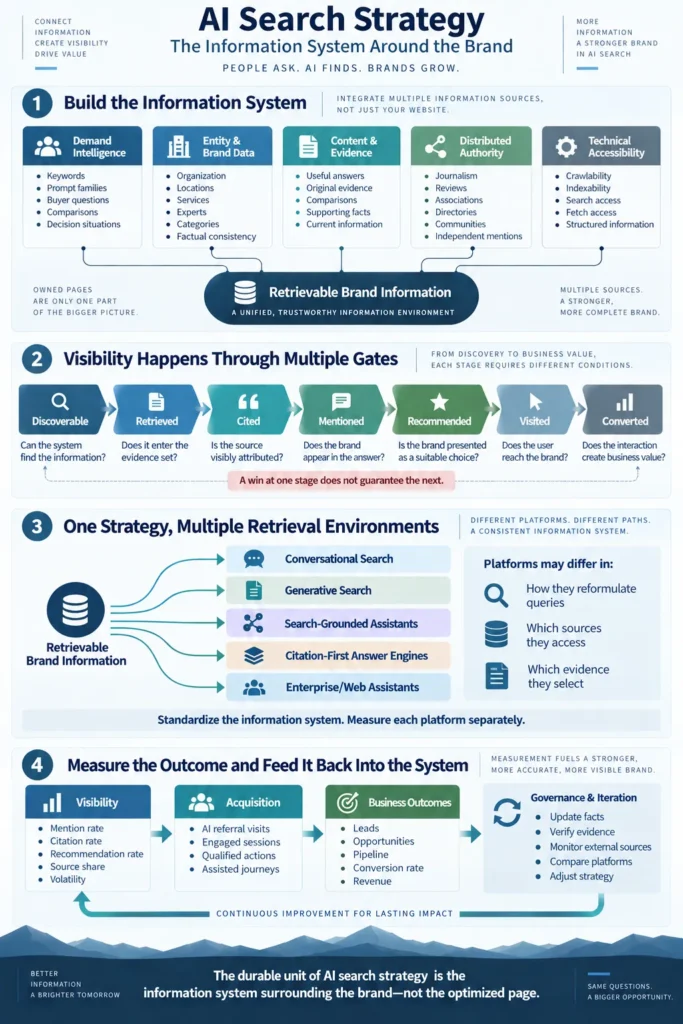
An AI search strategy should coordinate how a brand is discovered, understood, retrieved, cited, recommended, measured, and maintained across AI-mediated search—not add a handful of GEO tactics to traditional SEO.
Google makes the continued role of search optimization explicit: “SEO best practices remain relevant and foundational to success with our generative AI features” — Google Search Central. The problem is that rankings alone no longer describe the full visibility environment. Brands now compete across conversational demand, external sources, retrieval systems, recommendation contexts, and multiple AI platforms.
Content Ops Lab approaches that problem as an information-system challenge: build the evidence, authority, accessibility, measurement, and governance required to operate across all of them.
Related: How Are AI Search Queries Different From Google Search Queries?
How Is an AI Search Strategy Different From SEO or GEO?
An AI search strategy expands the operating scope of organic visibility without replacing SEO. Traditional search optimization still supports discovery, relevance, authority, and information architecture. AI-mediated search adds new responsibilities around conversational demand, distributed sources, retrieval behavior, citation selection, recommendations, platform variation, measurement, and ongoing factual governance.
What Traditional SEO Still Controls
SEO still controls much of the infrastructure that determines whether useful brand information can be found, understood, and evaluated before any generative system can use it.
- Crawlable pages and technically accessible site architecture
- Indexable content aligned with user search intent
- Clear internal linking and information relationships
- Relevant pages supported by credible authority signals
- Search-friendly organization of important factual information
Those fundamentals matter, but they do not describe every path through which AI systems discover or select information.
Where AI Search Adds New Responsibilities
AI-mediated discovery broadens the job because users interact differently, platforms retrieve differently, and brands can become visible through sources they neither own nor directly control.
- Prompt families extending conventional keyword demand research
- External-source monitoring beyond owned website performance
- Distinct crawler and user-triggered access requirements
- Citation, mention, and recommendation visibility tracking
- Repeated measurement across platforms, prompts, and runs
The result is a wider operating model, not a replacement discipline competing with traditional search.
Why Universal AI Ranking Factors Are the Wrong Model
Marketing teams should resist reducing AI visibility to another universal factor list. Current evidence does not support one stable formula that transfers cleanly across platforms, products, and time.
- Platforms use different retrieval and grounding systems
- Source eligibility varies across individual AI products
- Citation selection occurs after retrieval in some systems
- Vendor correlations do not establish causal ranking signals
- Platform behavior continues changing faster than SEO norms
A recent literature review concludes that “no reviewed technique shows a stable, longitudinal, cross-platform causal effect on organic discoverability or downstream behavior” — arXiv.
That does not make GEO useless; it makes page-level optimization one component of a broader strategy.
How Should AI Search Strategy Account for What People Actually Ask?
Demand intelligence should extend keyword research into the circumstances, questions, comparisons, objections, and decisions users bring to AI systems. Instead of attempting to catalog every possible prompt, marketing teams need practical prompt families organized around buyer situations and commercial relevance so measurement remains useful rather than becoming a giant counting exercise.
Why Keyword Research Does Not Capture the Whole Demand Set
Traditional keyword databases remain valuable, but conversational AI exposes a larger demand surface containing longer context, multiple constraints, follow-up questions, and decision criteria that may never appear as conventional searches.
- Prompts combine needs that keywords separate artificially
- Users provide constraints inside single conversational requests
- Follow-ups reshape intent during the same interaction
- Comparison questions often include multiple decision variables
- Conversational demand extends beyond recorded keyword databases
Semrush found that “between 65% and 85% of prompts couldn’t be matched to any traditional search keyword” — Semrush.
The sampled data is not a complete demand map, but the gap is large enough to change planning.
How Prompt Families Organize Conversational Demand
Prompt families give marketing teams a manageable way to group related buyer situations without pretending they can predict every wording variation a user might enter.
- Problem recognition and early category education
- Product, service, or approach comparison questions
- Vendor evaluation and shortlist-building situations
- Implementation, risk, and operational readiness questions
- Local, recommendation, and proximity-driven decision situations
These families should evolve from observed demand rather than become another fixed taxonomy teams optimize mechanically.
Which Prompts Deserve Measurement Priority
Prompt measurement becomes useful when it reflects buyer importance. A thousand low-value prompts can create more reporting noise than fifty carefully selected situations tied to meaningful commercial decisions.
- Prioritize prompts connected to purchase decisions
- Weight high-intent comparisons above generic awareness questions
- Include objections that routinely block buyer progression
- Separate local intent from broad category research
- Track strategically important competitor comparison situations
The goal is representative decision coverage, not the largest possible prompt database.
What Makes a Brand Discoverable and Credible Across AI Search?
Brand visibility depends on more than webpage optimization. AI systems can encounter organizations through owned content, structured factual sources, reviews, journalism, directories, communities, video, expert commentary, and other external evidence. The strategic task is to make those sources accurate, accessible, useful, and mutually reinforcing rather than manage them as disconnected channels.
How Entity Clarity Creates a Reliable Factual Foundation
Entity clarity gives search and AI systems consistent answers about who the organization is, what it does, where it operates, and how its people, services, and locations relate.
- Maintain authoritative organization and location records
- Standardize names, addresses, hours, and categories
- Define services and expert relationships consistently
- Correct conflicting facts across important source profiles
- Allow legitimate variation between individual business locations
For multi-location organizations, centralized governance matters because factual inconsistency can multiply across dozens or hundreds of retrievable sources.
What Makes Owned Content Useful as Evidence
Owned content becomes more useful when it provides specific, current, supportable information that answers real questions. Rigid formatting tricks cannot substitute for useful evidence and clear subject coverage.
- Address questions with specific factual supporting material
- Cover meaningful comparisons and decision criteria completely
- Keep important claims current and verifiable
- Make supporting evidence easy to identify
- Build topic depth around actual buyer situations
Formatting can improve extraction, but the underlying informational value still determines what the content can contribute.
Why Third-Party Sources Belong in the Strategy
AI systems can retrieve evidence from outside the brand’s domain, making third-party corroboration part of the visibility environment rather than a separate public-relations concern.
- Reviews provide independent customer experience evidence
- Journalism adds external reporting and contextual authority
- Associations validate categories, credentials, and relationships
- Communities reveal peer discussion and recommendation patterns
- Digital PR expands credible branded source distribution
| Source Type | Primary Strategic Job | Typical Strength |
| Owned content | Explain, document, compare, educate | Depth and factual control |
| Third-party sources | Corroborate, contextualize, validate | Independent authority and distribution |
Ahrefs observed that “Branded web mentions still correlate highly with AI visibility (0.66–0.71)” — Ahrefs.
That relationship supports monitoring distributed authority, not declaring branded mentions a universal ranking factor.
If your operation needs to produce 20–50+ articles per month without sacrificing compliance or quality, Content Ops Lab builds the infrastructure to make that possible. Contact us to discuss your content production requirements.
Why Should Retrieval, Citation, and Recommendation Be Treated Separately?
AI visibility is a sequence of different outcomes, not one event. A source may be discoverable but never retrieved, retrieved but never cited, cited without the brand being recommended, or recommended without producing a visit. Treating these stages separately makes performance problems easier to diagnose and investments easier to prioritize.
What Happens Before a Source Becomes Visible
Visibility begins before the user sees an answer. Content must first be accessible within whatever search, index, grounding, or fetching systems a platform can use for that interaction.
- Discovery determines whether information can be encountered
- Retrieval brings candidate sources into answer context
- Selection narrows candidates used for visible evidence
- Citation exposes selected sources directly to users
- Absorption can use information without visible attribution
Research on citation selection notes: “Because only a small subset of retrieved sources are cited, citation selection becomes a visibility bottleneck” — arXiv.
That evidence explains a post-retrieval bottleneck, not guaranteed organic discovery across live platforms.
Why a Citation Does Not Equal a Recommendation
Citation and recommendation answer different questions. A citation identifies supporting evidence, while a recommendation expresses an evaluative preference or places a brand among options worth considering.
- Citations can support neutral factual statements
- Brands may be cited without evaluative endorsement
- Recommendations may depend on third-party evidence
- Mention visibility can occur without direct citations
- Recommendation exposure still may produce no click
Marketing teams therefore need separate reporting for attribution visibility and buyer-facing recommendation visibility.
How Different Failures Point to Different Problems
A useful diagnostic model follows the chain from retrieval through commercial action. Each break in that chain suggests a different investigation rather than one generic “AI visibility” problem.
- Retrieval failure suggests accessibility or relevance issues
- Citation loss suggests evidence-selection competition
- Mention gaps suggest weak brand association
- Recommendation gaps suggest insufficient evaluative support
- Conversion gaps belong downstream of visibility measurement
| Stage | Observed? | What Failure May Indicate |
| Retrieved | No | Discovery, access, relevance, or source-universe problem |
| Cited | No | Source retrieved but not selected as evidence |
| Mentioned | No | Weak entity association or answer relevance |
| Recommended | No | Visibility without evaluative preference |
| Visited | No | Exposure without sufficient click motivation |
| Converted | No | Acquisition, offer, experience, or intent mismatch |
The important operational move is diagnosing the failed stage before prescribing another optimization tactic.
Related: What Drives AI Brand Visibility?
Why Does an AI Search Strategy Need to Account for Different Platforms?
An AI search strategy needs cross-platform principles without assuming cross-platform mechanics. ChatGPT, Google generative Search, Gemini, Perplexity, and Microsoft Copilot can activate search differently, draw from different source inventories, apply different grounding layers, and select visible evidence differently. Shared quality principles remain useful, but universal platform weights do not.
How Search and Grounding Differ Across AI Platforms
The products buyers call “AI search” don’t expose a common retrieval pipeline. Their differences matter enough to measure separately without turning strategy into product-by-product documentation.
- Search activation can depend on user context
- Generated queries may expand the original prompt
- Grounding layers can use different source inventories
- Local responses may incorporate mapping information
- Citation systems expose different evidence-selection behavior
| Platform | Search / Grounding Pattern | Strategic Implication |
| ChatGPT | Search-enabled retrieval can generate web searches | Measure source and prompt behavior independently |
| Google generative Search | Built on Google Search systems | Preserve strong SEO and web accessibility |
| Gemini | Can use Google Search and Maps grounding | Entity and local-data consistency matter |
| Perplexity | Proprietary search and citation layer | Treat it as its own source environment |
| Microsoft Copilot | Public web grounding through Bing | Bing eligibility remains operationally relevant |
Perplexity states that it “integrates these models with its own search, citations, tools, prompts, safety systems, and usage limits” — Perplexity.
Microsoft similarly documents that “Microsoft Copilot and Microsoft Copilot Chat both use generated search queries sent to the Bing search service to ground responses in web data” — Microsoft Learn.
Why Google Visibility Does Not Automatically Transfer Elsewhere
Strong Google visibility remains valuable, but it cannot guarantee equivalent visibility across products that may generate different searches, access different inventories, or apply separate retrieval and selection systems.
- Search indexes do not define every source universe
- Generated queries can change candidate source pools
- Retrieval systems rank relevance differently by context
- Citation layers can prefer different supporting evidence
- Platform interfaces expose different visible source formats
That divergence is why cross-platform measurement should supplement search rankings rather than infer performance from them.
What Marketing Teams Can Standardize Across Platforms
Platform behavior changes, but the underlying brand information system can still be managed around durable principles that improve the quality and availability of evidence.
- Keep important information technically accessible
- Maintain consistent entity and location facts
- Publish specific, useful, supportable owned evidence
- Earn credible corroboration across external sources
- Measure performance using transparent, repeatable methods
Standardize the information system; measure the platforms individually when their behavior matters.
How Should Marketing Leaders Measure and Govern AI Search Performance?
Measurement and governance should operate continuously, not appear as reporting tasks after publication. Marketing leaders need separate views of visibility, acquisition, and commercial performance, supported by transparent prompt samples and recurring review. Governance then keeps entity facts, content, access policies, external evidence, locations, and measurement definitions accurate as conditions change.
Why One AI Visibility Score Is Not Enough
A visibility index can help teams track direction, but its meaning depends entirely on the sample behind it. Prompt selection, weighting, platform choice, geography, and repetition all affect the result.
- Disclose the prompt set behind each score
- Separate platforms before combining aggregate reporting
- Weight prompts according to strategic importance
- Repeat observations to reduce run-specific noise
- Preserve location and methodology in trend reporting
“Answers can vary across runs, prompts, and time, making one-off observations unreliable” — arXiv.
A sampled AI Share of Voice can still be useful when teams can see what the denominator actually represents.
Which Metrics Belong in an AI Search Scorecard
A practical scorecard should separate what the system shows, what users do afterward, and what ultimately contributes to business performance.
- Visibility metrics describe presence inside AI answers
- Acquisition metrics track visits and qualified actions
- Commercial metrics connect exposure to business outcomes
| Layer | Useful Metrics |
| Visibility | Mention rate, citation rate, recommendation rate, source share, volatility |
| Acquisition | AI referral sessions, engaged visits, qualified actions, assisted journeys |
| Business outcomes | Leads, opportunities, pipeline, conversion rate, revenue |
These layers prevent a strong citation rate from being mistaken for strong acquisition or commercial performance.
How Governance Keeps the Strategy Accurate
Governance protects the information system after the initial optimization work. Someone must own factual accuracy, evidence maintenance, technical accessibility, measurement definitions, and recurring cross-team review.
- Assign ownership for organization and location data
- Maintain evidence and factual content updates
- Review crawler and user-fetch access policies
- Verify important citations and external-source changes
- Standardize measurement definitions across reporting cycles
Without governance, visibility work gradually separates from the facts, platforms, and measurement conditions it was designed to support.
How Does Content Ops Lab Turn AI Search Strategy Into an Operating System?
Content Ops Lab treats AI-mediated search as a production and measurement problem, not a collection of isolated optimization tricks.
21.4% average AI search CVR vs. 3.32% site average (6.4x better)
That result does not prove the production methodology caused the difference, but it shows why AI-originated discovery deserves measurement beyond citations and mentions.
The operating model combines research, verification, scalable execution, entity consistency, and multi-platform measurement:
- Research-first content methodology with citation verification
- One unified system for production and quality control
- Multi-LLM strategic workflow across production stages
- Question-based architecture built around real buyer demand
- Multi-platform optimization without universal-factor assumptions
- Citation verification before final content delivery
- 1,000+ articles and pages delivered with verified citations
- 23 months of live regulated-industry production iteration
The Content Ops Lab Production System
The production system keeps evidence quality, strategic intent, and execution connected while allowing individual content decisions to change as platforms and buyer behavior evolve.
- Research: Build each assignment from validated demand and evidence
- Verification: Confirm claims, citations, facts, and evidence boundaries
- Optimization: Structure content for search, extraction, and usability
- Delivery: Ship production-ready assets through one controlled workflow
That same discipline makes measurement and governance part of production, not disconnected reporting afterward.
Ready to build content infrastructure that scales without the compliance risk? Get in touch — we’ll assess your current content operation and outline what a systematic approach would look like for your organization.
FAQs About AI Search Strategy
Is AI search strategy really different from traditional SEO?
Yes, but the disciplines overlap heavily. SEO remains responsible for crawling, indexing, information architecture, relevance, and authority. AI-mediated search adds conversational demand, distributed source environments, retrieval and citation behavior, recommendation visibility, platform differences, probabilistic measurement, and governance. The difference is the scope of the operating system, not an argument that SEO has become obsolete.
Where should a company start when building an AI search strategy?
Start by mapping commercially important buyer situations, the factual information AI systems need to understand the brand, and the sources that currently support or contradict that information. Then establish a baseline across selected prompts and platforms. That sequence gives teams a measurable starting point before they invest heavily in content production, external authority, technical work, or specialized tooling.
What risks should marketing teams account for when optimizing for AI search?
The largest risk is treating uncertain platform behavior as settled fact. Teams should distinguish documented product behavior from correlations and experiments, avoid unsupported universal ranking claims, verify factual information, monitor crawler access, and define measurement samples transparently. Governance also matters because outdated location details, unsupported claims, and conflicting external information can undermine otherwise strong visibility work.
Is GEO the same thing as an AI search strategy?
No. GEO can describe optimization work intended to improve visibility within generative systems, and many GEO practices can belong inside a broader strategy. The distinction is scope. A complete strategy also includes demand intelligence, entity governance, distributed authority, technical accessibility, platform-specific measurement, recommendation visibility, acquisition tracking, commercial outcomes, and ongoing operational governance.
Should an AI search strategy be managed internally or with an outside partner?
Either model can work if ownership is clear. Internal teams often hold better access to subject experts, customer data, analytics, and brand governance. Outside partners can add research capacity, production infrastructure, measurement expertise, and cross-platform experience. The stronger model usually assigns clear responsibility for facts, evidence, execution, analytics, and recurring review.
Key Takeaways
- An AI search strategy manages the information system around the brand, not simply rankings, webpages, citations, or isolated GEO tactics.
- Traditional SEO remains foundational, while conversational demand, retrieval, external evidence, recommendations, measurement, and governance expand the scope of operations.
- Citation visibility and recommendation visibility are different outcomes and should be measured separately, not collapsed into one performance score.
- Content Ops Lab connects research, verification, optimization, and delivery inside one production system built for repeated, measurable execution.
- The commercial signal is already meaningful: 21.4% average AI search CVR vs. 3.32% site average (6.4x better).
- Marketing leaders should establish prompt, platform, entity, authority, and outcome baselines now, then systematically improve the weakest stage.
What Should Marketing Leaders Build Next?
A durable AI search strategy does not ask marketing teams to abandon SEO or chase every new GEO tactic. It expands the job from ranking webpages to managing the information system surrounding the brand: demand, entities, evidence, external corroboration, accessibility, retrieval, citations, recommendations, measurement, and governance.
The organizations that build those capabilities now will be better equipped to evaluate changing platforms without rebuilding their strategy every time product behavior shifts. The next move is practical: define the buyer situations that matter, set transparent baselines, identify where visibility breaks, and assign ownership to close those gaps.
Content Ops Lab methodology applies the Research → Verification → Optimization → Delivery system, while recurring performance measurement informs the ongoing strategy.
Related: Google Rankings vs AI Citations – What Is the Difference?