

What Do ChatGPT Ads Mean for Organic AI Visibility?
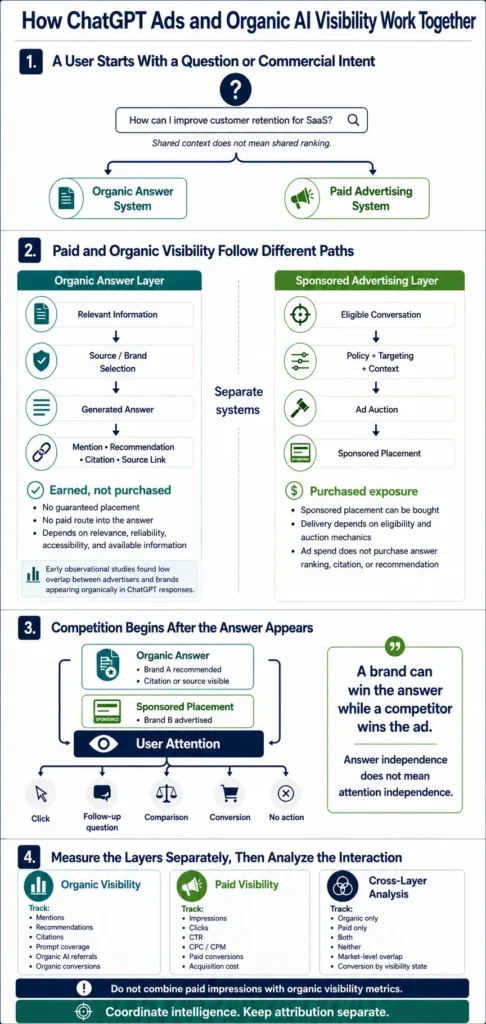
ChatGPT Ads provide a paid way to reach users within the conversational experience, but they do not currently offer a paid route into the generated answer or replace organic AI visibility. OpenAI states that “Ads run on separate systems from our chat model” — OpenAI. That distinction matters because marketers now have two visibility mechanisms within the same interface, each operating differently. A brand can buy sponsored exposure while another earns the recommendation, citation, or source link above it.
Content Ops Lab approaches those layers as separate acquisition systems, with independent measurement, attribution, and optimization requirements.
Related: What Improves AI Search Discoverability for a Brand?
What Is the Difference Between ChatGPT Ads and Organic AI Visibility?
ChatGPT Ads purchase sponsored exposure around a conversational experience. Organic AI visibility refers to non-sponsored mentions, recommendations, citations, source links, and discovery within generated responses. They can appear near one another, but the systems determining paid placement and answer inclusion are currently separate.
How Does ChatGPT Decide Which Ads Appear?
ChatGPT advertising uses a paid-placement system designed to determine which eligible sponsored messages appear around relevant conversations. That process is separate from determining what the model says in its answer.
- Ads respond to eligible conversational context.
- Advertisers compete for available sponsored inventory.
- Eligibility depends on applicable advertising policies.
- Sponsored units remain identified as advertising.
- Placement does not guarantee answer inclusion.
The advertising layer can influence commercial exposure without establishing control over the generated response itself.
How Does Organic ChatGPT Visibility Work?
Organic visibility depends on whether ChatGPT surfaces a brand, source, product, or recommendation without payment. OpenAI outlines some search principles, but it does not publish a comprehensive formula for selecting generic brands.
- Relevance influences organic search result selection.
- Reliability remains part of search evaluation.
- Eligible sources can surface without payment.
- Organic inclusion cannot currently be purchased.
- Recommendation placement carries no guaranteed position.
“ChatGPT ranks search results using multiple factors intended to help users find relevant, reliable information”— OpenAI.
OpenAI also states that “Product results are selected independently by ChatGPT and are not ads” — OpenAI.
Those documented principles establish separation without revealing every factor behind recommendation, citation, or brand-selection decisions.
Where Is the Boundary Between Paid and Organic Visibility?
The boundary is purchasing exposure versus earning inclusion. Advertisers can pay for sponsored placement associated with a conversation, but the paid layer does not currently purchase answer ranking, recommendation status, citations, or model endorsement.
- Paid placement buys sponsored conversational proximity.
- Organic visibility remains non-sponsored answer presence.
- Advertising cannot guarantee model recommendations.
- Citations remain outside the advertising transaction.
- Sponsored exposure and endorsement remain different concepts.
That boundary becomes clearer when the two visibility mechanisms are compared directly.
| Dimension | Paid ChatGPT Visibility | Organic ChatGPT Visibility |
| Placement type | Sponsored advertising | Non-sponsored answer presence |
| Primary mechanism | Paid media system | Chat/search selection systems |
| Can placement be purchased? | Yes | No |
| Can answer inclusion be purchased? | No documented mechanism | No |
| Typical outcomes | Impressions, clicks, paid conversions | Mentions, recommendations, citations, organic referrals |
| Core measurement | Paid-media efficiency | Earned visibility and organic performance |
| Guaranteed presence | Subject to campaign delivery | No |
The interface may combine both experiences visually, but marketers should not combine their underlying acquisition logic.
Can ChatGPT Ads Improve Organic Mentions, Recommendations, or Citations?
There is no credible public evidence that buying advertising on ChatGPT causes higher organic mentions, recommendations, citations, or answer inclusion. OpenAI documents separation between advertising and answer generation, while early third-party studies show patterns consistent with that architecture rather than evidence of a causal relationship.
What Does OpenAI Say About Advertising and Answer Generation?
OpenAI provides the most important evidence because it describes the architecture directly. Its current documentation states that advertising systems and chat-model systems operate separately, rather than treating ad spend as an answer-ranking input.
- Advertising and chat systems remain separate.
- Paid spend does not purchase recommendations.
- Sponsored placement does not purchase citations.
- Organic inclusion remains independently determined.
- No paid answer-ranking mechanism is documented.
That architecture establishes the current product boundary more reliably than advertiser experiments or third-party prompt studies can.
What Do Early Paid-Organic Overlap Studies Show?
Early studies suggest that advertisers and brands appearing organically in responses often differ, although each dataset reflects a particular prompt sample and cannot represent every ChatGPT conversation.
SE Ranking reports: “We analyzed 50,006 commercially oriented prompts across 20 niches in the United States” — SE Ranking.
Seer Interactive found that “Across 3,697 ads, the advertiser appeared in ChatGPT’s actual response 5.4% of the time” — Seer Interactive.
- Large prompt samples provide useful observations.
- Commercial prompts are not all conversations.
- Advertisers frequently differed from organic brands.
- Low overlap aligns with system separation.
- Observed overlap does not establish causation.
These findings work best as consistency checks on OpenAI’s documentation, not substitutes for it.
What Can Those Studies Not Prove?
Low advertiser-response overlap cannot prove that advertising suppresses organic visibility. Occasional overlap cannot prove that advertising improves it. Both conclusions would convert observed co-occurrence into a causal claim the datasets cannot support.
- Samples cannot establish advertising causation.
- Overlap does not prove organic lift.
- Non-overlap does not prove organic suppression.
- Prompt selection affects observed percentages.
- Results cannot become universal benchmarks.
| Evidence | What It Establishes | What It Does Not Establish |
| OpenAI documentation | Ads and chat-model systems are separate | Complete organic ranking formula |
| SE Ranking | Observed patterns across 50,006 commercial prompts | Universal ChatGPT ad behavior |
| Seer Interactive | 5.4% advertiser-response overlap in its sample | Causal effect of advertising on answers |
The defensible conclusion remains narrow: paid participation currently provides no documented shortcut into organic answer visibility.
How Do ChatGPT Ads Change Competition Around an Organic Answer?
The paid layer can change commercial competition even without changing the answer. Once sponsored placement appears near an organically generated response, two independently selected brands can compete for attention, clicks, and conversions within the same user journey. System separation therefore does not eliminate market-level competition.
Can One Brand Win the Answer While Another Wins the Ad?
Yes. A brand can earn an organic recommendation or citation, while a competitor purchases a sponsored placement in the same conversational context. Both can become commercially visible without sharing the same allocation mechanism.
- Brand A can earn answer visibility.
- Brand B can purchase sponsored exposure.
- Both can occupy one conversational journey.
- User attention becomes the shared resource.
- Paid proximity does not rewrite recommendations.
That creates competitive interception after the answer rather than paid manipulation inside the answer.
Could Sponsored Placement Affect What Users Click Next?
It could, but marketers should treat the effect as a measurement question rather than an established outcome. Direct ChatGPT-specific evidence quantifying the displacement of organic citation clicks by sponsored cards is not yet available.
Adjacent research shows why the question matters. Pew found that “Users who encountered an AI summary clicked on a traditional search result link in 8% of all visits”— Pew Research Center.
- AI answers can alter click behavior.
- Google data cannot represent ChatGPT behavior.
- Sponsored cards add another action path.
- Citation displacement remains unquantified in ChatGPT.
- Paid-organic interaction requires direct measurement.
The correct operating response is instrumentation, not an assumed click-loss percentage borrowed from another platform.
Does Advertising Change How Users Trust AI Answers?
Technical independence and perceived independence are different problems. OpenAI can separate advertising from answer generation while users still react differently to an interface that places commercial messages near generated information.
EMARKETER reports that “63% of US adults say ads in AI search results would make them trust those results less” — EMARKETER.
- Survey results measure stated consumer attitudes.
- They do not demonstrate answer bias.
- ChatGPT-specific trust effects remain unresolved.
- Clear sponsorship labeling still matters.
- Perception can affect commercial response behavior.
Marketers should distinguish system integrity from user perception rather than assuming one automatically guarantees the other.
If your operation needs to produce 20–50+ articles per month without sacrificing compliance or quality, Content Ops Lab builds the infrastructure to make that possible. Contact us to discuss your content production requirements.
How Should Marketers Measure Paid and Organic ChatGPT Visibility?
Marketers should measure paid ChatGPT exposure and organic AI visibility as separate channels, then analyze where they intersect. Combining sponsored impressions with earned answer presence yields a misleading visibility number because paid delivery can increase even as organic recommendations, citations, or referrals remain unchanged.
Which Metrics Belong to Organic AI Visibility?
Organic measurement should describe earned presence inside non-sponsored AI interactions and the business activity that follows. The objective is understanding where the brand appears without purchasing that specific exposure.
- Answer mention rate by prompt category.
- Recommendation visibility across relevant conversational intents.
- Citation presence and linked-source visibility.
- Organic ChatGPT referral sessions and engagement.
- Organic AI-attributed leads and conversions.
These metrics should show whether non-sponsored visibility is strengthening independently of paid campaign delivery.
Which Metrics Belong to ChatGPT Ads?
Paid measurement should follow media economics rather than organic visibility conventions. Marketing teams need to know whether sponsored exposure reaches qualified users efficiently and generates commercially meaningful downstream actions.
- Sponsored impressions and eligible reach.
- Clicks and paid click-through rate.
- CPC, CPM, and campaign spend.
- Paid attributed leads and conversions.
- Acquisition efficiency by campaign and audience.
No unavailable industry-wide ChatGPT benchmark should substitute for the organization’s own campaign economics and attribution data.
How Should Paid and Organic Data Be Reported Together?
Leadership should see both layers on the same reporting surface, without collapsing them into a single score. That makes interaction visible while preserving the distinction between purchased exposure and earned answer presence.
- Organic visibility only.
- Paid visibility only.
- Both layers visible together.
- Neither layer currently visible.
- Conversion performance by acquisition source.
| Measurement Area | Organic Visibility | Paid Visibility | Cross-Layer Analysis |
| Exposure | Mentions, recommendations, citations | Sponsored impressions | Paid and organic co-presence |
| Traffic | Organic ChatGPT sessions | Paid clicks | Next-action distribution |
| Conversion | Organic AI conversions | Paid attributed conversions | Conversion rate by layer |
| Coverage | Prompt and topic visibility | Campaign/audience reach | Category coverage gaps |
| Market | Earned visibility by location | Paid delivery by location | Market-level overlap |
| Efficiency | Organic conversion performance | CPC, CPM, CPA | Incremental channel contribution |
A paid impression should never increase an organic AI visibility score simply because both occurred inside ChatGPT.
Related: Why Do AI Search Platforms Cite Different Sources?
What Do ChatGPT Ads Mean for Multi-Location and Regulated Businesses?
Multi-location and regulated organizations need more granular planning because paid availability and organic strength can diverge across markets, services, and industries. As of August 29, 2026, advertising access and category restrictions remain conditional, while organic AI visibility continues to depend on the discovery of non-sponsored information — OpenAI.
Why Should Multi-Location Brands Measure Visibility by Market?
A national visibility average can hide weak local performance. One market may receive paid exposure while another earns stronger organic recommendations, making location-level measurement necessary to understand the actual competitive position.
- Track prompt categories within individual markets.
- Separate sponsored and organic market presence.
- Compare location-level recommendation strength independently.
- Identify markets with paid-organic imbalances.
- Prioritize information gaps by local demand.
The prompt category, market, and visibility layers together provide a practical operating unit without turning them into a single blended KPI.
How Do Advertising Restrictions Change the Strategy?
Paid access cannot be assumed across regulated industries. Policy varies by category, market, and the nature of the advertised service, making compliance review part of media planning rather than a final campaign check.
OpenAI currently states: “Ads for legal advice, representation, or legal services offered to individuals or businesses are not permitted” — OpenAI.
- Some regulated categories remain restricted.
- Eligibility can differ within broader industries.
- Geography can change advertising availability.
- Policies can change during rollout.
- Organic visibility remains a separate opportunity.
As of August 29, 2026, organizations should verify current policy rather than infer eligibility from another advertiser’s participation.
What Happens When Paid Reach Is Available but Organic Visibility Is Weak?
Paid media can create immediate exposure without addressing the information problems that limit organic visibility. A location can therefore buy attention while remaining absent from non-sponsored recommendations, citations, or discovery.
- Paid reach does not repair location data.
- Ads cannot correct inaccessible source information.
- Media spend cannot guarantee recommendations.
- Incomplete or inaccessible information may be omitted.
- Information quality still requires separate investment.
That separation becomes especially visible when paid campaigns stop, but the organization still needs to earn non-sponsored discovery.
Should ChatGPT Ads Change Your Organic AI Visibility Strategy?
The advertising product should expand the acquisition mix, not replace organic AI visibility work. Paid campaigns can accelerate exposure in eligible conversations, while organic investment builds the information footprint needed to earn non-sponsored mentions, recommendations, citations, and referral traffic across a broader range of interactions.
What Should Stay Separate?
Budgets, KPIs, attribution, and causal claims should remain separate. Treating paid and organic performance as interchangeable makes it impossible to know whether stronger visibility came from media spend or earned answer presence.
- Maintain independent budgets and cost centers.
- Preserve separate attribution channel definitions.
- Report paid and organic conversions independently.
- Avoid causal claims across visibility layers.
- Protect organic metrics from paid impressions.
Coordination becomes useful only after measurement preserves what each program actually produced.
Where Should Paid and Organic Teams Share Intelligence?
The teams should share market intelligence without sharing attribution. Paid campaigns can reveal commercial language and market demand, while organic visibility analysis can expose information gaps and categories where the brand rarely surfaces.
- Share high-intent prompt and query themes.
- Compare customer language across channels.
- Identify common geographic opportunity gaps.
- Exchange funnel-stage demand observations.
- Coordinate content and campaign priorities.
Shared intelligence can improve planning without implying that one visibility mechanism caused performance in the other.
Where Should Marketing Leaders Invest First?
Start by making the measurement architecture trustworthy. Then strengthen organic eligibility and information quality before treating paid participation as a substitute for work the advertising system cannot perform.
- Separate paid and organic reporting now.
- Audit organic visibility across priority prompts.
- Fix market-level information and source gaps.
- Test ads where policy permits participation.
- Compare economics without blending attribution.
- Reallocate investment using measured channel contribution.
The first operating decision is not paid versus organic. It is whether leadership can accurately measure both.
How Does Content Ops Lab Build Organic AI Visibility That Paid Media Cannot Replace?
Content Ops Lab has documented an average AI search CVR of 21.4% vs. 3.32% site average (6.4x higher). That result does not prove a particular citation, optimization tactic, or methodology caused the conversion rate. It does show why commercially meaningful earned AI traffic should not be treated as expendable simply because sponsored ChatGPT inventory now exists.
Organic visibility requires an information operation capable of consistently producing accurate, accessible, and current content. Buying an impression is a media transaction. Maintaining the source footprint AI systems can discover and use is an ongoing production problem.
Content Ops Lab has built that operating capability around:
- Research-first content development across complex subjects.
- Citation verification before claims enter production.
- Google and AI search optimization together.
- Multi-location production built for distributed organizations.
- More than 1,000 articles and pages delivered.
- Zero compliance issues across documented engagement.
- Systematic workflows suited to regulated industries.
The Content Ops Lab Production System
The production system separates evidence gathering, claim control, optimization, and execution so increased publishing volume does not require lowering editorial or compliance standards.
- Research — Build every assignment from evidence before production begins.
- Verification — Validate citations, statistics, and claim boundaries before drafting.
- Optimization — Structure content for SEO, AEO, and AI extraction.
- Delivery — Produce scalable assets with consistent editorial quality controls.
Paid media can accelerate exposure; this system addresses the non-sponsored information infrastructure advertising cannot purchase.
Ready to build content infrastructure that scales without the compliance risk? Get in touch — we’ll assess your current content operation and outline what a systematic approach would look like for your organization.
FAQs About ChatGPT Ads
If ChatGPT Ads Do Not Influence the Answer, Are They Worth Buying?
They can be. Advertising does not need to control the generated answer to create commercial value. Sponsored placement can put a brand in the midst of a high-intent conversation and create another path to a click or conversion. The relevant question is whether campaign economics justify the spend, not whether advertising changes ChatGPT’s organic recommendation.
How Should Marketers Measure ChatGPT Ads Separately From Organic AI Visibility?
Use independent channel definitions. Measure sponsored impressions, clicks, costs, and paid conversions for advertising. Measure organic mentions, recommendations, citations, ChatGPT referral sessions, and organic conversions separately. Leadership can then compare paid-only, organic-only, and combined user journeys without allowing purchased impressions to inflate the organization’s organic AI visibility reporting.
Can Regulated Industries Advertise on ChatGPT?
Eligibility depends on the category, service, geography, and current OpenAI advertising policy. As of August 29, 2026, some regulated activities remain restricted, including ads for legal advice, representation, or legal services. Healthcare, finance, legal, and other regulated organizations should therefore verify current policy before treating ChatGPT advertising as an available acquisition channel.
Can a Competitor Advertise Beneath a ChatGPT Answer That Recommends My Brand?
Yes, that competitive scenario is possible under the current separation between sponsored placement and answer generation. Your brand could earn the recommendation while another eligible advertiser purchases nearby exposure. The competitor has not purchased your organic position; it has purchased another commercial opportunity inside the user’s post-answer decision path.
Should Paid ChatGPT Campaigns Replace Investment in Organic AI Visibility?
No. Paid campaigns and organic AI visibility solve different acquisition problems. Advertising can purchase sponsored exposure while the campaign remains funded and eligible. Organic work supports non-sponsored mentions, recommendations, citations, and discovery across interactions where no ad is purchased. Marketing leaders should coordinate the programs while keeping their investment logic and performance measurement separate.
Key Takeaways
- ChatGPT Ads purchase sponsored exposure around answers, not organic recommendations, citations, or answer inclusion.
- OpenAI currently separates advertising systems from the chat model systems responsible for generating answers.
- Paid and organic visibility compete for user attention even when their allocation systems remain independent.
- Content Ops Lab documented an average AI search CVR of 21.4% vs. 3.32% site average (6.4x higher).
- That performance reinforces the case for why earned AI traffic should remain a distinct acquisition priority alongside paid experimentation.
- Separate paid and organic measurement now, while advertising practices, access, and competitive norms are still developing.
- Test paid acquisition where economics and policy support it while continuing to strengthen non-sponsored information visibility independently.
What Should Marketing Leaders Do as ChatGPT Advertising Expands?
ChatGPT Ads add a new acquisition layer; they do not eliminate the need to earn visibility inside AI answers. Marketing leaders now have to manage both systems without confusing them. Paid campaigns can purchase proximity, accelerate exposure, and intercept commercial attention. Organic AI visibility still determines whether the organization appears without that media transaction through mentions, recommendations, citations, and source discovery.
The strategic advantage belongs to teams that measure the two layers separately while coordinating the intelligence each produces. Content Ops Lab treats that separation as an operating requirement: build the information infrastructure required for earned visibility, then use paid distribution where access, compliance, and economics make sense.
Related: What Is AI Citation Absorption and Why Does It Matter?