

What Improves AI Search Discoverability for a Brand?
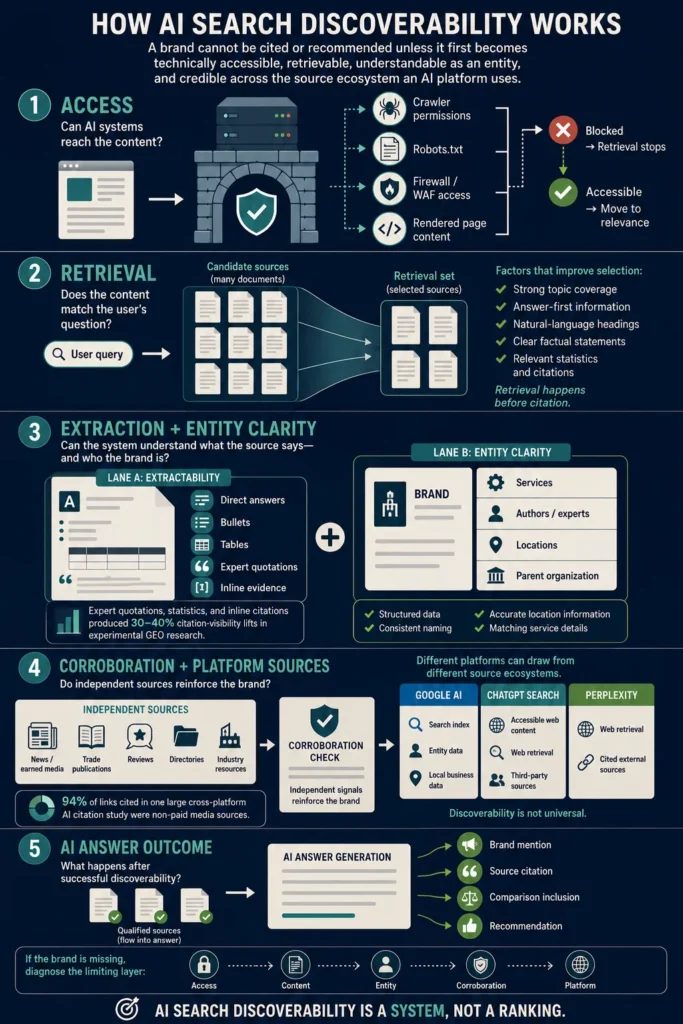
AI search discoverability improves when a brand becomes technically accessible, retrievable, unambiguous as an entity, and independently corroborated across the sources AI systems use to construct answers. Ranking well or publishing more content can help, but neither guarantees inclusion in an active retrieval set.
“Non-paid media accounts for about 94% of links cited by AI” — Muck Rack Generative Pulse Report.
That creates a broader operating problem than conventional SEO alone addresses. Brands must coordinate technical access, content structure, entity data, earned presence, and platform coverage. Content Ops Lab approaches that problem through research, verification, optimization, and delivery built around retrievability rather than publishing volume alone.
Related: What Drives AI Brand Visibility?
What Does AI Search Discoverability Mean for a Brand?
AI search discoverability is the probability and consistency with which a brand, its content, and its entity signals become available during retrieval and synthesis. It sits upstream of citation and AI share of voice: a system must first find and understand a relevant candidate source before that source can influence an answer.
How Is Discoverability Different From Being Indexed?
Indexation means a search system knows a URL exists. Discoverability requires that the page become relevant enough to enter the candidate set for a particular conversational query.
- Indexed pages may never enter active retrieval sets.
- Retrieval depends on query-specific semantic relevance signals.
- Availability alone does not guarantee source selection.
- Rankings and retrieval overlap without being identical.
- Discoverability changes across prompts and platforms.
An indexed site can therefore remain functionally absent from important AI-assisted buyer journeys.
Where Does Retrieval Fit Between Ranking and Citation?
Retrieval sits between source availability and final answer construction. A brand cannot be quoted, cited, summarized, or recommended if its relevant evidence never reaches the candidate-source stage.
- Search visibility can increase potential exposure to sources.
- Retrieval narrows sources for the current question.
- Synthesis determines which evidence enters the answer.
- Citation occurs after candidate sources are considered.
- Retrieved sources are not always ultimately cited.
Citation share is therefore a downstream outcome, not a complete measure of discoverability.
How Should Marketing Teams Measure Discoverability?
Marketing teams should measure discoverability by tracking repeated prompt coverage across commercially relevant topics, rather than treating a single generated answer as a stable ranking.
- Track prompt families instead of isolated queries.
- Repeat tests because generated answers can change.
- Separate brand mentions from explicit source citations.
- Compare visibility across major AI platforms.
- Review results through rolling measurement windows.
The objective is to identify recurring retrieval patterns rather than to celebrate or diagnose a single favorable screenshot.
How Does Technical Access Affect AI Search Discoverability?
Technical access is the entry requirement for systems that retrieve current web content. Crawler restrictions, WAF rules, rendering failures, or inaccessible page structures can remove otherwise strong content before relevance or authority receives consideration, making access one of the first areas to test when a brand disappears from AI search.
Which AI Crawlers Need Access to Brand Content?
Marketing and technical teams should distinguish search-oriented crawlers from model-training crawlers because blocking one does not necessarily have the same business consequences as blocking the other.
- Search crawlers support current-content retrieval use cases.
- Training crawlers serve a different processing purpose.
- Robots directives can distinguish crawler permissions individually.
- Blanket bot blocks may create unintended exclusions.
- Access policies should reflect specific business objectives.
“For your site content to be included in summaries and snippets in ChatGPT, make sure you aren’t blocking OAI-SearchBot” — OpenAI Help Center Publishers FAQ.
| Access Type | Primary Function | Consequence of Blocking |
| Search-oriented access | Supports current web retrieval | Content may be unavailable for search summaries or snippets |
| Model-training access | Supports model development | Separate from current search retrieval access |
| Site-level restrictions | Governs automated crawler access | Broad rules may block desired search access |
Crawler permission matters, but technical access can still fail elsewhere in the delivery stack.
How Can Firewalls and Rendering Block Retrieval?
A crawler allowed in robots.txt can still fail at the server or application layer. Firewalls, WAF configurations, authentication requirements, and JavaScript-dependent rendering can prevent automated systems from receiving usable source content.
- Repeated 403 responses can stop automated access.
- WAF rules may misclassify legitimate search crawlers.
- Client-side rendering can conceal primary page content.
- Authentication gates restrict publicly retrievable information.
- Server failures can interrupt otherwise valid crawling.
Teams should test what automated systems actually receive rather than assume crawler permission proves accessibility.
Why Does Semantic Page Structure Matter to AI Retrieval?
Clear page structure creates explicit boundaries between questions, answers, entities, and evidence. Clean HTML and descriptive labels improve machine interpretation without guaranteeing ranking or citation.
- Descriptive headings establish clear topical relationships.
- Semantic HTML separates meaningful page components.
- Explicit labels clarify services, authors, and locations.
- Structured data can reinforce entity relationships.
- Clean source content reduces unnecessary parsing friction.
Technical access makes content available for consideration; relevance and extractability influence whether it enters a query-specific retrieval set.
How Do Content Relevance and Structure Improve AI Retrieval?
Accessible content improves its retrieval potential when it directly answers the user’s question and presents useful information in extractable form. Topic depth, natural-language headings, answer-first passages, statistics, expert quotations, citations, lists, and tables help create discrete evidence units that can match conversational requests.
Why Does Topic Coverage Matter More Than Isolated Keywords?
Conversational search produces many ways to express the same underlying need. Strong topic coverage addresses the concepts, questions, comparisons, conditions, and evidence surrounding the need, rather than repeatedly inserting a single target phrase.
- Cover questions buyers ask throughout decision stages.
- Connect related concepts with explicit contextual language.
- Address comparisons, limitations, and decision criteria.
- Use keywords where they clarify genuine relevance.
- Build depth around topics rather than repetition.
Keyword targeting still supports relevance, but density cannot substitute for the information required to answer broader conversational queries.
Why Should Important Answers Appear Early in the Page?
Answer-first writing places central information where readers and retrieval systems can identify it quickly. The useful principle is information priority, not simply moving every target phrase toward the top.
- Lead sections with direct question-specific answers.
- Put definitions before extended supporting explanation.
- Surface important evidence near related claims.
- Avoid long introductions before useful information begins.
- Keep early passages specific rather than promotional.
“44.2% of all LLM citations come from the first 30% of content, the introduction” — Omnibound.
That pattern supports answer-first construction, but it does not prove that moving a passage earlier guarantees retrieval or citation.
What Makes a Passage Easier for AI Systems to Extract?
Extractable passages make the claim, context, and evidence easy to identify without requiring a system to reconstruct meaning across several vague paragraphs. Specific information generally creates stronger source utility than promotional language.
- State factual answers in concise declarative language.
- Attach statistics directly to supported claims.
- Attribute expert quotations to identifiable sources.
- Use inline citations where verification matters.
- Format parallel information with lists or tables.
“Peer-reviewed evidence (Princeton, KDD 2024) identifies three interventions that empirically improve LLM citation: expert quotations (+41%), statistics (+30%), inline citations (+30%)” — Rampify AI Visibility Research.
| Lower Extractability | Higher Extractability |
| Broad promotional claims | Specific factual statements |
| Generic section headings | Natural-language question headings |
| Unsupported assertions | Statistics, quotations, and cited evidence |
| Dense comparative prose | Structured lists or comparison tables |
| Important answers buried late | Direct answers placed before elaboration |
Retrievable content still needs a clearly resolved brand entity and credible external evidence around it.
If your operation needs to produce 20–50+ articles per month without sacrificing compliance or quality, Content Ops Lab builds the infrastructure to make that possible. Contact us to discuss your content production requirements.
Why Do Entity Clarity and Third-Party Corroboration Improve Discoverability?
Entity clarity helps AI systems determine who a brand is, what it does, where it operates, and how its properties relate. Third-party corroboration addresses whether independent sources reinforce those claims. Strong owned content can support the process, but it cannot fully substitute for consistent entity data and external validation.
How Does Entity Ambiguity Reduce Brand Visibility?
Entity ambiguity appears when websites, local profiles, directories, authorship information, or third-party references describe the same organization differently. Those conflicts make relationships harder for automated systems to resolve confidently.
- Keep official brand naming consistent everywhere.
- Align addresses across owned and external properties.
- Standardize service terminology between relevant locations.
- Clarify parent-brand and local-location relationships.
- Maintain consistent author identities and credentials.
As organizations add services or locations, small inconsistencies can compound into a fragmented entity footprint.
What Role Does Structured Data Play in Entity Recognition?
Structured data can clarify relationships already present in the underlying content, including organizations, locations, authors, and services. It functions as machine-readable clarification rather than a shortcut to AI rankings.
- Mark organization identity with consistent structured properties.
- Connect local entities to appropriate parent organizations.
- Identify authors through stable authorship information.
- Describe services with accurate supporting page content.
- Keep markup aligned with visible information.
Schema can reduce ambiguity, but it does not independently prove authority, trigger retrieval, or guarantee citation.
Why Does Independent Brand Corroboration Matter?
Third-party sources provide retrieval systems with information about a brand that the brand itself did not publish. Trade coverage, directories, reviews, and earned mentions can reinforce identity, expertise, reputation, and factual claims.
- Earn relevant mentions in credible industry publications.
- Maintain accurate listings across trusted directories.
- Build review profiles with specific customer context.
- Keep external descriptions consistent with owned information.
- Pursue coverage that adds verifiable brand context.
“Brand mentions correlate 3x more strongly with AI visibility than backlinks: 0.664 vs. 0.218” — Omnibound / Ahrefs.
That correlation does not mean mentions replace backlinks; it shows why semantic brand presence deserves separate attention.
Related: What Increases a Brand’s AI Citation Share?
Why Does AI Search Discoverability Differ by Platform?
AI search is not one retrieval environment. Google, ChatGPT, Perplexity, and other systems can rely on different search infrastructure, entity sources, and third-party information. A brand can therefore have strong discoverability on one platform while remaining weak for comparable prompts on other platforms.
What Supports Discoverability in Google AI Search?
Google-based generative experiences operate close to Google’s established search and entity infrastructure. Organic visibility remains relevant, while structured business data and local information can add context for entity and location-specific discovery.
- Maintain technically indexable and useful web content.
- Strengthen relevant traditional organic search performance.
- Keep entity information consistent across Google properties.
- Maintain accurate Google Business Profile information.
- Test generative visibility separately from organic positions.
“There is a strong 76.1% correlation between URLs cited in AI Overviews and the top 10 organic search results” — OptimizeGEO.
That relationship applies to Google AI Overviews, not AI search universally.
What Changes in ChatGPT and Perplexity?
ChatGPT and Perplexity require separate testing because strong Google visibility does not guarantee equivalent availability of sources elsewhere. Different retrieval and source-selection processes can produce materially different brand representation.
- Confirm documented search-crawler access where applicable.
- Evaluate third-party sources appearing in each platform.
- Compare cited domains across equivalent prompt families.
- Track where owned pages repeatedly enter answers.
- Avoid assumptions about proprietary retrieval architecture.
The operational question is not whether platforms work identically, but whether the brand consistently appears where its buyers search.
Why Does Cross-Platform Visibility Require Separate Measurement?
Cross-platform measurement reveals where a discoverability problem actually exists. A single aggregate score can hide differences between strong Google visibility and weak source representation elsewhere.
- Run comparable prompts across target AI platforms.
- Record mentions, citations, and linked source domains.
- Repeat measurements across rolling time periods.
- Segment results by topic and buyer intent.
- Investigate gaps before changing content strategy.
| Platform | Search / Source Context | Major Inputs Supported by Assignment | Principal Implication |
| Google AI features | Closely tied to Google search infrastructure | Organic index, entity data, local business information | Traditional SEO supports visibility without guaranteeing citation |
| ChatGPT Search | Web search and retrieval | Accessible web pages, OAI-SearchBot, third-party sources | Verify access and measure ChatGPT independently |
| Perplexity | Web retrieval with cited external sources | Selected web and third-party sources | Evaluate its source set independently from Google |
That separation prevents teams from treating one platform’s visibility as proof of universal AI retrieval strength.
What Should Multi-Location Brands Prioritize for AI Search Discoverability?
Multi-location brands should prioritize centralized entity governance alongside local accuracy. Every location adds names, addresses, services, reviews, profiles, directories, and pages that retrieval systems must reconcile, increasing the risk that inconsistent data weakens brand visibility in AI search for high-intent local questions.
How Does Location Data Consistency Affect Entity Trust?
Consistent local data helps systems distinguish individual locations while connecting them to the correct parent brand. Conflicting addresses, service lists, naming conventions, or location relationships create unnecessary ambiguity.
- Standardize names, addresses, and phone information.
- Define parent-brand relationships across location properties.
- Align service availability with actual local operations.
- Correct directory drift through centralized data governance.
- Keep location pages synchronized with profile changes.
As networks expand, local consistency becomes a production requirement rather than an occasional cleanup project.
How Do Reviews and Local Profiles Affect Discovery?
Reviews and local profiles provide current third-party context about where a business operates and what customers associate with each location. Within Google, Business Profile data is particularly important for local discovery.
- Keep every location profile complete and up to date.
- Build consistent review acquisition across active locations.
- Encourage reviews containing useful service-specific context.
- Monitor location changes across major directories.
- Resolve duplicate or conflicting local business records.
“GBP signals account for 32% of local pack influence — and now feed directly into Google’s AI Overviews and Gemini responses. Review signals have surged to 20% of ranking influence, up from 16% in 2023” — Whitehat SEO / Whitespark Survey.
Those percentages describe local-search influence, not measured AI citation weights.
How Can Marketing Teams Diagnose a Discoverability Gap?
Teams should diagnose absence by issue type before deciding that more content is the answer. The same missing brand can result from access failures, low relevance, entity conflicts, limited corroboration, or differences in source selection.
Access
- Confirm that the desired search crawlers can reach the pages.
- Check WAF, rendering, and server response failures.
Content
- Confirm pages answer the intended buyer question.
- Check whether key evidence is easily extractable.
Entity
- Compare brand, service, and location information.
- Resolve conflicting parent and local relationships.
Corroboration
- Review credible independent mentions and reviews.
- Identify gaps in third-party brand context.
Platform
- Repeat comparable prompts on each platform.
- Compare source domains before assigning root cause.
That diagnostic keeps teams from treating every discoverability loss as a publishing problem.
How Does Content Ops Lab Build for AI Search Discoverability?
Content Ops Lab treats discoverability as a production-system problem rather than as a collection of isolated AI search tactics. For a 12-location regulated healthcare client, AI search traffic averaged a 21.4% conversion rate versus a 3.32% site average—6.4x better. That difference makes AI retrieval visibility worth managing as an operating metric without implying that the content system caused the conversion-rate gap.
The production infrastructure creates useful, cited, entity-consistent content at sustained volume while preserving research and verification controls:
- 5x increase in monthly output, reaching 50+ articles.
- 1,000+ articles and pages delivered with verified citations.
- Zero compliance issues across the full engagement.
- 188 question-based keywords ranking, with 83% top-ten.
- 95+ confirmed AI search conversions from July 2025–February 2026.
- 887% ChatGPT traffic growth measured across seven months.
The Content Ops Lab Production System
The production system separates four responsibilities so teams can increase output without collapsing research quality, factual verification, optimization, and publication readiness into one uncontrolled drafting step.
- Research: Build evidence-backed assignments around validated buyer questions.
- Verification: Confirm citations, statistics, entities, and claim boundaries.
- Optimization: Structure answers for search relevance and extraction.
- Delivery: Publish consistent assets across topics and locations.
That discipline creates repeatable coverage while preserving the controls high-volume publishing often loses.
Ready to build content infrastructure that scales without the compliance risk? Get in touch — we’ll assess your current content operation and outline what a systematic approach would look like for your organization.
FAQs About AI Search Discoverability
Isn’t AI Search Discoverability Mostly the Same as Traditional SEO Visibility?
No. Traditional SEO can support AI discoverability, particularly in Google-based generative experiences, but the two are not interchangeable. AI systems still perform query-specific retrieval and source selection before constructing answers. A brand can rank prominently in organic search results yet fail to appear in AI search results if another source better matches the system’s retrieval needs.
How Long Does It Take to Improve AI Search Discoverability for a Brand?
There is no universal timeline because the constraint determines the work. A crawler block can sometimes be corrected quickly, while weak topic coverage, fragmented entities, or limited third-party corroboration require sustained operational changes. Teams should establish a repeated-prompt baseline, diagnose the limiting layer, implement corrections, and measure whether retrieval patterns improve over subsequent testing windows.
Can Brands Improve AI Discoverability Without Allowing Their Content to Train AI Models?
Yes, where a platform provides separate controls for search retrieval and model training. OpenAI, for example, distinguishes OAI-SearchBot access used for ChatGPT search from other crawler purposes. Marketing and technical teams should evaluate crawler directives individually rather than treating all AI bots as a single category, and align permissions with the organization’s visibility, privacy, and governance requirements.
Why Can a Competitor Appear in AI Answers Even When Our Brand Ranks Higher in Google?
Because organic position is only one potential input into AI retrieval. The competitor may provide a better semantic match, clearer extractable evidence, stronger entity signals, or more independent corroboration for the exact prompt. The platform may also use a different source set. Google rankings provide useful evidence of search strength without guaranteeing equivalent visibility elsewhere.
Can an Internal Marketing Team Manage AI Discoverability Without a Specialized Content System?
Yes, if the team can consistently manage technical access, research, content structure, entity governance, external corroboration, and cross-platform measurement. The difficulty appears at scale. As topic counts and locations increase, manual coordination creates more opportunities for inconsistent claims, stale local data, missed citations, duplicated work, and uneven QA. The requirement is disciplined infrastructure, whether built internally or externally.
Key Takeaways
- AI discoverability begins with retrieval; brands cannot earn citations without first entering relevant candidate source sets.
- Technical access, useful content, entity clarity, independent corroboration, and source coverage must work together rather than independently.
- Strong Google rankings can support AI visibility on Google without guaranteeing equivalent discovery across other platforms.
- Content Ops Lab separates research, verification, optimization, and delivery, ensuring high-volume production maintains consistent evidence and entity controls.
- AI search traffic produced a 21.4% average CVR versus 3.32% sitewide, a 6.4x difference worth measuring operationally.
- The current first-mover window favors brands building discoverability infrastructure before cross-platform AI search competition becomes substantially more mature.
- Marketing teams should diagnose the limiting layer before responding to weak visibility with additional publishing volume.
How Should Brands Improve AI Search Discoverability From Here?
Improving AI search discoverability requires managing the full path to an AI answer rather than optimizing for a single downstream metric. Traditional SEO remains part of that system, but rankings alone cannot explain whether a brand enters the candidate set for a particular conversational query.
The practical next move is diagnostic: establish repeated prompt coverage, determine where the brand disappears, and correct the limiting layer instead of automatically publishing more content. Teams that build this infrastructure while the AI search competition is still developing can establish stronger source and entity coverage before the environment matures. Content Ops Lab applies that systems discipline through research, verification, optimization, and delivery at production scale.
Related: Why Can a Brand Rank Well in Google but Have Low AI Share of Voice?






One Comment
Comments are closed.