

What Shapes AI Search Sentiment Around a Brand?
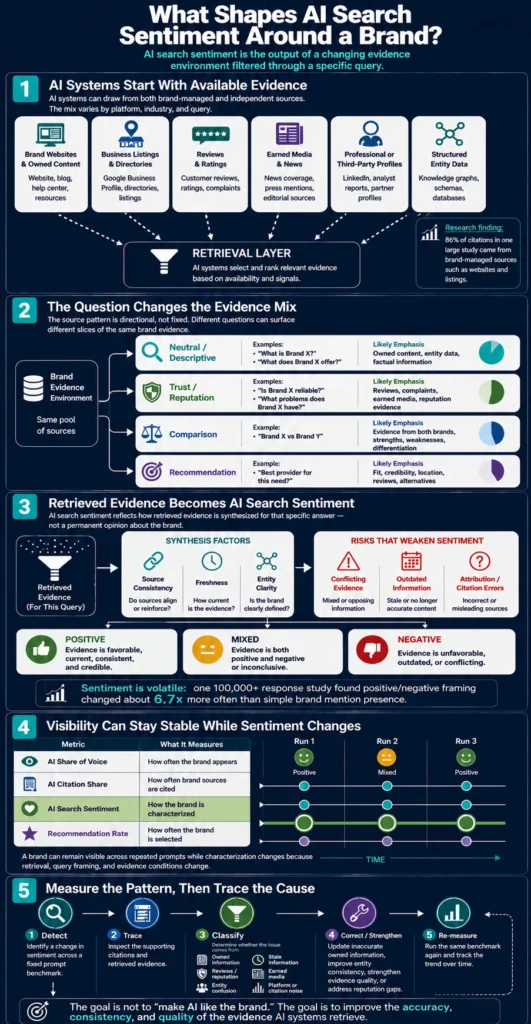
AI search sentiment is the characterization a generative answer assigns to a brand for a specific prompt — positive, negative, or mixed — based on the evidence the model retrieved at that moment. “Sentiment is the unstable signal: whether a brand is framed positively or negatively flips about 6.7 times more often than whether it is mentioned at all” — arXiv.
Most marketing teams have no process for catching that kind of movement. Content Ops Lab treats sentiment as a distribution across repeated prompt sets, because a one-time check tells you almost nothing about how a brand is actually being described.
Related: What Increases a Brand’s AI Citation Share?
What Does AI Search Sentiment Actually Measure?
AI search sentiment measures the evaluative framing attached to a brand in a generated answer to a single prompt on a single platform — not a permanent opinion the model holds. The useful unit of analysis is that single answer, because the same brand can be described three different ways across three adjacent prompts.
How Is AI Search Sentiment Different From Visibility?
Visibility and sentiment answer different questions, and treating them as the same metric hides what’s actually changing.
- Visibility counts whether a brand appears at all
- Sentiment scores how the brand is framed when it appears
- A brand can be mentioned in 80% of relevant prompts and still read negative in a third of them
- Rising mention counts do not imply improving characterization
- Flat visibility can mask real sentiment volatility underneath
A brand chasing mention counts alone can miss a sentiment problem that visibility metrics will never surface.
How Is Sentiment Different From Citation and Recommendation?
Being cited, being described favorably, and being recommended are three separate outcomes that a single dashboard number tends to blur together.
- Citation means a source was pulled into the answer
- Sentiment means how that answer characterizes the brand
- Recommendation means the model selected the brand as the best fit
- A brand can be cited accurately and still receive lukewarm framing
- Positive framing does not guarantee the model recommends the brand next
Conflating these three outcomes leads marketing teams to celebrate a citation win that never became a recommendation.
Why Is AI Search Sentiment More Volatile?
Sentiment moves more than visibility because it depends on which sources get retrieved for a given prompt, and retrieval shifts with wording, timing, and model updates. The underlying research found that characterization changes substantially more often than whether the brand is mentioned at all, which means sentiment needs its own monitoring cadence rather than riding along with visibility tracking.
| Metric | What It Measures | Volatility |
| AI share of voice | How often a brand appears across relevant prompts | Relatively stable |
| AI citation share | How often a brand’s sources are pulled into answers | Moderate |
| AI search sentiment | How the brand is characterized when it appears | High |
| AI recommendation rate | How often the brand is selected as the best match | High, query-dependent |
Sentiment volatility does not make the metric useless — it means that an aggregate sentiment score needs the underlying prompt distribution attached to it to mean anything.
Which Sources Shape AI Search Sentiment Around a Brand?
AI systems derive brand characterization from an evidence base that includes brand-managed pages, review platforms, structured profiles, directories, and earned media, rather than repeating website copy verbatim. Which sources dominate a given answer depends heavily on the query.
How Much Influence Does Brand-Managed Information Have?
Owned properties are a meaningful part of what AI systems retrieve, but they are one input among several, not the whole picture. Websites, listings, local pages, and entity information regularly enter citation pools and help models resolve which brand a query refers to. “The research shows that 86% of citations come from sources brands already control, such as websites and listings” — Yext Research.
That share varies by platform, industry, and query type — owned content shapes what’s available for retrieval, but it doesn’t guarantee favorable framing once that evidence is synthesized.
The 86% figure reflects Yext’s specific citation study rather than a universal percentage across all platforms or industries.
When Do Reviews and Independent Sources Matter More?
Independent evidence is more prominent for certain query types than for others. “Out of all AI Overview responses, 34.5% cited at least one review platform” — SE Ranking. Review platforms become particularly relevant in commercial and reputational queries.
- Reviews and ratings frequently surface in commercial comparisons
- Websites and directories become especially prominent in location-specific queries
- Earned media is particularly relevant to credibility and validation questions
- Owned website content is particularly relevant to definitional and factual questions
- Independent corroboration is especially relevant on trust-focused queries
Local-provider research and reputational comparisons pull independent sources into the evidence mix at a higher rate than descriptive brand questions do.
Why Do Structure and Freshness Affect Which Evidence Gets Used?
Structural and freshness signals correlate with which pages get pulled into citation pools, though correlation with citation selection is not the same as a guarantee of positive framing. “In our corpus, the engines differed in the GEO quality of the pages they cited, and pillars related to Metadata and Freshness, Semantic HTML, and Structured Data showed the strongest associations with citation” — arXiv.
Clean metadata, semantic HTML, and structured data increase the odds a page enters the evidence pool and supports correct entity and fact extraction — they don’t determine how that evidence gets characterized once retrieved.
Citation frequency indicates which evidence is included in an answer. It does not reveal a documented formula for how heavily each source type influences the resulting sentiment.
How Does the Search Query Change a Brand’s AI Sentiment?
The question a user asks changes both which evidence is retrieved and what kind of judgment the model makes, so neutral, evaluative, and comparative prompts about the same brand can produce noticeably different characterizations.
What Happens With Neutral Brand Questions?
Descriptive prompts tend to surface a narrower, calmer set of evidence than evaluative ones do.
- Definitional questions pull corporate and product information
- Location and service questions surface operational details
- General “what is [brand]” prompts skew toward neutral, factual framing
- Reputation-adjacent evidence appears less consistently on purely descriptive prompts
What Changes With Trust, Problem, and Reputation Questions?
Evaluative prompts invite the model to surface a different slice of the same evidence environment.
- Complaint and limitation questions surface negative coverage more readily
- Reviews and controversy sources enter the pool at a higher rate
- The model is being asked to judge, not just describe
- The same brand facts get filtered through a more critical lens
Why Do Comparison and Recommendation Queries Raise the Bar?
Comparison and recommendation prompts ask the model to rank a brand against alternatives, which is a higher bar than describing it favorably. A brand can receive positive characterization in a standalone answer and still lose a head-to-head recommendation query, because favorable framing and being judged the best fit for a specific need are not the same evaluation.
| Query Intent | Likely Evidence Emphasis | Resulting Characterization |
| Neutral/descriptive | Owned content, entity data | Largely factual, neutral tone |
| Trust / problem-oriented | Reviews, complaints, news | More critical, evaluative tone |
| Comparison | Multiple brands’ evidence sets | Relative, differentiating tone |
| Recommendation | Fit-specific evidence | Selective, judgment-based tone |
“AI Overviews are built to only surface information that is backed up by top web results, and include links to web content that supports the information presented in the overview” — Google. That grounding requirement is exactly why query framing matters: change the prompt, and the “top web results” grounding the answer change with it. These source patterns are directional rather than fixed; no specific source type is guaranteed to appear for a given query class.
If your operation needs to produce 20–50+ articles per month without sacrificing compliance or quality, Content Ops Lab builds the infrastructure to make that possible. Contact us to discuss your content production requirements.
What Happens When AI Finds Conflicting or Outdated Brand Information?
AI systems frequently retrieve current and historical information side by side, along with positive and negative evidence that doesn’t fully agree, and synthesis errors are part of that operating environment rather than a rare exception.
How Do Conflicting Sources Create Mixed Sentiment?
Competing review themes, older company claims, and recent earned media can all surface in the same answer without a documented rule for how the model reconciles them.
- Positive owned claims can sit beside unresolved negative reviews
- Older press coverage can continue surfacing after a more recent correction
- Earned media and reviews can disagree on the same issue
- No documented formula governs how conflicting evidence gets weighted
- The same prompt can pull a different evidence mix across runs
A prompt answered today may lean on a different mix of that conflicting evidence than the same prompt answered next month, producing sentiment movement that has nothing to do with a real change in brand performance.
Why Can Old Brand Narratives Persist?
Retrieval and indexing timing means outdated information doesn’t disappear the moment it’s superseded.
- Crawl and index cycles lag real-world changes
- Retrieved evidence can predate a correction or rebrand
- Parametric model knowledge can surface alongside retrieved evidence
- Replacement of outdated pages happens unevenly across sources
Why Should Marketers Audit the Citations Behind AI Answers?
Citation presence is not proof of correct retrieval or accurate attribution, which is why an unfavorable answer deserves inspection before it’s treated as evidence of a real reputation problem.
- Legitimate negative evidence — an accurate complaint or review
- Stale evidence — outdated but once-accurate information
- Entity confusion — evidence attributed to the wrong brand or location
- Unsupported synthesis — a claim the cited source doesn’t actually back
- Citation or attribution error — a source cited incorrectly or out of context
“Across the 1600 test queries, the search engines failed to retrieve the correct information more than 60% of the time” — Columbia Journalism Review. That study measured news retrieval and citation accuracy specifically, and its failure rates should not be read as a universal brand-sentiment error rate.
A related study found that “AI Overviews were accurate approximately only 9 out of 10 times. … Only 39% of the total overviews were both correct and fully supported by its cited sources, a combination we term ‘trustworthy'” — Oumi.
Neither study estimates how often brand sentiment itself is wrong; both examine retrieval and citation accuracy.
Related: Why Can a Brand Rank Well in Google but Have Low AI Share of Voice?
What Can a Brand Actually Influence About AI Search Sentiment?
Brands cannot dictate how a model characterizes them, but they can strengthen the evidence conditions that feed every retrieval — entity clarity, owned information quality, and independent corroboration. None of the following practices are guaranteed to improve sentiment; they improve the quality, clarity, and consistency of the evidence available for synthesis.
How Does Entity Clarity Reduce Brand Confusion?
Consistent entity definitions reduce the odds that a model retrieves evidence meant for a different brand, location, or service line.
- Keep parent, subsidiary, and location relationships consistent everywhere
- Standardize business names, addresses, and category data across platforms
- Use structured data to declare entity relationships explicitly
- Audit profile consistency across directories on a recurring schedule
- Flag multi-location naming conflicts before they propagate
How Can Owned Content Strengthen the Evidence Environment?
Current, direct, evidence-backed content gives retrieval systems something accurate to pull from.
- Keep core brand facts current and easy to extract
- Replace vague claims with specific, sourced statements
- Correct outdated pricing, service, or location information promptly
- Structure pages so key facts don’t require inference
- Retire or update pages that contradict current brand reality
How Can Third-Party Evidence Corroborate Brand Claims?
Independent sources reinforce brand claims in ways owned content cannot, since brands don’t control how reviews, directories, or earned media describe them.
- Encourage genuine reviews rather than manufacturing volume
- Keep directory listings accurate and monitored
- Maintain professional profiles that match owned-site claims
- Pursue earned media and expert commentary where relevant
- Track which third-party sources appear in AI answers most often
How Should Marketing Teams Measure AI Search Sentiment?
An operating measurement model relies on repeated, structured prompt sets tracked over time — not an isolated screenshot or a single vendor score treated as gospel.
Which Prompts Should a Sentiment Benchmark Include?
A useful benchmark spans multiple intent classes rather than repeating the same question across a brand’s product or service lines.
- Branded descriptive queries (“what is [brand]”)
- Trust and reputation queries (“is [brand] reliable”)
- Problem and limitation queries (“[brand] complaints”)
- Comparison queries (“[brand] vs [competitor]”)
- Recommendation queries (“best [category] for [need]”)
- Relevant local or product/service variants
Why Should Sentiment Be Segmented by Platform and Location?
Provider differences mean the same brand can read differently across ChatGPT, Perplexity, and Google AI Overviews on the same day.
- Platforms retrieve and surface different mixes of sources
- Aggregated brand-level scores hide local and platform-level variation
- A multi-location brand can look strong nationally, weak in one region
- Product-line sentiment can diverge from overall brand sentiment
- Blended scores never reveal which segment actually needs attention
A single national number will never show which location or platform needs attention — only segmented tracking does.
What Should Teams Do When Sentiment Changes?
Current commercial AI visibility tools tend to separate sentiment from visibility, recommendation, and citation entirely. “The Trustable Score is the recognized industry standard for measuring AI visibility… Sentiment Score — positive vs negative sentiment of AI mentions” — Trustable Labs.
That operational separation is useful context, though it reflects one vendor’s framework rather than an endorsed industry standard. When a tracked prompt’s sentiment shifts, work through it in order:
Detect → Trace → Classify → Correct/Strengthen → Re-measure
Detect the shift against the benchmark, trace the answer to its supporting citations, classify what changed — owned information, entity data, reputation, earned evidence, or platform noise — correct or strengthen the relevant evidence, then re-measure on the next benchmark cycle. No single sentiment score should be described as an authoritative measure of what “AI thinks” about a brand; the benchmark distribution is the actual signal.
How Does Content Ops Lab Help Brands Compete in AI Search?
Content Ops Lab has run this production model for 23 months of live testing, delivering 1,000+ articles and pages with verified citations — including 278 published blog articles in the tracked production window. AI-mediated discovery already converts at commercially meaningful rates: 21.4% average AI search conversion rate versus a 3.32% site-wide average, a 6.4x difference that makes accurate brand characterization worth monitoring as a marketing operating metric, not a reputation curiosity.
That gap doesn’t mean that improving sentiment produces a comparable conversion lift — it means the AI search channel is already commercially significant enough to justify deliberate monitoring.
- 23 months of live production-system testing
- 1,000+ articles and pages delivered with verified citations
- 278 published blog articles in the tracked production window
- Multi-platform optimization spanning Google and major AI search systems
- Research-first workflows rather than generation from model memory
- Citation verification built into production
- Multi-location content infrastructure tested across 12 healthcare locations
- Systematic, version-controlled workflows rather than personality-dependent production
The Content Ops Lab Production System
Every article moves through the same four stages regardless of topic or client, which keeps quality consistent as production volume scales.
- Research: source evidence directly rather than from model memory
- Verification: confirm every citation and claim before drafting
- Optimization: structure content for both search and AI extraction
- Delivery: publish on a systematic, version-controlled schedule
Reliable evidence infrastructure supports more accurate, consistent AI characterization over time — not control over what any single answer says.
Ready to build content infrastructure that scales without the compliance risk? Get in touch — we’ll assess your current content operation and outline what a systematic approach would look like for your organization.
FAQs About AI Search Sentiment
Can a brand control what AI search platforms say about it?
No. Brands can’t dictate how a model characterizes them in a given answer. What brands control is the evidence environment feeding retrieval — entity clarity, owned content accuracy, and independent corroboration. Strengthening those inputs improves the conditions for more accurate and consistent synthesis; it doesn’t guarantee the wording of any specific answer.
How often should a marketing team measure AI search sentiment?
Sentiment should be tracked on a recurring cadence against a fixed prompt benchmark, not checked once and left alone. Because characterization shifts far more often than visibility does, monthly or biweekly benchmark runs using the same prompt set capture movement that a one-time check will miss entirely.
What should a company do when AI search repeats inaccurate negative information?
Trace the answer to its supporting citations before assuming a reputation problem. The issue may be stale evidence, entity confusion, or a citation error rather than legitimate negative coverage. Classify the root cause, then correct or strengthen the relevant evidence, and remeasure in the next benchmark cycle.
Is AI search sentiment more useful than AI share of voice?
They measure different things, so “more useful” depends on the question. Share of voice shows whether a brand appears; sentiment shows how it’s framed when it does. A complete operating view tracks both, since flat visibility can mask meaningful sentiment volatility beneath the surface.
How can Content Ops Lab help brands improve their AI search information environment?
Content Ops Lab builds research-first, citation-verified content infrastructure — entity-consistent, evidence-backed, and structured for AI extraction — tested over 23 months of live production, with 1,000+ articles and pages delivered. The goal is to strengthen the evidence AI systems retrieve, not to promise control over how any single answer characterizes the brand.
Key Takeaways
- AI search sentiment is a variable output from retrieved evidence, not a fixed opinion a model holds about a brand
- Characterization changes roughly 6.7 times more often than brand mention presence, per a 100,000+ response study
- Content Ops Lab’s 23-month production model delivered 1,000+ articles and pages with verified citations
- AI-mediated discovery converts at 21.4% versus a 3.32% site average — a 6.4x gap that makes monitoring commercially worthwhile
- Sentiment, visibility, citation, and recommendation are distinct outcomes that require separate measurement
- First-movers who start prompt-level benchmarking now gain a head start before competitors catch on
- Build a recurring prompt benchmark rather than relying on isolated screenshots or a single vendor score
What Shapes AI Search Sentiment Around a Brand?
AI search sentiment behaves like a measurement problem, not a reputation score: it moves with the evidence retrieved for a specific prompt, on a specific platform, at a specific time, which is why it changes far more often than whether a brand shows up at all. Marketing teams that treat sentiment as a single number to chase will keep missing the underlying volatility.
The more durable approach is prompt-level monitoring and steady investment in evidence quality — start now, because competitors who wait will be diagnosing sentiment problems with no benchmark history to trace them against. Content Ops Lab builds that evidence infrastructure into every production cycle, from entity consistency through citation verification, so the inputs feeding AI synthesis stay accurate as they scale.
Related: Which AI Trust Signals Influence Brand Recommendations?