

Why Can a Brand Rank Well in Google but Have Low AI Share of Voice?
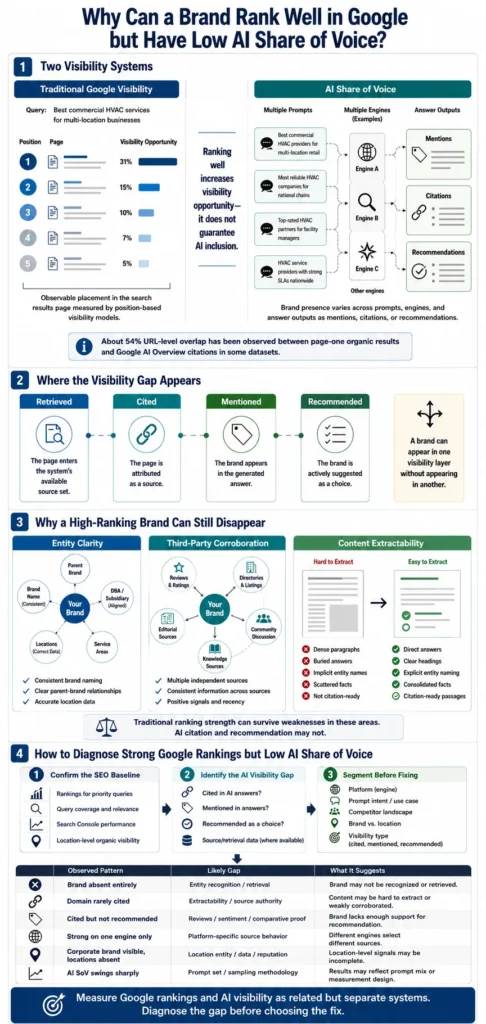
A brand can rank on page one of Google and still be nearly invisible in AI-generated answers, because ranking measures relevance for a single query while AI share of voice measures whether a brand is retrieved, cited, mentioned, or recommended across an entire set of prompts.
“Google’s AI Overviews (AIO) are increasingly citing sources that also rank on page one of organic search. Multiple 2025 datasets indicate the URL-level overlap has climbed to around 54%—a progression from roughly a third of citations in mid-2024 to over half this year” — Geneo. That overlap is real, but it still leaves roughly 46% of cited URLs outside the page-one organic overlap measured in that dataset — a gap most marketing teams aren’t measuring.
Content Ops Lab treats organic rankings and AI visibility as separate measurement layers because strong performance in one does not establish visibility in the other.
Related: Google Rankings vs AI Citations – What Is the Difference?
Why Don’t Strong Google Rankings Guarantee High AI Share of Voice?
Google ranking position measures where a page lands for one query at one moment. The AI visibility metric instead measures whether a brand appears across a defined set of prompts, engines, and time windows — a fundamentally different unit of measurement.
Google Rankings and AI Visibility Measure Different Outcomes
Organic rank position reflects how well a page satisfies a single query against a competitive set at a specific moment in time. The AI visibility score instead tracks whether a brand shows up across many prompts, phrasings, and platforms.
- Ranking answers one query at one moment
- AI SoV samples many prompts over time
- Rank position is public and directly observable
- AI SoV depends on the prompt set chosen
- One high ranking doesn’t guarantee repeat AI presence
A brand can dominate a keyword and still miss most of the prompts that actually matter to buyers.
Retrieval, Citation, and Recommendation Are Separate Layers
A page being found by an AI system’s retrieval process is not the same as that page becoming a cited source, and being cited is not the same as the brand being actively recommended.
| Layer | What It Means |
| Retrieved | The system pulls the page into its working context |
| Cited | The page is linked as a source in the answer |
| Mentioned | The brand name appears without a source link |
| Recommended | The system actively suggests the brand as a choice |
A brand can appear in one of these visibility layers without appearing in another, which is why each outcome needs to be measured separately.
Organic and AI Visibility Overlap Without Moving in Lockstep
Overlap studies disagree sharply on how much AI citation tracks organic ranking, and that disagreement reflects methodology differences, not a single wrong dataset. “AIO sources and organic top 20 are largely independent (~95% non-overlap)” — Serpstat. Platform, query type, measurement period, and matching criteria all shift the reported overlap rate. Brands should expect a directional relationship between ranking and citation, not a fixed formula they can rely on.
Mention and citation also carry different structural meaning depending on the platform, which complicates any single overlap number. “ChatGPT and Google AI Overview don’t just differ in how often they mention brands. They differ in what ‘mention’ means structurally” — ZipTie.dev. Treating every AI surface as a single visibility channel obscures exactly the distinctions marketing teams need to diagnose their gap.
What Can Keep a High-Ranking Brand Out of AI Answers?
Several additional factors can affect whether a ranking page becomes an AI citation: how clearly the brand’s entity is defined, how much third-party corroboration exists, and how extractable the content is.
Weak Entity Clarity Can Limit Brand Recognition
Clear, consistent entity information can help AI systems distinguish a brand, understand what it does, and connect individual locations to the parent organization.
- Inconsistent brand naming across web properties
- Unclear parent-brand-to-location relationships
- Ambiguous category or service descriptions
- Conflicting business details across directories
- Missing or outdated structured entity information
Inconsistent entity signals can make it harder for AI systems to connect those references to the same organization.
AI Systems Look Beyond What a Brand Says About Itself
AI-generated answers frequently rely on third-party sources alongside first-party brand content, making external corroboration a separate visibility factor from on-site SEO.
- Review platforms and star-rating aggregators
- Industry directories and licensing databases
- Community discussion and forum mentions
- Independent editorial and press coverage
- Third-party comparison and roundup content
Citation concentration data shows how much weight these external sources carry. “Across nearly every industry, three domains dominate AI’s citations: YouTube (~23.3%), Wikipedia (~18.4%), and Google.com (~16.4%)”— Surfer SEO. That concentration shows why stronger on-page content alone may not be enough when external sources heavily influence the citation set.
Ranking Content Can Still Be Hard to Extract
A page can satisfy Google’s relevance signals while still failing to give an AI system a clean, attributable passage to cite, which is a structural extractability problem rather than a ranking problem.
| Ranking-Friendly but Hard to Extract | Ranking + Citation-Ready |
| Answer buried after long narrative setup | Direct answer in the first sentence |
| Ambiguous pronouns and vague references | Named subjects and explicit claims |
| Weak heading hierarchy | Clear, question-based headings |
| Key facts scattered across paragraphs | Facts consolidated near the claim |
Schema and clean structure improve machine understanding, but they don’t guarantee citation or recommendation on their own.
If your operation needs to produce 20–50+ articles per month without sacrificing compliance or quality, Content Ops Lab builds the infrastructure to make that possible. Contact us to discuss your content production requirements.
Why Does AI Share of Voice Change by Prompt and Platform?
There is no single AI visibility environment. Informational, comparison, “best,” and recommendation prompts surface different brand sets, and ChatGPT, Perplexity, and Gemini retrieve and cite sources differently.
Informational and Recommendation Queries Apply Different Tests
An informational prompt asks whether a source is useful enough to cite, while a recommendation prompt asks whether a brand is trustworthy enough to endorse — and reputation and sentiment matter far more for the second test.
- Informational prompts reward clear, sourced answers
- Recommendation prompts weigh reputation and sentiment
- “Best” and comparison prompts test competitive proof
- Local recommendation prompts can be especially sensitive to reviews and reputation
- The same brand can pass one test and fail another
Optimizing only for informational citation leaves recommendation visibility unaddressed.
AI Engines Do Not Use the Same Source Mix
Citation volume and source-selection behavior vary meaningfully across engines, so a brand’s visibility profile on one platform doesn’t predict its profile on another.
| Engine | Typical Source-Selection Behavior |
| ChatGPT | Fewer citations per answer, more synthesis |
| Perplexity | Higher citation counts, wider page sampling |
| Google AI Overviews | Partial, query-dependent overlap with organic rankings |
Citation depth differs by a wide margin between platforms. “Perplexity averages 17.7 citations per multi-constraint query, compared to ChatGPT’s 3.4. For simpler queries, Perplexity typically cites 3–4 sources after visiting approximately 10 web pages during retrieval” — Machinerelations.ai. A brand absent from one engine’s citations may still be well represented on another.
Prompt Selection Can Distort AI Share of Voice Scores
An AI share-of-voice percentage means little without knowing exactly which prompts, platforms, and runs produced it, since the denominator behind the score is rarely disclosed.
- prompt taxonomy
- platforms tested
- number of runs
- measurement period
- query/location segmentation
Vendor scoring tools often present a single percentage without disclosing that denominator. “Traditional share of voice (SOV) is effectively obsolete, yet many organizations have replaced it with an equally flawed successor: AI share of voice. Software vendors now claim to measure brand visibility across ChatGPT, Gemini, Claude, Perplexity, and other AI platforms using a single percentage score. The problem is that these metrics rely on a hidden denominator — Search Engine Land. A transparent methodology matters more than the headline number itself.
Related: What Drives AI Brand Visibility?
Why Is the Google-to-AI Visibility Gap Bigger for Multi-Location Brands?
A strong corporate domain and a healthy brand-level average can mask individual locations that AI systems rarely recognize, cite, or recommend, because individual locations can function as distinct entities within local AI discovery.
Brand Authority Does Not Automatically Transfer to Every Location
Corporate-domain rankings and brand-level reputation don’t automatically extend entity recognition or recommendation confidence down to each individual location.
- Corporate site authority stays at the domain level
- Each location needs its own entity clarity
- Local reviews rarely inherit brand-level sentiment
- Location pages compete on local relevance, not brand size
- A strong brand average can hide weak individual units
Treating the brand as one visibility unit misses where the actual gap lives.
Reviews and Local Data Affect Recommendation Confidence
Location-level recommendation confidence depends on accurate, differentiated local information and reputation signals that a corporate domain can’t supply on a location’s behalf.
- Review volume and recency at each location
- Consistent name, address, and phone data
- Location-specific service and capability details
- Distinct, non-duplicated location descriptions
- Sentiment trends visible across review platforms
Local proof can strengthen the signals an AI system has available when deciding whether to recommend a specific location.
Brand-Level Averages Can Hide Location-Level Weakness
Aggregate brand visibility scores routinely conceal wide swings between a company’s best- and worst-performing locations, which is why unit-level measurement matters more than the brand average.
| Brand-Level View | Location-Level View |
| Domain rankings | Individual-location AI presence |
| Average visibility | Best/worst location disparity |
| Brand reputation | Location reviews and sentiment |
| Corporate content | Local proof and entity data |
The disparity is measurable at scale. “Birdeye’s 2026 Location Disparity Inside AI Visibility report, which analyzed 1,762 multi-location brands, found that individual locations are roughly three times more visible in AI answers than the brand-level score suggests, and that 46.7% of brands have a 50-point-or-larger visibility gap between their best and worst locations” — Birdeye.
Local AI recommendation is also simply harder to win than local organic visibility. “AI visibility is three to 30 times harder to achieve than ranking well in traditional local search, SOCi estimated” — Search Engine Land / SOCi. Not every high-ranking multi-location brand will underperform in AI search — the point is that a brand-level average can’t establish how any single location is actually doing.
How Can You Diagnose Low AI Share of Voice When Google Rankings Are Strong?
A disciplined diagnostic sequence identifies whether the gap originates in measurement, retrieval, citation, recommendation, entity clarity, corroboration, content structure, platform differences, or specific locations — before any optimization work begins.
Confirm That the SEO Baseline Is Actually Strong
Before treating AI visibility as the problem, verify the organic advantage is real using Search Console data, current ranking positions, query coverage, and location-level organic performance.
- Pull current rankings across the full target query set
- Check query coverage, not just top-line positions
- Review location-level organic performance separately
- Confirm rankings reflect current, not historical, data
- Rule out a false baseline before diagnosing AI visibility
Skipping this step risks diagnosing an AI problem that’s actually an organic-performance problem.
Test Where the Brand Drops Out of the AI Pipeline
Run the same prompt set across multiple engines and classify each result as retrieved, cited, mentioned, or recommended, rather than treating every instance of missing visibility as one undifferentiated failure.
- Track citations, mentions, and recommendations directly. Where a platform exposes source or retrieval information, log that separately as well.
- Run identical prompts across every target engine
- Repeat prompts across multiple sessions for consistency
- Note which layer the brand consistently fails at
- Compare results against direct competitors on the same prompts
The layer where the brand drops out determines which fix actually applies.
Segment the Gap Before Choosing What to Fix
Break the diagnostic results down by platform, prompt intent, competitor, brand or location entity, and visibility type before prioritizing any intervention.
| Observed Gap | Investigate First |
| Brand absent entirely | Entity recognition/retrieval |
| Domain never cited | Extractability / source authority |
| Cited but not recommended | Sentiment/reviews / comparative proof |
| Strong on one engine only | Platform-specific source behavior |
| Corporate brand visible, locations absent | Location entity/data/reputation |
| SoV swings sharply | Prompt set / sampling methodology |
Diagnosis has to precede optimization — the same fix will not resolve every brand’s low AI SoV, because the underlying cause differs by segment.
How Does Content Ops Lab Build Content for Search and AI Visibility?
Content built for AI visibility has to work as a search asset and an AI-usable source asset at once, which is why Content Ops Lab treats ranking success and AI citation as two outcomes that require separate verification, not one workflow that automatically produces both. For a 12-location regulated healthcare client using that dual-purpose approach, AI search traffic converted at 21.4% on average versus a 3.32% site average — 6.4x higher — evidence that AI-referred discovery can carry disproportionate commercial value even at lower traffic volume.
- 1,000+ articles and pages delivered with verified citations across the full engagement
- 278 published blog articles in the tracked production window
- 188 question-based keywords ranking, with 83% in positions 1–10
- 95+ confirmed AI search conversions during the eight-month tracked period
- 887% ChatGPT traffic growth in seven months
- 23 months of live production-system iteration in a regulated healthcare environment
- Zero compliance issues across the engagement
The Content Ops Lab Production System
Every article moves through the same four stages so that ranking performance and AI extractability get verified separately rather than assumed from one general optimization pass.
- Research — build the evidence base before drafting begins
- Verification — confirm every claim traces to a source
- Optimization — structure content for search and AI extraction
- Delivery — publish with citation formatting intact
The structure allows organic search performance and AI citation readiness to be addressed within the same production system without treating them as the same outcome.
Ready to build content infrastructure that scales without the compliance risk? Get in touch — we’ll assess your current content operation and outline what a systematic approach would look like for your organization.
FAQs About AI Share of Voice
If our brand already ranks well in Google, do we really need to track AI share of voice?
Yes — ranking well increases the odds of retrieval but doesn’t determine whether an AI system cites, mentions, or recommends the brand. Overlap between organic rankings and AI citation is meaningful but incomplete, so strong Google performance alone can’t confirm AI visibility. Tracking both separately is the only way to see the actual gap.
How should a brand start measuring AI share of voice alongside SEO?
Start with a defined prompt set spanning informational, comparison, and recommendation queries, run consistently across the target AI engines. Log citations, mentions, and recommendations for each prompt, plus retrieval or source data where the platform exposes it. Pair that data with existing organic rankings to see where the two visibility types diverge.
Can AI share of voice data be trusted enough to guide marketing decisions?
AI SoV is a sampled, directional metric, not an exact measurement of total AI visibility — its meaning depends on the prompt set, engines, and measurement window used. It’s most trustworthy as a comparative trend over time with a transparent methodology. Treat any single percentage from a vendor tool with caution unless the denominator is disclosed.
Why can competitors with weaker Google rankings appear more often in AI answers?
AI systems weigh entity clarity, third-party corroboration, and content extractability alongside relevance, so a competitor with weaker rankings but stronger reputation signals or cleaner content structure can still be retrieved and recommended more often. Recommendation visibility in particular can diverge sharply from organic position. Ranking strength alone doesn’t guarantee it carries over.
How does Content Ops Lab help brands improve visibility across Google and AI search?
Content Ops Lab runs every article through a four-stage system — research, verification, optimization, and delivery — built to satisfy organic ranking requirements and AI extractability requirements as distinct checkpoints. During the tracked period, ChatGPT traffic also grew 887% over seven months while organic keyword visibility remained strong. The goal is dual performance, not one visibility type at the expense of the other.
Key Takeaways
- Google rankings and AI visibility are related but separate outcomes that require independent measurement.
- Retrieval, citation, mention, and recommendation are distinct layers — a brand can pass one and fail the next.
- Entity clarity, third-party corroboration, and content extractability influence whether ranking strength converts into AI citation.
- A 12-location regulated healthcare client saw a 21.4% AI search conversion rate versus a 3.32% site average, showing AI discovery’s disproportionate commercial value.
- Multi-location brands should diagnose visibility at the location level — Birdeye found 46.7% of studied brands had visibility gaps of at least 50 points between their best and worst locations.
- Operators should run a defined diagnostic sequence — confirm the SEO baseline, test where the brand drops out of the AI pipeline, then segment the gap before fixing anything.
Measuring Ranking Success and AI Visibility as Two Separate Systems
Strong Google rankings and strong AI visibility measure different things, and treating them as the same outcome leaves the gap between them undiagnosed. Retrieval, citation, mention, and recommendation are distinct visibility outcomes, so strength in one does not guarantee presence in another. Operators who wait to separate these two metrics will keep missing the prompts, platforms, and locations where their brand simply isn’t showing up.
Content Ops Lab builds content systems that verify organic and AI performance as distinct checkpoints, not assumptions of one continuous outcome, because that’s the only way either metric holds up under scrutiny.
Related: How Do You Measure Success in AI Search Beyond Rankings and Traffic?