
How Do You Correct Wrong Service or Location Information in AI Answers?
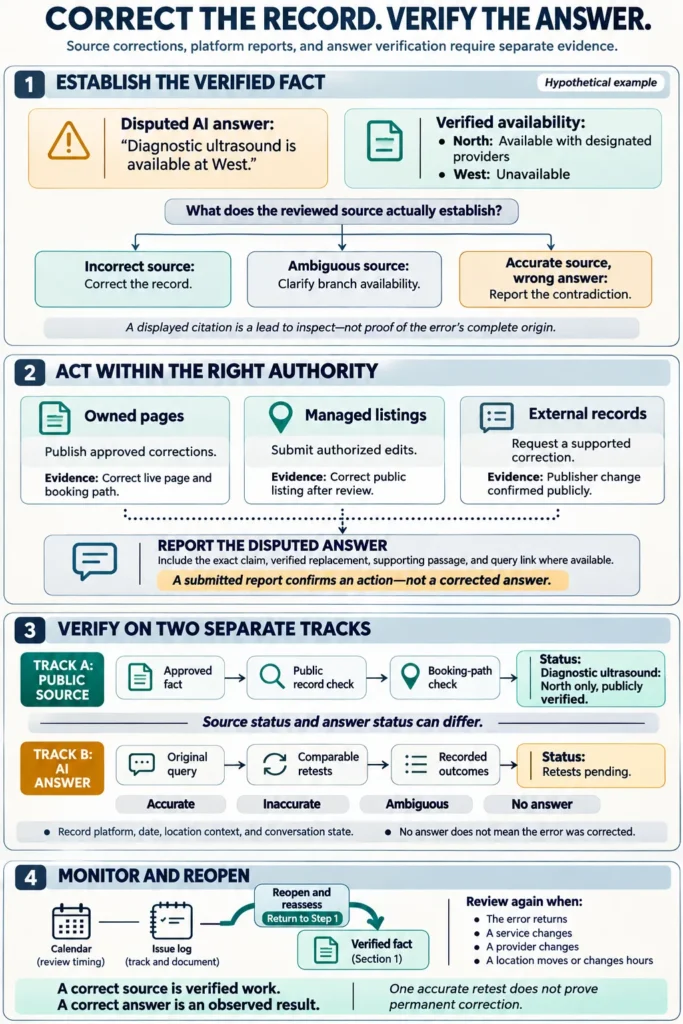
To correct wrong service or location information in AI answers, establish the verified business fact, repair conflicting records within your authority, report the disputed answer through the appropriate platform channel, and retest separately. A published source correction establishes what your organization changed; subsequent observations establish what the AI actually answered.
Google acknowledges that “AI Mode may misinterpret web content or miss context” — Google Search Help.
For a multi-location business, that gap can send a customer toward an unavailable service. Customers bear the inconvenience. Content Ops Lab approaches the underlying publishing work through verified organizational information, documented responsibilities, and accountable content operations.
Related: What Does NAP Consistency for AI Visibility Actually Do?
What Should You Verify Before Correcting an Inaccurate AI Answer?
Verify the exact disputed statement and obtain its replacement from the person accountable for that business fact. To correct wrong service or location information responsibly, distinguish what the answer claims, what available sources establish, and what remains unknown about how the platform produced the error.
The Disputed Claim and Business Fact
An answer about a whole network can contain one consequential branch error. Preserve that statement with enough context for another reviewer to examine the same incident.
- Original query and complete preserved answer artifact.
- Platform, product surface, date, and conversation context.
- Affected branch, disputed service, and cited URLs.
- Approved replacement fact and accountable business owner.
The replacement needs factual approval before anyone chooses which records or reports require action.
The Citation and Source Assessment
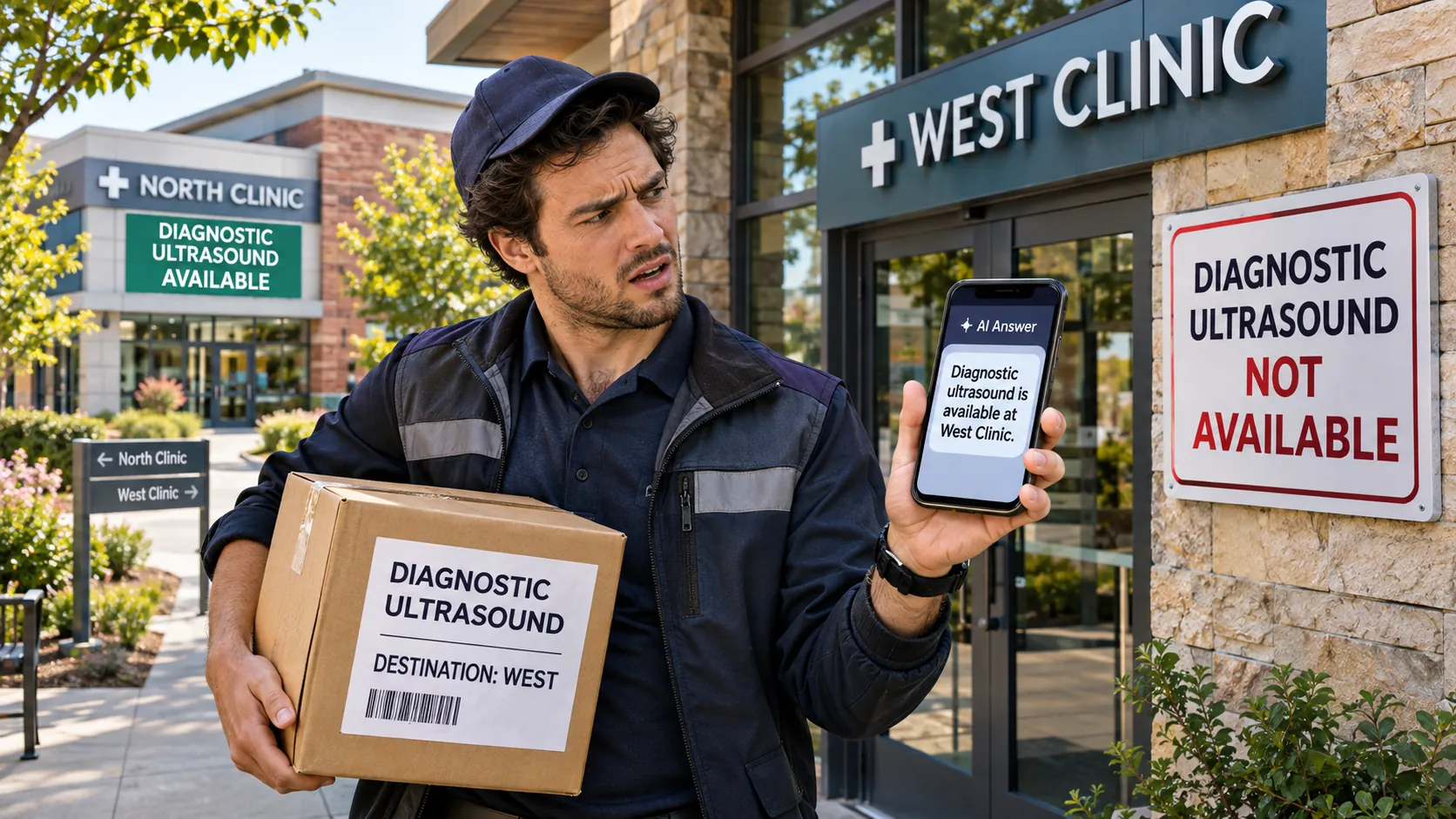
In a hypothetical healthcare network, diagnostic ultrasound is available at North, but an AI answer assigns it to West. West’s service owner confirms that it is unavailable there.
OpenAI cautions: “Search results and citations can be incomplete, outdated, or incorrect” — OpenAI.
- Incorrect West page: an explicit source error.
- Accurate corporate copy: branch relationship left ambiguous.
- North-only source wording: West attribution contradicts the passage.
- Matching uncited wording: possible lead, provenance unknown.
An unsupported generated statement may remain unexplained even after you inspect every displayed citation.
The Customer Consequence and Priority
Prioritize the likely consequence of reliance, rather than treating every inconsistency equally. A false service claim can disrupt access even when the branch name and address are correct.
- Unavailable treatment: escalate to accountable service reviewers.
- Wrong appointment destination: involve scheduling and operations.
- Cosmetic naming variation: assess actual identification difficulty.
- Documented customer misdirection: preserve the reported consequence.
Urgency follows customer impact; the next decision is who can change each record.
Which Records Can a Business Correct Directly?
A business can publish changes to its owned content, submit authorized listing edits, and request corrections from external publishers. Each route has different dependencies. Assign factual approval and publication responsibility explicitly, whether employees, agencies, listing vendors, or AI-assisted tools prepare the work on the organization’s behalf.
Owned Websites and Scheduling Destinations
Owned content offers a direct publishing route once the facts are approved. Review the relevant page relationships and booking destination together to preserve accurate material while resolving actual contradictions.
- Service pages identify the approved participating branches.
- Branch pages describe their actual local capabilities.
- Contact records supply the correct appointment destination.
- Booking paths confirm the intended service-location combination.
A saved edit still needs public inspection before its publication status can be closed.
Managed Google and Bing Listings
Authorized administrators can submit listing changes, but submission and acceptance remain separate events. Record what was requested, inspect the resulting status, and verify what customers can publicly see.
Google states: “Edits that you make to your verified Business Profile are reviewed to ensure they follow our guidelines” — Google Business Profile Help.
Microsoft describes Bing Places: “Once imported, managing listings is easier than ever—with intuitive dashboards, bulk editing tools, and real-time status updates” — Microsoft Bing.
- Assign an authorized administrator for each account.
- Use Bing.com/forbusiness for current Bing listing management.
- Inspect edit status and public listing details.
These controls concern listings; they do not establish a corresponding change in generated answers.
Third-Party Publishers and Directories
External publishers control their own records. Send the exact replacement with supporting evidence, retain the response, and investigate upstream feeds only where a documented distribution relationship exists.
- Identify the publisher responsible for the record.
- Supply approved wording and supporting source evidence.
- Retain request, response, and public verification dates.
| Record | Action Within Business Control | External Dependency | Completion Evidence |
| Owned content | Approve and publish changes | Hosting or publishing support where needed | Correct live page and booking path |
| Managed listings | Submit authorized edits | Platform review and publication | Correct public listing; recorded edit status |
| Third-party records | Request a precise replacement | Publisher acceptance and implementation | Correct public record; retained correspondence |
This distinction helps teams correct wrong service or location information without overstating their authority.
How Should You Document Service Availability Across Locations?
Document availability as an approved relationship between a specific service and a specific branch, including restrictions and effective dates. A network’s overall capability or geographic service area does not establish availability inside every location. Public pages and scheduling should express the same verified relationship customers need when choosing care.
Verified Branch and Service Relationships
A shared availability record gives content and operations the same reference point. Unknown details remain unverified until the responsible owner approves them; they should not become public availability claims.
- Stable identifiers for each location and service.
- Record availability status and applicable provider restrictions.
- Effective dates, approver, and last review date.
- Link the approved booking destination to the relationship.
The hypothetical network’s record could capture the confirmed distinction this way:
| Field | Hypothetical Approved Fact |
| Service | Diagnostic ultrasound |
| North availability | Available with designated providers |
| West availability | Unavailable |
| Booking destination | Approved North diagnostic-ultrasound scheduling path |
| Responsible owner | Accountable diagnostic-ultrasound service owner |
Provider identities and effective dates still require approval before this compact record supports publication.
Consistent Public Pages and Booking Paths
Customers should not have to infer availability from unrelated pages. Corporate service content establishes participating branches, while branch content and scheduling confirm the location-specific options available to book.
- Corporate ultrasound page identifies North’s participating service.
- West page avoids implying local ultrasound availability.
- Relevant branch links connect service and location.
- Scheduling reflects approved provider and availability restrictions.
Clear relationships help correct wrong service or location information while keeping the customer journey usable.
Visible Content and Structured Data
Keep visible statements, relevant internal links, and existing structured data consistent with approved facts. Accessible, accurate pages provide a clearer public record without establishing control over an AI response.
Google states: “There’s also no special schema.org structured data that you need to add” — Google Search Central.
- Match markup to accurate visible page content.
- Remove contradictory branch and service relationship claims.
- Keep relevant pages accessible and internally connected.
Technical eligibility and information clarity still leave the platform’s subsequent answer behavior to verify.
If your operation needs to produce 20–50+ articles per month without sacrificing compliance or quality, Content Ops Lab builds the infrastructure to make that possible. Contact us to discuss your content production requirements.
How Do You Report an Incorrect Answer to an AI Platform?
Report an inaccurate answer through that product’s documented feedback mechanism, using the disputed wording and verified replacement as evidence. Feedback is distinct from editing a business listing. No uniform reporting interface, response deadline, or right to replace future answers is established across the platforms discussed here.
The Correct Feedback Channel
Choose the route that matches the problem. Ordinary factual errors belong in answer feedback; listing edits, policy complaints, and rights-based legal requests address different records or issues.
Microsoft states: “The Copilot experience includes tooling that allows users to submit feedback” — Microsoft Support. This documentation concerns Copilot for individuals.
Perplexity instructs: “Use the flag icon below the answer to report issues. Alternatively, create a ticket on our support window” — Perplexity.
- Use response feedback for disputed factual statements.
- Use listing administration for managed business records.
- Reserve formal legal routes for applicable issues.
The available reporting route determines submission mechanics, while the evidence determines what reviewers can assess.
The Evidence for the Report
For the hypothetical West incident, provide the exact ultrasound claim and the approved North-only relationship. A concise report should let reviewers compare the statement against a specific public passage.
- Exact disputed wording and affected West branch.
- Verified replacement fact and supporting public passage.
- Source URL and query URL where available.
- Relevant platform, date, mode, and conversation context.
The request can identify the error precisely without claiming to know its complete source history.
The Submission and Follow-Up Record
Treat feedback as a recorded request with an accountable follow-up owner. Acknowledgment confirms receipt when provided; it does not guarantee subsequent users will receive a different answer.
- Preserve report date and submitted evidence copy.
- Retain available acknowledgment or support ticket reference.
- Assign follow-up responsibility and next review date.
- Record subsequent answer observations in separate entries.
Efforts to correct wrong service or location information need evidence beyond the submission receipt.
Related: Why Can ChatGPT Find Your Business Facts but Still Recommend a Competitor?
How Can You Verify That an AI Answer Actually Changed?
Verify source publication and answer behavior independently, using comparable tests and a defined review period. Record the platform, query, context, and observed result for each answer. One correct response does not establish a permanent resolution, and an improvement after an intervention does not prove the intervention caused it.
Public Source Verification
Inspect the live record from a customer’s perspective after publication. A CMS save, approved internal document, or listing submission cannot substitute for checking the public information and destination.
- Open the actual public page or listing.
- Confirm the approved service and branch relationship.
- Follow the relevant live appointment booking path.
- Preserve verification date and observed public wording.
Correct public records establish source status even when the disputed AI answer remains unresolved.
Comparable Answer Retests
Retest the original wording under recorded conditions before exploring alternatives. A branch-explicit query may answer a different question, so keep its results separate from the original test series.
OpenAI describes using “an approximate location based on your IP address” for local results — OpenAI. Geography is one context variable, not an explanation for every error.
- Record platform, mode, date, geography, and language.
- Preserve location permissions and signed-in account state.
- Distinguish fresh conversations from existing conversation context.
- Label branch-explicit variants as separate exploratory tests.
Correcting the current conversation does not establish changed behavior for other users or future sessions.
Repeated Observations and Recurrence
Repeat observations according to the consequence and your team’s review policy. Keep accurate, inaccurate, ambiguous, and absent answers distinct; absence provides no affirmative confirmation of the replacement fact.
- Define review period and comparable test scope.
- Record each outcome without collapsing ambiguous results.
- Reopen the issue when consequential errors recur.
- Treat test counts and cadence as policy.
The same hypothetical incident needs two records, even if public sources are correct:
| Record | Status and Required Evidence |
| Source record / public verification | North-only availability confirmed publicly; retain URLs, approved wording, verification date, and booking check. |
| Answer observation/test scope | Original West error preserved; retests pending. Log platform, query, context, review period, and every subsequent result. |
An accurate retest would narrow the observed problem without proving permanent correction or causation by intervention.
What Operating Controls Reduce Recurring Information Errors?
Assign factual owners, connect approved changes to publication tasks, and reopen reviews when business conditions change. These are proposed operating controls for maintaining information and investigating errors. Assess their value through internal completion evidence and bounded answer observations, rather than assumed prevention rates or recovered revenue.
Accountable Owners and Change Triggers
Responsibility should follow authority over the underlying fact. Local operations confirms branch details; service owners approve consequential availability; content and listing administrators publish or submit approved changes.
- Moves trigger address and appointment-destination record reviews.
- Hours changes trigger affected public access checks.
- Provider changes trigger service restriction approval reviews.
- Service pauses trigger availability and scheduling updates.
Change-triggered reviews give teams a reason to act before the next customer complaint arrives.
Linked Issue and Change Records
Link the disputed answer to its approved replacement, publication work, and subsequent observations. Separate status fields let leadership see completed internal work alongside unresolved requests and external answer errors.
- Approved fact, owner, assessment, and affected URLs.
- Approval dates, publication evidence, and external requests.
- Answer observations linked to their test conditions.
- Reopening conditions and accountable next review owner.
Teams can correct wrong service or location information more accountably when unresolved dependencies remain visible.
Operational Measures and Business Effects
Measure effort and observed outcomes using explicit denominators. An internal test set describes the answers examined, while customer reports describe documented incidents; neither reveals every person’s exposure to the error.
- Track completion against identified source-correction tasks due.
- Measure approval-to-publication time and staff review effort.
- Report inaccurate, ambiguous, absent, and accurate test counts.
- Track recurrence within the comparable review series.
- Retain documented misdirection; leave unknown exposure unestimated.
For an answer-error proportion, specify the eligible tests and report all outcome counts alongside it. Keep changed test conditions separate. Do not convert fewer observed errors into forecast revenue recovery.
These measures describe work and observations; attribution of broader business effects requires separate supporting evidence.
How Can Content Ops Lab Support Accurate Multi-Location Content?
A 5x increase in monthly output, from 10 to 50+ articles per month, documents Content Ops Lab’s historical production scope for a 12-location regulated healthcare client. The engagement ran from April 2024 through March 2026 and combined research, organizational knowledge, citation verification, and publishing review.
That experience informs how COL structures content work around approved information. For a multi-location team, the practical connection is maintaining usable organizational knowledge and review responsibilities so writers can identify which branch facts are established and which need an owner’s decision.
The relevant capabilities and self-reported historical results are:
- Research-first methodology grounds content in relevant supporting information.
- Citation verification checks source passages against published claims.
- Custom knowledge integration connects organizational information to content.
- Multi-stage quality control supports review before content delivery.
- 5x increase in monthly output (10 → 50+ articles/month)
- 1,000+ articles and pages delivered with verified citations across full 23-month engagement
These figures describe production and citation-verification experience. They do not measure AI-answer corrections, location-data accuracy, prevented incidents, revenue recovery, or independent assurance. The hypothetical North/West example illustrates the operating decisions in this article; it is separate from that historical client engagement.
The Content Ops Lab Production System
The production system connects approved organizational knowledge with reviewed content. Each stage gives the next participant a clearer basis for completing the work and identifying unresolved factual questions.
- Research: Gather relevant evidence and approved organizational information.
- Verification: Check source support and flag facts requiring owner approval.
- Optimization: Structure approved content for clear reading and information extraction.
- Delivery: Supply reviewed material with the context needed for publication.
Your team retains factual authority over branch availability and responsibility for external answer testing.
Ready to build content infrastructure that scales without the compliance risk? Get in touch — we’ll assess your current content operation and outline what a systematic approach would look like for your organization.
FAQs About Correcting Wrong Service or Location Information
Can we correct wrong service or location information just by telling the AI it is wrong?
Telling the AI may change the current conversation, but it does not establish a correction for other users, future sessions, or unrelated queries. Preserve the exact disputed claim, confirm the replacement fact, and address relevant source records. Use the platform’s feedback route where appropriate, then evaluate later answers through separately recorded tests under comparable conditions.
How long does it take for an AI answer to reflect corrected business information?
No universal correction timeline is established here. Record public source publication separately from answer observations, because a public edit and a changed response are different events. Assign a review period based on the error’s consequences and your team’s capacity. Report what happened within that period without promising when future answers will change.
What should we do if an AI answer sends patients to the wrong location or service?
Escalate the disputed information to accountable operations and qualified service reviewers so they can confirm availability and assess customer-access consequences. Preserve the answer and any documented misdirection, correct relevant records, and check the booking destination. Keep the issue visible while external reports or answer retests remain unresolved; an internal edit alone does not close it.
Is correcting a business listing the same as correcting an AI answer?
No. A listing correction changes a managed business record once the platform publishes it. An AI answer is a separate observed output that may still misstate the branch or service. Verify the current public listing, then retest the original query under recorded conditions. Keep the publication status and answer status separate in your issue record.
Can Content Ops Lab help our internal team maintain accurate location and service content?
Yes. COL’s content infrastructure work connects organizational knowledge, source verification, content structure, and publishing review. Your internal team supplies authoritative branch facts and approves consequential availability details. That supports maintaining the source content your organization controls. AI platforms control their responses, so any later improvement still requires separate testing.
Key Takeaways
- Source publication, platform feedback, and observed answer accuracy are separate outcomes; close each record only against its own evidence.
- Content Ops Lab connects organizational knowledge, citation verification, and publishing review while business owners retain authority over branch facts.
- COL self-reports historical output growth from 10 to 50+ articles monthly for an anonymized 12-location regulated healthcare client.
- COL also reports 1,000+ citation-verified articles and pages across that 23-month engagement; those results do not measure AI-answer corrections.
- Start with one consequential error, confirm its replacement and owner, then maintain separate source-publication and comparable answer-observation records.
Correct Wrong Service or Location Information With Verifiable Records
The useful question is what changed and what evidence establishes it. A corrected page, accepted listing edit, submitted report, and accurate answer each deserve their own record. Keeping those distinctions visible lets leadership recognize completed work while assigning responsibility for unresolved customer-facing errors.
Select one consequential mistake. Preserve the answer, establish the authoritative replacement with its owner, and open separate source and answer records. Review public publication and subsequent responses on their own terms, with clear conditions for reopening the issue. Content Ops Lab’s role is documented publishing infrastructure: approved organizational knowledge, source verification, and reviewed content that internal teams can maintain.